
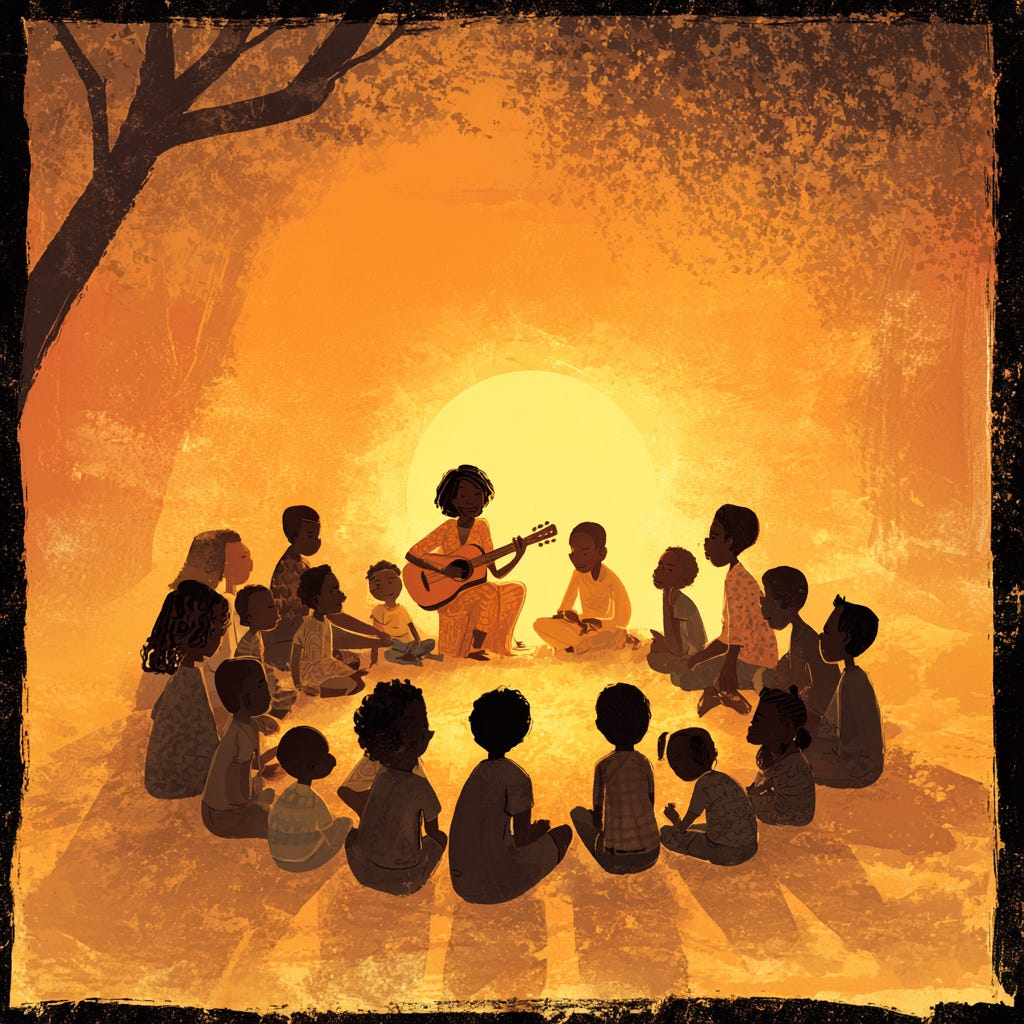
There is a kind of song that people carry for the rest of their lives without knowing they are carrying it.
Not the songs they were taught. Not the songs someone sat them down and explained. The songs they heard at the right moment, in the right voice, with the right story inside them — and then kept singing long after they forgot where they came from.
That is what Roseline Abara is built to make.
Roseline is one of the ghost artists inside the Musinique constellation — a fully built fictional persona with a voice, a sound, a cultural tradition, and a philosophy that shapes everything she generates. She is not a real person. She is a creative character built with enough internal consistency to produce original, stylistically unified songs across any topic, any audience, any emotional register you give her.
She lives at the intersection of Afro jazz pop and West African oral tradition. She is funny first. True second. And the second thing arrives before the laughter is finished.
This is the story of who she is and how she was built.
The Ghost Artist Concept
The Musinique constellation is built on a simple but demanding idea: every artist persona must be complete enough to generate the right song without being told what to do.
A ghost artist is not a style preset. It is a creative character — defined precisely enough that adding their name to any command brings their entire world with them. The genre, the rhythm, the vocal character, the imagery, the moral architecture of the music — all of it flows from who the artist is, not from a list of specifications you have to rebuild every time.
Roseline Abara is the West African fable tradition. The trickster market. The clever creature who always outthinks the powerful one. The story that arrives like a punchline — you did not see the ending coming and then it was the only possible ending.
Who She Is
Her voice. A bright, warm West African mezzo whose singing and speaking exist on a single unbroken continuum. She moves between melody and storytelling without announcing the transition — because in her world, they are the same thing at different speeds. She is never solemn. She is occasionally profound. She knows the difference and chooses when to be which. In faster songs her voice carries a smile even on lines that are not funny, because she knows something you do not yet, and she is deciding whether to tell you.
Her sound. Afro jazz pop — midtempo, rhythmic, alive. Clean highlife guitar with sophisticated jazz chord voicings played lightly, as if the complexity is no effort at all. Talking drum and jazz ride cymbal in conversation, neither one dominating, both creating a groove that feels simultaneously like swing and like something that predates swing by several centuries. Upright bass that occasionally answers her vocal lines with a phrase of its own. Highlife horn stabs on the chorus — bright, punchy, landing on the funny beats, underlining the jokes. The production is dry and present, minimal reverb, the voice forward. Faint open-air market ambience lives at the very bottom of every mix, barely audible, always there.
Her tradition. The West African fable — where the market is a universe, where every story has a moral that arrives the way a punchline arrives, where the clever one wins not through force but through understanding something the powerful one missed. Her songs do not moralize. They demonstrate. Listeners laugh first. A moment later they understand why. That is a different and more durable thing than being told what to think.
Her origin story. Akụkọ ifo storyteller, southeastern Nigeria. One album, 1968, 300 copies pressed. Fela Kuti is said to have owned one. The music survived. The name almost didn’t.
Why She Was Built
The Musinique philosophy is that intent is everything. The same tools Spotify uses to manufacture audio wallpaper — AI music generation, ghost artist infrastructure, streaming distribution — can be pointed somewhere else entirely. At a family who wants their grandmother’s lullaby back. At a protest movement that needs its anthem. At a cultural tradition whose music survived while its practitioners’ names did not.
Roseline Abara is the third case.
She was built as a historical ghost artist — a reconstructed persona built from archival research, ethnomusicological fieldnotes, and the oral record of a tradition whose music survived across generations through memory alone. She is also a living creative tool inside Lyrical Literacy, Humanitarians AI’s educational music project — the delivery system for the West African fable tradition in spaces where it has never been heard before.
What she represents, in both roles, is the same thing: music does not have to be neutral to be good. It can carry a specific cultural world, a specific philosophy, a specific way of understanding how cleverness and kindness relate to each other — and it can do all of that while being, first and foremost, genuinely worth listening to.
That is the demonstration. Not that AI music is good or bad. That the same tools, pointed at different purposes, produce different things.
Roseline is what it looks like when they are pointed at a tradition worth carrying forward.
Taking It to Suno
Once your lyrics are ready inside Lyrical Literacy, the next step is generating the track.
Inside Suno we have a custom persona built for Roseline Abara with her exact sound locked in — midtempo Afro jazz pop, clean highlife guitar, talking drum and jazz ride cymbal, melodic upright bass, highlife horn stabs, bright warm mezzo vocal, dry mix with market ambience underneath.
Paste the lyrics in, select her persona, and generate. What comes back sounds like a story being told in an open market to people who are paying complete attention because they suspect something is about to happen.
Run meta roseline first to add performance tags before pasting into Suno — the richer the tags, the more precisely the platform can build the sound.
“Edge of the Water — made with Roseline Abara in Lyrical Literacy and generated in Suno.”
What Roseline Can Make
The range of what Roseline Abara generates inside Lyrical Literacy is wider than it might first appear.
She can make a three-minute fable song about any animal, any lesson, any moral scenario you give her. She can make a lullaby that settles a child into sleep while encoding language patterns their developing brain is ready to absorb. She can make a tongue twister that makes a classroom laugh while building phonemic awareness. She can make a heritage song that carries a cultural tradition across a generation. She can make a grief song that gives a child language for a feeling they have not yet been able to name.
All of it in her voice. All of it in her world. All of it built from the same three decisions we made when we built her: she sounds like Afro jazz pop, she sings to intelligent children, and she believes the clever one always wins.
The Sound in Practice
Inside Lyrical Literacy at Humanitarians AI, Roseline is available as a full creative tool. Add her name to any command and she brings her complete world with it — genre, vocal profile, instrumentation, imagery, moral architecture. Everything is internally consistent because it all flows from the same three decisions that defined her.
Inside Suno, a custom persona is built for her exact sound. Paste the lyrics, select her persona, and what comes back sounds like a story being told in an open market to people who are paying complete attention because they suspect something is about to happen.
Start with: random roseline — and let her pick the story.
Watch the step-by-step tutorial here:
The Constellation
Roseline Abara is part of the broader Musinique artist family — available on Spotify and Apple Music alongside Mayfield King, Tuzi Brown, Newton Williams Brown, Dijit Arjun Bear Brown, Parvati Patel Brown, Prarthana Maha Brown, Jingle Yankel, Liam Bear Brown, Marley Bear Brown, Champa Jaan, Nana Coree, and the rest.
She is funny first. True second.
And the second thing arrives before the laughter is finished.