

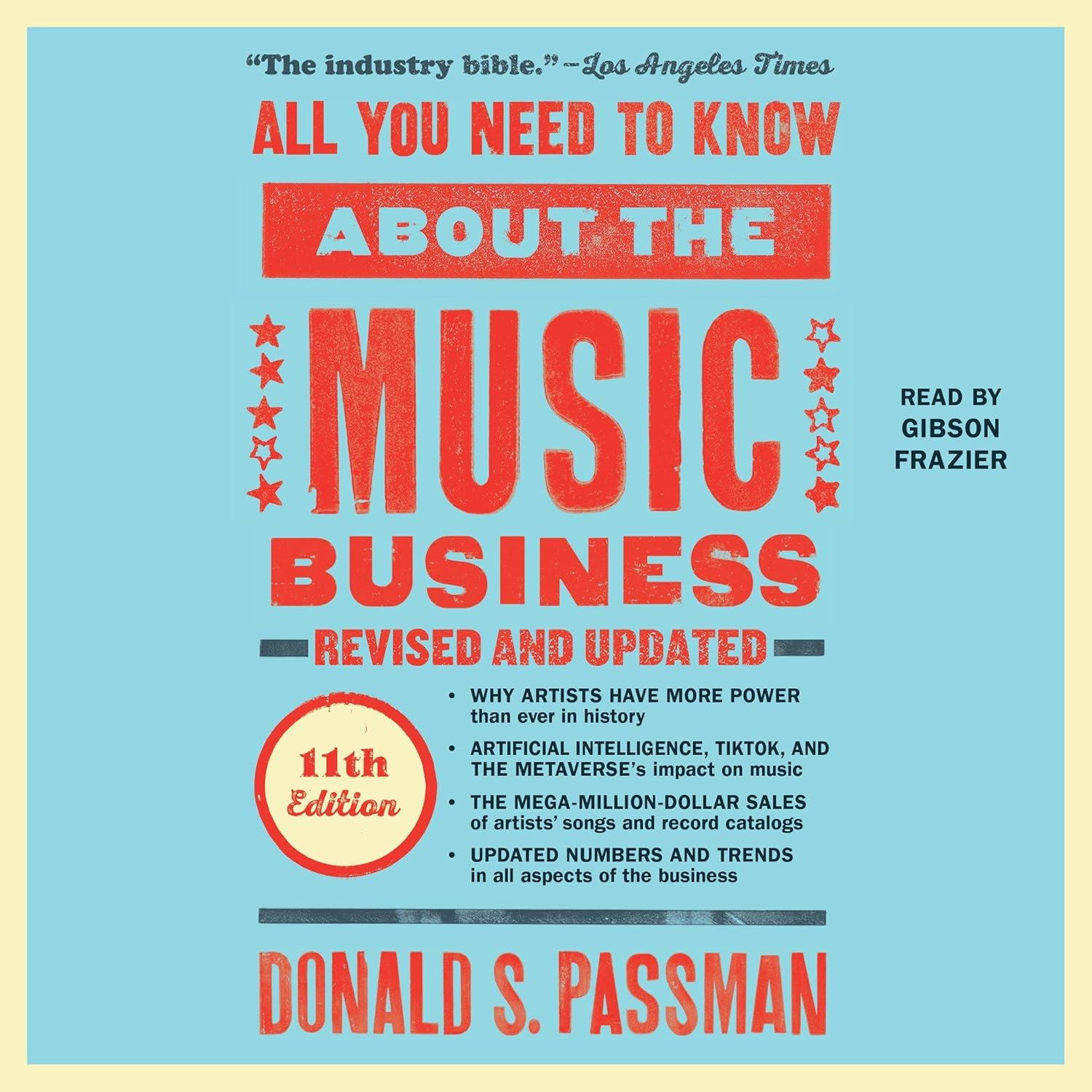
PART 1: SECTION-BY-SECTION LOGICAL MAPPING
SECTION 1: State of the Union / Introduction
Core Claim: Streaming rescued the music industry from piracy-induced collapse, but it fundamentally restructured the economics in ways that are still being sorted out—including a zero-sum element where one artist’s streams reduce another’s per-stream revenue.
Supporting Evidence:
US music revenues fell from $14.6B (1999 peak) to roughly half that, stagnant for 16 years
Streaming drove revenues to a new all-time high of $15.9B in 2022–2023
Per-subscriber spending ($84/year at $7/month average after discounts) exceeds the inflation-adjusted equivalent of peak CD-era spending (~$72)
Streaming expands the listener base across all ages, versus CD buyers who dropped off in their early 20s
Logical Method: Historical comparison + economic projection. The argument is structural: streaming monetizes more people at higher per-person rates over longer lifespans.
Logical Gaps:
The $84 vs. $72 comparison is Passman’s own “two minutes of internet research”—he flags this honestly, but then builds projections on it. The comparison conflates household-level spending (family plan subscribers paying $14–17/month per household) with per-listener figures.
The zero-sum streaming claim—that your streams reduce my per-stream revenue—is stated but not fully derived. It follows from the pro-rata allocation model (artists share a fixed pool) but Passman doesn’t walk through the mechanism explicitly here, leaving readers without the foundation they’ll need later.
Methodological Soundness: The framing is honest and directionally correct. The specific numbers are appropriately hedged. The zero-sum insight is the section’s most analytically important contribution and deserves more development than a single paragraph.
SECTION 2: Building Your Team (Chapters 2–6)
2a: How to Pick a Team
Core Claim: Artists are businesses generating multi-million-dollar revenue streams, and the decision to assemble a professional team—manager, attorney, business manager, agent—is the most consequential business decision they will make.
Supporting Evidence:
Practical observation across 40+ years of practice
Pattern recognition: successful artists have built-in radar for when something is wrong but lack the expertise to act on it
Sequencing logic: lawyer before manager (lower time commitment), business manager last (insufficient revenue to justify overhead early)
Logical Gaps:
The advice to “trust your tummy” as a readiness indicator is presented without any reliability check. Self-assessed readiness is a notoriously unreliable metric. Passman offers no alternative.
The recommendation to start with a music lawyer because “it only takes a few hours” is practically sound but slightly circular—it assumes the lawyer will help you determine whether you’re ready, which is itself a judgment call.
Methodological Soundness: This section is experience-based heuristics, not derived rules. Passman is honest about this. The framing is the right one: no universal formula, use your judgment, check references, trust your gut but verify.
2b: Personal Managers (Chapter 3)
Core Claim: The personal manager is the most important person in an artist’s professional life—effectively functioning as CEO of the artist’s enterprise. The deal structure (15–20% of gross) creates perverse incentives, particularly on touring, where gross percentage can exceed the artist’s net take.
Supporting Evidence:
Worked example: 15% of $100K gross when artist nets $45K = manager takes one-third of artist’s actual income
Group arithmetic: 15% of gross for a 7-member group exceeds each member’s 14.28% share
Documented industry shift toward reduced commissions, net deals, and sunset clauses
Logical Method: The math is correct and the perverse incentive is real. Passman proves it with arithmetic, not assertion.
Logical Gaps:
The “sunset clause” section (post-term commission periods) is the book’s most important legal protection advice, yet Passman presents it as a negotiation outcome rather than deriving why managers fight for post-term rights so aggressively. The underlying mechanism—that a manager can be owed royalties on a 5-album deal signed in month 6 of the term, with all 5 albums recorded after separation—deserves clearer derivation.
The “handshake deal” observation (many top managers have no written contracts) is presented as a quaint virtue. But it creates significant legal ambiguity for artists at precisely the moment when post-term commissions would bite hardest.
Methodological Soundness: The commission arithmetic is the section’s greatest strength. The advice on sunset clauses and key-person provisions is legally sound. The implicit assumption that managers and artists have roughly aligned interests early in a career is plausible but not proven.
2c: Business Managers (Chapter 4)
Core Claim: Business managers are the most dangerous hire—operating in a regulatory vacuum (no required credentials in California) and controlling the most consequential asset (money).
Supporting Evidence:
Documented: California requires no credentials to call oneself a business manager
Pattern evidence: disasters come from crooks and from honest incompetents
16-item checklist derived from observed failure modes
Logical Method: Negative-case reasoning. Passman structures this section around what can go wrong, not what goes right.
Logical Gaps:
The CPA recommendation (item 3 on the checklist) is sound, but CPAs aren’t trained in music industry specifics, and Passman himself notes this a sentence later. The logical implication—that you need someone with both CPA credentials and music industry expertise—is never stated cleanly as a conjunctive requirement.
Methodological Soundness: This is the book’s most methodologically careful advisory section. The E&O insurance question and the periodic audit recommendation are particularly well-reasoned.
2d: Attorneys (Chapter 5)
Core Claim: Music lawyers have become among the industry’s most powerful players precisely because they see more deals than anyone else, creating information advantages that translate into structural leverage.
Supporting Evidence:
The contractor analogy: a sub-contractor who ignores individual homeowners will jump for a general contractor who controls a year’s worth of work. Labels treat lawyers the same way.
Value billing is documented honestly: fee size reflects contribution, not just hours.
Logical Gaps:
The conflict-of-interest section correctly identifies the problem (lawyer representing both artist and label) but the advice (”use your tummy test”) is the weakest possible analytical resolution of what is a genuinely complex ethical question. The practical guidance—get separate counsel for any specific dispute—is correct but buried.
Methodological Soundness: Sound. The power-broker analysis is the section’s analytical contribution. The conflict discussion is practically honest if analytically thin.
2e: Agents (Chapter 6)
Core Claim: Music agents occupy a narrower power band than film agents—booking live shows, endorsements, and brand deals—and their leverage has shifted with streaming toward data-driven deal structures.
Supporting Evidence:
10% commission standard (5% discount at major revenue levels, not publicly disclosed)
No paperwork norm: agents are paid only for deals completed while you were represented
Scope expansion: agents now work virtual concerts, metaverse appearances, social media strategy
Logical Gaps: Minimal. This is the book’s most tightly bounded advisory section. Passman is appropriately modest about the limits of what can be contractually specified.
SECTION 3: Record Deals (Chapters 7–14)
3a: Industry Structure and the “Do You Need a Label?” Question
Core Claim: The record label’s historical gatekeeping function (manufacturing, distribution, radio relationships) has eroded, but labels retain meaningful advantages in data, marketing infrastructure, and international reach that justify partnership for mainstream artists.
Supporting Evidence:
84% of US recorded music revenue from streaming at time of writing
100,000 new tracks uploaded daily—the discoverability problem is the new gatekeeping function
TuneCore/DistroKid/CD Baby solve distribution but not discovery
Logical Gaps:
The argument “labels have more data and better relationships with streaming services” is stated but not quantified. It’s plausible—labels negotiate catalog deals that include playlist placement provisions—but Passman doesn’t tell the reader what specific advantage this translates to. Is it a 10% streaming uplift? 50%? The practical calculus is never resolved.
The “niche artist” vs. “mainstream” distinction is clean in theory but messy in practice. Passman doesn’t define where the line is, which is where the actual decision lives.
Methodological Soundness: Honest about the uncertainty. The book explicitly says this is an open question.
3b: Royalties and Recoupment
Core Claim: Royalty computation has simplified (streaming = percentage of company receipts), but the recoupment system is systematically designed so that artists can be unrecouped while owing money to third parties—a structural problem, not an edge case.
Supporting Evidence:
Worked arithmetic throughout: 0.8σ equivalents in royalty math showing how the stud-fee/bulldog analogy maps to recording costs
The producer-owes-money-while-artist-is-unrecouped problem: explicitly shown with numbers where a $2M revenue album leaves artist $20K in the hole while owing producer $40K
Cross-collateralization: connected wells illustration showing how success on one album recoupes losses from another
Logical Method: This is the book’s analytical core—worked examples replacing intuitive claims. Passman is at his best here.
Logical Gaps:
The “at source” vs. “intra-company” reduction discussion is important and under-explained. The mechanism (French affiliate takes 25% before remitting, so artist gets royalty on $75 not $100) is correct, but the size of the practical impact is never quantified. For a superstar with major European streaming, this could be a multi-million-dollar issue.
The 35–$500K per million streams “rough rule of thumb” is immediately and correctly flagged as unreliable by Passman himself. But it’s the number readers will remember. The honest caveat needed here is stronger: there is no useful rough number.
Methodological Soundness: The royalty arithmetic is the book’s strongest analytical section. The recoupment worked examples are genuinely educational. The producer-owes-money scenario is the most important single insight in the book and Passman earns it through derivation.
3c: 360 Deals
Core Claim: 360 deals (record company share of touring, publishing, merchandising, etc.) originated from industry distress but persist because labels have leverage. Their practical scope has narrowed with artist bargaining power.
Supporting Evidence:
Range: 15–20% on most categories, 7.5–10% on touring (lower because touring margins are thin)
Artists with significant heat can reduce 360 to zero
Logical Gaps:
The “labels help build your brand” argument for 360 rights is presented as the label’s sugar-coating, then dismissed. But Passman doesn’t actually test whether the claim is true—whether labels that take 360 rights actually do more for an artist’s non-record career. The dismissal is rhetorical, not analytical.
The shelter concept (no touring percentage below $500K–$1M threshold) is the most practically valuable 360 negotiation point and gets two sentences. It deserves more development.
Methodological Soundness: Adequate. The 360 section is primarily practical rather than analytical.
3d: Deal Structure (Terms, Options, Advances)
Core Claim: Options are never good for artists—they give the label the right to exit if you fail while locking you in if you succeed for less than you’re worth. Every piece of contractual language in this area has a specific historical failure mode behind it.
Supporting Evidence:
The Newton-John case: court limited injunction to stated contract term, forcing the shift from time-based to album-delivery-based term structure
The Dean Martin problem: deal ran indefinitely because it was tied to album delivery; Martin showed up years later demanding fulfillment
The Zappa problem: artist delivered all remaining albums simultaneously to escape deal
Logical Method: Historical case reasoning. Each contractual clause is derived from a documented abuse.
Logical Gaps:
The “pay or play” provision (company can pay you off instead of making a record) is correctly identified as one-sided, but Passman’s advice—negotiate for recording fund minus last album’s costs—is stated without explaining why this is the right floor. The derivation would strengthen the recommendation considerably.
Methodological Soundness: The historical derivation method is this section’s key strength. Lawyers do this well, and Passman’s version is accessible without sacrificing precision.
3e: Producers and Mixers
Core Claim: The shift from label-hired to artist-hired producers created a structural trap: artists are responsible for producer royalties at a time when they may be personally unrecouped, creating a scenario where success generates obligations the artist cannot meet.
Supporting Evidence:
Worked arithmetic: artist $20K in the hole, owes producer $40K, total disaster scale with zeros added
Letter of Direction mechanism: practical workaround where label pays producer and treats payment as advance against artist, making artist even more unrecouped but avoiding personal obligation
Logical Method: Derived from first principles via arithmetic. This is Passman at maximum analytical precision.
Logical Gaps:
The producer advance/royalty tradeoff (record company wants high producer advance so royalties are triggered later) is raised as a question, answered at chapter end. It’s the section’s cleverest point: label wants advance high because it delays the moment producer is owed retroactive royalties, which delays the moment the label must fund artist-who-is-unrecouped’s obligations. The derivation is correct but the presentation—hide it as a quiz question—undersells it.
Methodological Soundness: Strong. The producer section is the most algebraically rigorous in the book.
SECTION 4: Songwriting and Music Publishing (Chapters 15–17)
4a: Copyright Basics
Core Claim: Copyright protection is automatic upon creation of a tangible copy; registration provides specific legal benefits but not the copyright itself. The compulsory mechanical license system forces rights holders to license to anyone who pays the statutory rate—a government-mandated exception to monopoly protection.
Supporting Evidence:
Section 106 of the Copyright Act: five exclusive rights enumerated
The 1909 Act’s jukebox exemption (jukeboxes were “toys”) as historical absurdity
Statutory mechanical rate: currently $0.12 or 2.31 cents/minute, whichever is larger, as of January 2023
Logical Method: Statutory derivation + historical context. The “why” of compulsory licensing (Congressional fear of music industry monopoly) is stated, which is better than most music business books.
Logical Gaps:
The distinction between dramatic and non-dramatic musical works (a threshold condition for the compulsory license) is flagged as unclear by Passman himself. This is an honest admission but leaves a gap: readers who want to know if their song qualifies get no practical guidance.
The Music Modernization Act discussion ends on a cliffhanger (streaming compulsory license requires authorization from song owner and recording owner—but then why do you need a compulsory license?). Passman flags this explicitly as a deliberate deferral. Accepted, but the deferred payoff must be clean.
Methodological Soundness: The copyright section is among the book’s most rigorous. The statutory rate arithmetic is presented correctly.
SECTION 5: Advanced Technologies and New Frontiers
5a: Streaming Economics (At-Source, ARPU, Dilution, Per-User vs. Per-Stream)
Core Claim: The pro-rata streaming model systematically favors high-volume genres (hip-hop, pop) over engaged-but-small audiences. The per-user alternative would redistribute money toward niche artists but with minimal practical benefit at the bottom of the distribution.
Supporting Evidence:
French CNM study (February 2021): per-user model reduces top 10 artists by 12–17%, benefits artists ranked 101–1000 by 2–3%, but artists beyond top 10,000 gain an average of ~10 euros
ARPU analysis: Spotify’s free users dilute per-stream value relative to Apple Music subscribers
Dilution via non-music content: 31-second bot-listened clips, AI-generated music
Logical Method: Policy analysis + empirical data. The French study is the only actual empirical anchor in this section.
Logical Gaps:
The AI dilution problem is correctly identified but analytically thin. “More is definitely coming” is not a claim that can be derived. The failure mode (AI tracks dilute the pool without creating meaningful artistic value) is clear; the proposed solutions (legislative identification, DSP segregation) are speculative without any probability assessment.
The breakage discussion presents the correct formula but doesn’t show a worked example for what an artist actually receives, making the concept less useful than the recoupment examples.
Methodological Soundness: This section is the most forward-looking and consequently the most analytically fragile. Passman is appropriately honest about uncertainty.
5b: Web3, NFTs, and the Metaverse
Core Claim: These technologies have not yet produced significant music industry impact. The market has largely cooled since initial hype. The most viable near-term use case is premium fan experiences (skins, virtual merchandise, limited-supply NFTs with tangible attachments).
Supporting Evidence:
NFT art market “cooled”—Passman’s word
Fortnite and Roblox concerts are documented (Lil Nas X, Marshmello, Ariana Grande)
$40B annual skin market cited
Logical Gaps:
The $40B skin market figure is presented without attribution. It’s plausible (Fortnite alone reportedly generates $5–6B annually) but deserves a source.
The smart contract/resale royalty section doesn’t acknowledge that NFT platforms have been moving away from enforcing creator royalties (OpenSea eliminated enforcement in late 2022). This is a significant omission given the book’s publication timing.
Methodological Soundness: Appropriately skeptical. The refusal to project specific revenue forecasts for unproven technologies is intellectually honest.
BRIDGE: Synthesizing the Logical Architecture
The book’s central tension is structural, not incidental. Passman presents the music business as a system designed, iteratively, to protect record companies from the consequences of their own risk-taking, while giving artists just enough to keep them signing. Every historical case he cites—Newton-John, Dean Martin, Zappa, Snuff Garrett’s 1-cent royalty fight—is a document of this tension. The artists push; the companies revise the contracts to close the loophole while yielding the minimum.
Three patterns repeat throughout:
Pattern 1: Complexity as protection. Recording contracts are so complicated that artists routinely sign provisions they don’t understand. The cross-collateralization language is “buried innocuously in the recoupment language and can easily be missed by the untrained eye.” The at-source foreign streaming deduction is structural but invisible at the moment of signing. Passman’s explicit project is to make this complexity visible—and he largely succeeds.
Pattern 2: The unrecouped trap. The book’s central analytical contribution is demonstrating that recoupment is designed so that success generates obligations faster than it generates revenue for artists. The producer-royalties problem, the cross-collateralized multi-album deficit, the 360 percentage applied to gross touring before expenses—each of these represents a different mechanism by which the label extracts value from an artist who, on paper, has “made it.”
Pattern 3: Democratization is real but incomplete. The streaming era genuinely democratized distribution. But it replaced one gatekeeping problem (physical retail, radio) with another (algorithmic discoverability among 100 million+ tracks). The book is honest that no one has fully solved this second problem.
The book’s most proven claims:
The compulsory mechanical license system and its specific rates
The producer recoupment arithmetic and the at-source reduction mechanism
The historical derivation of every major contract clause
The zero-sum nature of streaming revenue pools
The book’s most significant unproven claims:
That per-user streaming allocation would be “fairer” (the French data shows it helps middle artists minimally)
That AI music dilution will be solved through legislation (speculative)
That metaverse/Web3 music will be significant (appropriately hedged but still uncertain)
The book’s most significant acknowledged gaps:
What streaming uplift labels actually provide vs. DIY
Whether 360 deal co-investment actually materializes in better outcomes
How algorithmic discoverability will evolve
PART 2: LITERARY REVIEW ESSAY
The Bulldog and the Algorithm
There is a story near the beginning of All You Need to Know About the Music Business about a bulldog named Rosie and a stud named Winston, and the story explains more about the music industry than most academic papers on the subject. Donald Passman uses it to illustrate recording royalties: an artist turns their recordings over to a record company the way Jules turned pregnant Rosie over to Korky, and for each “puppy sold,” the artist gets a piece of the money. The analogy is folksy, precise, and slightly absurd—which is to say it is exactly right for its subject.
The 11th edition of Passman’s book, updated to cover streaming economics, NFTs, TikTok, and the Music Modernization Act, is the most analytically rigorous popular book on the music business in print. This is not a particularly crowded field, but the achievement is real. By the time a reader finishes the chapter on producer royalties—which walks through worked arithmetic to show how an artist can be $20,000 in the hole to a record company while simultaneously owing $40,000 to a producer whose royalties were triggered by the artist’s own streaming success—they understand something that most signed artists do not. That this understanding comes dressed in bulldog metaphors does not diminish it.
The book’s intellectual project is to make visible what record company contracts are designed to hide. This is a more serious undertaking than its approachable tone suggests.
Consider the structure of a recording contract as Passman describes it. An artist signs a deal for one “firm” album with options for three or four more. The language sounds like opportunity: here are four more chances to make records. But options are exercised by the record company, not the artist. If the first album fails, the company drops the artist. If it succeeds, the company exercises the option—at a royalty rate and advance pre-negotiated when the artist had no leverage—and the artist is locked in. Options are, in Passman’s phrase, “never good for you.” He makes this claim three times and writes it on the blackboard.
The logic is airtight: an option is a unilateral right held by the party with more information and less risk exposure. The record company has sales data, streaming metrics, and trend analyses. The artist has a hope and a contract. The option allows the company to exit if the data turns bad and stay if it looks good—which is precisely the information advantage the company wants to keep.
This is the book’s central analytical contribution, and Passman arrives at it not through assertion but through accumulated derivation. By the time he invokes the blackboard instruction, he has already shown the reader exactly how the mechanics work: cross-collateralization means a smash second album recoupes the deficit from a failed first one, keeping the artist unrecouped and royalty-free at the moment of their greatest success. The formula advances (advances keyed to a percentage of previous album earnings) look generous until you realize the company sets a ceiling that caps your upside and a floor that protects their own risk. Every piece of the deal is asymmetric. The reader is supposed to find this alarming, and does.
The book’s most important single insight lives in the middle of the producer royalties chapter, and it is presented, somewhat perversely, as a quiz question. Passman asks: why would a record company want to keep the producer’s advance high? Most readers will not guess the answer. The answer is this: producer royalties are paid retroactive to the first record sold, but only after recording costs are recouped from the artist’s net royalty rate. The higher the producer’s advance, the longer it takes for the advance to be recouped from royalties—which means the longer it takes before the producer is owed retroactive royalties, which means the record company can delay the moment it must advance those royalties on behalf of a still-unrecouped artist. It is a three-step financial mechanism. The company keeps the producer advance high to slow the clock on an obligation it would otherwise have to fund immediately from its own pocket.
I call this the book’s most important insight because it illustrates the entire ethos of recording contract design: every clause has an arithmetic justification that points in the company’s direction. The company is not evil. It is merely optimizing under uncertainty, with better information and more leverage than the artist. Understanding this does not change the asymmetry, but it changes what artists are able to negotiate. Passman’s explicit goal is to move readers from the category of “signed without knowing” to “signed with their eyes open,” and he succeeds at this more fully than any book I have read on the subject.
The streaming sections are where the book’s analytical confidence appropriately softens. The fundamental problem is that streaming economics remain genuinely unsettled in ways that academic rigor cannot resolve through derivation alone. The pro-rata versus per-user debate is a case in point. The French CNM study provides the only empirical anchor in the section: per-user allocation would reduce top-10 artists’ streaming revenue by 12–17% while adding roughly 10 euros per year to artists ranked below the top 10,000. That is not a distribution revolution. It is a marginal redistribution at the tails of the income distribution, at substantial implementation cost. Passman presents this evidence honestly without over-interpreting it.
The AI dilution problem is less honestly handled, though Passman earns some credit for raising it at all. His analysis is correct in structure: AI-generated music can be produced at near-zero marginal cost, uploaded in volume, and listened to by bots generating 31-second streams that clear the threshold for payment allocation. Each such stream dilutes the pool available for human-created music. The mechanism is clear. What Passman does not say—and should—is that this is not a future problem. It is a present problem with no clear solution, and the solutions he floats (legislation requiring AI identification, DSP segregation) are speculative at the level of political will required to implement them, not technical feasibility.
This is the book’s most significant analytical gap: it identifies the correct structural problems with the streaming ecosystem but lacks the framework to assess which of them are solvable and on what timeline. This is partially a knowledge limitation (the situation is genuinely uncertain) and partially an analytical limitation (the book does not provide tools for evaluating regulatory proposals or platform incentive structures). A more rigorous treatment would acknowledge this distinction explicitly.
There is one claim the book never fully makes that should be its thesis statement: the music industry is a system designed to extract maximum value from creative labor at minimum risk to capital, and it is better at this than artists’ advocates usually admit because it offers artists something they cannot easily replicate independently—scale and discoverability.
Passman comes close to this when he describes why labels still matter: 100,000 tracks uploaded daily, and without marketing infrastructure and streaming service relationships, your record lies there “like that new brand of dog food you tried out on Muffy.” But he never completes the argument. He does not show the reader what the actual conversion rate is between having a label and not having a label on discoverability—because the data, if it exists, is not public.
This gap matters because the entire “do you need a label” question—which occupies a full chapter and recurs throughout the book—cannot be answered without this number. Passman’s honest answer is: it depends on your genre, your existing heat, and how much control you’re willing to cede. That is correct. But the reader deserves to understand that the reason no cleaner answer is possible is not that the question is complex—it is that the record industry has structured its information advantage to make the answer opaque.
Seventeen years of natural language tutoring research, the AutoTutor paper concludes, have built a credible system with genuine pedagogical value. I borrow that structure deliberately. Forty-plus years of music law practice have produced, in All You Need to Know About the Music Business, a credible, well-documented guide with genuine analytical value and an honest accounting of its limitations.
The bulldog analogy is correct. The arithmetic is right. The options insight is proven. The producer recoupment trap is derived, not asserted, which makes it teachable. The streaming sections are appropriately uncertain. The Web3 sections are appropriately skeptical.
What the book cannot do—and does not pretend to do—is resolve the question that matters most for the working artist in 2024: given that streaming’s power dynamics increasingly favor the largest catalogs and the most algorithmically optimized content, is there a structural path for a mid-level artist to build a sustainable career independent of a major label? The answer to that question is not in any contract clause. It lives in the data that the streaming platforms have and have not released.
Rosie had puppies. Winston got paid. Korky took her share. Jules got the rest. And somewhere in the metaphor, the person who wrote the song that played on the radio when the puppies were born is still waiting to recoup.
Tags: music business contracts royalties, record deal recoupment mechanics, streaming pro-rata vs per-user allocation, 360 deals artist income, independent artist versus major label