

There is a number that haunts the streaming economy. Not the per-stream royalty rate — $0.003 to $0.005 — but the number above it, the one that explains the rate: one hundred million. That is approximately how many tracks Spotify currently hosts. One hundred million tracks, adding roughly a hundred thousand more every day, each one arriving into an environment so saturated that the music itself has become the least important thing about the music. What matters is the metadata, the playlist placement, the algorithmic trigger. What matters is whether the song gets served to someone in the right mood at the right moment in the right geography to register as a stream rather than a skip.
In that environment, music has stopped being an object of attention and become a texture of inattention. The platform has achieved something genuinely strange: it has made access infinite and made listening worse.
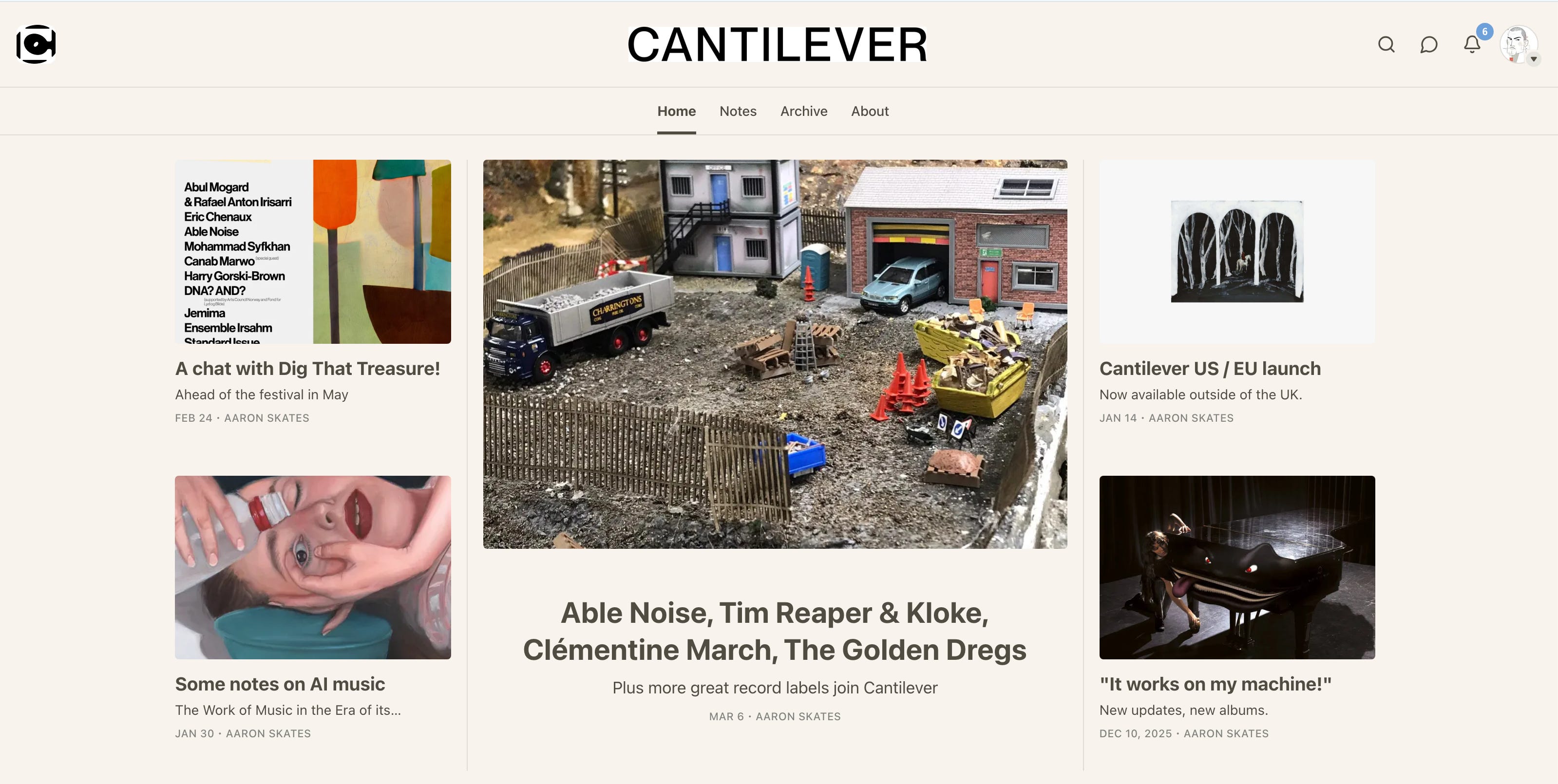
Cantilever, a London-based streaming service launched in October 2025, is built on the premise that these two facts are not coincidental. That the infinite catalogue does not democratize music so much as drown it. That scarcity — ten albums, rotating monthly, each one chosen, each one contextualized, each one justified in writing before it can be heard — is not a limitation. It is the condition of actual listening.
What Cantilever Actually Is
Aaron Skates is a music writer — not a founder who discovered music, but someone who spent years inside independent record labels watching the streaming era hollow out everything he cared about, and who eventually decided to build the environment he wanted rather than critique the ones that existed.
The result began as a Substack newsletter in 2023 — a music magazine, he called it — and became a streaming application formally launched on the iOS App Store two years later. The framing matters: Cantilever describes itself as “a music magazine you can listen to.” Not a streaming service that also publishes writing. A magazine. The writing is infrastructure, not decoration. (Cantilever’s journalism is free to read at cantilevermusic.substack.com; the music requires a subscription.)
The mechanics are straightforward enough to explain in a sentence: ten albums on the platform at any given time, one entering every few days, each one staying for exactly one month before cycling off. A free tier gives access to the journalism. A premium subscription at $5.99 per month, or £4.99 in the UK, gives access to the music alongside contextual articles. Every paying subscriber generates royalties through a user-centric payment system — meaning their fee flows only toward the artists they actually listened to, not toward the global streaming pool where popular artists collect a portion of money spent by someone who listened exclusively to a single independent release.
By February 2026, Cantilever had expanded to the US and EU, onboarded labels including Warp, XL Recordings, Ninja Tune, Beggars Group, and Hyperdub, and earned a Guardian feature describing it as an anti-Spotify — a phrase Skates seems to have accepted as accurate.
How Music Became Furniture
Music has stopped being an object of attention and become a texture of inattention. Here is how that happened.
The music streaming economy was supposed to solve a specific problem. In 2000, the problem was piracy: people were taking music without paying for it, and no one had figured out a legal alternative as frictionless as Napster. Spotify, launched in 2008, solved that problem. It was more convenient than piracy, it was legal, and it paid something — however little — to the rights holders. The deal was: infinite access in exchange for a monthly subscription, distributed to artists in proportion to their share of total streams.
The math of that deal contained a buried assumption: that listeners would stream enough music broadly enough that the pro-rata model would roughly track cultural value. If people listened to what they cared about, then what people cared about would be rewarded.
What actually happened was different. The platform optimized for engagement rather than listening. Engagement meant time-on-app. Time-on-app was maximized not by helping people find music they would care about deeply but by surfacing music that would not cause them to close the app. The mood playlist was the perfect instrument for this: music calibrated to stay out of the way of whatever else the listener was doing. Functional audio. Wallpaper that played back.
The market responded accordingly. “Functional noise” — sleep sounds, rain, white noise — began harvesting streaming royalties at scale. Ghost artists, manufactured specifically for mood playlist placement, displaced independent musicians from the royalty pool. By 2024, researchers had estimated that a substantial share of streams on major platforms were generated by content that no one actively chose, placed in playlists that the algorithm served to passive listeners whose attention was elsewhere.
The deeper problem is psychological. The research on music and attention is not ambiguous: deep listening, repeated engagement with a specific album, the kind of relationship that forms between a person and a body of work encountered at the right moment — these produce qualitatively different neurological effects than passive exposure to mood-matched audio. The limbic system responds differently to music that has been chosen than to music that has been served. The person who has listened to an album twenty times knows something that a person who has streamed fifteen thousand tracks across three years does not know.
Cantilever is a wager that the people who know this difference are willing to pay for a service organized around it.
The Structure of the Bet
The question Cantilever forces is one the music industry has been avoiding for a decade: what is streaming actually for?
The user-centric payment model is the financial argument. The rotation model is the attention argument. Together they constitute a claim: that the way the streaming economy currently works is not a neutral delivery mechanism but a value system, and that the value system is wrong.
The financial argument is straightforward. Under the pro-rata model, a user who pays $10.99 and listens exclusively to one independent artist contributes approximately nothing to that artist’s royalties. The money goes to the pool. The pool goes to whoever has the most streams. The most streams go to the artists who are already the most played — the artists with the most algorithmic support, label promotion, and playlist placement — which is to say the artists who least need the money. The independent musician’s dedicated listener subsidizes the pop star they never heard.
Cantilever reverses this. The $5.99 premium subscription, after the platform’s administrative cut, flows only toward the albums that subscriber actually played. The math now points in the direction of the actual listening.
The attention argument is subtler and more interesting. By limiting the catalogue to ten albums, Cantilever does something no major platform has been willing to do: it tells the listener what to pay attention to. Not through an algorithm that mirrors the listener’s existing preferences back at them, reinforcing what they already like and slowly narrowing the world. Through editorial judgment — a human being, or a team of human beings, deciding that these ten releases are worth your time this month, and here is why.
This is the function the music press used to serve. Before the streaming era, a trusted critic or a well-edited magazine could orient a listener in a catalogue that was large but not infinite. Could say: this is what matters this month. Could make a case for it in prose. The editorial voice was part of the infrastructure of attention. Streaming killed it not by replacing it but by making it seem unnecessary — if you can access everything, why would you need someone to tell you what to hear?
The answer Cantilever gives is: because access is not the same as listening. Because unlimited access to a hundred million tracks has not produced a generation of more engaged music fans; it has produced a generation of more exhausted ones. Because the curator is not an obstacle to discovery but its precondition.
What This Means for the People Making Music
Warp Records signed on. So did XL, Ninja Tune, Beggars Group, Hyperdub, and Young. These are not small names. These are the labels that built the independent infrastructure the streaming era inherited and then degraded. Their participation is an argument by demonstration: this is what we think our releases deserve. A month in the foreground. Writing around them. A royalty model that flows toward the people listening rather than away from them.
If streaming is for listening — for the formation of relationships between people and music, for the kind of engagement that produces not passive consumers but active fans who show up to shows, buy records, pay attention over years — then the current architecture is failing at its own stated purpose. A listener who has spent a month with ten albums, guided by journalism, paying royalties that flow to the artists they heard, is a different kind of listener than one who skipped through fifty algorithmically generated playlists. They know what they listened to. They might know why they liked it. They might show up.
This is what Cantilever is actually betting on: that there is a listener who wants to be that person. Who is tired of the scroll, the skip, the mood-matched wallpaper. Who is willing to accept ten albums this month in exchange for knowing that those ten were chosen by someone with taste, justified in writing, and paid for in a way that lands where it should.
The platform is small. The catalogue is limited. The five-person team in South London is building something that makes no attempt to compete with the celestial jukebox on its own terms.
That refusal is the whole point. You cannot beat the jukebox by being a better jukebox. You beat it by reminding people that they didn’t want a jukebox. They wanted music.
<iframe width=”560” height=”315” src=”
title=”YouTube video player” frameborder=”0” allow=”accelerometer; autoplay; clipboard-write; encrypted-media; gyroscope; picture-in-picture; web-share” referrerpolicy=”strict-origin-when-cross-origin” allowfullscreen></iframe>
<iframe data-testid=”embed-iframe” style=”border-radius:12px” src=”
width=”100%” height=”352” frameBorder=”0” allowfullscreen=”“ allow=”autoplay; clipboard-write; encrypted-media; fullscreen; picture-in-picture” loading=”lazy”></iframe>
Nik Bear Brown is Associate Teaching Professor of Computer Science and AI at Northeastern University and founder of Musinique LLC and Humanitarians AI (501(c)(3)). The Musical Endogeneity research trilogy — examining Spotify’s popularity score architecture, the perceptual boundary between human and AI music, and the economics of algorithmic momentum — is ongoing research conducted through Humanitarians AI. More of his work lives at skepticism.ai and theorist.ai.