

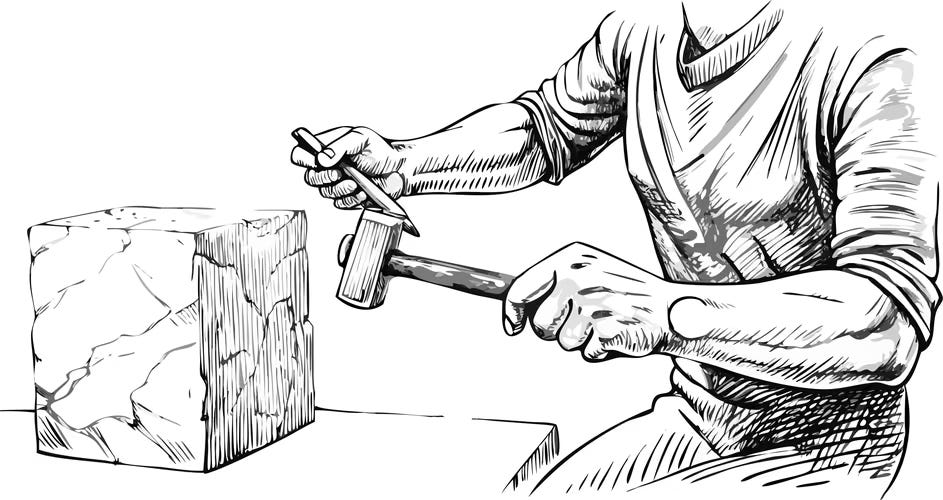
It is what slows you down. What interrupts momentum. What stands between the intention and the output, between the idea and the thing the idea becomes. It is the resistance in the process — and resistance, in any system built for efficiency, is what you remove.
This definition is not wrong. It is simply incomplete. And the part it leaves out is the part that matters most.
Friction has been treated as a problem for so long that the treatment has become invisible. It is built into the architecture of every tool designed to help you create — in the prompt that suggests a direction when you have none, in the template that resolves the structural question before you have had to ask it, in the interface that moves you from idea to output along a path of least resistance. The goal is always the same: make it easier. Make it faster. Remove the obstacles.
In manufacturing, this logic is sound. In distribution, it is essential. In any system where the goal is to move a defined object from one place to another, friction is genuinely the enemy — it is waste, delay, cost.
But art is not a system for moving defined objects. It is a process for discovering what an object should be. And that discovery requires resistance. Not the resistance of external barriers — the inability to record, to distribute, to reach an audience — but the internal resistance of a work that does not yet know what it is, pressing back against the person trying to find out.
This is a different kind of friction. And removing it does not accelerate creation. It changes what creation is.
A song that comes too easily often leaves just as quickly.
Not because it is poorly made. Not because the craft is absent or the emotion is false. But because nothing in its making required a decision to be held — nothing forced the work into a form it could not have taken otherwise. It arrived at completion along the path of least resistance, which is to say it arrived at the form most immediately available, the structure already known, the emotional register already proven.
Ease produces familiarity. Not always. But systematically, over time, across a body of work — a practice built on frictionless creation tends toward what has already been established, because what has already been established is what the process of least resistance reaches first.
Friction interrupts this. It creates a gap between impulse and execution — a space where the first answer can be questioned, where the obvious direction can be refused, where the work is held long enough to reveal whether it is true or merely convenient. This gap is not inefficiency. It is where the work becomes itself rather than becoming the nearest available approximation of itself.
The first version of anything is usually immediate. It follows instinct, follows familiarity, follows the grooves worn by everything made before it. There is nothing wrong with the first version. But it is a beginning, not an arrival. And moving past it — past the familiar, past the immediately available, toward the specific form this particular work requires — takes time. Takes resistance. Takes the willingness to stay in uncertainty longer than is comfortable.
Friction is what makes that staying necessary.
The system cannot reward this.
It is not built to. What the system measures is output — what was made, how quickly, how often, how far it traveled. It cannot measure the time spent on something that was not produced. It cannot recognize the value of a decision that prevented the work from becoming something easier. It cannot account for the version that was cut, the direction that was refused, the line that was wrong in a way that took months to understand.
So it treats these things as if they do not exist. As if the work begins at the moment of completion and the process that shaped it is irrelevant to what it became.
But the process is the work. Everything visible is shaped by what did not survive it — by the decisions that were forced by resistance, by the directions that friction closed off, by the moments where the work pushed back and the creator had to push harder to find out what was actually there.
This is where questions arise that do not arise in frictionless conditions. Is this what I mean? Is this necessary? Is this the truest version of this, or the most convenient one? Without friction, these questions are not answered. They are not asked. The work moves forward before it has to confront them, and arrives at completion having never been tested by its own difficulty.
A work that has not been tested does not fail. It simply does not hold. It reaches an endpoint but does not arrive — because arrival requires having pushed against something that did not immediately give way.
There is friction that obstructs and friction that shapes. The distinction matters.
The friction of inaccessibility — the inability to record without expensive equipment, to distribute without label infrastructure, to reach an audience without institutional gatekeepers — is genuinely obstructive. It has nothing to do with the work itself. It is a barrier between the creator and the conditions that make creation possible, and removing it is unambiguously good. The democratization of access to recording and distribution tools has opened real possibilities for real artists who would otherwise have remained unheard.
But the friction that exists within the act of creation — the moment where something does not quite fit, where a line feels almost right but not enough, where a decision cannot be made immediately because the work has not yet revealed what it needs — this is not the same kind of thing. It is not an obstacle between the creator and the work. It is the work, asking to be taken seriously.
Removing this friction does not make creation more accessible. It makes it shallower. It removes the condition that forces the work into specificity — that prevents it from remaining general, familiar, undemanding. And what is left, once that condition is removed, is work that is easier to produce and harder to mean.
Meaning is not efficient.
It does not arrive on schedule. It does not respond to the pressure of deadlines or the incentive of visibility. It forms in the space that friction creates — in the time spent with something unresolved, in the discomfort of not knowing, in the decision that could not be made until the work had been held long enough to reveal what it required.
This is uncomfortable in ways that feel unproductive. Sitting with a song that refuses to resolve, returning to a lyric that is wrong in a way you cannot yet articulate, remaining in the uncertainty of a work that has not yet told you what it needs — none of this looks like progress. In an environment calibrated to reward output, it registers as failure.
So the tools offer a way through. A suggestion that moves things forward. A structure that resolves the uncertainty. A prompt that produces something where there was nothing.
And the work moves forward. The discomfort is gone.
But the discomfort was doing something. It was the signal that the work had not yet found what it needed — that something remained unresolved not because the creator was failing but because the work was still becoming. Removing the discomfort does not resolve what was unresolved. It skips it. And what was skipped is absent from the finished work, which arrives at completion having never been pressed hard enough to discover what it was made of.
A work that has encountered real friction carries it forward.
Not visibly. Not as evidence of struggle or as proof of effort. But as a quality of necessity — the sense, felt rather than analyzed, that this could not have been otherwise. That the form was arrived at rather than selected. That something was worked through here, not merely produced.
This quality is what makes certain works stay. Not their technical accomplishment, not their emotional familiarity, not their structural correctness. The sense that they were made by someone who remained with them long enough for the work to become what it needed to be — who did not move on when moving on was easier, who did not settle for the first answer when the first answer was insufficient.
The system cannot create this. It can remove barriers. It can accelerate processes. It can make creation more accessible than it has ever been. These are genuine contributions, and they matter.
But it cannot replace the friction that shapes. Because that friction is not a limitation of the tool. It is a condition of the work — the pressure that forces form, that closes off the easier versions, that demands the harder truth.
Remove it entirely, and creation becomes faster.
But the work becomes easier to produce and harder to mean.
And meaning is the only thing that stays.