

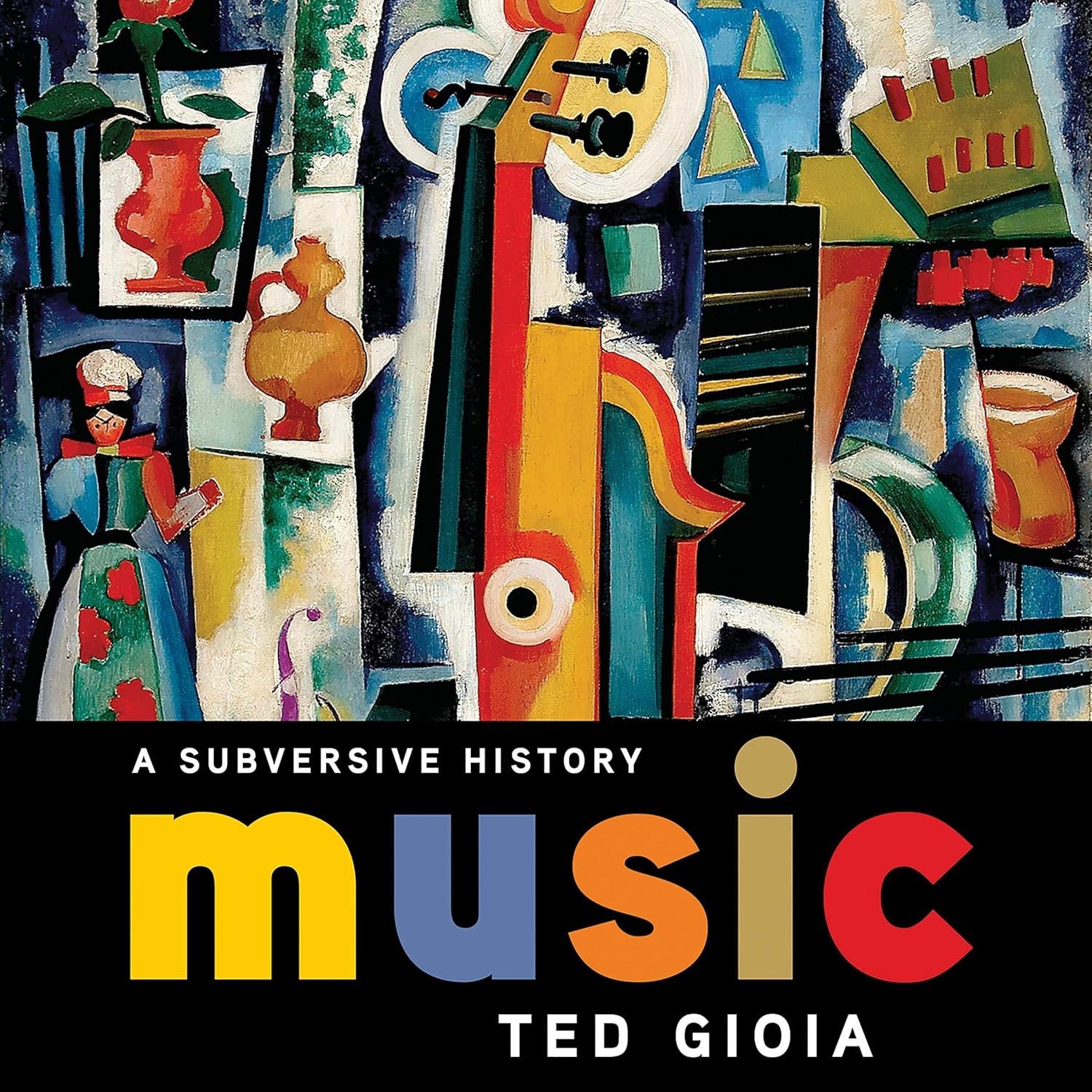
PART 1: SECTION-BY-SECTION LOGICAL MAPPING
What if every music history class you've ever taken was a cover-up? ... Power structures have buried the truth for 4,000 years. They silenced the women who carried it. They burned the followers who practiced it. They co-opted the outsiders who created it. The pattern is brutal... and it's still running today. Scott Joplin died broke in 1917. He got a Pulitzer in 1976. Fifty-nine years — that's the tax on being ahead of your time. This review breaks the whole machine apart... because you deserve the history they didn't want you to have.
INTRODUCTION: The Argument Stated
Core Claim: Conventional music history is systematically distorted by its emphasis on respectable, institutionally sanctioned music while suppressing what actually drives innovation: the “shameful” elements—sex, violence, magic, trance, and social disruption—that power structures work to eradicate or co-opt.
Supporting Evidence:
Institutional incentives for “sanitizing” music history (status, funding, prestige)
25+ years of cross-disciplinary research spanning folklore, neuroscience, anthropology, musicology
The recurring pattern of radical music being denounced, then mainstreamed, then celebrated as establishment
Logical Method: Argument by indictment—the conventional account is corrupt, therefore a subversive alternative is needed.
Logical Gaps:
The claim that shameful elements are “engines of innovation” is asserted, not proven, at this stage. The introduction promises to demonstrate it; whether it does is the book’s central methodological question.
“Institutions want to suppress X” and “X is genuinely important” are two separate claims. Gioia sometimes conflates them: the fact that rulers feared the lament does not automatically prove the lament was culturally central.
Methodological Soundness: The introduction functions as advocacy, not proof. This is appropriate for an introduction, provided the subsequent chapters deliver the evidence.
CHAPTERS 1–4: Origins — Music Before History
Core Claims:
Music predates humanity (Neanderthal flute, ~43,000–82,000 years old)
The origins of music are dual: sexual selection (Darwin) and territorial/violent assertion (bird song, scavenger hypothesis)
These two origins are not contradictory—oxytocin release links music to both bonding and conflict mobilization
Musical universals exist and are systematically denied by ethnomusicologists for ideological reasons
Around 500 BC (Pythagoras/Confucius simultaneously), a cultural rupture imposed mathematical rationalism over the older magical conception of music
Supporting Evidence:
Ivan Turk’s excavation of the Divje Babe flute
Jeffrey Miller’s 2006 survey: 90% of recordings made by males during peak fertility years
Harvard study (referenced but not precisely cited) showing 60-country recognition of music function types
Oxytocin research linking music to in-group bonding and out-group aggression
The structural similarity of shamanistic rituals across Siberia, Native America, Australia, and southern Africa
Pythagoras condemned, exiled, followers burned; Confucius imposing moralistic readings on the Xi Jinping love lyrics
Logical Method: Convergent evidence from multiple disciplines to establish cross-cultural musical universals, then identification of the historical rupture that suppressed them.
Logical Gaps:
The Pythagorean rupture thesis is chronologically convenient but causally underspecified. Gioia asserts that Pythagoras’s mathematical model “displaced” magical music, but the evidence for actual displacement (rather than coexistence) is thin. Musical healing traditions, trance rituals, and shamanism clearly survived well past 500 BC.
The oxytocin explanation for why music creates both love-bonding and war-mobilization is accurate as neuroscience, but it doesn’t distinguish music from many other shared activities (communal meals, religious rituals, athletic competition). The specific potency of music versus these alternatives is asserted but not demonstrated.
Gioia acknowledges the “problem of musical universals” in Chapter 4 but his critique of ethnomusicology for resisting universals, while largely fair, overstates the consensus in opposition. Several ethnomusicologists (Patrick Savage, Ellen Dissanayake) have actively pursued universals.
Methodological Soundness: Strong on interdisciplinary synthesis; weaker on mechanism. The convergence of evidence for cross-cultural musical similarity is persuasive. The causal chain explaining why is more speculative.
CHAPTERS 5–8: Ancient Civilizations — The First Culture Wars
Core Claims:
Mesopotamian music was inseparable from fertility cults, sacred sexuality, and shamanistic magic; the oldest named composer (Enheduanna, ~2300 BC) was a high priestess
The Pythagorean rupture was not merely theoretical but politically motivated—mathematical music displaced magical music as part of a broader rationalist agenda
The lyric tradition (personal emotional expression in song) originated in Egyptian artisan communities at Deir el-Medina (~13th century BC), not in aristocratic courts
The Song of Songs represents a co-optation: secular erotic lyrics absorbed into scripture and given moralistic interpretation to neutralize their power
Sappho represents a hinge figure between the old communal/ritual music and the new individualist lyric
Supporting Evidence:
Enheduanna’s 40+ hymns with explicit sexual content
Deir el-Medina evidence: literate artisan community, the first documented labor strike, 30+ foreign names in archaeological record suggesting multiculturalism
Confucian reinterpretation of Xi Jinping love lyrics into political treatises
The defaced Enheduanna disc as physical evidence of attempted erasure
Sappho’s appearance as a comic figure in multiple Middle Comedy works within two centuries of her prominence
Logical Method: Archaeological and textual evidence for a recurring pattern—powerful music arises from outsiders/women/slaves, institutions co-opt and sanitize it, the original is suppressed but leaves traces.
Logical Gaps:
The claim that Deir el-Medina represents “the first time songs expressed the inner lives of individuals outside the institutional power structure” is difficult to substantiate given the fragmentary nature of surviving evidence. We simply don’t know what common people sang in most ancient cultures.
The co-optation thesis for the Song of Songs is plausible but circular: Gioia assumes the text was originally secular, then argues the moralistic interpretation is a cover-up. The evidence that the text was originally secular cannot be fully separated from this assumption.
Sappho’s degradation into comedy is presented as evidence of her threat to the new order, but it could equally reflect the normal process of satirizing famous historical figures.
Methodological Soundness: Adequate for establishing that outsider music has repeatedly been suppressed. Weaker as proof of specific causal mechanisms in individual cases.
CHAPTERS 9–13: Medieval — The Long War on Music
Core Claims:
Christianity conducted the most sustained attempt in Western history to police and prohibit secular song, lasting ~1,000 years, and largely failed
Women were the primary carriers of the forbidden tradition (love songs, laments, lullabies) during this period
The Goliards (renegade clerics) were the counter-cultural avant-garde of medieval music
The troubadour revolution was built on Islamic slave-singer foundations (the Kayan tradition) transmitted through Moorish Spain
Courtly love’s servitude language derives directly from actual slavery—the metaphor is the institution, transposed
Supporting Evidence:
Repeated church council denunciations of women’s songs (Osir, Chalong, Rome, 789, 853, etc.)
Samuel Stern’s 1948 discovery that apparently incoherent lines in Arabic/Hebrew texts were vernacular romance lyrics
Al-Tifashi’s 13th-century account crediting Avempace with combining Eastern and Christian songs in Andalusia
Ziryab’s music school in Córdoba
Abelard’s admission that his popular love songs predated his philosophical works, and Eloise’s confirmation that they were widely known
The caricature of servility in troubadour lyrics matching the actual social position of Kayan performers
Logical Method: Historical documentation of transmission routes from Islamic slave music to Provençal troubadours, combined with structural analysis of lyrical conventions.
Logical Gaps:
The Kayan-to-troubadour transmission thesis is well-argued but remains circumstantial. The linguistic evidence (Stern’s discovery) shows coexistence and mixing of traditions; it does not prove that the troubadour love lyric derived from the Kayan tradition rather than evolving parallel to it.
Gioia’s framing of women’s music as the preserved underground tradition is plausible but unfalsifiable with available evidence. We simply have very few surviving secular vernacular songs from before the troubadours, which makes it impossible to assess what was actually suppressed versus what was never documented.
The claim that the troubadours “legitimized” rather than “invented” the love song is likely correct but difficult to distinguish empirically from the claim that William IX was a genuine innovator who built on oral traditions we cannot document.
Methodological Soundness: The strongest section historically. The Islamic transmission thesis is persuasively argued and based on actual archival discoveries. The limitations are inherent to the available sources, not methodological failures.
CHAPTERS 14–19: Early Modern — Celebrity, Nationalism, and the Commercial Turn
Core Claims:
The rise of the troubadour tradition gradually created the concept of the audience as aesthetic arbiter, replacing institutional authority
The Renaissance intensified this shift: composers became celebrities, murders were tolerated, patrons cow-towed
The Baroque era created the first true music business (opera, publishing, guilds)
Bach was a subversive who got posthumously sanitized into an establishment figure
Beethoven was politically closer to negative liberty (freedom from interference) than to any coherent ideological program; his co-optation by Nazism, Communism, and the EU alike demonstrates the bankruptcy of nationalist appropriation
The folk music movement, despite its authenticity claims, was riddled with forgery, agenda, and distortion (Percy, McPherson/Ossian, Herder)
Supporting Evidence:
Tromboncino and Gesualdo murdering their wives unpunished
Bach’s documented drinking, brawling, knife-pulling, imprisonment, and repeated conflicts with authorities
Beethoven’s contradictory dedications to aristocrats alongside anti-authoritarian musical gestures
The Ossian forgeries and Percy’s explicit admission that he “improved” his sources
The Cecil Sharp/Maud Karpeles selective documentation of Appalachian songs (Sharp transcribed music accurately; Karpeles edited out obscene lyrics)
Logical Method: Case studies in the gap between legend and documented reality, combined with structural analysis of the legitimization process.
Logical Gaps:
The Bach-as-subversive thesis, while entertainingly argued, rests substantially on Lawrence Dreyfus’s analytical framework. Gioia presents it as documented fact rather than as one scholarly interpretation among others.
The Beethoven political analysis is sophisticated but relies heavily on Isaiah Berlin’s negative/positive liberty distinction, which Gioia applies without acknowledging its contested status in political philosophy.
The folk music critique, while largely accurate, risks overcorrecting. Gioia’s debunking of Percy and McPherson is well-evidenced, but the conclusion that “legitimization always requires distortion” is too sweeping. Some folk collectors (e.g., John Lomax, for all his limitations) made genuine efforts at accuracy.
Methodological Soundness: Strong on the celebrity and commerce narrative. The folk music critique is the sharpest analytical section of the book—well-evidenced and appropriately nuanced.
CHAPTERS 20–27: Modern — The Black Diaspora and Permanent Revolution
Core Claims:
The “great flip-flop”: after the folk music movement established the outsider as the source of authenticity, commercial music began actively seeking out marginalized communities for innovation
African American music—ragtime, blues, jazz, R&B, soul, hip-hop—constitutes the single most important force in 20th-century popular music globally
Rock and roll reproduced the ancient sacrificial ritual: superstars as quasi-victims, instrument destruction as symbolic violence, early deaths as recurring pattern
Punk rock was the most extreme modern manifestation of the sacrificial dynamic
The music industry’s response to digital disruption was inadequate and self-defeating; tech companies displaced record labels as the dominant force
Supporting Evidence:
Statistical pattern of founding-member deaths in major rock bands (Lennon, Brian Jones, Bonham, Morrison, Hendrix, Joplin, Cobain, Vicious, Holly, etc.)
René Girard’s sacrificial victim theory applied to rock performance culture
The NWA FBI letter, subsequent Library of Congress preservation, Grammy Hall of Fame induction—exactly 25 years between denunciation and canonization
Napster litigation as the record industry’s last major win before the tech takeover
Scott Joplin’s posthumous Pulitzer (1976) for music he wrote in the 1890s, as a template for the legitimization timeline
The Birdie and Tallis music publishing patent used to suppress competitors, showing that musician control of technology is not necessarily beneficial
Logical Method: Pattern recognition across multiple cases, combined with theoretical frameworks (Girard, oxytocin biology, the outsider-innovation thesis) to explain observed regularities.
Logical Gaps:
The Girardian sacrificial ritual framework is intellectually compelling but not empirically tested. It generates interpretations that fit the data, but those interpretations are unfalsifiable in ways that should make us cautious. Rock stars die young; this is documented. That their deaths function as ritual sacrifices channeling communal violence is a theoretical claim, not a demonstrated fact.
The “Black diaspora as the engine of all 20th-century popular music” thesis, while broadly defensible, sometimes elides important distinctions. Country music, for example, does draw on African American influences, but the Scots-Irish folk tradition Gioia acknowledges in his pastoral herding music chapter cannot be entirely reduced to African derivation.
The digital disruption section is perceptive journalism but thinner analytically than the historical sections. The tech company critique is accurate but does not fully engage with whether streaming has actually been net-negative for musicians (some evidence suggests it has increased overall listening and career longevity for mid-tier artists even while compressing per-stream revenue).
Methodological Soundness: The legitimization timeline observations are genuinely illuminating. The sacrificial ritual framework is suggestive but speculative. The digital disruption analysis is timely journalism rather than rigorous historical argument.
EPILOGUE: 40 Precepts
Core Claim: A distillation of the book’s core lessons as operational principles rather than ideological positions.
Logical Assessment: The 40 precepts function as a summary, not as new argument. They are, however, notable for their intellectual honesty. Several (precepts 19–23 on the Pythagorean rupture, precept 29 on the generation-long legitimization timeline, precept 31 on shameful elements as engines of innovation) represent genuinely testable claims that Gioia has, with varying degrees of success, attempted to document. Others (precept 40: “with music, we can all be wizards”) are rhetorical rather than analytical.
The most significant methodological concession appears in the precepts’ framing: Gioia acknowledges these are “truths that music imposed on my beliefs,” not hypotheses he formulated and tested. This is honesty about the nature of the project—it is a retrospective synthesis, not a prospective research program.
BRIDGE SYNTHESIS: The Book’s Logical Architecture
The Spine of the Argument:
Gioia’s thesis operates at three levels, and they need to be distinguished:
Level 1 (Empirical, Well-Supported): Musical innovation repeatedly comes from socially marginal groups. Institutions repeatedly attempt to suppress these innovations. After a period of roughly a generation, the innovations are mainstreamed and the original subversive elements are obscured. This pattern is documented across ancient Mesopotamia, medieval Europe, the Islamic world, colonial America, and 20th-century popular music.
Level 2 (Analytical, Partially Supported): The suppressed elements—sexuality, violence, magic, trance—are not incidental features of subversive music but causally necessary to its power. Remove them and you remove the engine of innovation. This is the book’s most important and most contested claim. The evidence is substantial but not conclusive: we cannot run the counterfactual experiment of a culture that successfully removed all sexual and violent elements from music and observe whether innovation ceased.
Level 3 (Speculative, Insufficiently Supported): Music is a form of magic in a quasi-literal sense, not merely a metaphor. The ancient shamanic conception of music as a technology for altering reality was correct, and the Pythagorean rupture was an error. This claim is underdeveloped and rests primarily on appeals to neuroscience that support music’s biological potency without demonstrating the quasi-supernatural claims Gioia wants to make.
Three Cross-Cutting Tensions:
Tension 1: Outsider Origins vs. Insider Transmission. Gioia convincingly demonstrates that innovations arise from outsiders. He is less convincing about whether this is a structural necessity (outsiders must be the innovators because they lack allegiance to prevailing conventions) or a historical contingency (outsiders happen to have been the innovators given specific power structures that may not be universal). His own epilogue precept 8 states this as a structural claim; the evidence supports it as a strong historical pattern.
Tension 2: Pattern vs. Mechanism. The book excels at identifying recurring patterns (legitimization timelines, sacrificial dynamics, outsider origins) but is weaker at specifying mechanisms. Why does the legitimization process take approximately 25–50 years? Why do tech companies displace record labels rather than merge with them? Why does the oxytocin response to music translate into both love-bonding and war-mobilization for music specifically? These questions deserve more than “music is magic.”
Tension 3: The Critique of Co-optation and the Book Itself. Gioia is writing for a mainstream audience under a commercial publishing contract. The 40 precepts at the end risk being exactly the kind of “listicle” distillation that removes the subversive content from an argument and makes it palatable for institutional consumption. This is not a criticism of Gioia so much as an observation that the process he documents is operating on his own work even as he writes it.
What the Book Proves:
That a recurring pattern of outsider innovation, institutional suppression, and co-option exists across music history, documented from at least 2300 BC to the present
That the “shameful” elements of music—sex, violence, magic—are present at every major historical turning point in ways conventional histories suppress
That legitimization processes systematically distort the historical record, requiring active reconstruction to recover original contexts
That African American music was the decisive force in 20th-century popular music globally
What the Book Does Not Prove:
That music is magical in any non-metaphorical sense
That the Pythagorean rupture caused magical music to be suppressed (versus merely being correlated with changing attitudes)
That the sacrificial ritual theory explains rock star death rates (rather than, say, industry conditions, drug availability, and the psychological profiles attracted to extreme performance)
That tech company dominance of music distribution is unambiguously negative for musicians and culture
PART 2: LITERARY REVIEW ESSAY
The Mechanism Gioia Cannot Name
Consider the rhetorical situation at the center of Ted Gioia’s Music: A Subversive History: a book arguing that musical innovation always comes from outsiders, published by Basic Books, a division of one of the largest publishing conglomerates in the world. A 500-page argument that institutional co-optation distorts the historical record, written under a commercial contract, packaged with blurbs from academics, and ending with 40 precepts suitable for a motivational calendar. Gioia documents this process across four millennia. He does not acknowledge that it is happening to his own argument in real time.
This is not hypocrisy. It is evidence that the process he describes is genuinely structural. You cannot write about the mainstream for a mainstream audience without participating in the mainstreaming. The book’s existence is proof of its own thesis.
That said, Music: A Subversive History is a remarkable work of synthesis, and its central empirical claim is among the better-documented assertions in modern cultural history. Across Mesopotamian fertility cults, Islamic slave-singer salons, Provençal troubadours, Appalachian folk music, Mississippi Delta blues, South Bronx hip-hop, and the sacrificial theater of rock-and-roll, Gioia traces a single recurring pattern: musical innovation arises from the socially marginal, gets suppressed by institutions, then gets co-opted after roughly one generation—twenty-five to fifty years—into the mainstream it once threatened. The timeline is real. Scott Joplin died in obscurity in 1917 and received a posthumous Pulitzer in 1976. NWA was denounced by the FBI in 1988 and entered the Grammy Hall of Fame in 2016. The gap in each case is almost exactly a generation.
This is not a metaphor. It is a documented historical pattern that Gioia traces with enough case studies across enough cultures and time periods to constitute genuine evidence. It is the book’s most important contribution, and it is largely independent of the more speculative claims about music’s quasi-magical properties that Gioia layers on top of it.
The book’s central analytical weakness is that Gioia can identify his pattern but cannot convincingly name its mechanism. Why does musical innovation require outsider origins? Why does the legitimization process take a generation rather than five years or a century? Why do the same elements—sex, violence, magic, trance—keep appearing at every turning point?
Gioia’s answer oscillates between three incompatible explanations. The first is sociological: outsiders have no allegiance to prevailing conventions, so they are free to innovate. This is plausible but incomplete—not all outsiders innovate musically, and some insiders clearly do. The second is neurobiological: music triggers oxytocin release, which creates both bonding and aggression, and these ancient biological responses ensure that genuinely powerful music always carries dangerous social energy. This is better grounded, but it predicts that all music will be subversive, which is clearly false. The third, which Gioia reaches for in his more florid passages, is essentially metaphysical: music is magic, and the shamans were right, and modernity has simply forgotten.
I find the third explanation the least satisfying and the most revealing of what Gioia actually wants to say. The neuroscience he cites—oxytocin release, neural entrainment to rhythm, immune system effects of group drumming—is real but does not support the stronger claim. Knowing that music affects body chemistry is not the same as knowing that the Neanderthal flute player was channeling supernatural power. Gioia knows this, which is why he retreats to phrases like “music still possesses magic” and “we can all be wizards,” formulations that gesture at a claim without committing to it. This is intellectual hedging dressed as poetic assertion.
The gap is significant because the book’s most important insight—that the suppressed elements of music are causally necessary to its power—requires a mechanism. Without one, we have correlation, not causation. The fact that every major musical revolution has been accompanied by sexuality and violence does not prove that sexuality and violence are the engines of innovation. They might be incidental features of the social environments that produce outsiders. They might be the aspects of innovation that make institutional suppression more emotionally motivated, without themselves being the source of creative energy.
Gioia is at his most rigorous in the long historical sections on the medieval period and the Islamic transmission thesis. The evidence that Provençal troubadour conventions derive in part from the Kayan slave-singer tradition is genuinely new historical scholarship assembled from primary sources—Samuel Stern’s 1948 linguistic discovery, Al-Tifashi’s 13th-century account, Ziryab’s Córdoba music school—and Gioia presents it with appropriate caution. He does not claim this as the singular origin of the troubadour love lyric, only as a significant and systematically ignored transmission route. The argument that courtly love’s servitude language derives from the actual social position of slave performers who invented it is one of the book’s most original and persuasive claims.
The same rigor is on display in the folk music critique, where Gioia documents the extensive forgery and agenda-driven distortion at the foundation of the folk music movement. Bishop Percy’s explicit admission that he “improved” his sources, James McPherson’s Ossian hoax, Cecil Sharp’s selective transcription that preserved musical accuracy while editing out obscene lyrics: these are documented facts that most folk music scholarship prefers not to foreground. Gioia’s conclusion—that the process of legitimization always involves distortion, and that this is structural rather than contingent—is the book’s most defensible theoretical claim.
The sacrificial ritual framework applied to rock music is less rigorous but more interesting. Gioia borrows René Girard’s theory that ritual sacrifice channels communal violence by focusing it on a quasi-divine victim who is simultaneously celebrated and destroyed, then applies it to the pattern of founding-member deaths in major rock bands. The statistical pattern is real: Lennon, Brian Jones, Bonham, Morrison, Hendrix, Joplin, Cobain, Vicious, Holly—the list is long enough that “coincidence” becomes implausible as an explanation. But “ritual sacrifice” is also not an explanation; it is a redescription. Saying that rock audiences unconsciously desire the destruction of their idols explains the pattern no better than “the music industry creates conditions that kill young performers,” which is at least empirically investigable.
What the framework does illuminate is the cultural function of these deaths. The veneration of the 27 Club, the collector market for Kurt Cobain’s suicide note, the museum display of Sid Vicious’s bass guitar: these are behaviors that look more like relic-worship than fan nostalgia. Gioia is right that something structurally similar to the ancient scapegoat ritual is operating here, even if the Girardian theoretical apparatus over-determines the explanation.
The book’s most glaring analytical gap is its treatment of the digital disruption of the music industry. Gioia is perceptive in identifying that tech companies now dominate music distribution and treat songs as “content”—a fungible commodity designed to sell subscriptions or devices. His observation that this represents a qualitative shift from record labels, which however venal at least saw musicians as their primary product, is accurate. But his analysis stops at diagnosis. He does not seriously engage with the counterevidence that streaming has dramatically increased total music consumption globally, or that the collapse of physical media has reduced barriers to entry for non-commercial artists who could never have secured a record deal, or that the democratization of production tools has enabled musical cultures (K-pop, Afrobeats, Latin trap) to reach global audiences from outside the traditional Anglo-American axis. These developments are at least partially consistent with his own thesis about outsider origins and multicultural melting pots. The digital disruption section reads like technology journalism from 2015 rather than historical analysis.
Where does this leave us? Music: A Subversive History has made a genuine historical argument, not merely assembled a provocative thesis. The outsider-innovation pattern is documented. The legitimization timeline is real. The co-optation mechanism is structurally described, even if not fully explained. The recovery of Islamic origins for the troubadour tradition is original scholarship. The folk music critique is devastating and well-evidenced.
What the book cannot do—what Gioia’s 40 precepts gesture at but cannot deliver—is explain the causal engine underneath the pattern. Why must innovation come from outside? Why does co-optation take a generation? What is the actual mechanism by which “shameful” elements generate creative energy rather than merely accompanying it? These questions remain open, and Gioia’s recourse to “music is magic” is a placeholder, not an answer.
The question this book leaves permanently in the air is whether the answer to these questions would itself require the kind of outsider perspective that no mainstream-published synthesis can provide. Gioia has written an establishment book about anti-establishment music. The pattern he documents is operating on his own work. That is either a limitation or, read generously, the most honest possible demonstration of his thesis.
There is no escaping the mainstream once you’ve entered it. The songs endure, but they always get rewritten.
Tags: Ted Gioia music history outsider innovation, legitimization co-optation cultural pattern, Islamic troubadour transmission Kayan slave singers, folk music forgery Percy McPherson, sacrificial ritual rock music Girard