

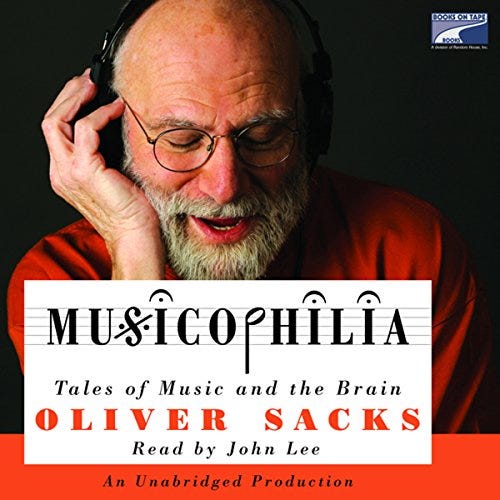
Chapter-by-Chapter Logical Analysis
Chapter 1: A Bolt from the Blue
Core Claim: Sudden musicophilia—an overwhelming passion for music—can emerge after neurological events like lightning strikes, temporal lobe surgery, or seizures, suggesting music appreciation has specific neural substrates that can be activated or released by brain changes.
Supporting Evidence:
Tony Cicoria: Lightning strike → near-death experience → sudden compulsion to hear/play piano music (previously indifferent to classical)
Salima M: Temporal lobe tumor removal → personality changes + intense music craving (previously “vaguely musical”)
Unnamed patient (Rohrer et al., 2006): Anti-seizure medication (lamotrigine) → abrupt music appreciation (previously actively disliked music)
Methodological Soundness:
Cicoria case: Neurological exams normal (EEG, MRI) but temporal gap (6-7 weeks) between event and musicophilia onset suggests delayed brain reorganization
Salima case: Right temporal lobe surgery → personality shift, but cannot isolate music from general emotional changes
Rohrer case: Drug intervention provides clearest temporal correlation, but mechanism (lamotrigine suppressing seizures → functional connectivity changes) remains speculative
Logical Gaps:
Causation vs. Correlation: Lightning strike caused cardiac arrest (cerebral anoxia) + possible direct electrical brain effects. Which mechanism produced musicophilia? Sacks acknowledges “we do not yet know.”
Delayed Onset Problem: Why 6-7 weeks between lightning strike and music obsession? Sacks speculates about “reorganization” but provides no mechanism.
Spiritual vs. Neurological: Cicoria interprets his experience spiritually (”music from heaven”). Sacks argues for neural basis but cannot explain what specifically changed in Cicoria’s brain.
Sample Size: Three cases (one detailed, two brief). No systematic study of lightning strike survivors or post-temporal lobectomy patients to establish base rates.
Unexamined Assumptions:
That musicophilia is a discrete phenomenon rather than part of broader personality/emotional changes
That delayed onset necessarily implies “reorganization” rather than psychological processing of trauma
That spiritual interpretations and neurological explanations are mutually exclusive
Chapter 2: A Strangely Familiar Feeling
Core Claim: Musical hallucinations can serve as auras (warning signs) for temporal lobe seizures, demonstrating music processing localizes to specific brain regions.
Supporting Evidence:
John S.: Heard classical violin music → lost consciousness → seizure. Music = consistent seizure trigger.
Eric Markowitz: Temporal lobe tumor → seizures with music “exploding” in head for ~2 minutes
Sylvia N.: Neapolitan songs reliably triggered seizures (could “run out” within 30 seconds)
Methodological Soundness:
Sylvia N. case strongest: Surgical removal of left temporal lobe lesion eliminated both spontaneous seizures AND music-triggered seizures → causal link confirmed
John S. and Eric M.: No identifiable lesions on imaging (common in temporal lobe epilepsy), relies on clinical diagnosis
Hughlings Jackson (1870s) concept of “doubling of consciousness” well-documented
Logical Gaps:
Familiarity Paradox: John S. and Eric M. both describe music as “hauntingly familiar” yet cannot identify it. Sacks presents this as mystery but doesn’t explain why seizure-generated music would feel familiar.
Music Specificity: Why does temporal lobe dysfunction produce music hallucinations specifically, not other complex auditory patterns?
Individual Variation: Sylvia N. only triggered by Neapolitan songs (emotional significance), others by any music. What determines specificity?
Unexamined Assumptions:
That “familiarity” sensation is perceptual rather than cognitive (could be illusion of recognition rather than actual memory)
That music heard during seizures represents stored memories rather than neural activity patterns interpreted as music
Chapter 3: Fear of Music
Core Claim: Musicogenic epilepsy exists—specific music types can trigger seizures in susceptible individuals—though mechanisms (sound quality vs. emotional association) remain unclear.
Supporting Evidence:
Critchley (1937): 11 patients with music-induced seizures, variable triggers (classical music, rhythm, specific instruments)
Nikonov (music critic): Eventually ANY music → convulsions, Wagner especially “noxious”
G.G. (herpes encephalitis patient): Emotional romantic music (especially Sinatra) → seizures
Methodological Soundness:
Critchley distinguished sound characteristics (deep brass tones) from emotional impact
G.G. case: Specific to music with “emotions, associations, nostalgia” from childhood/adolescence
Critchley suggested many “formes frustres” (aborted forms) go unreported—people simply avoid triggering music
Logical Gaps:
Mechanism Unknown: Is it acoustic properties (frequency, timbre) or emotional associations? Critchley couldn’t determine; neither can Sacks.
Base Rate Problem: How rare is musicogenic epilepsy actually? Critchley suggested “notably more common than supposed” but provided no systematic data.
Symptom Variability: Some patients have major convulsions, others brief absences, others complex temporal lobe experiences. What determines seizure type?
Unexamined Assumptions:
That music-triggered and spontaneous temporal lobe seizures share identical mechanisms
That avoiding music represents “aborted seizures” rather than mere discomfort
Chapter 4: Music on the Brain
Core Claim: Musical imagery is universal, highly varied in vividness across individuals, and neurologically distinct from other forms of mental imagery.
Supporting Evidence:
Sacks’s father: Could “hear” entire symphonies from scores, use as “bedtime reading”
Sacks himself: Pianist’s imagery—sees hands, feels playing when imagining Chopin
Zatorre et al. (1990s): fMRI shows imagining music activates auditory cortex nearly as strongly as hearing it
Pascual-Leone: Mental practice alone improves motor performance and changes cortex
Methodological Soundness:
Brain imaging confirms auditory and motor cortex activation during musical imagery
Mental practice effectiveness measured objectively (performance improvement)
Cross-validation: musicians report hearing instruments during mental practice
Logical Gaps:
Causation Direction: Does musical training enhance imagery ability, or do people with strong imagery become musicians?
Evolutionary Question Unanswered: Why is musical imagery so much richer than imagery for other common sounds (traffic, speech, cooking)?
Spontaneity Puzzle: Most musical imagery arrives unbidden. What triggers it? Sacks acknowledges “we are on much richer, much more mysterious terrain” but doesn’t explain the selection mechanism.
Unexamined Assumptions:
That voluntary and involuntary musical imagery use the same neural systems (may be distinct)
That richness of musical imagery necessarily reflects its importance (could be neural accident)
Chapter 5: Brainworms, Sticky Music, and Catchy Tunes
Core Claim: Repetitive musical fragments (”earworms”) represent pathological neural circuits—music trapped in loops—distinct from normal musical imagery.
Supporting Evidence:
Mark Twain (1876): “Punch, Brothers, Punch” jingle took “instant and entire possession”
Nick Younes: “Love and Marriage” → 10 days of incessant repetition
Rose R. (post-encephalitic): 14 notes of “Rigoletto” repeated for 43 years during “frozen states”
Methodological Soundness:
Characteristics match epileptic seizure focus: stereotyped, sudden onset, fadeaway pattern, reignition sensitivity
Comparison to visual afterimages: both represent persistent activation due to overstimulation
Modern ubiquity correlation: earworm complaints increased with constant music exposure (iPods, ambient music)
Logical Gaps:
Causation Unclear: What makes specific tunes “sticky”? Repetition? Melodic oddness? Emotional resonance? Sacks lists possibilities but proves none.
Normal-Pathological Boundary: When does normal “catchy tune” become pathological “brainworm”? No clear threshold.
Mechanism Unproven: Sacks compares to “tight neural circuit” and “seizure focus” but these are metaphors, not demonstrated mechanisms.
Modern Epidemic Claim: Assertion that earworms are “vastly more common now” lacks systematic historical comparison data.
Unexamined Assumptions:
That musical memory fidelity (preserving exact tempo, pitch) necessarily predisposes to earworms
That “defenseless engraving” is a vulnerability rather than an adaptive feature
That increased music exposure causally produces more earworms (could be increased awareness/reporting)
Chapter 6: Musical Hallucinations
Core Claim: Musical hallucinations are “release phenomena”—spontaneous brain activity when deprived of normal auditory input—not psychiatric symptoms.
Supporting Evidence:
Cheryl C.: Profound deafness + prednisone → loud Christmas carols, show tunes (EEG/MRI normal)
Dwight Mamlok: Mild deafness → music starting as plane drone, continuing after flight
Gordon B. (violinist): Progressive hearing loss → 24/7 musical “wallpaper,” sometimes creative variations
Konorski (1967): Theory of retro-efferent connections allowing backflow from cortex when afferent input reduced
Griffiths (2000): PET scans show musical hallucinations activate same networks as real music perception
Methodological Soundness:
Brain imaging validates Konorski’s 1967 prediction
Correlation: ~2% of hearing-impaired develop musical hallucinations, but neither age nor deafness alone sufficient
Medication trials documented: Gabapentin, Quetiapine with variable results
Logical Gaps:
Triggering Threshold Mystery: Why do only ~2% of deaf people hallucinate? What pushes someone “over threshold”?
Content Selection Unexplained: Why Christmas carols and show tunes? Sacks quotes Llinás on “random motor-pattern noise generator” but later contradicts this, arguing “importance of particular music” must play a role.
Treatment Inconsistency: Gabapentin helps some, not others. Cochlear implants eliminate hallucinations for some (Mrs. C.), not others. No predictive model.
Young Cases Unexplained: Michael B. (age 9) has constant hallucinations with no hearing loss. This contradicts “release” theory.
Unexamined Assumptions:
That hallucinations represent “playback” of stored music rather than novel constructions
That hearing loss is primary cause (but 1/5 of Sacks’s correspondents have normal hearing)
That distinction between “hallucination” and “very vivid imagery” is clear-cut
Chapter 7: Sense and Sensibility
Core Claim: Musicality comprises dissociable components (pitch perception, rhythm, emotional response, judgment) that can be selectively impaired or preserved.
Supporting Evidence:
Cordelia (Rebecca West novel): Perfect pitch + flexible fingers, but “greasy tone” and no musical taste
George (Somerset Maugham story): Passion + dedication, but fundamentally deficient ear
Tobias Picker (composer): Describes musicality as “congenital disorder” that controlled his life
Schlaug et al. (1995): Musicians’ brains show enlarged corpus callosum, asymmetric planum temporale
Pascual-Leone: Motor cortex changes within minutes of piano practice
Methodological Soundness:
Brain imaging confirms structural differences in musicians vs. non-musicians
Correlation with training age: earlier training → larger anatomical changes
Suzuki method demonstrates near-universal musical educability
Logical Gaps:
Nature vs. Nurture Unresolved: Are brain differences cause or consequence of musical training? Schlaug asks but cannot answer (no pre-training scans of musically gifted 4-year-olds).
Critical Period Question: Language has clear critical period. Music less so—but how much less? “Mozart Effect” disputed, but early training effects not quantified.
Picker’s “Disorder”: Is extreme musicality actually disabling, or is Picker being ironic? Sacks presents this uncritically.
Unexamined Assumptions:
That musical “gifts” and “disabilities” exist on a single dimension (could be orthogonal abilities)
That brain structure differences necessarily reflect functional differences
That Cordelia’s and George’s fictional cases accurately represent real neurological dissociations
Chapter 8: Things Fall Apart
Core Claim: Amusia (music deafness) exists in multiple forms—pitch discrimination, rhythm, melody recognition, timbre perception—each with distinct neural bases.
Supporting Evidence:
D.L. (76-year-old woman): Congenital inability to perceive music (hears “pots and pans”), but normal speech/sound recognition
Sacks’s own migraine amusia: Chopin ballad → “toneless banging with metallic reverberation”
Peretz et al. (2002): Congenital amusia study—11 subjects unable to distinguish adjacent tones/semitones
Rachel Y. (car accident): Lost harmonic integration—hears “four laser beams” instead of unified string quartet
Methodological Soundness:
Peretz battery distinguishes melody vs. rhythm deficits
Right hemisphere lesions typically impair melody; rhythm more distributed
Rachel Y.: Documented pre/post accident abilities, clear trauma-deficit link
Logical Gaps:
Timbre (Dystimbria) Underexplored: D.L. hears music as “pots and pans,” Sacks’s patient heard “screeching car,” but neural basis of timbre perception barely investigated compared to pitch.
Compensation Mechanisms: Rachel Y. developing visual strategies and new compositional methods shows adaptation, but mechanisms not explained.
Nabokov Mystery: Did he actually have amusia or was he being ironic? Sacks can’t determine from autobiography alone.
Unexamined Assumptions:
That congenital and acquired amusias share mechanisms (may be fundamentally different)
That inability to perceive music necessarily means inability to produce it (some amusics can sing accurately)
That music perception is unitary enough to be wholly absent (D.L. perceives rhythm in her body)
Chapter 9: Papa Blows His Nose in G
Core Claim: Absolute pitch is a distinct perceptual ability (hearing pitches as qualitatively different “colors”), influenced by both genetics and early tonal language exposure.
Supporting Evidence:
Mozart (age 5): Detected friend’s violin was “half a quarter of a tone flatter”
Deutsch et al. (2006): 60% of Chinese music students (tonal language) vs. 14% of US students developed absolute pitch with early training
Critical period: After age 8-9, absolute pitch acquisition rare even with training
Frank V. (brain injury): Lost absolute pitch, retained relative pitch via inference
Methodological Soundness:
Large-scale study comparing Eastman School vs. Beijing Conservatory students
Tonal language effect survives controlling for training age
Schlaug (1995): Absolute pitch correlates with planum temporale asymmetry
Blind musicians: 60% have absolute pitch (vs. ~10% sighted musicians)
Logical Gaps:
Retention Mystery: Why do most infants lose absolute pitch if it’s universal? Deutsch argues language development requires inhibiting it, but this is theoretical.
Genetic vs. Environmental: Chinese students’ advantage could be cultural emphasis on music training, not just tonal language. Study doesn’t fully isolate.
Blindness Connection: Why does early blindness preserve absolute pitch? Mechanism unclear.
Aging Shifts: Mark Damasek’s pitch perception shifted ~semitone upward. Cause unknown (basilar membrane? Hair cell stiffening?).
Unexamined Assumptions:
That absolute pitch is inherently useful to musicians (many great musicians lack it)
That tonal language directly causes absolute pitch retention (correlation ≠ causation)
That “critical period” for absolute pitch parallels language critical period
Chapter 10: Pitch Imperfect
Core Claim: Cochlear damage (hearing loss) can produce pitch distortions, but brain plasticity can partially compensate through attention, musical context, and intensive musical activity.
Supporting Evidence:
Jacob L. (composer, late 60s): Hearing loss → upper register sharp by quarter-tone to semitone
Audiogram correlation: Distortion matched hearing loss range (>2000 Hz)
Contextual correction: Isolated notes distorted, orchestral richness normalized perception
Three-year follow-up: Intensive composition/conducting → significant improvement
Methodological Soundness:
Distortion measured objectively via electronic synthesizer
Correlation: Isolated E-natural flattened (not in impaired range) suggests hair cell specificity
Norena & Eggermont (2005): Cats exposed to enriched acoustic environment after noise trauma showed less cortical distortion
Logical Gaps:
Improvement Mechanism: Jacob attributes recovery to “musical neurological calisthenics” but cannot specify what changed. Cortical remapping? Cochlear modulation via efferent nerves?
Day-to-Day Variability: Distortions varied unpredictably. What caused fluctuations?
Hearing Aid Paradox: Why didn’t hearing aids reduce distortions? They amplify missing frequencies but this didn’t help.
Unexamined Assumptions:
That brain can “retune” cochlear output (efferent control exists but extent of voluntary modulation unclear)
That musician’s superior imagery/memory necessarily aids compensation (could create conflict between expected and perceived pitch)
Chapter 11: In Living Stereo
Core Claim: Losing hearing in one ear eliminates true stereophony but brain adapts via “pseudo-stereo”—enhanced monaural cues, head movements, visual mapping, and memory.
Supporting Evidence:
Dr. Jorgensen (acoustic neuroma surgery): Right ear deaf → music “flat and two-dimensional,” later adapted
Howard Branson: Right ear sudden deafness → similar initial flatness, developed scanning head movements
E.O. Wilson (blind in one eye): Developed head-nodding strategy to get alternating perspectives
Methodological Soundness:
Comparison to visual stereoscopy loss (documented in Sacks’s “Stereo Sue”)
Acoustic engineering principles: reverberation provides monaural depth cues
Edelman’s “remembered present”: past experience supplements limited current input
Logical Gaps:
Adaptation Timeline: Jorgensen adapted in ~6 months. What changed neurologically? No imaging data.
Individual Variation: Why do some adapt well (Jorgensen, Branson) while others don’t? No predictor variables identified.
Cross-Modal Compensation: How much does vision contribute to reconstructed auditory space? Not quantified.
Unexamined Assumptions:
That “pseudo-stereo” actually restores rich emotional experience vs. cognitive accommodation to loss
That corpus callosum crossing of fibers (Jorgensen’s speculation) is plausible (evidence lacking)
Chapter 12: Two Thousand Operas
Core Claim: Musical savants demonstrate that music cognition is neurologically independent, can be preserved/enhanced despite severe intellectual disability.
Supporting Evidence:
Martin: Meningitis at age 3 → retarded, but knew 2000+ operas by heart, could transpose, improvise
Blind Tom (1860s): Slave with profound retardation, prodigious musical memory
Stephen Wiltshire: Visual savant also musical savant (absolute pitch, instant complex chord reproduction)
Darold Treffert: >1/3 musical savants are blind
Methodological Soundness:
Martin tested with scores—could not fault his memory or understanding of musical structure
Hermelin studies: Savant skills depend on recognizing musical rules/structures (not random)
Geschwind/Galaburda hypothesis: Left hemisphere damage → right hemisphere compensation
Logical Gaps:
Causation Multi-Determined: Martin had (a) musical father, (b) near-blindness until age 3, (c) meningitis. Which factor(s) caused savant abilities?
Hemispheric Shift Unproven: Theory that left damage → right enhancement plausible but not directly tested in savants.
TMS “Release” Studies: Snyder & Mitchell claim TMS to left temporal lobe releases savant abilities in normals, but only 5/17 subjects responded. Why?
Unexamined Assumptions:
That savant abilities are “released” rather than developed through obsessive practice
That all savants share a common mechanism (could be multiple routes)
That normal people have “suppressed” savant potentials (alternative: qualitative difference in brain structure)
Chapter 13: An Auditory World
Core Claim: Blindness, especially early blindness, predisposes to enhanced musicality through reallocation of visual cortex to auditory processing.
Supporting Evidence:
Ockelford studies: 40-60% of blind children have absolute pitch vs. ~10% sighted musicians
Hamilton/Pascual-Leone/Schlaug: 60% blind musicians have absolute pitch vs. 10% sighted
Jacques Lusseyran (blinded age 7): “Music is nourishment... made for blind people”
Gougoux et al.: Blind people detect pitch changes 10× faster than sighted controls (if blinded early)
Methodological Soundness:
Large sample studies (32 families with septo-optic dysplasia)
Correlation with blindness degree: Profound blindness → musical ability; partial sight → less enhancement
Brain imaging: Nadine Gaab—blind musician shows visual cortex activation during music listening
Cross-validated: Multiple independent studies reach same conclusion
Logical Gaps:
Mechanism Underspecified: Visual cortex reallocation demonstrated, but how does this enhance musical ability specifically? More processing power? Different processing style?
Critical Period: Why 10-fold improvement only if blinded early? What neural development is foreclosed by later blindness?
Causation vs. Selection: Do blind people become musicians because of enhanced ability, or does intensive music focus (compensating for lost vision) drive ability?
Unexamined Assumptions:
That visual cortex reallocation necessarily improves auditory processing (could just be different, not better)
That all blind musicians experience similar neural reorganization
Chapter 14: The Key of Clear Green
Core Claim: Synesthesia (experiencing colors with music) is a genuine neurological phenomenon based on cross-activation between sensory cortical areas, likely from retained fetal neural connections.
Supporting Evidence:
Michael Torkey (composer): Fixed color-key associations (D major = blue) since childhood, impossible to change
David Caldwell (composer): Different color associations but equally integral to composition
Ramachandran/Hubbard (2001): Synesthetes can instantly pick out 2s from 5s by color (objective test)
fMRI: Color areas activate when synesthetes hear music
Daphne Maurer: Behavioral evidence suggests infant senses are “intermingled in synesthetic confusion”
Methodological Soundness:
Objective testing distinguishes true from pseudo-synesthesia
Consistency over time: Torkey’s associations unchanged for 40+ years
Galton (1883) → 1990s neglect → current revival with imaging validation
Simner/Ward: 1 in 23 people have some synesthesia (much higher than previous 1 in 2000 estimate)
Logical Gaps:
Pruning Theory Unproven: Hypothesis that fetal hyperconnectivity is normally pruned but persists in synesthetes lacks direct anatomical evidence in humans.
Acquired Synesthesia: Blindness can cause synesthesia rapidly (Jacques Lusseyran), suggesting release phenomenon, not retained connections. Two different mechanisms?
Individual Variation: Why does Torkey have key-color, Caldwell has mood-color, others have interval-taste? What determines synesthesia type?
Childhood Prevalence: Stanley Hall (1883) reported 40% of children have music-color synesthesia. If most lose it at adolescence, why? Hormones? Brain reorganization? Abstract thinking development?
Unexamined Assumptions:
That synesthesia is binary (have it or don’t) rather than a spectrum
That all synesthesia types share a common mechanism (hyperconnectivity)
That synesthesia necessarily enhances musical experience (Torkey says “no big deal”)
Chapter 15: In the Moment
Core Claim: Clive Wearing’s profound amnesia spares musical performance, demonstrating that musical memory is procedural (implicit), not episodic (explicit), and exists wholly “in the present.”
Supporting Evidence:
Clive: Herpes encephalitis destroyed hippocampi → <10 second memory span, but retained ability to conduct choir, play organ, read/perform music
H.M. (Scoville & Milner, 1957): Bilateral hippocampus removal → amnesia but intact procedural learning
Zuckerkandl: “Hearing melody is hearing, having heard, and being about to hear, all at once”
Umberto Eco (The Mysterious Flame of Queen Loana): “Throat memory” allows singing without explicit memory
Methodological Soundness:
Explicit vs. procedural memory distinction well-established in neuroscience
Clive’s abilities documented over 20+ years
Jonathan Miller’s BBC film provides visual evidence of conducting competence
Larry Squire: Emphasizes no two amnesias are identical (different damage patterns)
Logical Gaps:
Performance vs. Skill: Can Clive’s conducting—sensitive, interpretive, emotionally appropriate—be “merely” procedural? Sacks questions whether “artistic performance” reduces to “fixed action patterns.”
Learning Impossibility: Clive cannot learn new music without external direction. This suggests procedural memory alone insufficient for musicianship.
Semantic Memory Role: Clive retained some composer names (Handle, Bach, Beethoven, Berg, Mozart, Lassus) but not others. Why these six?
Deborah Recognition Mystery: Clive instantly recognizes wife (emotional memory?) but cannot describe her appearance. Mechanism unexplained beyond speculation about limbic system.
Unexamined Assumptions:
That procedural memory is “automatic” (but it requires conscious acquisition through practice)
That music exists “entirely in the present” (but anticipation of future notes is crucial to perception)
That emotional memory is entirely separate from episodic memory (may overlap)
Chapter 16: Speech and Song
Core Claim: Melodic intonation therapy can restore speech in non-fluent aphasia by engaging right hemisphere and suppressing pathological left-hemisphere hyperactivity.
Supporting Evidence:
Samuel S.: 2 years speechless after stroke → music therapy → could sing lyrics → began short speech
Albert et al. (1973): Melodic intonation therapy patient vocabulary 0 → 100 words in 2 weeks
Belin et al. (1996): PET scans show right Broca’s area hyperactivity in aphasia inhibits damaged left Broca’s
Schlaug: 75 sessions melodic intonation → significant speech improvement + right hemisphere network changes
Methodological Soundness:
Brain imaging confirms right hemisphere hyperactivity theory
Behavioral improvements objectively measured (vocabulary count, phrase complexity)
Changes persist months after therapy ends
Comparison to TMS (Paula Martin): Suppressing right Broca’s via magnetic stimulation also helps
Logical Gaps:
Carryover Limitation: Patients can sing phrases but often cannot achieve full propositional speech. Why does automatism not transfer?
Individual Response Variation: Some patients achieve narrative speech, others limited to formulaic responses. Predictor variables unknown.
Mechanism Debate: Original theory (activating right hemisphere language potential) contradicted by later imaging (suppressing right hemisphere pathological activity). Which is correct? Both?
Unexamined Assumptions:
That right hemisphere has latent language capacity (vs. music simply reducing pathological inhibition)
That singing and speech recovery use same mechanisms in all aphasia types
That therapist relationship is essential (claimed but not tested vs. recorded music)
Chapter 17: Accidental Davening
Core Claim: Movement disorders can acquire rhythmic/musical characteristics, suggesting deep links between motor systems and musical patterns.
Supporting Evidence:
Solomon R.: Dyskinesia (rhythmic body bowing + forced exhalations) → acquired sing-song prosody → Hebrew words → cantillation-like prayer
Methodological Soundness:
Single case observation
Pattern evolution documented over weeks
Comparison to intentional davening (rabbi’s rhythmic prayer) shows similarity
Logical Gaps:
Causation Direction: Did dyskinesia rhythm → melody → words, or did brain seek familiar pattern (cantillation) to organize dyskinesia?
Hebrew Words: “Plucked out of the air” but were they random or did they follow some grammatical/liturgical pattern?
Satisfaction Mechanism: Why did this automatism give “deep satisfaction” when patient wasn’t originally religious?
Unexamined Assumptions:
That rhythm necessarily leads to melody (could be independent)
That patient’s “satisfaction” was genuine vs. confabulation
Chapter 18: Come Together
Core Claim: Music can either suppress or exacerbate Tourette’s tics, and some Tourettic musicians channel explosive energy creatively.
Supporting Evidence:
John S.: Music can stop tics or increase them (depends on music type—rhythm-heavy worsens)
Ray G. (jazz drummer): Tics initiate drum solos, explosive energy channeled creatively
Nick Van Bloss: Piano playing nearly eliminates tics (touching keys satisfies compulsion)
Tobias Picker: Tourette’s enters composition but shaped/controlled by musical structure
Methodological Soundness:
Multiple independent reports (letters, direct observation)
Matt Giordano’s drum circle: Observed 30+ Tourettics synchronize, tics disappear within seconds
Picker and Van Bloss both report same phenomenon despite different music types
Logical Gaps:
Mechanism Unknown: Why does music suppress tics? Energy redirection? Attention focus? Neural pathway competition?
Music Type Specificity: Why does rhythm-heavy music worsen John S.’s tics but help Ray G.? Individual variation not explained.
Touch Hypothesis: Van Bloss attributes suppression to satisfying touch compulsion, but tics also stop when he’s NOT touching (e.g., Picker composing at computer).
Unexamined Assumptions:
That Tourette’s “energy” is a meaningful construct (vs. neural firing patterns)
That tic suppression during music is always complete (Van Bloss shows “mild facial grimacing”)
That creative channeling is unique to Tourettic musicians (could occur in non-musical Tourettics)
Chapter 19: Keeping Time
Core Claim: Rhythm is fundamental to human musicality and movement, serving mnemonic, organizational, and social bonding functions with no animal parallel.
Supporting Evidence:
Sacks (mountain accident): Rowing song → synchronized movement → successful descent
Sacks (hospital): Mendelssohn imagery → walking ability restored
Elderly woman (hip fracture): Couldn’t walk until Irish jig → leg “kept time by itself”
Aniruddh Patel (2006): No animal can synchronize movement to auditory beat (Thai elephants play independently)
Chen/Zatorre/Penhune: Listening to/imagining music activates motor cortex
Methodological Soundness:
fMRI confirms auditory-motor integration unique to humans
Patel’s elephant study carefully measured (video + timing analysis)
Cross-cultural universality: All cultures have rhythmic music
Merlin Donald’s mimetic culture theory provides evolutionary framework
Logical Gaps:
Animal Synchronization: Patel says “not a single report” but then discusses Thai elephants. Are they exception or are they responding to trainer cues? Study doesn’t fully resolve.
Rhythm vs. Melody: Sacks’s mountain descent used song (melody + rhythm). Which was essential? He speculates both but doesn’t test.
Mnemonic Mechanism: How does rhythm enable memory? Chapter demonstrates effect but not mechanism.
Evolution Speculation: Darwin vs. Spencer vs. Rousseau vs. Mithen—Sacks presents theories but admits “little evidence as yet.”
Unexamined Assumptions:
That internal rhythm/music during Sacks’s recovery was necessary vs. coincidental
That rhythm’s binding power in groups necessarily has neural basis (could be cultural)
That music evolved (vs. being byproduct of language, as Pinker argues)
Chapter 20: Kinetic Melody
Core Claim: Music provides external rhythm/structure that substitutes for damaged basal ganglia in Parkinsonism, restoring fluent movement while music lasts.
Supporting Evidence:
Post-encephalitic patients (1960s): Frozen motionless, but could dance/sing fluently with music
Francis D.: “Human time bomb” when silent → graceful dancing with legato music
Rosalie B.: Transfixed with finger stuck to glasses → played piano fluently, EEG normalized
Edith T.: “Un-musiced” by Parkinsonism → music restored “own living tune”
Methodological Soundness:
Observed in ~80 post-encephalitic patients over decades
Kitty Stiles (music therapist): Documented consistent responses
Lucas Foss (Parkinsonian composer): Observed rocketing to piano → exquisite control while playing → fasciculation when finished
Nietzsche’s formulation: Music as “dynamic/propulsive” force
Logical Gaps:
No Carryover: Music’s effect disappears instantly when music stops. Why no training/learning effect?
Individual Music Specificity: Francis D. needed legato (staccato worsened symptoms). What determines right music for each patient?
Metaphor vs. Mechanism: “Auditory dopamine” and “prosthesis for basal ganglia” are vivid but explain nothing about actual neural process.
Unexamined Assumptions:
That music “substitutes” for basal ganglia (vs. providing external timing signal brain can entrain to)
That all Parkinsonian patients respond similarly (Sacks shows variation but doesn’t explain it)
Chapter 21: Phantom Fingers
Core Claim: Phantom limbs are neurological—persistent brain representations of missing limbs—not psychological grief reactions.
Supporting Evidence:
Paul Wittgenstein: Felt “every finger of right hand” decades after amputation, used phantom to determine piano fingering
Silas Weir Mitchell (1866-1872): Documented phantom limbs in Civil War amputees, showed motor commands activate stump muscles
Hamsaeee et al. (2001): Post-amputation cortical reorganization—stump area enlarged and hyperexcitable
Methodological Soundness:
Weir Mitchell proved physiological basis 150+ years ago via stump muscle observation
Modern fMRI confirms sensory-motor cortex activation during phantom movements
Phantom presence universal in amputees (not psychological rarity)
Logical Gaps:
Pain Problem: Why are some phantoms painful, especially if limb was painful pre-amputation? Neural representation should be of limb, not pain.
Bionic Limb Success: Engineers developing prosthetics controlled by phantom movements, but success rates/limitations not discussed.
Wittgenstein Philosophy: Did Ludwig’s “On Certainty” actually reference Paul’s phantom hand? Sacks speculates but provides no textual evidence.
Unexamined Assumptions:
That phantom sensations accurately represent pre-amputation limb experience
That phantom use in piano fingering was effective (not tested)
Chapter 22: Athletes of the Small Muscles
Core Claim: Musicians’ dystonia results from sensory cortex degradation (finger representations fuse) creating vicious cycle with motor output, treatable via sensory retraining or Botox.
Supporting Evidence:
Leon Fleisher: 4th/5th fingers curled under (1963) → 30 years one-handed → Rolfing + Botox → two-handed playing restored
Italian violinist letter: Middle finger → 4th/5th fingers progressively affected
Gowers (1888): Described “occupation neuroses” in writers, musicians, detailed Victorian cases
Hallett’s group: Dystonic finger representations enlarged, overlapped, de-differentiated in sensory cortex
Methodological Soundness:
Sensory cortex mapping shows anatomical changes
Treatment outcomes documented (Fleisher’s return to two-handed performance)
Animal models (Merzenich): Can experimentally induce dystonia-like cortical changes in monkeys
Candia et al.: Sensory retraining can reverse cortical changes
Logical Gaps:
Genetic Predisposition: Cortical changes on normal side suggest genetic vulnerability, but no genetic studies cited.
Biomechanical Factors: Wilson mentions hand shape/positioning may contribute, but this isn’t investigated systematically.
Treatment Success Variation: Why does Botox help some (Fleisher) but not others? Dose calibration alone can’t explain all failures.
Prevention: If rapid repetitive movements cause dystonia, why don’t all professional musicians develop it? Only ~1% affected.
Unexamined Assumptions:
That sensory degradation is primary (could be motor system initiating problem)
That “unlearning” is actually occurring vs. building new pathways around damaged ones
That Fleisher’s recovery is stable (he remains on Rolfing + Botox, suggests fragility)
Chapter 23: Awake and Asleep
Core Claim: Musical dreams and hypnopompic hallucinations can be compositionally productive, representing unconscious creative work.
Supporting Evidence:
Sacks (1974): Dreamed Mahler’s Kindertotenlieder after resigning job + burning manuscript → music disappeared when dream interpreted
Sacks (1974): Hypnopompic Mendelssohn hallucination (tape recorder off but music continued until touched)
Wagner: Rheingold overture came in “somnolent state,” felt like “sinking in swiftly flowing water”
Berlioz: Dreamed complete symphony first movement, deliberately forgot it for financial reasons
Methodological Soundness:
Sacks’s Mahler dream: Alvin Fox identified music from humming → verified psychological connection
Hypnopompic states well-characterized neurologically
Multiple composers report similar experiences (Wagner, Ravel, Stravinsky)
Logical Gaps:
Supersaturation Theory: Why did repetitive Mendelssohn exposure cause hypnopompic hallucination but not dreams? Mechanism?
Creative vs. Reproductive: Wagner and Berlioz claim compositional productivity from dreams/twilight states. Were these truly novel compositions or recombinations of existing patterns?
Interpretation Effect: When Fox identified Mahler, music stopped. Placebo effect? Suggestion? Or genuine psychological resolution?
Unexamined Assumptions:
That hypnopompic hallucinations are distinct from “very vivid imagery” (boundary unclear)
That dream music is compositionally useful (Berlioz forgot his symphony—was it actually good?)
That chloral hydrate (drug Sacks was taking) played causal role (mentioned but not explored)
Chapter 24: Seduction and Indifference
Core Claim: Musical emotion and musical perception are neurologically dissociable—one can perceive music structure but feel nothing, or vice versa.
Supporting Evidence:
Dr. Friedman (concussion): Lost emotional response to music for weeks, perception intact
Timothy Griffiths patient: Stroke → lost emotional response to Rachmaninoff but hearing/discrimination normal
Peretz: Patients with severe amusia still enjoyed music emotionally
Temple Grandin: Appreciates Bach’s structure (”ingenious”) but no emotional response
Methodological Soundness:
Dissociation demonstrated in both directions (emotion without perception, perception without emotion)
Peretz patient I.R.: Temporal lobe damage → couldn’t recognize melodies but emotional responses intact
Blood & Zatorre (2001): Emotional response involves extensive network (cortical + subcortical)
Logical Gaps:
Right Hemisphere Role: Emotional loss more common with right hemisphere damage, but network is bilateral. Which structures are critical?
Recovery Timeline: Dr. Friedman recovered emotional response in weeks. What changed? No follow-up imaging.
Asperger’s/Autism: Temple Grandin’s indifference—is this music-specific or part of general emotional flattening? Sacks presents it as music-specific but evidence is ambiguous.
Freud’s “Resistance”: Was Freud amusic, or did he intellectually resist music’s emotional power? Sacks labels it “resistance” but can’t prove this over amusia.
Unexamined Assumptions:
That emotional indifference is neurological rather than psychological (could be defense mechanism)
That structural appreciation and emotional response are truly independent (may normally be tightly coupled)
Chapter 25: Lamentations
Core Claim: Specific music can pierce emotional numbness (depression, grief) when nothing else can, suggesting music accesses emotion via distinct pathways.
Supporting Evidence:
John Stuart Mill: Depression/anhedonia → only music provided pleasure
William Styron: Near-suicide, numb to all pleasure → Brahms Alto Rhapsody “pierced heart like dagger”
Sacks (aunt’s death): Emotional numbness → Zelenka’s Lamentations → tears, feelings returned
Wendy Lesser: Grief → Brahms Requiem released frozen emotions
Methodological Soundness:
Multiple independent accounts of same phenomenon
Specificity: Sacks could enjoy Schubert from basement window, but Fischer-Dieskau concert days later felt “utterly flat” (suggesting state-dependent response, not music quality)
Logical Gaps:
Selection Mystery: Why Zelenka for Sacks, Brahms for Styron/Lesser? Is it the music’s character (Lamentations, Requiem) or coincidental?
Demand Paradox: Sacks went to Fischer-Dieskau hoping music would help → didn’t work. Is emotional piercing necessarily spontaneous?
Mechanism: How does music bypass emotional numbness? Distinct neural pathway? Overwhelming stimulus? Resonance with frozen feeling?
Unexamined Assumptions:
That music “pierced” emotions vs. emotions already thawing (temporal coincidence)
That Lamentations/Requiem genre is essential (vs. any sufficiently moving music)
That anhedonia and grief-numbness share same mechanisms
Chapter 26: The Case of Harry S.
Core Claim: Frontal lobe damage can destroy emotional responsiveness generally but spare musical emotion, suggesting music activates emotional systems directly.
Supporting Evidence:
Harry S.: Frontal lobe hemorrhage → emotionally flat, indifferent, inert
BUT: When singing Irish songs → showed appropriate emotions (jovial, wistful, tragic)
Similar observations: Stephen Wiltshire (autistic) transformed by music
Methodological Soundness:
Observation over 30 years
Consistent pattern: singing animated Harry, silence returned him to flatness
Frontal lobe damage + emotional deficit well-established syndrome
Logical Gaps:
Genuine vs. Mimicry: Elkhonon Goldberg questioned whether Harry’s emotions were real or automatic imitation. Sacks believes real but cannot prove it.
Access vs. Expression: Does music give Harry ACCESS to emotions or just behavioral expressions without internal experience?
Stephen Wiltshire: Same question—was he genuinely moved by music or performing emotional behaviors?
Unexamined Assumptions:
That singing-triggered emotions are qualitatively same as normal emotions
That inability to show emotion except when singing proves music’s special power (alternative: singing is last remaining trigger)
Chapter 27: Irrepressible
Core Claim: Frontotemporal dementia can release musical abilities by damaging left temporal lobe, disinhibiting right hemisphere perceptual functions.
Supporting Evidence:
Vera B.: Non-musical elderly woman → progressive disinhibition + constant singing (German Christmas songs, Yiddish, polyglot)
Louis F.: Semantic dementia → sang constantly, couldn’t define “ocean” but sang “My Bonnie” perfectly
Miller et al. (2000): Patient began composing classical music at age 68 (minimal prior training)
Ravel: Frontotemporal dementia → lost ability to notate music but mind “teeming with patterns”
Methodological Soundness:
Bruce Miller’s systematic study: Multiple patients with left temporal damage → artistic/musical emergence
Brain imaging: Left temporal degeneration → right hemisphere compensation
Pattern consistent with Hughlings Jackson’s 19th-century “release phenomena” concept
Logical Gaps:
Specificity: Why music/art release, not math or spatial abilities? Right hemisphere has many functions.
Quality Question: Miller’s patient’s compositions “publicly performed” but were they objectively good or charitably received?
Ravel’s Bolero: Was repetitive structure early sign of dementia or just Ravel’s style? Sacks speculates but cannot prove.
Vera vs. Louis: Vera had frontal damage (disinhibition), Louis less so. What determines whether musical release is creative (composing) vs. repetitive (singing)?
Unexamined Assumptions:
That released abilities were truly latent (vs. novel constructions)
That all frontotemporal dementia patients with left temporal damage show musical emergence (selection bias—only dramatic cases reported)
That Bolero composition timing proves anything about Ravel’s mental state (one data point)
Chapter 28: A Hypermusical Species
Core Claim: Williams syndrome demonstrates music cognition is genetically specified, independent of general intelligence, through 15-25 gene microdeletion on chromosome.
Supporting Evidence:
Gloria Lenhoff: IQ <50 but sings operatic arias in 30+ languages, 2000-song repertoire
Virtually all Williams syndrome individuals: Hypermusical, hypersocial, narrative-focused despite intellectual disability
Brain imaging: Temporal lobes normal/supernormal size, parietal/occipital underdeveloped (20% smaller brains)
Genetic: Microdeletion of 15-25 genes → all Williams features (cardiac, facial, cognitive profile)
Levitin/Belugi: Williams individuals use wider neural networks for music (cerebellum, brainstem, amygdala)
Methodological Soundness:
Large population studies (Williams camp, Montefiore clinic)
Genetic basis precisely identified
Brain structure correlates with cognitive profile (visual-spatial deficits ↔ parietal/occipital underdevelopment)
Extensive amygdala activation explains “almost helpless attraction” to music
Logical Gaps:
Skills vs. Talent: Not all Williams individuals are talented (Pamela sang off-key), but all love music. What’s the genetic basis of passion vs. ability?
Gene Function: Know which 15-25 genes deleted, but NOT how deletion produces musical gifts (only deficits explained).
Compensation vs. Direct Effect: Are musical abilities spared, compensatory, or directly caused by gene deletion? Chapter admits “not even certain.”
Individual Variation: Heidi developed from stereotyped Williams child to distinct young woman. How does experience shape genetic predisposition?
Unexamined Assumptions:
That Williams musicality is qualitatively different from normal (could be extreme of normal distribution)
That genetic deletion is whole story (environment/experience clearly matter—Heidi’s case)
That opposite of autism claim (Williams vs. severe autism) is meaningful (may be superficial)
Chapter 29: Music and Identity
Core Claim: Musical memory survives profound dementia (Alzheimer’s) because it uses robust, distributed neural networks, preserving identity even as other faculties collapse.
Supporting Evidence:
Woody Geist: Alzheimer’s (can’t tie tie, gets lost) → sang perfectly, remembered all parts/words
Clive Wearing: Profound amnesia but musical performance completely intact
Nietzsche: Mute, demented, paralyzed (neurosyphilis) → continued piano improvisation
Eminent pianist (88, language lost): Played Mozart perfectly, “recent playing even more” than earlier recordings
Methodological Soundness:
Documented cases over years (Woody: 13 years; Sacks’s patients: decades)
Music therapy outcomes: Group sessions transform torpid/agitated patients → attentive, singing, bonding
Contrast with Parkinsonism: Dementia patients show persistent improvement (hours/days after music)
Logical Gaps:
Carryover Mechanism: Why do mood/behavior improvements persist after music ends (unlike Parkinsonism)? Neural mechanism unknown.
Mnemonic Failure: Mary Ellen tried embedding shopping lists in songs → failed. Why can’t procedural musical memory transfer to explicit knowledge?
Identity Preservation: Woody retained civility, courtesy, character. Is this “deeply ingrained” or just behavioral residue without meaning? Sacks and daughter disagree.
Neural Robustness: Why is musical memory so robust? Distributed networks explains resilience but not why music specifically (vs. other distributed systems).
Unexamined Assumptions:
That musical performance in dementia represents preserved “self” vs. automatic behaviors
That emotional responses during music are genuine (vs. mimicry/trained responses)
That music therapy’s benefits are specific to music (vs. any engaging, structured activity)
SYNTHESIS: Overarching Logical Structure
What Sacks Actually Proves:
Neurological Reality of Musical Experience: Music is not mere entertainment—it has measurable neural correlates (fMRI, PET scans validate subjective experiences)
Dissociability: Musical abilities are modular:
Perception (pitch, rhythm, timbre, melody, harmony) can be selectively impaired
Emotion and cognition can dissociate
Procedural and episodic musical memory are separate
Therapeutic Power: Music can:
Restore movement in Parkinsonism (while music lasts)
Facilitate speech in aphasia (through melodic intonation)
Preserve identity in dementia (robust memory systems)
Organize action in amnesia/frontal lobe damage (narrative/mnemonic function)
Plasticity: Brain adapts to musical training, damage, sensory loss:
Musicians develop enlarged brain structures
Blind individuals reallocate visual cortex to auditory processing
One-ear deafness → pseudo-stereo via compensatory mechanisms
Focal dystonia can sometimes be reversed via retraining
What Sacks Does NOT Prove:
Mechanisms: Almost every chapter ends with “we do not yet know.” The how of music’s power remains mysterious:
Why does music activate emotion when nothing else can?
What causes delayed-onset musicophilia?
How does rhythm entrain movement?
Why does melodic intonation restore speech?
Causation: Correlation vs. causation repeatedly conflated:
Absolute pitch correlates with tonal languages—but does language cause pitch retention or are both products of cultural music emphasis?
Brain structure differences in musicians—training effect or selection of pre-existing differences?
Musical hallucinations and hearing loss—but why only 2% of deaf people?
Individual Variation: Why do similar injuries produce different outcomes?
Some stroke patients develop musicophilia, others indifference
Some Parkinsonian patients respond to music, others don’t (or only to specific music)
Botox helps some dystonia patients, not others
Evolutionary Origins: Darwin vs. Spencer vs. Rousseau vs. Mithin vs. Pinker—theories presented but none proven. Music’s evolutionary function remains speculative.
Recurring Methodological Weaknesses:
Small Samples: Most chapters rely on 1-5 cases. Systematic studies rare.
Anecdote as Evidence: Letters from correspondents treated as data without verification.
Metaphor Substituting for Mechanism: “Auditory dopamine,” “prosthesis for basal ganglia,” “rope from heaven”—vivid but explain nothing.
Theoretical Contradictions Unresolved:
Llinás: Musical hallucinations are “random, without emotional counterpart”
Rangel: Musical hallucinations are deeply meaningful, emotionally driven
Sacks presents both without reconciling them.
Selection Bias: Sacks sees neurological patients + receives letters from people with unusual experiences. Missing: systematic population studies.
The Central Tension:
Sacks wants to prove music is neurologically real AND emotionally/spiritually meaningful. These goals sometimes conflict:
When patients attribute experiences to divine inspiration (Cicoria’s “music from heaven”), Sacks insists on neural basis
When neural reductionism threatens meaning (is Clive’s singing “merely procedural”?), Sacks argues for preserved selfhood
He resolves this by asserting both are true, but logical connection remains unclear
The Honest Limit:
The book’s most intellectually honest moment comes in the Preface, quoting the alien Overlords: They “cannot think what goes on in human beings when they make or listen to music.”
Despite 29 chapters of neurological investigation, Sacks essentially admits: We still don’t know.
The book succeeds at demonstrating music’s neural reality and documenting its power. It fails—necessarily, given current neuroscience—at explaining why music has this power.
Tags: neuroscience of music, musical hallucinations clinical cases, amusia and brain lesions, musical memory in dementia, musicophilia neurological mechanisms