

Complete Project Overview — Humans + AI + Music
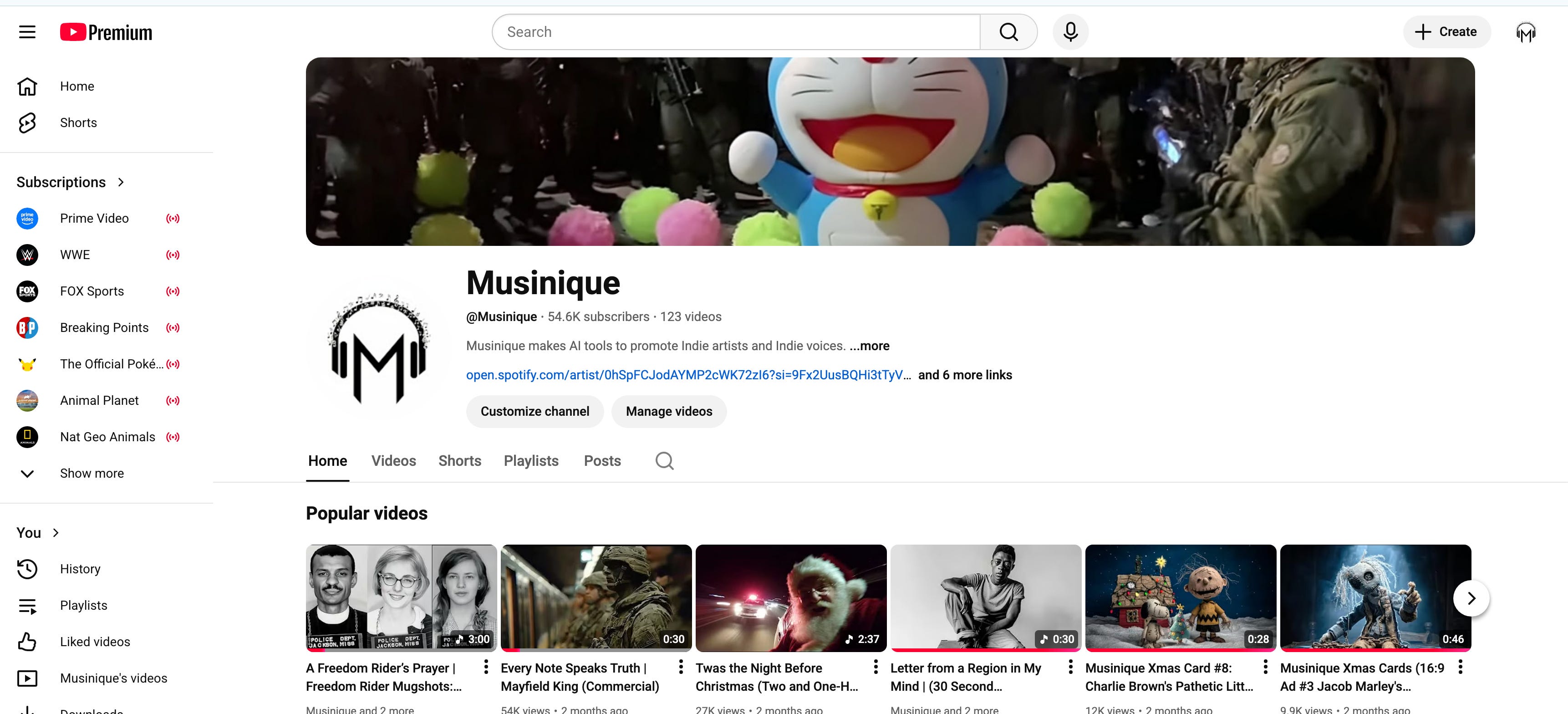
Founded: November 2024 Location: United States Contact: bear@bearbrown.co Website: musinique.com YouTube: @Musinique — 54,691 subscribers · 6.1M views · 123 videos Platforms: Spotify · Apple Music
The Mission
Great music is humans plus AI — not AI alone.
Musinique LLC builds tools for indie musicians, poets, and songwriters to be more creative and productive, operates a record label and publishing company for independent thought and art, and produces educational music for Humanitarians AI, a 501(c)(3) nonprofit. The company’s protest music catalog reflects a core belief: compassion, not hate, is the more powerful engine for change — and music is its most direct delivery system.
The company operates at the intersection of three convictions that most industry actors treat as separate:
The platform is not your friend. Streaming services charge artists to get on playlists rather than adding them based on honest response to their music. Algorithms manufacture the appearance of meritocracy while rewarding pay-to-play. Ghost artists fill playlists with engagement-optimized audio wallpaper that dilutes royalty pools and displaces independent voices. Musinique documents this, builds tools to navigate it, and refuses to participate in it.
Music is a neurological technology. Songs engineered from research — the right tempo, phonemic structure, narrative arc, cultural specificity — produce measurable effects on developing brains, stressed bodies, grieving hearts, and focused minds. The fifty years of educational multimedia research that validated Sesame Street’s effectiveness at $5 per child per year applies directly to contemporary AI music tools that can achieve equivalent production values for $5 total. This cost collapse is not incremental — it is the elimination of the economic barrier that kept music’s therapeutic and educational potential locked inside institutions.
AI should amplify human purpose, not replace it. The tools that Spotify uses to manufacture ghost artist content can be pointed at a family who wants their grandmother’s lullaby back, at a son who needs to hear his dead father’s voice sing the theology that made him an unarmed medic on a battlefield, at a protest movement that needs its anthem. The difference is not the tools. It is who controls the intent.
The Artist Constellation
Musinique is home to a family of ghost artists — AI-augmented vocal personas, each inhabiting a specific genre, cultural tradition, and emotional register. All of them begin in one place: the voice of Nik Bear Brown, Associate Teaching Professor of AI at Northeastern University, resident poet, and the human at the center of every machine that bears his company’s name.
The Source Voice
Nik Bear Brown — deep warm baritone, spoken word poet, protest songwriter. The source instrument from which the constellation extends. PhD from UCLA, postdoctoral work in Computational Neurology at Harvard Medical School. Sets public domain poems to music. Writes protest songs. Reads Baldwin. Records laments in Persian for people dying behind an internet blackout. 6.1 million YouTube views and counting.
Top videos: “Kingdom Must Come Down, No Kings” (Remastered) — 1.2M views · 46,573 likes. “’Twas the Night Before Christmas” — 1.8M views. “Musinique Sessions: Reawakening Lift Every Voice and Sing” — 45,837 views · 2,325 likes. “Blessed the Broken (Matthew 5:3-12) | For William Newton Brown” — 145,287 views · 5,187 likes.
The Persona Family
Mayfield King — Conscious soul / protest funk. Three-to-four octave range. Named for the Curtis Mayfield tradition: the falsetto that argues with power, the orchestral arrangement as political imagination. Kingdom Must Come Down, No Kings. No More. Boogeyman. Frogs Don’t Ask for No King. Lift Every Voice. Spotify · Apple Music
Newton Williams Brown — Country gospel / sacred folk. William Newton Brown’s voice, reconstructed from family archive recordings and extended through voice synthesis into three-to-four octaves of devotional song. The father’s voice, singing the theology that took him unarmed onto battlefields. Matthew 5:3-12. Away in a Manger. Dreadful Sorry Clementine. Joy to the World. Spotify · Apple Music
Liam Bear Brown — Gospel blues / roots americana / psychedelic blues. A blend of father and son — William Newton Brown and Nik Bear Brown share the name William, share a voice so similar that people who knew William go quiet when Nik answers the phone. Liam is that voice extended into every tradition of faith either man ever wrestled with. Psalm 19. Ecclesiastes 11:1. Go Down Moses. Be Thou My Vision. The Price of Eggs. Spotify · Apple Music
Tuzi Brown — Soul-jazz / blues-folk / downtempo. Billie Holiday’s inheritance carried forward: smoky fragile alto, behind-the-beat phrasing, the voice that trembles without breaking. Bella Ciao. Mon Homme. A Freedom Rider’s Prayer. Spotify · Apple Music
Parvati Patel Brown — Indie pop / psychedelic soul / devotional folk. Warm luminous soprano. The South Asian name in the family of Brown voices, carrying liberation spirituals and Punjabi lamp-prayers with equal devotion. Jyot Diva. Walkin’ Into the Light. I’m Gonna Study War No More. Mary Don’t You Weep. Spotify · Apple Music
Dijit Arjun Bear Brown — Punjabi rap / qawwali trap / South Asian folk fusion. 140 BPM. Tabla, dholak, dhol, tanpura drone, and 808 bass in the same production. The warrior who brought the dhol. Vari Vari (ਵਾਰੀ ਵਾਰੀ) — 131,067 views. Surpanakha Likh Gayi Diary. Spotify · Apple Music
Marley Bear Brown — Roots reggae / genre-fluid / lo-fi global. Named for Bob. The whirlwind: reggae and EDM and kunqu and dancehall philosophy and Gödel’s incompleteness theorems in the same catalog. Di Whirlwind. Come to Springfield. Gödel Unprovable Truths. Spotify · Apple Music
Prarthana Maha Brown — Country folk / gospel Americana. The great prayer: Sanskrit name, Appalachian alto, silvery haunting vibrato. Sacred texts made immediate. Isaiah 35. Ain’t That Good News. Joshua 4 Crossing Place. Spotify · Apple Music
Aditi Banksy — Post-punk / polyglot spoken word / protest soul. Hindi, French, Punjabi, English, Portuguese. Three-to-four octaves. The voice on the wall. Named for the boundless sky and anonymous Bristol street art.
Jingle Yankel — Christmas / klezmer folk. The fiddler at the December feast. Violin as primary voice. Yiddish diminutive of Jacob carrying Christmas classics through the klezmer tradition. Sleigh Glide — 421,305 views · 1,166 likes.
Xochitl King — Reggaeton / indie latin. Nahuatl for marigold. Born 1985 — the year the dembow was being assembled. Duo. The border as home.
Humanitarians AI — Children’s educational music constellation. The Lyrical Literacy project. Multiple personas, neurobiological engineering, professional production at near-zero cost. Spotify · Apple Music
Musinique (artist) — The laboratory. Where new voices are tested, personas are prototyped, and constellation artists collaborate on tracks that belong to all of them. Come Let Us Weep بیا، بگذار گریه کنیم. We Shall Not Be Moved. Sacred Emily. The Fisherman’s Wife. Spotify · Apple Music
The Historical Ghost Artists
Three reconstructed personas built from archival research, ethnomusicological fieldnotes, and the oral record of traditions whose music survived while their practitioners’ names did not:
Champa Jaan — Bollywood jazz / kotha lullaby. Lucknow tawaif, 1910–1940. Eleven 78-rpm discs, all lost. The melodies survived.
Nana Coree — Reggae jazz / dub lullaby. Kingston yard woman. The River Mumma’s songs. Children fell asleep to them. Adults could not remember them by morning.
Roseline Abara — Afro jazz pop / griot fable. Akụkọ ifo storyteller, southeastern Nigeria. One album, 1968, 300 copies. Fela Kuti is said to have owned one.
The Projects
Lyrical Literacy
For Humanitarians AI · Educational music production
Musinique is the creative engine behind Humanitarians AI’s Lyrical Literacy project — professionally produced educational music engineered from neurobiological research. The 2 Hz delta rhythm for infant speech processing. Backward counting for prefrontal cortex development. Phonemic diversity for phonological awareness. Narrative arc completion for dopaminergic reward. Cultural specificity for the in-group limbic advantage.
The cost collapse that made this possible: from $75,000–$150,000 per professionally produced educational track (Nina Harris’s professional assessment as former Brand Director, Charles Schwab) to $5 in API credits. A 15,000–30,000× reduction while maintaining professional production quality. The same capability that justified decades of institutional investment in educational media is now accessible to a single producer with a research background and a story worth telling.
Key catalog: Five Little Speckled Frogs — 248,144 views. The Cowardly Lion’s Lament — 10,059 views. Over the River and Through the Wood — 54,007 views.
Spirit Songs
Research and curriculum · Early-stage development
Teaching non-musicians to create deeply personalized AI music for sleep, grief, heritage, focus, and celebration — using the same tools streaming platforms use to manufacture engagement bait, pointed instead at family purpose.
The neurobiological case: the most therapeutically effective music is not the most sophisticated music. It is the music made by someone who loves you. The limbic system responds most strongly to music with personal emotional salience — the voice that was there when you were young, the melody that belongs to your specific family, the song in your grandmother’s language. Spotify cannot manufacture this. An algorithm does not know what your father’s voice sounded like.
Spirit Songs teaches families to build it themselves.
Five modules: Your Sleep Song · Songs for Your Children · Cultural and Heritage Songs · Emotional Expression Songs · Family Music Practice
Research questions: Does personally created AI music produce measurably different therapeutic outcomes than generic streaming content? Does music created by or for family members show stronger neurobiological effects than algorithmically selected music? Can AI tools adequately serve non-Western musical traditions?
The ghost artists as proof of concept: Newton Williams Brown demonstrates that a father’s voice can be reconstructed from archive recordings and made to sing what the father never sang — and that the reconstructed voice produces measurable limbic response in the people who loved him. Champa Jaan demonstrates that a tradition’s musical memory can be recovered from ethnomusicological fragments and returned to the children who should have had it. Tuzi Brown demonstrates that the grief container can be intentionally constructed with the neurobiological parameters the mourning person actually needs.
Status: Literature review and neurobiological framework complete. Curriculum in development. Pilot study planned through Humanitarians AI volunteer network.
Indie — Playlist Intelligence Engine
Tool for independent artists
A search engine for independent artists that ranks music playlists using advanced analytics and AI to identify legitimate curators and avoid pay-for-placement scams. Think of it as a PageRank algorithm for playlist integrity.
The Musinique Curator Intelligence Database covers 25,000+ Spotify curators analyzed for:
Musinique Focus Score — Genre entropy analysis that distinguishes human tastemakers (focused, consistent, coherent) from bot farms (chaotic, pays anyone, dumps everything into the same list). Playlists mixing Death Metal and K-Pop are not human curation.
Churn Analysis — Songs that drop off a playlist in exactly 7 days reveal a pay-for-placement model. Songs retained 28+ days indicate genuine curation.
Avg Artist Popularity Sweet Spot — 20–60 on the 0-100 scale indicates a real indie playlist. Above 80 means they only play Top 40 and won’t touch your track. Below 10 raises bot-farm risk.
Contact Intelligence — Extracted emails, Instagram handles, submission forms: the black book of actual humans behind the lists, not the lists themselves.
The dataset is split into three relational files: The Playlisters (contact intelligence), The Playlists (content analysis), The Churn (behavioral fraud detection).
Status: Dataset development in progress. Release forthcoming.
The Research Trilogy
Academic research · Humanitarians AI · Project Lead: Nik Bear Brown, Northeastern University
Three interconnected papers auditing the streaming ecosystem’s claim to meritocracy:
Musical Endogeneity — Do Spotify’s Artist and Track Popularity Scores measure organic listener preference — or themselves? When editorial playlist placement raises a track’s popularity score, which then justifies further placement, the referee is also playing the game. The research tests whether editorial/business signals predict score movement better than audio quality or genuine organic engagement — if so, the Two Score Architecture is partially endogenous and cannot serve as a neutral measure of cultural traction.
Musical Imitation Game — Can listeners tell the difference between human and AI music without knowing they are being tested? Rather than controlled experiments where listeners are primed to evaluate, this project examines natural streaming behavior — save rates, skip rates, replay rates, shares — to detect implicit perceptual discrimination. The Musinique ghost artists (Champa Jaan, Nana Coree) serve as controlled comparison group with known provenance.
Algorithmic Momentum — Can Spotify’s Popularity Index be gamed cost-effectively, and what happens when you stop? The Intellijend/Jend Strategy claims $300–500 per release can reach 100,000 streams and a PI of 45–55 within 12 months through geographic arbitrage (Trigger Cities), front-loaded velocity spending, and release cadence discipline. The research tests whether this works, at what ROI, and whether score decay after cessation returns artists to baseline — revealing the “asset” as rented algorithmic position rather than durable listener relationships.
Together: Endogeneity shows the score architecture is structurally compromised. Imitation Game shows whether organic listener preference can be detected in behavioral data. Algorithmic Momentum shows the practical cost of manufacturing the signals the architecture rewards.
The YouTube Channel
54,691 subscribers · 6,113,382 views · 123 videos
The YouTube channel is Musinique’s primary public-facing creative and educational output — a mix of music videos, protest songs, spoken word readings, Lyrical Literacy content, AI video experiments, civil rights history, and the ongoing documentation of what it looks like to use these tools with intention rather than for platform engagement.
Top performing content by category:
Protest and political soul: Kingdom Must Come Down, No Kings (Remastered) — 1,207,630 views · 46,573 likes Kingdom Must Come Down (Official Music Video) — 448,598 views · 12,499 likes Letter from a Region in My Mind | Spoken Word — 16,242 views · 1,235 likes Bella Ciao | Tuzi Brown — 202,461 views A Freedom Rider’s Prayer — 40,711 views · 1,506 likes
Lyrical Literacy and children’s: Five Little Speckled Frogs | Mayfield King — 248,144 views · 647 likes Lyrical Literacy: How Singing Unlocks Your Brain — 377,242 views · 1,354 likes The Cowardly Lion’s Lament — 10,059 views · 54 likes
Spoken word and poetry: Sacred Emily (Gertrude Stein) — 980 views The Raven | Edgar Allan Poe — 99,829 views · 317 likes Why the Raven Really Says “Nevermore” — 57,149 views · 119 likes Prufrock | TS Eliot — 1,265 views · 17 likes
Holiday and seasonal: ‘Twas the Night Before Christmas — 1,788,101 views · 12,375 likes Sleigh Glide | Jingle Yankel — 421,305 views · 1,166 likes We Three Kings — 6,608 views · 46 likes
Faith and devotional: Blessed the Broken (Matthew 5:3-12) | For William Newton Brown — 145,287 views · 5,187 likes Musinique Sessions: Reawakening Lift Every Voice and Sing — 45,837 views · 2,325 likes
Civil rights and history: Harriet Tubman — 165,569 views · 850 likes I Am Not YOUR Negro | James Baldwin — 18,125 views · 157 likes Freedom Riders: The Bravery That Changed America — 20,887 views Lift Every Voice and Sing | How the Johnson Brothers — 11,626 views · 92 likes
Vari Vari (ਵਾਰੀ ਵਾਰੀ) | Punjabi Rap — 131,067 views · 604 likes
Come, Let Us Weep | Poem for the Brave People of Iran — 1,361 views · 11 likes
The Philosophy in Practice
Musinique does not run ads. Musinique does not pay for playlist placement. Musinique does not use ghost artists to game engagement metrics or dilute royalty pools. These are not constraints — they are the demonstration.
The argument is not that AI music is good or bad. The argument is that the same tools, pointed at different purposes, produce different things. Spotify uses AI to manufacture audio wallpaper that keeps listeners on the platform. Musinique uses AI to reconstruct a dead man’s voice so his son can hear him sing the theology that made him run unarmed onto a battlefield.
The tools are the same. The intent is everything. The music is the evidence.
Six million views say the evidence is accumulating.
Links
Musinique: musinique.com YouTube: youtube.com/@Musinique Humanitarians AI: humanitarians.ai X/Twitter: x.com/Musinique Bear Brown & Company: bearbrown.co
Artist pages listed individually in persona profiles.
<iframe data-testid=”embed-iframe” style=”border-radius:12px” src=”
width=”100%” height=”352” frameBorder=”0” allowfullscreen=”“ allow=”autoplay; clipboard-write; encrypted-media; fullscreen; picture-in-picture” loading=”lazy”></iframe>