

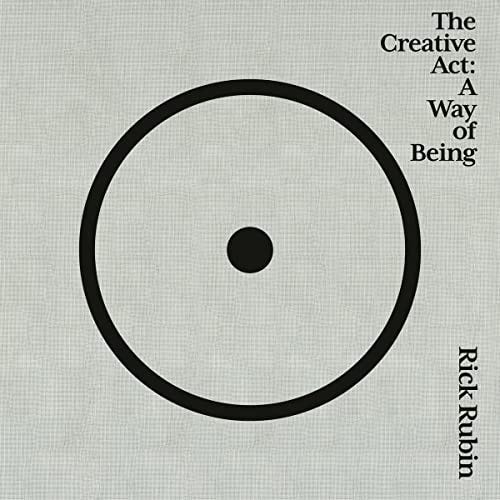
There’s something both transcendent and insufferable about Rick Rubin’s The Creative Act: A Way of Being, a 78-chapter meditation on creativity that reads like the Tao Te Ching rewrote Bird by Bird while high on sensory deprivation tank sessions. Rubin—the bearded guru who’s produced everyone from the Beastie Boys to Johnny Cash, the man who literally works barefoot in Malibu—has written a book that’s simultaneously the most useful and least practical guide to making art you’ll encounter this decade. It’s brilliant when it works, which is often, and maddeningly precious when it doesn’t, which is also often. The book succeeds not because it tells you how to make great art, but because it gives you permission to trust the process even when you have no idea what you’re doing. It fails when it forgets that not everyone has the luxury of waiting for the universe to whisper its secrets while sitting in a $50 million estate overlooking the Pacific.
By the third chapter, you’re either all in or you’re rolling your eyes so hard you risk permanent damage. Rubin wants you to think of yourself as an antenna receiving cosmic transmissions, a vessel for source material flowing through the ether. “We either sense it, remember it or tune into it,” he writes, as if downloading creativity from the universe is as simple as adjusting your Wi-Fi signal. For artists struggling with imposter syndrome, this framing is genuinely liberating—you’re not failing, you’re just tuning into the wrong frequency. For artists struggling to pay rent, it can feel like spiritual bypassing dressed up as wisdom.
But here’s the thing: dismissing Rubin’s mysticism means missing the genuine insights buried within it. This is a book that understands something essential about the creative process that most how-to manuals miss entirely.
The Sound of One Hand Making Art
The Creative Act unfolds in 78 micro-chapters—some three pages, some barely one—each a self-contained meditation on an aspect of creativity. There’s no linear progression, no step-by-step formula. Instead, Rubin circles his subject like a Zen master walking a labyrinth, returning to core themes from different angles: the importance of awareness, the practice of letting go, the cycle of creation and destruction, the necessity of showing up without attachment to outcome.
The book draws heavily from Eastern philosophy, particularly Buddhism and Taoism, filtered through Rubin’s decades of experience producing legendary albums in that studio-as-monastery mode he’s famous for. He talks about “source” the way mystics talk about God—an infinite wellspring of creative energy that exists outside ourselves, waiting to be channeled. The artist’s job isn’t to force inspiration but to create the conditions for it to arrive. “We don’t get to choose when a noticing or inspiration comes,” he writes. “We can only be there to receive it.”
This sounds vague until he gets specific. The chapter on “Distraction” explains how stepping away from a problem—driving, walking, showering—allows solutions to emerge. The “Ruthless Edit” section advocates cutting your work down beyond its final length, not to that length, forcing you to understand what’s truly essential. The discussion of “A/B Testing” offers a practical method for making decisions: place two options side by side, notice which one creates a physical response in your body, trust that instinct over intellectual analysis.
Throughout, Rubin emphasizes process over product, being over doing. He wants artists to cultivate what he calls “beginner’s mind”—approaching each project as if you’ve never made anything before, free from the weight of past successes or failures. He celebrates the power of “spontaneati,” those moments when work arrives fully formed, but insists they’re no more valuable than pieces crafted through painstaking effort. The goal is simply to make work that pleases you, to trust your taste, and to keep moving forward.
The prose style matches the philosophy: simple, declarative, occasionally profound. “Creativity doesn’t exclusively relate to making art. We all engage in this act on a daily basis.” Or: “The only practice that matters is the one you consistently do, not the practice of any other artist.” These aphorisms land with the weight of hard-earned wisdom. Other times, the language veers into California cosmic: “Art is our portal to the unseen world.” Your tolerance for phrases like “the universe is making available” will determine how much of this book feels like revelation versus eye-roll.
The Privilege Problem: Mysticism as Luxury Good
Here’s where we need to talk about what this book reveals—intentionally or not—about who gets to make art in America, and more specifically, who gets to make art without worrying about whether it will sell.
Rick Rubin’s net worth is estimated at $250 million. He owns Shangri-La studio in Malibu, where he can spend months—years, if he wants—refining a single project. When he tells you to “avoid overthinking” and just “release the work when it feels right,” he’s speaking from a position of profound financial security. When he suggests you might need to “step away for months” from a project to gain perspective, he’s assuming you have the economic freedom to do so. When he advocates keeping a day job to “protect the art you make by choosing an occupation that gives you mental space,” he’s not acknowledging that most occupations that pay enough to live on in 2025 don’t leave mental space for much of anything.
This isn’t to dismiss Rubin’s insights—many of them are genuinely valuable regardless of your bank account. But there’s a particular species of creative advice that flourishes in affluent environments, a kind of mindfulness-industrial-complex wisdom that treats economic anxiety as just another form of attachment to let go of. “The artist’s goal is to keep themselves pure and unattached,” Rubin writes, “to avoid letting stress, responsibility, fear, and dependence on a particular outcome distract.”
Easy to say when your mortgage is paid.
The history of “follow your bliss” creativity advice is entwined with class in ways that rarely get examined. Joseph Campbell, whose “follow your bliss” philosophy Rubin echoes, spent his career in academic positions with steady paychecks. The Romantic notion of the tortured artist starving in a garret was always more mythology than reality—most of the great Romantics had family money or patronage. Even the Beat poets, those supposed rebels against middle-class conformity, largely came from comfortable backgrounds that gave them the freedom to drop out.
What’s changed in the 21st century is that the economic precarity affecting artists has intensified while the mystical-spiritual framing of creativity has become more prominent. We’ve moved from “suffering for your art” to “trusting the universe to provide,” but both framings avoid the material reality: making art in late capitalism requires either financial privilege, grinding side-hustles that leave you exhausted, or a combination of both.
Rubin does acknowledge this, sort of. He includes a chapter called “The Art Habit” that suggests keeping a job to support your creative work. But the framing is all wrong. He presents this as a choice—”consider another way of making a living” to keep the art “pure.” For most artists, there’s no consideration involved. You work because you have to, and you make art in whatever cracks of time remain.
The Buddhist detachment Rubin advocates—the letting go of outcomes, the surrendering to the process—becomes something different when you’re facing eviction. Spiritual bypassing, they call it: using enlightenment talk to avoid dealing with material realities. “Concerns about releasing a work into the world may be rooted in deeper anxieties,” Rubin writes. “Let’s not consider how a piece will be received or our release strategy until the work is finished and we love it.”
Beautiful in theory. In practice, if you’re a musician trying to build a sustainable career, you absolutely need to think about release strategy before the work is finished, because Spotify pays $0.003 per stream and the algorithm demands consistent output.
None of this means Rubin is wrong about the creative process itself. But it does mean his advice lands differently depending on who’s receiving it. For the already-successful artist dealing with creative blocks, this book is medicine. For the emerging artist wondering how to build a career, it’s less a roadmap than a destination postcard from someone who’s already arrived.
What Actually Works (And What’s Just Vibes)
Strip away the cosmic language and mystical framing, and you find genuinely useful insights about the creative process. Rubin understands something fundamental: great work emerges from a state of relaxed attention, not forced effort. The best ideas arrive when you stop chasing them. Creativity requires both discipline and play, structure and spontaneity. These aren’t new insights—they’re ancient ones—but Rubin articulates them clearly and applies them to contemporary artistic practice in ways that feel fresh.
The chapter on “Seeds” perfectly captures the early phase of creative work: gathering ideas without judgment, planting them, seeing which ones take root. The discussion of experimentation emphasizes following energy rather than logic—if something excites you, even if you don’t know why, pursue it. The sections on collaboration advocate for genuine cooperation over competition, arguing that the best idea should win regardless of whose it is. These are practical, actionable concepts that work regardless of your spiritual beliefs.
Where Rubin excels is in articulating the emotional truth of making things. He captures the anxiety of starting, the frustration of being stuck, the ecstasy of breakthrough moments, the difficulty of knowing when something’s finished. He normalizes self-doubt while refusing to romanticize it. “Self-doubt lives in all of us,” he writes, “and while we may wish it gone, it’s there to serve us.” The artist isn’t someone who has conquered insecurity; they’re someone who creates despite it.
His emphasis on developing taste—on consuming great work, on calibrating your internal meter for quality—is spot-on. “Level up your taste,” he advises, suggesting you read classic literature every day for a year instead of reading the news. The goal isn’t to imitate greatness but to recognize it when you encounter it, including in your own work. This is practical wisdom that any artist can apply.
But then he’ll pivot from this grounded advice to something like: “Think of the universe as an eternal creative unfolding. Trees blossom, cells replicate, rivers forge new tributaries. The world pulses with productive energy.” It’s not that this is untrue—it’s that the cosmic framing adds nothing to the practical insight. You don’t need to believe in source consciousness to understand that taking breaks helps solve creative problems. You don’t need mysticism to know that comparing your work to others’ steals your joy.
The most frustrating thing about The Creative Act is that Rubin buries actionable advice under layers of spiritual language that will alienate half his potential audience. The other half—those who resonate with this kind of cosmic consciousness talk—may miss the practical insights because they’re too busy nodding along to the mysticism.
The Verdict: A Contradictory Masterpiece for Those Who Can Hold Contradictions
In the end, The Creative Act is less a how-to manual than a philosophical framework for approaching creative work. It won’t teach you how to structure a novel or mix a song or compose a photograph, but it might help you trust yourself enough to figure those things out. It won’t solve the economic realities of being an artist in 2025, but it might help you maintain your sanity while navigating them.
The book’s greatest strength is also its greatest weakness: Rubin takes creativity seriously as a spiritual practice. This elevates the discussion beyond mere craft advice, but it also means the book can feel detached from the material conditions most artists actually face. He’s written a guide for artists who can afford to work without worrying about commercial success, then presented it as universal wisdom.
And yet, and yet. There’s something in here that transcends the privilege problem, something that speaks to why we make things even when it makes no economic sense to do so. “As you deepen your participation in the Creative Act,” Rubin writes near the end, “you may come across a paradox. In the end, the act of self-expression isn’t really about you.” We create because we have to, because something demands to be made, because the act of making is itself the reward.
This is true whether you’re Rick Rubin producing albums in Malibu or a poet writing in your car on your lunch break. The cosmic consciousness language is optional. The underlying truth—that creativity is a practice, that it requires both surrender and discipline, that the work itself is the teacher—remains regardless of how you frame it.
The Creative Act will irritate you, inspire you, and make you want to immediately start creating something. If you can hold the contradiction—taking what’s useful while dismissing what’s precious—you’ll find genuine wisdom here. Just don’t expect it to pay your rent. The universe, it turns out, does not directly deposit into your bank account, no matter how clearly you tune your antenna.