

I want to tell you about Genevieve Capolongo, because her situation is yours if you are an independent artist and you have ever wondered why the algorithm keeps sending you to Drake.
Capolongo pays $11.99 a month for Spotify Premium. She describes herself as an indie music fan who uses the platform to find artists outside the mainstream — she names Proxima Parada, Julia Cooper, Brusco. But when she opens Discover Weekly, she finds Drake. When she opens Release Radar, she finds Zach Bryan. When she opens her AI DJ, she finds Justin Bieber. She sued Spotify in federal court in Manhattan in November 2025, seeking class action status for over 100 subscribers. The complaint — filed as Capolongo v. Spotify Technology S.A. in the U.S. District Court for the Southern District of New York — is 39 pages long and contains one sentence that cuts through everything: Spotify, it alleges, “charges listeners for the privilege of being deceived — $11.99 per month, to be exact.”
What Capolongo is describing has a name. Spotify calls it Discovery Mode. The music industry calls it, increasingly, payola. I want to explain exactly how it works, what it costs you, and what Spotify did in January 2026 that makes the whole picture harder to look away from.
What Discovery Mode actually is
The previous installment of this series noted, in passing, that Discovery Mode takes a 30% commission on promoted streams. I want to stop on that sentence, because passing over it is exactly what Spotify is counting on.
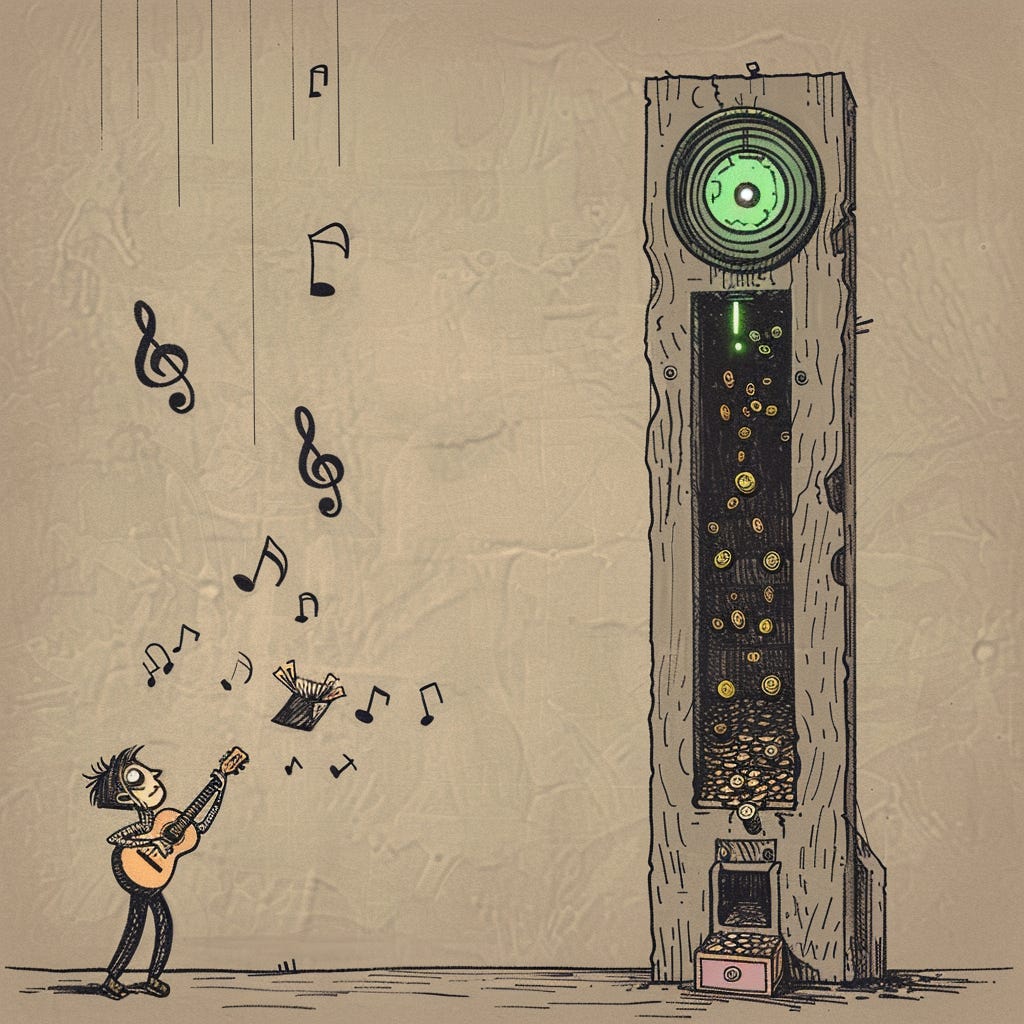
Discovery Mode launched in 2020. The mechanics are straightforward: you flag specific tracks for algorithmic priority in Spotify’s Radio and Autoplay features — the streams that play automatically when a listener finishes a playlist or searches for your radio station. In exchange, Spotify takes a 30% commission on every stream generated through that promotion. You receive 70 cents on what would otherwise be a dollar.
Spotify already pays between $0.003 and $0.005 per stream under standard rates. A 30% reduction brings that to roughly $0.002. To earn $1,000 at the standard rate requires approximately 250,000 streams. Under Discovery Mode, the same payout requires approximately 360,000 streams — and only if the Discovery Mode streams genuinely deliver that many additional listeners, which is not guaranteed. You are being asked to pay for visibility with income you have not yet received, in exchange for exposure that may not convert.
Spotify frames this as optional. Its promotional page quotes the CEO of TuneCore calling it “groundbreaking” and the founder of DistroKid calling it “a game changer.” Its own documentation notes that only streams generated through Radio and Autoplay carry the reduced rate — all other streams remain at full royalty. This is technically true. It is also how every toll booth in history has been described: you don’t have to use this road.
The road is the only road. Producer LUCA LUSH said it plainly on X in March 2023: “Classic prisoner’s dilemma. The ideal situation would be no one opts in, but the structure forces every manager, label and artist to do so if they want to remain competitive on the platform.” If other artists in your genre are paying the 30% commission to get algorithmic priority and you are not, you get less Radio and Autoplay. The opt-in is technically voluntary. In practice, it is a toll. And the toll is paid in the royalties you have not yet earned.
The earnings announcement and what it didn’t mention
On January 28, 2026, Spotify announced it had paid out more than $11 billion to the music industry in 2025 — the largest annual payment to music from any retailer in history. Charlie Hellman, who leads Spotify’s music team, wrote in a blog post that independent artists and labels accounted for half of all royalties. The announcement was widely reported as good news for working musicians.
Read it again: the largest annual payment to music from any retailer in history. That is a real number. I am not disputing it. What I am pointing out is what the announcement did not say. It did not mention that the royalties Spotify retains through Discovery Mode’s 30% commission are kept by the platform before the royalty pool is distributed. When you accept a 30% royalty reduction in exchange for algorithmic promotion, those royalties do not go to other artists. They go to Spotify. The $11 billion is the number after that extraction. The Recording Academy, the Future of Music Coalition, and the Artist Rights Alliance have each publicly labeled Discovery Mode exploitative. The House Judiciary Committee flagged it in 2021 as a potential “race to the bottom.” None of this appeared in the announcement.
“Modern payola” and why Spotify says that’s nonsense
Payola — paying broadcasters to play specific songs without disclosing the payment to listeners — was declared illegal in the United States in 1960, after Congressional investigations found radio stations across the country were taking undisclosed payments from record labels to inflate specific artists’ exposure. The scandal ended careers, produced federal legislation, and established a principle that still matters: listeners have a right to know when what they are hearing has been commercially influenced.
Capolongo’s lawsuit argues that Discovery Mode violates the same principle. Spotify’s own marketing tells subscribers they receive recommendations “made just for you” based on their listening history. Its fine print acknowledges that “commercial considerations may influence” those recommendations. The gap between “made just for you” and “commercially influenced” is not a disclosure. It is a deception. “Without that specificity,” her attorneys write, “users cannot distinguish between genuine personalization and covert advertising.” The House Judiciary Committee raised the same concern in 2021, asking Spotify directly whether Discovery Mode might “set in motion a race to the bottom” in which artists feel compelled to accept lower pay simply to remain visible. Four years later, Capolongo documents what that race looks like from the listener’s side: she paid for independent music discovery and received Drake.
Spotify called the lawsuit “nonsense.” A spokesperson said Discovery Mode is “optional, not used in flagship playlists like Discover Weekly or its AI DJ.” In January 2026, Spotify filed its motion to compel arbitration in Capolongo v. Spotify — arguing that when she signed up for the service, she agreed to arbitration and waived her right to bring the case in court. The primary defense against a payola lawsuit is not that the practice is legitimate. It is that the user agreed not to challenge it.
This is the posture of a company that controls approximately 31% of global music streaming revenue and has 750 million monthly active users. Abandoning Spotify means losing access to the dominant infrastructure of recorded music. The arbitration clause Spotify is invoking was agreed to not as a genuine choice but as the only available terms of entry into the platform where the world’s music lives. Consent under those conditions has a different meaning than the word ordinarily carries.
What this costs a real artist
I want to be specific here, because generality is where this kind of argument dies.
The ghost artist investigation documented on this Substack named Lance Allen — an instrumental guitarist who was earning enough from “Acoustic Concentration” and “Peaceful Guitar” to pay his mortgage, until Spotify stopped supporting him editorially and his playlist spots were replaced by tracks from Epidemic Sound and Firefly Entertainment. That was the ghost artist mechanism: fabricated identities capturing royalty pool share that would otherwise flow to real musicians.
Discovery Mode is a second and in some ways more direct mechanism. It does not require fabrication. It requires that you pay for algorithmic visibility with your own royalties — and that every artist who cannot afford that toll receives less visibility than the ones who can. Major labels absorb a 30% royalty reduction on specific promotional tracks without difficulty. Their revenues are diversified across thousands of artists and decades of catalog. If you are releasing your first record, you cannot absorb that reduction the same way. You are being told that visibility is available, that the platform is meritocratic, that the algorithm surfaces what listeners want. What you are not being told is that the algorithm surfaces what listeners want after accounting for who paid to be surfaced first.
We don’t pay for playlist placement at Musinique. We document the people who do — and publish the data. In our analysis of 5,859 verified playlists across 83 curators, the top 1% of curators by follower count control roughly half the total audience. The curators genuinely accessible to emerging independent artists — the ones with high Focus Scores and artist popularity profiles that reflect real openness to unknown music — hold roughly 4% of the total follower base. Discovery Mode accelerates the same concentration at the algorithmic level. The artists who opt in grow their presence at the cost of their per-stream income. The artists who cannot opt in recede. The platform captures the difference either way.
Two dates in January
On January 28, 2026, Spotify published its payouts announcement. “More than $11 billion to the music industry. The largest annual payment to music from any retailer in history. Once again, independent artists and labels accounted for half of all royalties.” The post described a platform working hard for artists, building tools, expanding reach, rewarding those who engage seriously with their careers.
Twenty-two days earlier, on January 6, 2026, Spotify filed its motion to compel arbitration. The argument: she agreed to the terms of service, the terms include an arbitration clause, she cannot sue in court. The platform that describes itself as music’s greatest benefactor simultaneously argued that a subscriber who paid $11.99 a month for a personalized listening experience had waived her right to challenge whether that experience was genuine.
These two positions are not contradictory from Spotify’s perspective. They are the same position: that the platform defines the terms and the terms are not open for challenge. The $11 billion is real. The arbitration clause is real. The 30% commission is real. The artist who opted into Discovery Mode because their competitors did, earned 30% less on the streams it generated, and found that their algorithmic appearances increased but their per-stream income fell — that artist is also real. Their name does not appear in the earnings announcement.
Spotify knows your streaming history. It doesn’t know what it cost you to make the music.
* * *
Tags: Discovery Mode, Spotify payola, independent artist royalties, streaming economy, Capolongo v. Spotify
<iframe width=”560” height=”315” src=”
title=”YouTube video player” frameborder=”0” allow=”accelerometer; autoplay; clipboard-write; encrypted-media; gyroscope; picture-in-picture; web-share” referrerpolicy=”strict-origin-when-cross-origin” allowfullscreen></iframe>
<iframe data-testid=”embed-iframe” style=”border-radius:12px” src=”
width=”100%” height=”352” frameBorder=”0” allowfullscreen=”“ allow=”autoplay; clipboard-write; encrypted-media; fullscreen; picture-in-picture” loading=”lazy”></iframe>