

Part 1: Chapter-by-Chapter Logical Mapping
Chapter 1: Why Spotify
Core Claim: Spotify represents the best opportunity for 21st-century artists because it enables recurring revenue from repeated listening, unlike the one-time payment model of physical album sales.
Supporting Evidence:
Author’s credentials: 130 million streams, 156,000 followers, 1 million monthly listeners achieved using book strategies
Financial proof: One song with 1,043,477 streams earned $3,185.75 ($0.003/stream)
Passive income model: Same song generates $15/day = $450/month = $5,400/year
Scale math: 20 songs at this rate = $108,000 annual passive income
Real-time data: “700 people were listening all at one time” - unprecedented audience visibility
Logical Method: Economic comparison model. Greenwood contrasts old economics (one-time CD sale) with new economics (recurring streaming royalties over decades). The argument rests on lifetime value calculation rather than per-transaction value.
The Singles Economy Argument:
Premise: Fans want to cherry-pick songs, not buy full albums
Artist advantages: Faster releases, lower costs per song, ability to test multiple producers/collaborators
Marketing advantage: Focus promotion on one song at a time rather than diluting effort across 10 tracks
Recommendation: Release ~8 singles before compiling into 10-song album
Gaps/Assumptions:
$0.003/stream rate is optimistic: Industry averages range $0.003-0.005, but many artists see lower rates depending on listener geography and subscription type
Survivorship bias: Greenwood has 130 million streams and industry connections. Does his waterfall strategy work for artists with zero followers?
Passive income claim requires sustained algorithmic placement: The $15/day assumes streams don’t decay. What percentage of songs maintain 5,000 daily streams after one year?
“60,000 songs uploaded daily” framing: He later admits most aren’t marketed, so actual competition may be lower—but how much lower? If 10% are marketed, that’s still 6,000/day.
No acknowledgment of platform risk: Spotify could change royalty rates, algorithm logic, or terms of service. The entire business model depends on one company’s stability.
Competition Reality Check: Greenwood claims “there is no competition” because most uploaded songs aren’t marketed. But this is circular logic—if his strategies become widely adopted (which is his goal), competition intensifies. The “60,000 songs daily” stat is used to create urgency, then dismissed to create confidence. Both can’t be true simultaneously.
Argumentative Structure: Establish pain point (crowded marketplace) → Reframe problem (most artists don’t market) → Present solution (this book’s strategies) → Prove with author’s results → Scale the vision (20 songs = $108K).
Chapter 2: Inside Your Artist Profile
Core Claim: Optimizing your Spotify artist profile’s visual and textual elements increases engagement and provides multiple conversion pathways for fans.
Profile Optimization Checklist:
Banner image (2660x1140px): Mood-setting + light promotion (artwork from new single, but no text per Spotify guidelines)
Image gallery: Press photos, live shots, brand-reflective images
Bio: Include call-to-action linking to website/email signup
Concerts tab: Link to Songkick/Ticketmaster for tour dates
Merch tab: Connect Shopify store, showcase 3 items, integrate with Printful for print-on-demand
More Info tab: Link social media (no website option—workaround via bio)
Artist Pick: Feature song/album/playlist (expires after 14 days—must refresh)
Canvas: 3-8 second vertical video loop (increases shares 145%, playlist adds 20%, profile visits 9%, streams 5%)
Canvas Impact Data:
145% increase in shares
20% increase in playlist adds
9% more likely to visit profile
5% increase in streams
Technical specs: 9:16 vertical, 720x1280px minimum, MP4 or JPEG, 3-8 seconds
Logical Method: Conversion funnel optimization. Each profile element serves a specific function in the user journey from discovery → engagement → conversion (follow/stream/purchase).
Gaps/Assumptions:
Canvas stats lack methodology: “According to a digital music news article” - no study details, sample size, or timeframe provided
Canva.com promotion: Greenwood repeatedly recommends Canva for free design. Is this sponsored or genuine recommendation? (Likely genuine, but worth noting pattern)
14-day Artist Pick expiration: He advises updating regularly but doesn’t address fatigue cost. How much time does constant profile maintenance require vs. creating music?
Shopify integration emphasis: Print-on-demand via Printful mentioned twice. This assumes artists have time/skill to design merch or hire designers. What’s the actual ROI on merch for sub-10K follower artists?
“Fans don’t hear you first, they see you first”: This visual-first claim is asserted without evidence. On Spotify, users often discover via algorithmic playlists (audio-first context).
Collaboration Hack (Artist Pick): Greenwood suggests mutual Artist Pick promotion: “Reach out to another band... offer to promote their songs in your artist pick for a week... Part of the deal is they link to your tracks too.” This costs nothing but requires relationship capital. Assumes both artists have similar follower counts for mutual benefit.
Strength: Tactical, actionable checklist. Every item maps to specific Spotify features with clear instructions.
Weakness: No prioritization. If an artist has 2 hours, which profile elements matter most? Likely: Canvas (measurable impact) → Artist Pick (high visibility) → Bio (conversion pathway). But Greenwood treats all equally.
Chapter 3: The Waterfall Release Strategy
Core Claim: Releasing 8 singles over 12-16 months before compiling into an album maximizes algorithmic exposure, builds momentum, and ensures every song gets proper marketing rather than being buried in a full album drop.
The Waterfall Mechanics:
Release single every 6-8 weeks
Each single triggers Release Radar (if pitched with 7+ days notice)
Consistent flow maintains algorithmic momentum
By album release, you’ve already touched fans 8 times instead of once
Album tracks that weren’t pre-released as singles get ~80% fewer streams
Case Study: “I Run With Wolves” Album:
7 of 10 songs released as singles (every ~2 months)
Each single accompanied by music video or lyric video
5 of 7 singles landed on editorial playlists
Album release: Pitched “Break the Habit” → 6 editorial playlists → 475K streams in 3 months
252K of those streams (53%) came from editorial playlist exposure
The 80% gap: 2 songs NOT released as singles = tens of thousands of streams vs. hundreds of thousands for singles
Regret expressed: “Each song costs me just as much in time and money to write, record and release but those two songs won’t recoup nearly as fast”
Release Radar Requirements:
7 days minimum notice (Greenwood recommends 1 month ahead)
Pitch via artist.spotify.com dashboard
Notifies all followers + algorithm consideration
Active for 4-6 weeks per release
Momentum Pattern:
Week 1-4: Peak streaming from release radar + followers
Week 4-6: Tapering begins
Week 6-8: Release next single to reignite momentum
Cumulative effect: Each new release lifts back catalog streams
“Albums Don’t Sell Albums, Singles Sell Albums”: Greenwood argues fans don’t love albums—they love specific songs that emotionally resonated. The album is just the container. In the streaming era, you can build emotional connection song-by-song, then compile later.
Logical Gaps:
6-8 week release cycle assumes high production capacity: Recording, mixing, mastering, artwork, video production for 8 singles = significant time and money. Many indie artists can’t sustain this pace.
Not all genres suit single-focus: Concept albums, prog rock, ambient, classical often depend on album-as-journey structure. Waterfall strategy may damage artistic vision.
Patience paradox: “A goal without a plan is just a wish” + “Most artists rush releases” - True, but 8 singles over 16 months requires patience most artists lack, especially if early singles underperform.
Label comparison misleading: “Labels were organized... I learned from being in the label system” - But labels have teams, budgets, and infrastructure. Solo artists must execute everything themselves.
Marketing intensity undefined: “Every song deserves its own promotional campaign” - but what does that entail? If it’s $1,000/song in ads (Southworth’s model), 8 singles = $8K. Not mentioned.
The Two-Track Failure: Greenwood’s regret over non-single album tracks is revealing. It proves the strategy works—but also highlights opportunity cost. What if those two songs were better than the 8 singles but didn’t get proper releases? The waterfall method optimizes for algorithmic performance, not necessarily artistic merit.
Alternative Strategy Not Considered: Hold back weaker songs entirely. If 2 of 10 tracks won’t recoup for years, why include them? Greenwood suggests “deluxe version” or “CD-only” but doesn’t explore cutting them completely. This points to attachment to “album as complete work” even while advocating singles economy.
Chapter 4: Editorial Playlists in Depth
Core Claim: Landing on Spotify editorial playlists can 10x your reach, but success requires strategic pitching, relationship-building with curators, and a comprehensive marketing plan—not just submitting a song.
The Pitching Process:
Minimum Requirements:
1-2 weeks advance notice (Greenwood recommends 1 month+)
Answer genre/mood/cultural influence questions thoroughly
Write compelling pitch in text box
What Curators Want to See:
Full marketing plan: ad budget, music video, publicity, touring
Accolades, TV/film placements, press coverage
Specific playlist targets: “I think my song fits [playlist name]”
Gratitude: “I always thank the curators in my pitch”
Steve Shirley (Spotify PM) Quote: “You’re in this sea of more than 2,000 songs that come into the curators every single day... being thorough with the information you give when you pitch will increase the chances.”
Key Insight: 2,000 songs pitched daily, but 60,000 uploaded. That means only ~3.3% of uploaded songs are even pitched. Greenwood notes: “How many are being marketed and actually pitched to editorial playlist? I see an opportunity here.”
Genre Consistency Matters: “The more I stay focused by releasing in one genre of music and not jumping from different styles, the better success rate I have with getting on editorial playlist.”
The Knock Knock Method (Relationship Building):
This is Greenwood’s systematic approach to curator relationships:
Step 1: Find head curator for your genre (Google, LinkedIn)
Step 2: Follow on most active social media
Step 3: Comment/share posts for 1 week (no asks, no spam)
Step 4: After 1 week, DM thanking them (genuine, no ask)
Step 5: Few days later, short intro: “Hey, love what you’re doing. My name is [Name]. I’m a [genre] artist from [city] and just released a new song. I’d love for you to check it out. [Spotify link]”
Step 6: Mail physical package (chocolate, Starbucks, food they like based on social media observation) + handwritten note + ask to check out song
Step 7: CRITICAL STEP - Follow up every other week with emails, DMs, 2 more packages, phone calls. Switch up messaging. Share tour news, career updates. Keep it interesting.
“99% of artists give up at step 7”: “Be willing to do what 99% of most artists won’t do so you can have what 99% of artists will never have. I have a million monthly listeners because I was willing to do this stuff.”
Logical Strength: The Knock Knock Method is relationship-building 101: provide value, show genuine interest, make specific asks, follow up persistently. It’s Grant Cardone (”If they don’t know you, they can’t flow you”) applied to music.
Logical Gaps:
Scalability problem: This works for building 1-3 key relationships, but what if your genre has 10+ relevant curators? The time investment becomes prohibitive.
Economic barrier: Sending 3+ packages to multiple curators = $50-100 per curator. For 5 curators = $500. Added to ad budget, this compounds costs.
Privilege assumption: “Most record labels won’t even go these lengths to put you and your music out there” - But labels have staff to execute this. Solo artist doing everything = burnout risk.
Success rate undisclosed: Greenwood says it worked for him, but how many curators did he contact vs. how many responded? If it’s 20 contacted, 2 responded, that’s 10% conversion requiring massive effort.
Ethical gray area: Is sending gifts to curators (who hold gatekeeping power) essentially pay-for-play with extra steps? Spotify’s TOS prohibit payment for playlist placement, but gifts occupy ambiguous territory.
Editorial Playlist Impact (from Chapter 3 case study):
252K of 475K streams (53%) from editorial playlists for “Break the Habit”
Proves editorial placement has massive impact when achieved
But: Song must already be strong enough to maintain position. High skip rate = removal.
“You Can’t Buy Onto Editorial Playlists”: Greenwood emphasizes this is against Spotify TOS (true), but then describes elaborate gift-giving system. The distinction: paying directly for placement vs. building relationship that influences placement decision. Technically compliant, but morally similar.
Comparison to Southworth:
Southworth: “Playlist promotion is the worst form of promotion” (passive listening, poor metrics)
Greenwood: “Editorial playlists can 10x your reach” (but require relationship capital)
Both agree: User playlists (passive listening) < Editorial playlists (curated, engaged)
Key difference: Greenwood focuses on editorial (requires connections), Southworth dismisses playlists entirely in favor of Facebook ads
Chapter 5: Algorithmic Playlists in Depth
Core Claim: Algorithmic playlists (Release Radar, Discover Weekly, Radio, Daily Mix) generate more total streams than editorial playlists, yet receive less attention. Understanding their mechanics allows artists to optimize for algorithmic triggers.
Release Radar vs. Discover Weekly:
Release Radar:
Shows new releases from followed artists
Active for 4 weeks post-release
Updates Fridays
If song performs well (high saves, low skips), Spotify expands Release Radar to non-followers
Greenwood: “Release radar alone generates more streams than any of Spotify’s self-curated playlists” (Brian Johnson, Spotify UK Director quote)
Discover Weekly:
Shows new-to-listener music based on taste profile
Updates Mondays
Requires higher popularity threshold (~30% vs. 20% for Release Radar)
User voting mechanism: Save button + “Don’t show me more music from this artist” button
Greenwood: “Once triggered can bring you streams for months on end”
Editorial vs. Algorithmic Longevity:
Editorial: Can be removed after 1 week (at curator discretion)
Algorithmic: Continues as long as metrics remain strong
Example: “My song Stones had been on some of the bigger playlists and stayed on there over a year because it had such a low skip rate”
Spotify’s Data Collection:
What Spotify tracks:
Song length listened
Pause points
Mid-listen searches (attention wandering)
Skips (especially within 30 seconds)
Saves/hearts
Playlist adds
Social media shares
Website embeds
Traffic source (especially new Spotify customers)
Skip Rate as Brutal Filter: “If a song has a high skip rate and if it keeps happening, then Spotify is going to stop recommending that song and possibly remove the song from playlists.”
Inverse: Low skip rate signals quality → Spotify shares to more users.
Popularity Score (0-100):
30+ triggers algorithmic playlist consideration
Check via musicstacks.com (free) or songstats (paid)
Acts as threshold: below 30 = unlikely algorithmic push, above 30 = eligible
Spotify Discovery Mode (New Feature):
Mechanics:
Opt-in per track (eligible after 30 days on platform)
Increases likelihood of Radio and Autoplay placement (not guaranteed)
30% commission on recording royalties from Radio/Autoplay only
All other streams commission-free
Publishing royalties untouched
Greenwood’s Results:
109,385 new listeners from Radio/Autoplay
268% listener lift
27,695 listeners who’d never streamed his music before
985 new saves, 708 playlist adds
Assessment: “Freaking awesome. Where do I sign up?”
Eligibility:
Distributed via DSP offering Discovery Mode (TuneCore, DistroKid)
Released on Spotify for 30+ days
Streamed in Radio or Autoplay in last 7 days
Logical Strength: Discovery Mode is Spotify’s version of Facebook’s “boost” button—pay for distribution via commission rather than upfront cost. For artists without marketing budget, this is powerful. The 30% commission only applies to incremental streams (Radio/Autoplay), not organic or playlist streams.
Comparison to Southworth’s Thresholds:
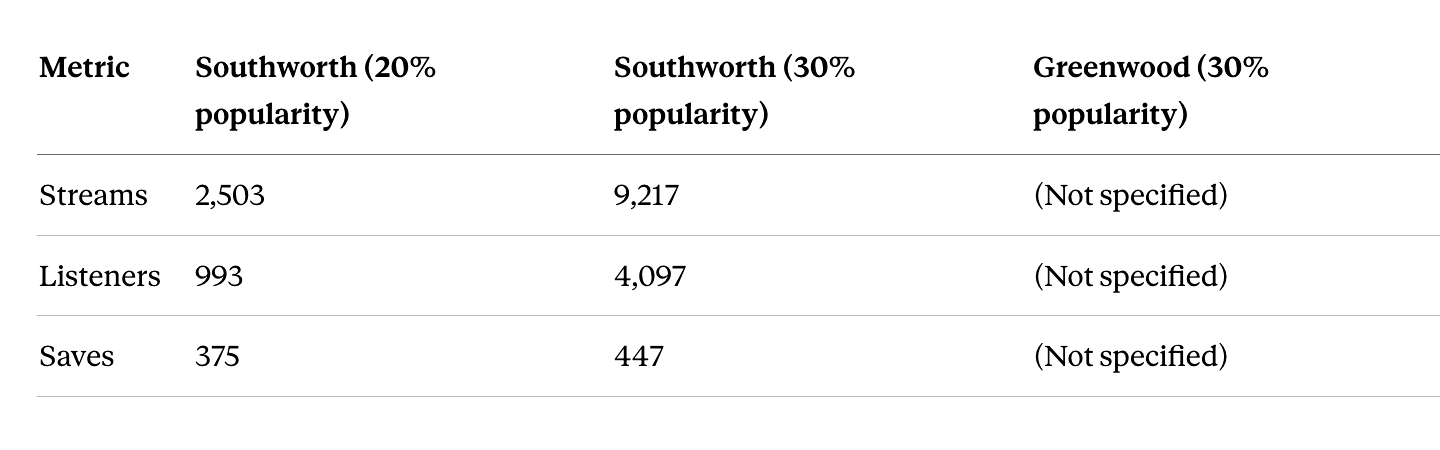
Greenwood doesn’t provide the numeric thresholds Southworth does, instead focusing on the 30% popularity score as the key metric. This is less actionable—artists can’t see popularity score in real-time within Spotify for Artists dashboard.
Gaps/Assumptions:
“Algorithmic playlists generate more streams than editorial”: This is presented as fact (with Brian Johnson quote), but it’s context-dependent. For mega-artists, editorial playlists likely dominate. For mid-tier artists, algorithmic may win due to longevity.
Skip rate is unviewable for most artists: Greenwood notes “Spotify doesn’t exactly give us that data, but I’ll be sharing later on in this book about your popularity score which affects the skip rate.” This creates dependency on third-party tools (musicstacks, songstats).
Discovery Mode commission is significant: 30% of recording royalties from Radio/Autoplay could equal or exceed what you’d pay in ads to drive equivalent traffic. Is this actually “no upfront cost” or just deferred payment? Depends on volume.
Eligibility threshold creates catch-22: Discovery Mode requires “streamed in Radio or Autoplay in last 7 days” to be eligible. But if you’re not getting Radio/Autoplay streams, you can’t use Discovery Mode to get more Radio/Autoplay streams. How do you bootstrap?
Time Factor (Echoes Southworth): Greenwood emphasizes algorithmic activity continues long after promotional campaign ends. The passive income model depends on triggering algorithmic placement early, which then sustains streams for months/years.
Chapter 6: Building and Growing a Genuine Fanbase
Core Claim: Real fanbases are earned through authentic engagement and value exchange, not purchased via bots or sketchy playlist promotion. Focus on cold → warm → hot → scorching journey, building community through merch creativity, social authenticity, consistency, and generosity.
The Bot Problem:
Why bots are tempting:
$50 for thousands of streams (far cheaper than ads)
Instant gratification vs. slow organic growth
Why bots fail:
Spotify detects and removes artificial streams
“Artificial stream = stream that doesn’t reflect genuine listener intent, including... automated processes, bots, or scripts”
Ruins algorithm: “It messes with the algorithm” because Spotify can’t correlate fake activity to recommend songs to real users
Violates TOS: Both artist and provider can be banned
The Fan Temperature Model:
Cold fans (never heard of you):
Don’t know your name or music
Largest potential audience
Require awareness campaigns (ads, playlists, covers)
Warm fans (heard of you):
Listened to your music via friend recommendation, ad, or playlist
Liked a few social posts
May follow you
Need nurturing to convert to hot
Hot fans (active supporters):
On your email list
Buy music and merch
Attend shows
Engaged community members
Scorching fans (superfans/tribe):
Buy everything you release
VIP ticket purchasers
First to support crowdfunding
Share your music proactively
Greenwood calls his: “My Fighters”
Key Insight: “Every fan you ever have will take that journey from not knowing your music, to knowing it a little, to really digging it.” This reframes marketing as shepherding fans through stages rather than converting cold to hot instantly.
Getting Creative with Merch:
Single-specific merch strategy:
Create artwork for every single release
Design t-shirts inspired by single cover
Launch merch before song release: “We made hundreds of dollars off it before we even released the song”
Ongoing revenue: Best-selling shirt continues generating income
Design resource: VisionCityArt.com (Greenwood’s wife Melanie) - specialized in music artwork
Logical strength: Merch as marketing. Fans wearing your shirt = walking billboard. Creating scarcity and moment-specific designs (single launch) increases urgency.
Gap: Assumes artists have design skills or budget to hire designers. For sub-5K follower artists, is merch ROI positive after production + shipping costs?
Getting Personal on Socials:
Content Strategy:
Music videos (obviously)
Lyric videos (secondary)
Behind-the-scenes mini-docs: Why you wrote the song, what it means
“Fans want the original exclusive view that only you can be”
Instagram Stories Tactics:
Post song clips repeatedly: “Just because I have 32,000 followers on Instagram, doesn’t mean they all saw the story or post the first time around”
Repost old songs with nostalgia angle: “Hey, guys, remember this song?”
New feature: Anyone can now include links in Instagram stories (not just verified accounts)
Link to Spotify playlist of your catalog
“You want to be promoting the junk out of anything you release”
Building Tribe, Not Just Fanbase: “You can build a massive tribe, not just around your music, but around you. Then your fans will support whatever you do, whether it’s music related or not.”
Forbidden: “Don’t be an annoying echo of someone else” - authenticity over imitation
Gap: Greenwood describes what to post but not how to build authentic voice. “Find their own unique voice” is advice without methodology. Contrast Southworth’s specificity on ad copy.
Being Consistent:
6-8 Week Release Cycle (echoes Chapter 3):
Keeps algorithm active
Provides fresh content for fans
Builds momentum cumulatively
Critical caveat: “I’m not saying without a whole bunch of half baked songs just to keep releasing something every six weeks. Please do not do that. It’s better if you release one smash song in a six month period than five mediocre tracks.”
Budget workaround - Repurposing:
Remix existing songs
Acoustic versions
Instrumental versions
Full instrumental album
Feature another artist on existing track
Strength: Acknowledges financial/time constraints. Repurposing is legitimate content strategy.
Gap: Quality control undefined. How does artist know if repurposed version is “smash” or “mediocre”? No testing methodology provided.
Being Generous (Law of Reciprocity):
Core Principle: Give music away strategically to invoke reciprocity. “Those who have been touched by our music will want to give back.”
Panda Express Anecdote: “I remember walking past Panda Express in the mall and being offered some of their orange chicken. After just one piece, I was sold... They were giving away their best selling item for free, and I was so grateful and inspired that that’s where I went for lunch.”
Application to Music:
Method 1 - Download Gate:
Exchange: Free song download for email address, Spotify follow, or pre-save
Tool: Hypedit (paid) or DistroKid’s HyperFollow (free)
Method 2 - Pre-Save Incentive:
Problem: “Most people, even if they like what you do, won’t pre-save a song because there’s nothing in it for them”
Solution: Offer instant download + bonuses (instrumental version, behind-the-scenes content)
Result: “Increase in conversions as well as lower ad costs”
The Ego Bubble Burst:
“I hate to burst your ego bubble, but right now barely anyone knows who you are. Your problem isn’t leaking the song to a few hundred or even a few thousand fans. Nobody knows you exist right now... Spotify currently has 165 million users. I have a million monthly listeners on there, which means there are 164 million who have no idea I even exist.”
Reframe: Obscurity, not leaks, is the real threat. Give music away to build awareness. Worry about piracy when you’re famous.
Quality Caveat: “You should never give away a song that you couldn’t sell for a profit. What do I mean? If it’s not good enough to sell, then why would you dare try to give it away for free thinking it would build a fan base?”
Logical tension: Greenwood says give away your best stuff (Panda Express model), then says don’t give away songs not good enough to sell. These align only if all your songs are sell-worthy. For artists with mixed-quality catalogs, which songs to give away?
Playlist Outreach (Independently Curated):
Research Strategy:
Search Spotify for genre-specific playlists
Type in similar artists to find playlists featuring them
Contact playlist owners (some have details on profiles, others require digging on Twitter/Facebook/LinkedIn)
Red Flags:
Playlists that charge money (be careful, verify legitimacy)
Playlists with random songs across genres
Playlists with low-quality songs
Verification: “I always double check the playlist to see not just the type of songs but the quality of songs. If I can see this playlist owner is just adding everything in anything then I’ll quickly pass.”
Outsourcing Options:
Hire virtual assistant (Fiverr, Upwork) to build database of playlist contacts
Hire playlist promotion company (due diligence required)
Greenwood’s take: Companies with existing relationships save time, but be wary of reputation
Time vs. Money Trade-off: “As an artist and also the CEO of your company, you need to stop doing minimum wage activities. So hire those tasks out to someone else and you can focus on a higher leveraged activity.”
Strength: Pragmatic delegation advice. Recognizes artists wear many hats and should outsource low-leverage tasks.
Gap: What’s the ROI threshold for hiring VA? If VA costs $10/hour for 5 hours ($50) to build playlist database, and playlist placement generates 1,000 streams ($3-5), break-even requires either high placement success rate or long-term compounding value.
Artist-Created Playlists (Search Engine Optimization):
Example: Greenwood created playlist called “Manifest and Thousand Foot Crutch” (band he’s friends with)
1,107 followers
~50,000 streams generated to date
Taps into Thousand Foot Crutch’s larger fanbase
Strategic Logic:
When people search for Thousand Foot Crutch, Greenwood’s playlist appears
Discovery by association
Free exposure
Scalability: “What if you made a playlist that’s a mix of your own music with someone else’s choosing a band or artist who has a similar sound to you?”
Cross-Pollination Examples:
Mix your songs with similar artist (e.g., Greenwood + Papa Roach)
TV show soundtracks
Movie soundtracks
Gaming playlists
“Making Yourself Findable on Spotify”: Treat Spotify as search engine. Optimize for discovery through strategic playlist creation.
Gap: This assumes Spotify’s search prioritizes user-created playlists. In practice, official artist profiles, editorial playlists, and algorithmic playlists likely rank higher. The discoverability value may be overstated unless playlist gains significant followers.
Chapter 7: Expanding Your Fan Base (Collaborations & Covers)
Length: ~3,500 words
Core Claim: Collaborations are “the fastest way to grow their fan base, receive royalties, and accelerate their music career” because you instantly tap into the collaborator’s existing audience.
The Collaboration Case Study:
Greenwood’s biggest song: “Impossible” - 38+ million streams
Collaboration with Trevor McNevan (Thousand Foot Crutch) singing chorus
Also co-written with 2 other songwriters
Result: “The big reason why collaborating with other artists is so powerful is because you get to tap into that artist’s existing fan base”
Instant Results Example: “One artist I know paid for a collaboration and went from 24,000 monthly listeners to 40,000 within 48 hours of that new song coming out. You couldn’t spend enough on advertising to get that kind of instant result.”
The Recommendation Analogy: “Imagine the difference between someone recommending a product to you personally versus you seeing the advertising online or receiving a marketing email about it. You’re way more likely to dismiss the advertising or the email than you would your friends recommendation.”
Personal Story - The Missed Opportunity: “A few years ago, there was one artist I was going to do a collaboration with, but I didn’t push to make it happen. The truth is I sent him a song and he wasn’t really feeling it. And instead of me following up and sending him another song, I got lazy... fast forward to today and that artist now has over 13 million monthly listeners. I could have tapped into that artist’s insane growth if we had done a song together.”
Lesson: “The fortunes are in the follow up” - persistence matters in collaboration outreach.
Strategic Selection - Begin with the End in Mind:
Factors to Consider:
Monthly Listener Count:
Rough guide: If you have ≤1,000 listeners, target artists with 5K-10K
Scaling up: Target artists 5-10x your size for asymmetric benefit
Genre Compatibility (or strategic mismatch):
Same genre = safe bet
Cross-genre = curveball that can work if song is strong
Examples: Eminem + Dido, Linkin Park + Jay-Z, Stormzy + Ed Sheeran, Metallica + Lou Reed
Social Media Strength:
“Check out how active their social media is and in particular see if they’re doing well on a platform which you haven’t totally got into yet”
Cross-promotion value: You have bigger Spotify following, they have bigger TikTok → mutual scratch
Strategic Doors You Want Opened:
Radio play example: Greenwood collaborated with artist getting active rock radio airplay → stations played their collaboration → easier for Greenwood to get his solo tracks added to rotation
“Everything is leverage when you’re first getting started”
Ad Targeting Advantage: “The cool thing about getting a bigger artist on your song is you can literally run Facebook and Instagram and even Spotify ads directly to their fan base. That’s a ready-made crowd of interested people.”
Radio Play Tangent - The $400 Cologne Story:
Greenwood bought Killian “Black Phantom” cologne ($400/bottle) in cool black box with skull design (aligned with his brand), sent to radio station with USB key preloaded with song + handwritten note.
Result: Song added, heard across USA/Canada/New Mexico, “royalties were 10 times my investment.”
Lesson: Creative, memorable outreach works. Standing out matters. “Put yourself out there, get noticed and stand out for all the right reasons.”
Gap: This is survivorship bias. How many $400 packages did he send that didn’t work? What’s the actual conversion rate? He shows one success, not the full testing data.
Negotiation & Money Dynamics:
How to Reach Out:
DM on social media: “Hey, I love the new song you just released. Would you be down for a collab?”
Direct pricing question: “Hey, I love your stuff and I have a song you’d sound awesome on. How much do you charge for a feature?”
Never send email attachments—use Dropbox, WeTransfer, or unlisted SoundCloud/YouTube links
Pricing Spectrum:
$500-$5,000+ depending on artist size
May include percentage of publishing and/or master
Sub-300K listeners: ~$500 or less
300K+ listeners: $1,000+
“It always depends on the artist and how into the track they are”
Negotiation Wisdom: “Be careful not to overnegotiate... Don’t be that guy or gal. Remember, you are coming to them for the feature, which is some of the best marketing dollars you’ll ever spend.”
50% Upfront Rule: Only send 50% payment upfront, not full amount. Protects against artist taking money and delaying delivery.
Get It In Writing: Screenshot email trails or social media conversations. “I don’t normally bother with contracts or getting lawyers involved because it tends to freak out artists and slow down the process.”
DistroKid Master Split Feature: Automatically splits royalties inside software so everyone gets paid correctly.
Long-Term Investment Mindset: “I always like to invest for the long term, so I’d rather pay a one-off fee for the feature and keep 100% of the master because that means I’ll get paid all the royalties for life.”
Alternative if No Cash: “If you don’t have the funds to pay your artist, you might negotiate no fee and just offer publishing royalties and or a split of the master.”
The Critical Admin Error (Primary Artist vs. Featured Artist):
Greenwood’s Mistake: Recorded collaboration, set up distribution, but listed collaborator as “featured artist” instead of “primary artist” on the song.
Consequence:
Song didn’t show up in collaborator’s Spotify artist dashboard
Collaborator couldn’t pitch to curators
Release radar didn’t trigger for collaborator’s followers
“Obviously, that’s a huge mistake to make because the whole point of the collaboration is to reach that other fan base”
The Frustration: “Can you imagine how frustrating it would be to go through the whole process of creating a song, reaching out to an artist, securing a collaboration, paying the fee, recording the song, getting it ready to go and the small mistake like that, which will have a far-reaching consequence.”
Recovery Attempt: Decided to re-release as acoustic version with collaborator as primary artist. But between first and second release, collaborator signed to label. Label blocked re-release.
Final Outcome: Had to rework song a third time with Greenwood singing all vocals.
Lesson 1: Plan ahead, submit songs 1 month before release to catch mistakes.
Lesson 2: “Even when things go wrong, you can work them out. You can push through, you can get creative and think outside the box. This is your dream, so keep fighting for it.”
Gap: This entire saga reveals the complexity of independent music distribution. Small errors have cascading consequences. Greenwood frames it as learning opportunity, but it also shows how fragile these strategies are—one checkbox error undoes months of work.
Cover Songs Strategy:
The Bob Dylan → Adele Example:
Original: Bob Dylan - “Make You Feel My Love” (22 million streams, ranks 4th in search)
Cover: Adele - “Make You Feel My Love” (875 million streams, ranks 1st in search)
“Isn’t that crazy? When you search in Spotify for that song title, the cover shows up as the number one result instead of Bob Dylan’s original version.”
Why Covers Work:
Search engine optimization: When fans search for original, your cover appears
Fanbase tap-in: Fans of original artist discover you
Master ownership: You own 100% of master (biggest royalty), just not publishing
Strategic Timing - The Taylor Swift Example: Band “I Prevailed” got tip that Taylor Swift was releasing “Blank Space.” They rushed to studio, covered it while song was climbing radio charts. Result: Massive exposure because every Taylor Swift search returned their cover too. “They ended up selling tens of thousands more copies of their EP.”
DistroKid Cover Feature: Handles all legalities including paying publishing to original songwriters. Small annual fee.
Historical Examples:
Joan Jett - “I Love Rock and Roll” (cover)
Run DMC - “Walk This Way” (cover)
Walk Off the Earth - “Somebody That I Used to Know” (197M YouTube views)
Panic at the Disco - started by covering Blink-182
Nickelback, Nirvana - performed covers before breaking
Justin Bieber - busking with covers
Quality Caveat: “Don’t just rush out an acoustic version without much thought or production value, put some real effort behind the recording and see what kind of new twist and personality you can give it. Re-imagined something amazing.”
Comparison to Southworth: Southworth doesn’t discuss covers or collaborations at all. His focus is pure ad-driven growth. Greenwood sees collaborations as highest-leverage marketing spend.
Gaps:
Cover song economics unclear: Yes, you own master, but how much of the streaming pie goes to original songwriters (publishing)? If it’s 50%, your $0.003/stream becomes $0.0015/stream.
Saturation risk: If everyone covers trending songs, you’re competing with hundreds of other covers. Search ranking advantage disappears.
Original artistry trade-off: Time spent covering others’ songs = time not spent developing original voice. Greenwood doesn’t address this tension.
Chapter 8: Introducing Spotify Ads
Core Claim: Spotify ads are superior to Facebook/Instagram ads for Spotify growth because you’re “fishing where the fish are”—targeting users already on Spotify, already listening to music, already logged in.
The Platform Friction Problem:
Facebook/Instagram ads:
User sees ad on Facebook
Clicks to Spotify
May not have Spotify account
May not be logged in
May not know username/password
Clicks don’t convert to streams
“You might see your ad getting a lot of clicks, but the numbers don’t add up to streams”
Spotify ads:
User already on Spotify
Already listening to music
Already logged in
Click goes directly to song/playlist
Higher conversion rate
Why Invest in Ads?:
“When you decide to use part of your marketing budget to run Spotify ads or any kind of ad campaign, you’re making in a financial investment. And what are you investing in? One of the best things you can ever invest in yourself.”
Long Game Framing: “You might not get an instant ROI, return on investment in the first few months or even the first six months... It’s about building momentum so that fans, new and old, continue to stream your music and earn new royalties for life.”
The Royalty Accumulation Model:
CD purchase = one-time payment
Spotify listener who streams you daily for 10 years = paid on every stream
“This is why the artist’s lifestyle is so coveted. When you write and record hit songs, they’ll earn you royalties for life.”
Spotify Ad Mechanics:
Getting Started:
Create account at adstudio.spotify.com
Workaround if unavailable in your country: VPN + USA credit card
Three Ad Types:
Audio ads
Horizontal video ads
Vertical video ads
Components:
640x640px image
Click-through URL
Voiceover (audio ads only—can use Spotify’s free voice actors)
Call to Action Requirement (Critical): “Hey, are you looking for more [genre] like you just heard? Then check out [artist name] and their song [song name]. Click Listen Now.”
Template: “Hey, are you looking for more [insert your genre] like you just heard? Then check out [insert your artist name] and their song [insert your song name]. Click Listen Now.”
Budget & Timing:
Minimum: $250 per ad campaign (can run 14 days = $17.85/day)
Can stop early if not working (only charged for spent amount)
Wait 3 days minimum for data before evaluating
Recommended:
30-60 days minimum
$250 for 30 days ($8.33/day)
$500 for 60 days ($8.33/day)
Or scale up to $16-20/day for stronger impact
Early Performance Check:
If CTR <1%, change creative or targeting
Benchmark: 100 conversions should generate 100-150 streams, 50+ listeners, 25+ saves
Link Destination Strategy:
Greenwood echoes Southworth here:
❌ Don’t link directly to song (next song = random artist)
✅ Link to profile, album, or playlist (keeps listener in your ecosystem)
Create “This Is [Your Artist Name]” Playlist:
Add full catalog
Put promoted song at top (track 1 or 2)
This is different from Spotify’s auto-generated “This Is” playlist (which you don’t control)
“Look at the creation of this playlist as building a promotional asset”
Example: Greenwood released cover of “Crawling” by Linkin Park, added to his “This Is Manifest” playlist → 2,317 streams from playlist followers.
The Cold/Warm/Hot/Scorching Framework (Expanded from Chapter 6):
Cold: Never heard of you
Warm: Heard of you, maybe listened once
Hot: Engaged fans (email list, merch buyers, show attendees)
Scorching: Tribe/superfans (buy everything, VIP tickets, crowdfunding support)
Strategic Implications for Ads:
Don’t promote tour to cold audience (they don’t know you yet)
Don’t promote merch to cold audience (no loyalty yet)
Don’t promote crowdfunding to cold/warm (only hot/scorching fans care)
First Spotify Ad Strategy: Target cold fans to grow streams and followers. Build audience base first.
Targeting Strategy:
Minimum Criteria:
List 10+ similar artists
Each artist must have 100K+ monthly listeners
Research Method: Go to similar artist’s Spotify profile → Scroll to “Fans Also Like” → Build target list
Niche Focus Principle: “As soon as you get over yourself and recognize your music is not for everybody, you’ll start to win... Someone once told me the riches are in the niches.”
The Lifeguard Analogy: “I remember hearing about an interview with a lifeguard who rescues people stranded in the ocean. He was asked, how do you know who to rescue first? And he replied, we go to the people swimming towards us first.”
Application: Target people most likely to enjoy your music. Don’t chase people who aren’t interested.
Ad Creative Optimization:
Voiceover Example (targeting Linkin Park fans): “Hey, this is manifest. If you’re a fan of Linkin Park or Papa Roach, check out my new song [song name].”
Music Placement: Use catchiest part of song (usually chorus). Don’t talk over the hook—let it hit cleanly.
Split Test Results:
Greenwood tested 2 ads, $250 budget each
Ad with chorus: 800+ new followers
Ad without chorus: 200 new followers
4x better performance just from song section choice
Script Length: Keep short and clear. “You only have 30 seconds and you don’t want it to be spent talking.”
Artwork Consistency: Use same artwork as single cover for visual recognition.
Spotify Popularity Score (0-100):
Magic Number: 30
Score of 30+ triggers algorithmic playlist consideration (Radio, Discover Weekly)
Check via musicstacks.com (free) or songstats (paid)
Strategy: Monitor score before and after ad campaign. Use as KPI for algorithm-triggering success.
Spotify Marquee (Premium Ad Format):
What It Is: Full-screen ad that appears when users open Spotify app
Benefits:
Shows only to users who’ve already shown interest in your music (warm/hot audience)
2x more likely to save track or add to playlist
More effective at driving streams than social media ads (per Spotify)
Eligibility Requirements (at time of writing):
5,000+ streams in last 28 days
1,000+ followers
US billing setup (workaround: US credit card)
Use Case: “I always use Spotify Marquee as part of my single or album launch strategy to increase streams and help increase my chances of getting on an editorial playlist.”
First 24-48 Hours Critical: “The first 24 to 48 hours of releasing a new song are crucial to its long-term success, so the more streams you can get, the better.”
Access Limitation: Not available to all artists yet. If you don’t qualify, “keep growing your fanbase via all the strategies I’m sharing in this book until you do.”
Comparison to Southworth:
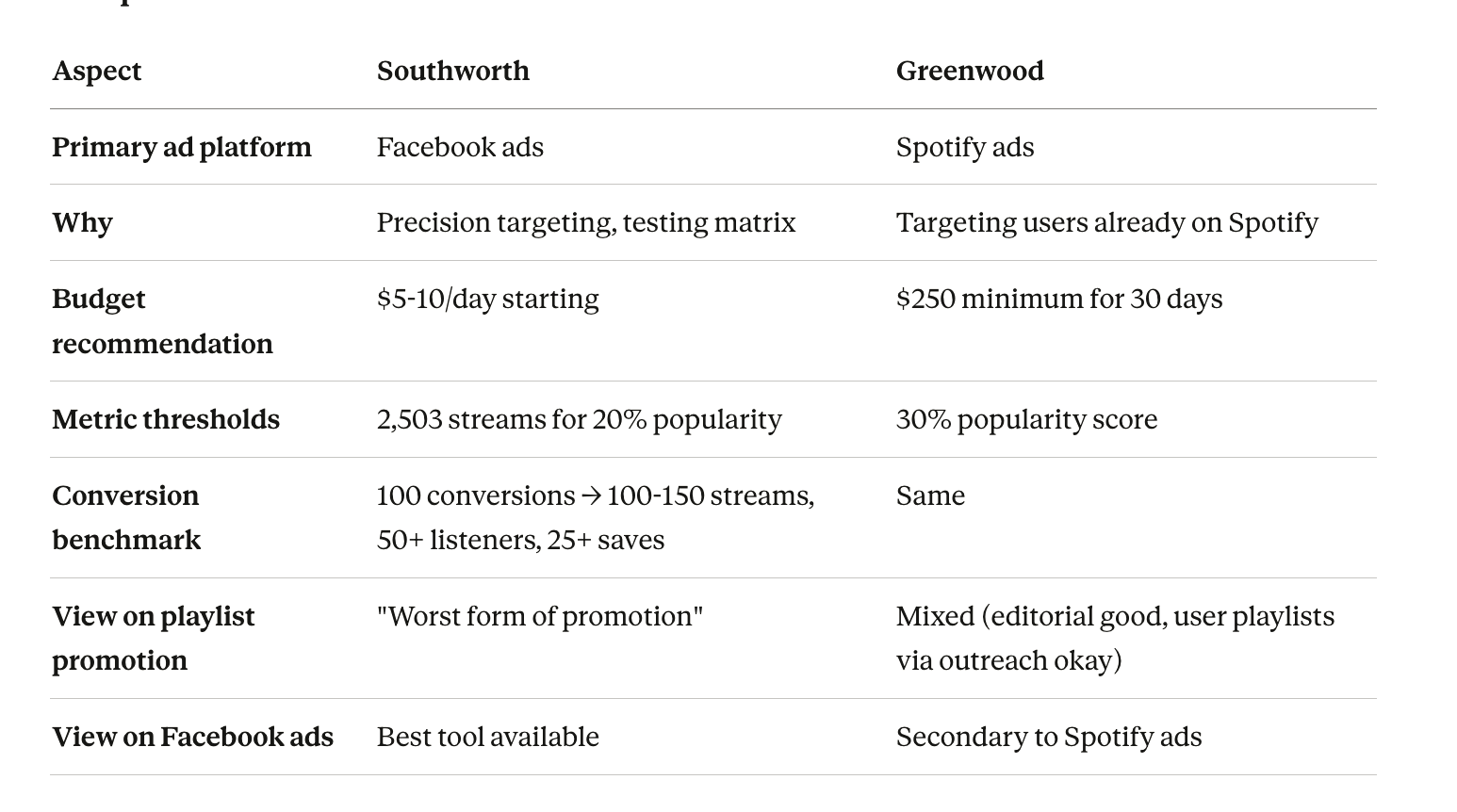
Key Philosophical Difference:
Southworth: “Fish where the fish are” = use Facebook because billions of people are there
Greenwood: “Fish where the fish are” = use Spotify because you want Spotify listeners
Both are right within their frameworks, but they prioritize different parts of the funnel.
Gaps/Assumptions:
$250 minimum may be barrier for new artists: Greenwood mentions this is “doable” but doesn’t address artists who can’t afford $250 upfront. Southworth’s $5/day is more accessible.
Platform availability: Spotify ads not available in all countries. VPN workaround technically violates TOS and requires US credit card (hard to obtain for non-US residents).
“Long game” framing hides short-term pain: “Might not get instant ROI... in the first six months” - How many artists can sustain $500-1,000+ monthly ad spend for 6 months with no return? This requires either savings or other income.
Marquee eligibility catch-22: Need 5K streams in 28 days to access Marquee, but Marquee is pitched as tool to get more streams. How do you bootstrap?
Conversion benchmarks identical to Southworth: Interesting that both authors cite same 100 conversions → 100-150 streams ratio. Suggests this is industry-standard metric, which validates both.
Chapter 9: Spotify Ads for Tours and Shows
Core Claim: Spotify ads can geographically target listeners by city, making them ideal for promoting shows. Run two-ad strategy: Ad 1 (cold audience, music-only) + Ad 2 (warm/hot audience, show-specific).
Two-Ad Strategy:
Ad 1 - Cold Audience, Music Focus:
Target: Cold fans who live in show city (or surrounding cities)
Goal: Get them to listen to your music (warm them up)
Does NOT mention show
Timeline: Run 3 months before show, then again 3-4 weeks before
Ad 2 - Warm/Hot Audience, Show Focus:
Target: Your own fanbase (select your artist name in targeting) who live in show city
Goal: Drive ticket sales
Mentions show details: venue, date, time, VIP options
Timeline: Same as Ad 1 (3 months out + 3-4 weeks out)
Geographic Targeting Strategy:
City Selection Logic:
Primary: Show city
Secondary: Surrounding cities (some fans drive 6 hours for shows)
Tool: Use Google Maps to identify nearby cities/towns
“I’ve had fans drive up to six hours to come see me play, especially if that’s the only show I’m playing in the state”
Example: Show in Toronto → Also target surrounding Ontario cities to maximize reach.
Ad 1 Script Example (Cold Audience):
Same as Chapter 8 music promotion script:
“Hey, this is manifest. If you’re a fan of [similar artist], check out my new song [song name]. Click to listen now.”
Link destination: Spotify playlist (not show page—goal is music discovery first)
Ad 2 Script Examples (Warm/Hot Audience):
Version 1 - VIP Offer: “Hey, what’s up? This is manifest and I’m playing a show in Toronto at [venue] at 9 p.m. on Saturday May 25th. You can get your VIP tickets now, which includes a sign poster plus meet and greet with the band. Just click to learn more now and come party with us.”
Version 2 - Scarcity/Free Gift: “Hey, what’s up? This is manifest. I’m playing a show in Toronto at [venue] at 9 p.m. on Saturday May 25th. The first hundred ticket buyers get a free CD signed by the band at the door. Just click to learn more and get yours free before we sell out.”
Split Testing: Try your voice vs. Spotify’s voice actors to see which performs better.
Landing Page Strategy (ClickFunnels):
Greenwood uses ClickFunnels to build ticket sales pages. Free template at smartmusicbusiness.com/spotify-bonuses.
VIP Ticket Strategy:
What to Include:
Early entry to show
Meet and greet
Photo opportunity
Laminate lanyard
VIP merch shopping (browse before doors open)
Pricing Psychology:
Example: Regular ticket $15, VIP ticket $25
Extra $10 = “really hard to resist when you see all of the bonuses”
“People love feeling like they got a great deal”
Scarcity Tactic: Make VIP tickets limited. When they sell out, raise price for next show.
Why VIP Works:
Higher revenue per sale
Strengthens fan connection (meet and greet builds loyalty)
Free marketing: “What do you think your fans will do if they get a photo with you? They’ll immediately post it on social media, sharing it with all their friends, promoting you even more”
Order Bump Strategy:
Definition: Additional offer on checkout page (one-click upsell)
Concert Application:
Offer: “Bring a friend” ticket for additional $20
Logic: “Who likes to go to a concert alone? Probably nobody, right?”
Result: Increases ticket sales just by being present on checkout page
Other Order Bump Ideas:
T-shirt
CD
Poster
Merch bundle
Timing Principle: “The best time to invite someone to buy something extra is when they already have their credit card out.”
Beyond Book Bonus (Not in original text): Greenwood mentions retargeting ticket page visitors with Facebook/Instagram ads—those who landed but didn’t buy. This creates multi-platform funnel:
Spotify ad →
Ticket page (cold traffic) →
Facebook pixel captures visitors →
Retarget on Facebook/Instagram (warm traffic)
Cross-platform remarketing = “getting even more bang for your buck.”
Using Spotify to Plan Tours:
Data-Driven Tour Routing:
Step 1: Check Spotify for Artists → Audience tab → Cities where you’re popular
Example: Greenwood’s data shows 6 of 7 top cities are in USA → Plan 6-city US tour
Step 2: Sketch route on map connecting cities
Step 3: Research venues in each city
Step 4: Pitch venues with data:
Email: “I’ve got thousands/hundreds of people listening to my music in your city, and my fans would love to see me play there, plus I’ll run Spotify and Facebook ads to make sure fans show up.”
Attach screenshot of Spotify data as proof
Advantages Over Old Model: “I wish I had this kind of data at my fingertips when I was planning tours back in the day, because I played so many new markets where no one had ever heard of me. It makes so much more sense to build the demand up online first as opposed to grinding it out on the road.”
Best Practice: “I suggest only playing cities where you know you have fans via the Spotify data, unless you’re opening up for someone else and pulling from their fan base.”
Scale Advice: “Don’t bite off more than you can chew. Doing a 6 or 7 city tour takes a lot of planning, promotion, and risk. What if you just played one cello show in your biggest city and where you have the most dreams? I’d rather have one killer show that was promoted well with a great turnout than a stressful half-baked tour that was thrown together.”
“Listeners Also Like” Feature for Tour Partnerships:
Strategy: Use Spotify’s “Listeners also like” data to find artists whose fans overlap with yours.
Outreach Email Template: “Hey [artist name], I saw in my Spotify dashboard that my fans also listen to your music. Would you be interested in doing a show or a mini tour together?”
Benefits:
Shared audience = higher attendance
Split costs
Cross-promotion opportunities
Potential for collaboration on new song (double impact: recorded collaboration + live performance)
Local Opener Strategy:
Invite local bands to open (they bring local fanbase)
Or charge them to buy onto show (common practice for international bands)
Comparison to Southworth:
Southworth doesn’t discuss touring at all. His focus is pure streaming growth. Greenwood integrates touring into streaming strategy, using Spotify data to inform tour logistics and Spotify ads to drive ticket sales.
Gaps/Assumptions:
Assumes touring is viable: Many artists (especially in 2020s) find touring unprofitable due to gas, hotels, food, gear transport. Greenwood doesn’t address break-even math.
VIP pricing example may not scale: $15 regular, $25 VIP works for small venues. For 500+ capacity venues, VIP pricing typically 2-3x regular price ($50 vs. $100).
Order bumps require tech infrastructure: ClickFunnels ($97-297/month) + payment processor fees. For artists doing 1-2 shows/year, ROI may be negative.
Data-driven touring assumes concentration: What if your Spotify listeners are evenly distributed across 50 cities with 100 listeners each? You can’t tour profitably to 100-listener cities.
Spotify ads for tour promotion: No case study or data on conversion rates. How many ad impressions → ticket sales? Without this, unclear if Spotify ads are cost-effective for tour promotion vs. local radio, venue mailing lists, social media.
Chapter 10: Spotify Ads for Merchandise
Core Claim: Spotify ads can sell merchandise to warm/hot fans by leveraging the power of “free” (free+shipping offers) and strategic upsells to maximize customer lifetime value.
Target Audience: Warm/Hot Fans Only
Why: Cold fans don’t know you yet, so they won’t buy merch. “Your target for a merch ad is going to be your warm or hot fans. Those folks who already know you, like you, and are therefore more likely to be willing to spend money on your merchandise.”
Targeting Setup: Select your own artist name in Spotify Ad Studio fanbase targeting. Ad plays between tracks when your fans are already listening to your music.
Country Selection: At time of writing, Spotify allows one country per ad. Greenwood always selects USA (majority of his fans).
Threshold Recommendation: “If you don’t have at least 10,000 monthly listeners in one country, then I would suggest you keep running the cold ads to keep building your fanbase and progress into ads for merch later.”
The Power of “FREE”:
“Do you know what the most powerful word is that you can use when marketing anything at all? It’s the word free.”
Free + Shipping Model:
Mechanics:
Give physical item (CD) for free
Fan pays shipping + handling only
Example pricing: $7.97 shipping charge
Economics:
CD production cost: ~$1 each (bulk pressing)
Shipping cost: $2-3 (media mail in USA/Canada)
Charge: $7.97
Gross profit: $3-4 per CD
But: “The secret of making my money isn’t in selling the one CD, it’s in the upsells.”
Upsell Strategy (ClickFunnels):
After customer enters credit card info for free+shipping CD:
Upsell 1: 3 stickers + 10 more songs for $X (one-click add)
Upsell 2: Another merch item (one-click add)
Thank You Page Offer: “Thank you so much for your order because you supported my music, use code friends 20 and get 20% off our store manifestshop.com”
Tech Stack:
ClickFunnels: For sales funnel and one-click upsells
Shopify: For full merch store
Printful: Print-on-demand fulfillment (no inventory, they handle printing and shipping)
Template Access: smartmusicbusiness.com/free-funnel (free templates)
Spotify Ad Script Examples:
Script 1 - Free CD + Poster: “Hey, it’s manifest. Thanks for listening to my music. I’m doing something really crazy right now. For a limited time, I’m giving away my CD plus a free fold out poster. We’ve only got limited quantities so we asked just two orders per household. Click learn more now to get your copy while I still have some left.”
Bolded Words (Scarcity/FOMO):
“free” (CD and poster)
“limited time”
“limited quantities”
“while I still have some left”
Script 2 - Free Shipping on Store: “Hey manifest fans for a limited time any order in the manifest shop will get free shipping. Click learn more now and see some of our brand new designs.”
Free Shipping Economics: “The secret to offering free shipping is that you increase your prices to cover it in a world with Amazon everyone expects free shipping when they buy.”
Alternative Framing: “Hey fans for a limited time get any of our merchandise at a huge discount plus we pay shipping for you.”
Same economics (price baked in)
Different psychological framing (discount + we pay)
Single-Specific Merch Ad:
“Hey it’s manifest if you’re digging my new single [song name] you’re going to love the merch we just created to go with it check it out in our manifest shop dot com.”
Strategy: Create unique merch for each single release (Chapter 6 strategy applied to ads).
Tracking & Optimization:
Promo Code Strategy: “Hey it’s manifest we just got some sick merch done it’s in our manifest shop click learn more now and use code Spotify to get 20% off your order”
Why: Track which ads drive sales. “That’s why when you hear a promotion on the radio within the ad they usually use specific codes for you to use so they can track if their ads are getting a good ROI return on investment.”
Email Service for Fulfillment: Use ActiveCampaign ($9/month for 500 subscribers) to automate email sequence after free+shipping opt-in.
Comparison to Southworth:
Southworth doesn’t discuss merch at all. Entire focus is on streaming growth. Greenwood integrates merch into revenue model—streaming is gateway, merch is monetization.
Revenue Philosophy Difference:
Southworth: Streaming revenue + long-term algorithmic passive income
Greenwood: Streaming revenue + merch revenue + show revenue + email list revenue
Greenwood’s model is more diversified, treating Spotify as one channel in multi-channel business.
Gaps/Assumptions:
Free+shipping only works for lightweight items: CDs and posters work. T-shirts, hoodies, vinyl = much higher shipping costs. Economics break down.
Upsell conversion rates not provided: What percentage of free+shipping customers buy upsells? If it’s 10%, you need high volume to make profit.
ClickFunnels cost not mentioned: $97-297/month. For artist doing one merch campaign/year, this is expensive infrastructure.
Print-on-demand margins are thin: Printful charges ~$15-20 for t-shirt production + shipping. To make profit, you must charge $30+. But Greenwood’s “discount” framing suggests lower prices.
Country restriction limits scale: “At time of writing, Spotify lets you target one country at a time” - if your fans are globally distributed, you need multiple campaigns.
10K monthly listeners threshold: This gates merch ads behind growth metric. But artists with 5K listeners may have highly engaged fanbase willing to buy merch. Threshold may be arbitrary.
No ROI data: Greenwood doesn’t share how much he spends on merch ads vs. revenue generated. Without this, we can’t evaluate if Spotify ads for merch are cost-effective.
Chapter 11: Facebook Ads for Spotify
Core Claim: Facebook ads can drive Spotify streams by reaching massive audiences, but require careful strategy to overcome platform-jump friction. Success requires minimum 30-60 day commitment and $500-600/month to trigger Spotify’s algorithm.
The Platform Paradox:
Greenwood’s “Fish Where the Fish Are” principle seems to contradict itself:
Chapter 8: “We run Spotify ads because we want to fish where the fish are” (on Spotify)
Chapter 11: “Millions of people are using Facebook and Instagram every day” (so fish there too)
Resolution: Use both, but master one first. “Don’t run ads on both Spotify and Facebook until you’ve mastered one first. Otherwise you’ll just burn a bunch of money.”
The Friction Problem (Redux):
Why Facebook ads have higher risk:
Potential fan sees ad on Facebook
Clicks to Spotify
May not have Spotify account
May not be logged in
May not remember password
“You might look at the stats for that ad and see you got a thousand clicks, but you didn’t get a thousand streams”
Why Facebook ads still work:
Massive audience (billions of users)
Sophisticated targeting
Can retarget based on engagement
“I’ve used both those platforms to sell 30,000 plus albums to strangers”
The Goal: “The purpose of running Facebook ads that link to Spotify is to trigger Spotify’s algorithm for a song so that it starts sharing your song automatically.”
Budget Realities:
Starting Budget: $5-10/day
Problem: “So many artists come to market their music and freak out. They’ll think $10 a day on ads is risky, and thousands over an entire campaign is crazy.”
Reframe: “Imagine if you were signed to a label and they said they were only prepared to put a small budget towards marketing and pushing your record. You wouldn’t be happy.”
Resource Allocation Advice: “I’d suggest you do 5 songs for 5,000 and put $10,000 into the marketing” (instead of 10 songs for $10K with $5K marketing).
Trigger Algorithm Minimum: “It only takes about 500 to 600 a month on a good performing Facebook ad campaign to trigger Spotify’s algorithm for a song.”
Math: $600/month = $20/day
Commitment Required: 30-60 days minimum. “Don’t even start Facebook or Instagram ads unless you are willing to commit to a 30 to 60 day campaign minimum.”
Five Steps to Create Facebook Ad:
Step 1: Decide on song to promote (focus on one song)
Step 2: Create 3 different 1-2 minute videos using that song
Use music video (if you have one)
Create lyric video
Cut together live concert footage
Slideshow of images with song
Budget-friendly: Perform at sunrise/sunset for magical backdrop
Select exciting section of song (not full track)
Step 3: Create “This Is [Artist Name]” playlist on Spotify
Add best songs or full catalog
Put promoted song at top (track 1 or 2)
This is different from Spotify’s auto-generated playlist (you control this one)
Step 4: Make list of 4-5 artists you sound similar to
Use Spotify’s “Fans also like” to expand list
Stay within genre
Be honest about similarity
Step 5: Set up Facebook Ad Campaign
Go to facebook.com/adsmanager
Create ad account, add credit cards
Select campaign objective: Link Clicks (not conversions—this is where Greenwood differs from Southworth)
Southworth uses conversion campaigns
Greenwood uses link click campaigns
Greenwood: “Facebook will optimize your ad by showing it to people who are most likely to click on it”
Targeting Setup:
Age Range:
Cold traffic (Spotify streams): 18-55
Selling merch/CDs: 25+ (more likely to have credit card)
Audience Size: Minimum 2 million
Optimization Threshold: “Facebook needs 50 conversions a week minimum for an objective to fine tune”
For link clicks objective: Need 50 clicks/week
Facebook collects data as ad runs, optimizes to show ad only to portion of 2M who are most likely to click
Facebook Pixel: Code placed on website/landing page to track actions (pre-saves, email signups, purchases)
Ad Burnout: “Ads start to burn out when you hit a frequency of 1.5 to 2 which means everyone you’ve targeted has now seen the ad 1 to 2 times”
Sign: Ad costs rising, costs per click increasing
Solution: Have new ad creative ready
Cost Per Click Expectations:
Third World Countries (Philippines, Brazil, Turkey): 1-2 cents per click
Good for split testing ads cheaply
Good for social proof (likes, comments, shares)
Top 5 Markets (USA, Canada, Germany, UK, Australia): 5-11 cents per click
Higher cost but higher conversion quality
“Build a fan base in a country where someone will actually pull out their wallet and purchase something from you one day”
Ad Copy Examples (Greenwood’s Actual Ads):
Example 1: “Most underrated rock artist manifest is giving away 10 of his new songs for free. Download now.”
Breakdown:
“Underrated” = attention-grabbing, polarizing
Called out genre (”rock”)
Value proposition (”10 songs”)
Magic word (”free”)
Example 2: “For fans of Linkin Park check out rock artist manifest and download his hit song Firestarter for free.”
Breakdown:
Social proof (name-drop famous artist)
Genre tag
Magic word (”free”)
Example 3: “Hey rock fans, check out rock artist manifest and download his hit song Firestarter for free.”
Self-Critique: “I probably didn’t need to have rock in there. Probably should have said hey rock fans, check out artist manifest. But I said hey rock fans, check out rock artist. See sometimes I’m not even perfect.”
Pre-Save Ad Strategy:
Problem: “No one wakes up thinking I can’t wait to pre-save a song from an unknown artist.”
Solution - Irresistible Offer:
❌ “Pre-save my song”
❌ “Pre-save my song and get it now”
❌ “Pre-save my song and get it now plus another nine songs”
✅ “Pre-save my song and get it now plus nine other songs and get entered into a contest to an emerged bundle in a $25 Amazon gift card”
Why It Works: “We’ve always got to think from a fans perspective which is along the lines of what’s in this for me.”
Split Testing Strategy:
Always run 2-3 ads simultaneously:
Same daily budget ($10/day split across 2-3 ads)
Facebook allocates evenly first 2 days to test
Then automatically spends majority of budget on best performer
Progressive Testing Method:
Test 2 thumbnails with same ad copy → Pick winner
Test 2 ad copy versions with winning thumbnail → Pick winner
Test winning combo against new thumbnail
Repeat infinitely
“If you try this yourself you’ll find the process never really ends but you keep trying to keep beating your last ad with each one leveling up as you go.”
Success Metrics:
5 Key Things to Monitor:
Cost Per Click:
Third world: 1-3 cents
Top markets: 5-11 cents
Can be cheaper if song/ad is really good
Ad Engagement: Likes, comments, shares, hate comments (engagement is engagement)
Spotify Impact (Most Important):
Increase in streams?
Increase in followers?
Song being added to playlists?
“If people are resonating with your song then you should see a jump in all of these areas”
Creative Elements: If not getting results, test different thumbnail, different video section, different CTA, different targeting
CTR in Ads Manager: “Your goal on Facebook should be 2% and up”
The Algorithm Trigger Timeline:
Critical Rule: “It’s more important in a much wiser strategy to run ads for the full 30 to 60 days spending a consistent budget of $16 plus a day than spending the full 500 in just a few days.”
Why: “We don’t just want a spike, but a continuous feed of streams going to Spotify so they can collect the data and get you on those playlists.”
Patience Required: “Once Spotify realizes you’re getting a good reaction, there’s way more chance you’ll get your song featured in those algorithmic playlists.”
Comparison to Southworth:
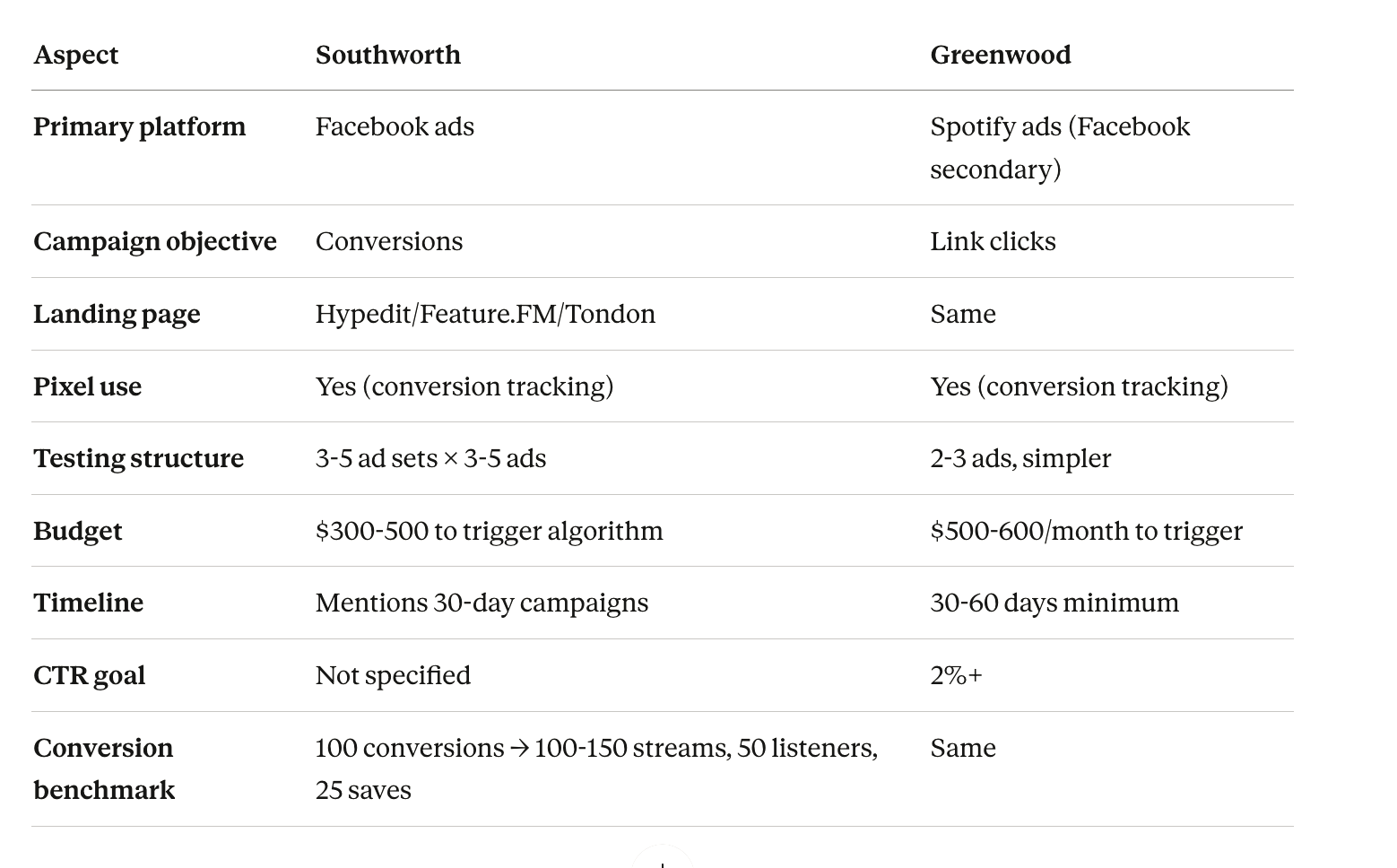
Major Difference - Campaign Objective:
Southworth: Conversion campaigns (optimizes for pre-save/follow action)
Greenwood: Link click campaigns (optimizes for click to Spotify)
This is significant. Conversion campaigns require Facebook Pixel to fire on successful action (email capture, pre-save). Link click campaigns just optimize for clicks. Southworth’s approach is more sophisticated, likely results in higher-quality traffic.
Gaps/Assumptions:
$500-600/month = $6,000-7,200/year per song: Greenwood doesn’t address how many artists can afford this, especially if releasing 8 singles/year (waterfall strategy). That’s $48K-57K in annual ad spend.
“Only takes about $500-600 to trigger algorithm”: This is presented as modest, but for most indie artists, this is 3-6 months of rent.
Link clicks vs. conversions: Greenwood uses link clicks objective while Southworth uses conversions. Southworth’s approach is likely more effective (Facebook optimizes for actual desired outcome, not just clicks). Greenwood doesn’t explain why he chose link clicks.
No A/B test data on Facebook vs. Spotify ads: Which platform performs better for triggering algorithm? Greenwood says Spotify ads are superior but then spends entire chapter on Facebook ads without comparative data.
Platform changes fast: “The Facebook ad platform is changing like every month or two” - This makes book advice ephemeral. Specific tactics described may already be outdated.
2% CTR goal is low: Industry standard for Facebook ads targeting interests (as Greenwood recommends) is 2-5% CTR. Aiming for 2% minimum is reasonable but not impressive.
Hater comments example: Greenwood shows screenshot of negative comment as “proof” ad is working. But engagement ≠ quality. If 100 people comment “this sucks” and 5 people stream, that’s low conversion despite high engagement.
Chapter 12: Beyond Spotify (Email Marketing)
Core Claim: Platform dependency is dangerous. Email is the only owned channel that has persisted for 25+ years, making email list building essential for long-term sustainability.
The Platform Risk Problem:
“What if we wake up tomorrow and Spotify has gone into liquidation in the platform folds? How do we stay in touch with those millions of followers that we’ve worked so hard to gain?”
Platform Mortality:
Facebook, Instagram, Twitter, TikTok, YouTube may not last forever
Internet trends come and go
Email has persisted 25+ years (and counting)
Why Email Wins: “It puts me in control. Once I have that very valuable piece of contact information, I can email or send messages out whenever I want and it’ll land in a fan’s inbox instantly.”
Email vs. Platform Messaging:
Email:
You own the list
Can contact fans anytime
No algorithm decides who sees your message
Can promote anything (new song, tour, crowdfunding, merch)
Spotify:
Platform owns the relationship
Can’t directly message followers
Dependent on algorithmic playlists to reach fans
Limited promotional options
Revenue Reality: “More people buy songs, merch and show tickets via email than they do from ads we place on any platform.”
Email List Building Strategy:
What to Give Away: Full album (not just one song)
Why: “Honestly, if it gets you an email list with thousands of subscribers, it’s worth it.”
The Opt-In Page:
Super simple (no distractions)
Only two actions: Give email to get album, or leave
“The more simple the page, the better”
Tool: DistroKid’s HyperFollow
Collects name + email
Gets pre-save on Spotify (bonus)
Tech Stack:
ClickFunnels for opt-in pages (templates at smartmusicbusiness.com/free-funnel)
Active Campaign for email service ($9/month for 500 subscribers)
NOT WordPress (”A regular website... just isn’t going to cut it here. They’re way more limiting and not designed for what we’re going for”)
Acquisition Strategy: Run Facebook ad offering free album download → Link to opt-in page
Welcome Email Sequence:
Email 1 - Delivery:
Subject: “Music downloads” or “Free music from [artist name]”
Body: “Hey [first name], thanks for listening to my music. Here’s your free download. Just click here [Dropbox link]. Hope you love the music. Make sure you subscribe to my YouTube channel or follow me on Spotify.”
Personal touch: “Share something short and personal about how you got started in music and why it means so much to you that they’re listening to it.”
Soft CTA: “You can add a PS with a link to something you’re selling if you want but be gentle with it at this early stage.”
Email 2 - Welcome Story:
Subject: “Welcome to my world”
“In there I share part of my story, essentially how I came to be a musician.”
Greenwood’s Note on Subject Lines: “Remember if they don’t open your email, they’re not clicking on anything... your goal with any email you send out should be to get it opened and generating curiosity in the subject line is the best way to encourage this.”
End with PS: “Make sure you check out my other albums or online store. I’m very soft with the cell.”
Emails 3+ - Nurture Sequence:
Frequency: Every other day initially
Content:
More stories about music journey
20% off coupon code for store
Behind-the-scenes content
Not overwhelming but staying in awareness
Ongoing Email Strategy (Post-Welcome Sequence):
Frequency: 2x per week
Content Ideas:
New releases
Crowdfunding campaigns
Tour announcements
Behind-the-scenes details from shows
Photos from recording sessions
Personal updates (”photos of your pets”)
Success metrics (”how well your album is doing”)
Even Short Emails Need CTA: If not promoting anything, link to previous Spotify release with nostalgia angle: “Hey, remember this?”
Email Best Practices:
Personality: “Don’t be robotic and don’t be a corporation. Pretend like you’re writing to a friend and add some personality in it.”
ROI: According to Forbes, average expected ROI is $42 for every $1 spent on email marketing.
Automation: Set up drip sequence so welcome emails send automatically when someone joins list.
Comparison to Southworth:
Southworth mentions email list building briefly (giving away music to build list) but doesn’t dedicate a chapter to it. Greenwood makes email the capstone of his strategy, framing it as the antidote to platform dependency.
Gaps/Assumptions:
“More people buy via email than ads”: This is asserted without data. What percentage of email subscribers actually buy? If 1,000 subscribers generate $100 in sales, that’s $0.10 per subscriber. If acquiring those subscribers cost $1 each via ads, ROI is negative.
$42 ROI per $1 spent: This Forbes statistic is general email marketing average (likely for e-commerce). Does it apply to music email marketing specifically? Probably lower for music given lower price points and purchase frequency.
ClickFunnels cost not mentioned again: $97-297/month. For small artists, this is significant monthly overhead.
Active Campaign at $9/month: Only for 500 subscribers. What happens at 1,000? 5,000? Cost scales, which isn’t addressed.
Free album giveaway: Assumes artists have full album recorded. For new artists using waterfall strategy (singles only), what do they give away? Older work? This isn’t addressed.
Email deliverability not mentioned: Gmail, Yahoo, etc. have aggressive spam filters. If your emails land in spam folder, list is worthless. Greenwood doesn’t address deliverability, authentication (SPF, DKIM, DMARC), or list hygiene.
List decay: Email lists decay ~25% per year (people change emails, stop engaging). This requires constant replenishment, which isn’t discussed.
GDPR/CAN-SPAM compliance: Not mentioned. For artists with international audiences, GDPR compliance is legally required.
Final Thoughts Section:
Motivational Close: “I am confident when I say that you can have it all as a contemporary artist on Spotify. If you’re willing to try out the strategies and techniques on these pages...”
Call to Action - Spotify 5 Day Challenge: 10XYourFanbase.com/live-challenge
What You’ll Learn:
Day 1: 7 alarming things before releasing on Spotify
Day 2: 3 hacks to triple chances of editorial/algorithmic playlists
Day 3: Where to find collaborators to 10X royalties
Day 4: How to get 4x more followers using Spotify ads
Day 5: Dirty truth about Spotify royalties + path to six figures without label
Alternative CTA - One-on-One Coaching: SmartMusicBusiness.com/coaching
Best Marketing Advice: “Have a great song. And the best tool I believe you can take into the studio is a great song idea. Songs are what drive the music business and without them the music economy would collapse.”
Final Message: “If you keep creating and you keep marketing and never give up, your star will rise. And I can’t wait to see you soar.”
Bridge Section: Synthesizing Greenwood’s Logical Architecture
The Core Argument Structure
Foundation (Chapters 1-2): Spotify enables recurring revenue model that beats one-time CD sales. Optimize your profile to maximize every fan touchpoint.
Strategy (Chapters 3-5): Release singles using waterfall method. Pitch to editorial playlists using relationship-building. Trigger algorithmic playlists by hitting popularity thresholds.
Tactics (Chapters 6-7): Build genuine fanbase through cold→warm→hot→scorching journey. Accelerate growth via collaborations and covers to tap existing audiences.
Promotion (Chapters 8-11): Use Spotify ads to target active listeners. Use Facebook ads to reach massive audiences despite platform friction. Promote tours and merch to monetize beyond streaming.
Insurance (Chapter 12): Build email list to own your audience independent of any platform.
Internal Consistency & Tensions
Coherent Elements:
Revenue Diversification: Streaming + merch + shows + email
Singles Economy Embrace: All strategies built around single releases, not albums
Relationship Capital: Repeatedly emphasizes building connections (curators, collaborators, fans)
Long-Term Investment: Every strategy requires patience, commitment, financial outlay
Data-Driven Decision Making: Use Spotify analytics to inform tour routing, audience targeting, song selection
Internal Tensions:
Spotify Dependency vs. Email Insurance:
First 11 chapters: Build everything on Spotify
Chapter 12: “What if Spotify folds?” → Pivot to email
Resolution: Email is backup, not primary strategy
But: If Spotify folds, your email list of Spotify fans may not care about music on new platform
“Fish Where the Fish Are” Paradox:
Chapter 8: Fish where fish are = Spotify (users already on platform)
Chapter 11: Fish where fish are = Facebook (billions of users)
Resolution: Master one platform first, then add others
But: This just means “fish everywhere,” not “fish where fish are”
Budget Accessibility:
Repeatedly emphasizes investment (”marketing budget should exceed creation budget”)
Strategies require: $250-500 for Spotify ads, $500-600/month for Facebook ads, $97-297/month for ClickFunnels, $50-100 per curator relationship, $500-5,000 per collaboration
Total for 1 song: ~$2,000-7,000
For 8 songs (waterfall): ~$16,000-56,000 per year
But: Target audience is indie artists who often lack this capital
Resolution: Greenwood says scale recording down to fund marketing, but doesn’t address bootstrapping for $0 budget artists
Quality vs. Quantity:
Says: “It’s better if you release one smash song in a six month period than five mediocre tracks”
Also says: Release every 6-8 weeks (6-8 songs/year) to maintain momentum
Tension: How do you ensure every song in 6-8 week cycle is “smash”?
Resolution: Repurpose existing songs (remixes, acoustics) to maintain schedule
But: Are repurposed versions “smash songs”?
Editorial vs. Algorithmic Priority:
Extensive curator relationship-building for editorial playlists (Chapter 4)
But: “In my experience, it’s the algorithmic playlist that generates the most streams for me” (Chapter 5)
If algorithmic generates more streams, why invest heavily in curator relationships?
Resolution: Editorial playlists provide credibility + initial boost that triggers algorithmic. They’re complementary.
What Greenwood Gets Right
Community Building Emphasis: Greenwood understands music career is built on relationships—with fans, collaborators, curators, fellow artists. The “knock knock method” and collaboration strategies recognize that personal connection >> cold pitching.
Revenue Model Sophistication: Unlike Southworth (streaming-only focus), Greenwood integrates streaming, touring, merch, email. This diversification is realistic for professional artists.
Long-Term Perspective: “3-5 year time horizon” advice is mature. Acknowledges building sustainable career takes years, not months. Counters get-rich-quick mentality.
Honest About Failure Risk: “Most songs will not profit” and “most people that try will fail” are refreshingly honest. No false promises.
Platform Risk Awareness: Email list building (Chapter 12) shows understanding that platform dependency is dangerous. This is sophisticated thinking most music marketing advice lacks.
What Requires Skepticism
Survivorship Bias: Greenwood has 130 million streams, 1 million monthly listeners, industry connections. His strategies may work for him but may not work for artist starting from zero. The “knock knock method” requires relationship capital; collaborations require credibility and budget; ads require significant capital.
Cost Transparency: Book repeatedly mentions costs (ads, collaborations, tech stack) but doesn’t provide ROI calculations or break-even analysis. “It’s worth it” is asserted but not proven.
Sample Size of One: Case studies are all from Greenwood’s own career. No data from students, clients, or other artists using his methods. We don’t know success rate of his strategies when applied by others.
Time Period Context: Book written ~2020-2023. Spotify’s algorithm, ad platforms, and market saturation have changed. Strategies that worked in 2020 may not work in 2025. For example:
Spotify Discovery Mode just finished beta (may change rules)
Facebook ad costs have increased
TikTok has emerged as major discovery platform (not addressed)
Ethical Gray Areas:
Sending $400 cologne + gifts to curators (is this pay-for-play with extra steps?)
Paying for collaborations (is this authentic artistry or purchased credibility?)
Using scarcity tactics in ads (”limited time,” “while supplies last”) when supplies are infinite (digital music)
Accessibility Gap: Strategies assume:
Access to capital for ads and collaborations
Time for relationship building, content creation, profile optimization
Technical skills for ClickFunnels, Active Campaign, Spotify pitch system
Artistic flexibility (genre consistency for algorithmic categorization may constrain creative vision)
For many independent artists, these assumptions don’t hold.
Comparison to Southworth - Key Philosophical Differences
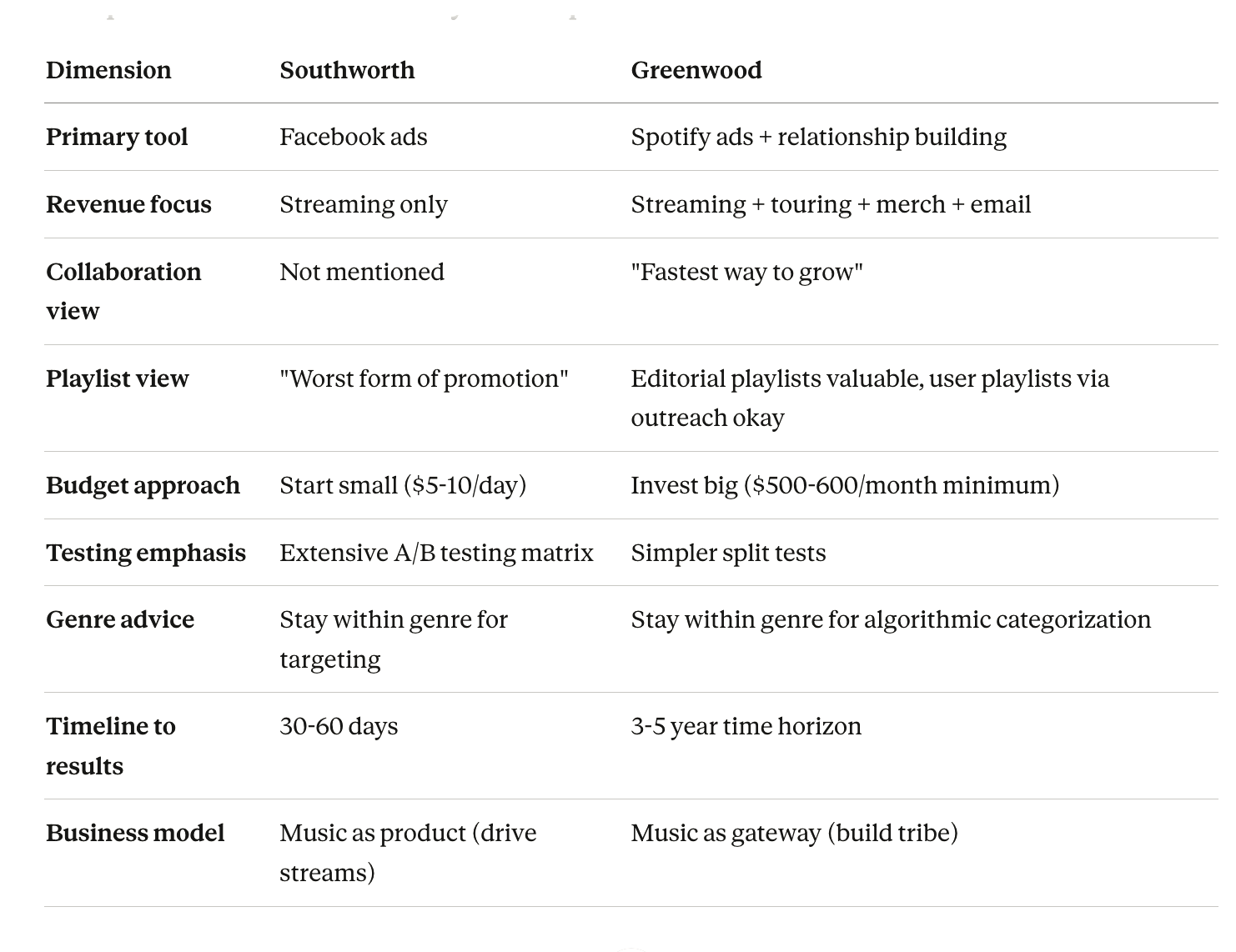
Deepest Difference:
Southworth is Facebook ads specialist applying digital marketing to music. Focus is optimization, testing, conversion funnels.
Greenwood is musician-turned-marketer applying music industry relationships to digital tools. Focus is community, collaboration, long-term career building.
Both work, but for different artist types:
Southworth: Good for artists comfortable with data, testing, ad platforms
Greenwood: Good for artists comfortable with networking, relationship building, multiple revenue streams
What the Book Reveals About Music Industry Economics (2020-2023)
The New Normal:
Success requires paid advertising (organic reach is dead)
Algorithmic playlist placement is gatekeep by metrics, not just quality
Artists must be marketers, not just creators
Streaming revenue alone is insufficient; diversification required
Platform dependency is dangerous; owned channels (email) essential
The Barrier to Entry:
Minimum viable marketing budget: $2,000-7,000 per song
For sustainable career (8 songs/year): $16,000-56,000 annual marketing spend
This gates professional music career behind significant capital
The Survivor’s Toolkit:
Data literacy (Spotify for Artists analytics)
Technical skills (ClickFunnels, email automation, ad platforms)
Business acumen (budgeting, ROI calculation, funnel optimization)
Relationship capital (curator connections, collaboration network)
Content production (videos, graphics, social media)
Patience (3-5 year horizon)
This is fundamentally different from music industry pre-2010s, when talent + label connection + radio play could build career. Now: talent + capital + technical skills + marketing expertise + patience.
The Unasked Questions
What about artists who can’t afford this? Book doesn’t address DIY marketing for $0-500 budget. All strategies require significant capital. For broke artist, what’s the path?
What about genres that don’t fit algorithmic mold? Experimental, avant-garde, genre-blending artists may not have “similar artists” to target or playlists to fit. Does waterfall strategy work for them?
What about artists who don’t want to be marketers? Book assumes artists should spend 50% of time on marketing. But some artists just want to make music. Is there still a path to success?
What about market saturation? If all artists follow this playbook, competition intensifies. Ad costs rise. Curator inboxes overflow. Collaboration rates increase. Does the system collapse under its own success?
What about platform algorithm changes? Spotify could change popularity thresholds, prioritize different metrics, or limit ad access. Facebook could ban music ads. ClickFunnels could shut down. How fragile is this system?
Part 2: Full Literary Review Essay (1,800-2,500 words)
The numbers arrive as testimony: 130 million streams, 156,000 followers, $3,185.75 from 1,043,477 plays of a single song. Chris Greenwood (performing as Manifest) has built a career on Spotify’s streaming economy, and Spotify Profits 2.0 documents the mechanics of that construction with the precision of someone who knows exactly which levers to pull. This is not artistic advice—it’s industrial engineering for the music business, a blueprint for converting songs into revenue streams through systematic manipulation of algorithmic recommendation systems, curator relationships, and advertising platforms. The question worth asking is whether Greenwood’s blueprint can bear the weight of evidence, and whether the strategies that worked for him can transfer to the artists he addresses: independent musicians trying to build careers without label backing, touring infrastructure, or significant capital.
Greenwood opens with economic reframing. Where musicians traditionally saw Spotify’s $0.003 per stream as insulting, he sees recurring revenue potential. The math: one song generating 5,000 daily streams = $15/day = $450/month = $5,400/year in passive income. Scale to 20 songs at this rate and you reach $108,000 annually—just from master recording royalties, not including publishing. This passive income model is Greenwood’s North Star, the justification for every marketing dollar spent. But the calculation assumes sustained daily streaming, which requires sustained algorithmic placement, which requires hitting specific popularity thresholds, which requires meeting save rate and repeat listen benchmarks, which requires driving the right kind of traffic through the right kind of promotional methods. It’s a chain of dependencies where each link must hold or the whole structure collapses. Greenwood knows this chain well—he’s navigated it successfully—but the book’s structure sometimes obscures how many things must go right simultaneously for the model to work.
The waterfall release strategy forms Greenwood’s structural spine. Release singles every six to eight weeks rather than dropping full albums. Pitch each single to Spotify’s editorial curators with comprehensive marketing plans. Build momentum cumulatively so that by album release, you’ve already touched fans eight times instead of once. The logic is sound and the evidence is personal: Greenwood’s album I Run With Wolves released seven singles over several months; five landed on editorial playlists; the title track “Break the Habit” pulled 475,000 streams in three months, with 252,000 (53%) coming directly from playlist exposure. The two album tracks that weren’t released as singles? Tens of thousands of streams, not hundreds of thousands. The gap is stark: 80% fewer streams for songs that didn’t get dedicated promotional campaigns. This is the waterfall method’s validation—measurable, dramatic proof that singles-focused strategy outperforms album drops.
But the validation comes with asterisks. Greenwood’s evidence is his own career, not a representative sample. He had industry connections from his time as a signed artist, technical skills from years of experimentation, and enough capital to test multiple approaches before finding what worked. The waterfall strategy assumes artists can sustain six-to-eight-week release cycles, which means recording, mixing, mastering, and creating artwork/videos for 6-8 songs per year. For many independent artists, this production velocity is unattainable without significant budget. Greenwood suggests repurposing existing songs—remixes, acoustic versions, instrumentals—to maintain schedule, but this creates tension with his other principle: “It’s better if you release one smash song in a six month period than five mediocre tracks.” Are repurposed versions smash songs? The book doesn’t reconcile the quality-versus-quantity tension that the waterfall strategy creates.
The editorial playlist pitching chapter reveals Greenwood’s most controversial tactic: the “knock knock method” for curator relationships. The system is systematic seduction—follow curators on social media, comment supportively on their posts for a week, then send DM thanking them, then send song link, then mail physical packages (chocolate, Starbucks gift cards, items reflecting their social media interests) with handwritten notes, then follow up every other week with emails, DMs, two more packages, even phone calls. Greenwood emphasizes what he calls the critical step: “99% of artists give up” at the follow-up stage. His advice: “Be willing to do what 99% of what most artists won’t do so you can have what 99% of artists will never have. I have a million monthly listeners because I was willing to do this stuff.”
This is relationship-building 101, but it occupies ethical gray area. Spotify’s terms of service explicitly prohibit paying for playlist placement. Greenwood’s method doesn’t technically violate this—he’s not paying curators for placement, he’s building relationships that influence placement decisions. But sending $400 cologne (his radio promotion story), multiple gift packages, and persistent outreach over months isn’t substantively different from payment; it’s just payment disguised as relationship cultivation. The distinction matters legally but less so ethically. More practically, this approach requires significant capital ($50-100 per curator across multiple curators), time (weeks of social media monitoring and outreach per relationship), and relationship capital (credibility to be taken seriously rather than dismissed as pest). For the broke artist sending their first cold pitch, this method is inaccessible.
Greenwood’s discussion of algorithmic playlists is where the book’s analytical strength emerges. He explains Spotify’s three-tier algorithm—collaborative filtering (primary), web crawling (secondary), audio analysis (tertiary for major artists only). He details how behavioral data drives recommendations: skip rates, save rates, repeat listen rates, playlist additions, social shares. He identifies the popularity score threshold (30% popularity index) that triggers Discover Weekly consideration. He explains why Release Radar requires seven days advance notice and how performing well in the first week can expand Release Radar placement beyond your followers. This is solid reverse-engineering of black-box systems, and while Greenwood has no insider access to Spotify’s actual code, his understanding aligns with how recommendation engines generally function. The weakness is lack of sample size—he references patterns observed across “hundreds” of client campaigns but doesn’t provide aggregate data, success rates, or confidence intervals. When he says “songs tend to get algorithmic release radar pushes when the popularity index of a song is about 20%,” we don’t know if this holds for 70% of songs or 90% or 30%.
Comparison to Andrew Southworth’s approach reveals philosophical divergence. Southworth, a Facebook ads specialist, builds entire strategy around conversion campaigns driving Spotify traffic. He dismisses playlist promotion as “the worst form of promotion” because playlist listeners are passive (low save rates, high skip rates). Greenwood dedicates entire chapters to playlist cultivation—both editorial (through curator relationships) and user-curated (through organic outreach). Where Southworth sees playlists as algorithm-poisoning passive traffic, Greenwood sees them as viable audience-building tools if approached correctly. Both cite similar conversion benchmarks (100 ad conversions should generate 100-150 streams, 50+ listeners, 25+ saves), suggesting shared understanding of what quality traffic looks like, but they prescribe different methods for generating it.
The divergence extends to budget philosophy. Southworth recommends starting at $5-10 per day and scaling based on results. Greenwood recommends $250 minimum for 30-day Spotify ad campaigns, or ideally $500-600 per month for Facebook ads to trigger algorithmic response. For eight singles per year (waterfall strategy), Greenwood’s approach requires $4,000-4,800 annually minimum just in ads, not including collaboration fees ($500-5,000 per feature), technical infrastructure (ClickFunnels at $97-297/month), or curator gift packages. His advice that “marketing budget should always be higher than the creation budget” makes financial sense—unpromoted music earns nothing—but assumes capital availability that many independent artists lack. The book never addresses bootstrapping for artists with $0-500 total budget.
Greenwood’s most pragmatic insights involve revenue diversification. Unlike Southworth’s streaming-only focus, Greenwood treats Spotify as gateway to wider monetization: touring (use Spotify data to identify fan-concentrated cities), merchandise (free+shipping offers with upsells via ClickFunnels), email list building (own your audience independent of platform), and collaborations (instant access to collaborator’s fanbase). The collaboration chapter is particularly strong, providing pricing guidelines ($500-5,000 depending on artist size), negotiation tactics (never pay full amount upfront), and technical requirements (list collaborator as primary artist, not featured artist, or Release Radar won’t trigger for their followers—a mistake Greenwood made himself and transparently documents). His regret story about missing collaboration with artist who later reached 13 million monthly listeners demonstrates intellectual honesty; he shows failures alongside successes.
But the collaboration economics reveal the book’s central tension: Greenwood’s strategies are high-capital, high-time-investment approaches that assume artists have resources and patience. Paying $2,000 for feature from mid-tier artist is “some of the best marketing dollars you’ll ever spend” if that artist’s fanbase converts to your streams. But if 40,000 listeners see collaboration and only 500 stream your song, and those 500 generate 2,000 total streams ($6-10 in royalties), the ROI is catastrophically negative. Greenwood argues the value comes from long-term audience building—those 500 listeners might become hot fans who buy merch and attend shows—but he provides no data on conversion rates from collaboration exposure to engaged fandom. We’re asked to trust that the investment pays off eventually, but “eventually” could be years, and many artists can’t afford years of negative cash flow.
The Spotify ads chapter advances Greenwood’s “fish where the fish are” principle—target users already on Spotify, already logged in, already listening to music. The logic is clean: Facebook ads create platform-jump friction (user must have Spotify account, remember password, actually follow through), while Spotify ads eliminate that friction. But then Greenwood dedicates entire next chapter to Facebook ads, describing them as viable despite friction, requiring just $500-600 per month to trigger Spotify’s algorithm. The “fish where fish are” principle becomes “fish everywhere,” which is reasonable advice (use multiple platforms) but undermines the original reasoning. If Facebook ads work despite platform friction, maybe friction wasn’t the determining factor. If Spotify ads are superior because of platform targeting, why invest heavily in Facebook ads? The book doesn’t resolve this clearly.
The email marketing chapter functions as capstone and escape hatch. After eleven chapters building everything on Spotify, Greenwood asks: “What if we wake up tomorrow and Spotify has gone into liquidation in the platform folds?” The email list becomes insurance against platform dependency—you own the email addresses regardless of which platforms rise or fall. This is sophisticated thinking most music marketing advice ignores. But the strategy comes late and feels underdeveloped. How do you convert streaming listeners to email subscribers? Greenwood suggests Facebook ads offering free album downloads in exchange for email addresses, then nurturing subscribers via ActiveCampaign. But the economics aren’t detailed. If acquiring email subscriber costs $2 (Facebook ad conversion), and average subscriber generates $0.50 in lifetime value (merch purchases, crowdfunding support), the model bleeds money. The Forbes statistic he cites—$42 ROI per $1 spent on email marketing—is general e-commerce average, likely inflated for music context where transaction frequency is lower and average order values are smaller.
The book’s treatment of Spotify Discovery Mode reveals how quickly tactical advice ages. Discovery Mode allows artists to opt songs into increased Radio and Autoplay placement in exchange for 30% commission on recording royalties from those sources (all other streams commission-free). Greenwood describes dramatic results: 109,385 new listeners, 268% listener lift, 27,695 listeners who’d never streamed his music before. He calls it “freaking awesome” and recommends immediate adoption. But Discovery Mode was finishing beta testing when book was written. Terms could change. Eligibility requirements (song must be streamed in Radio/Autoplay in last 7 days to qualify) create catch-22: if you’re not getting Radio/Autoplay streams, you can’t use Discovery Mode to get more Radio/Autoplay streams. How do you bootstrap? Greenwood doesn’t address this, and the feature’s newness means long-term effectiveness is unknown. Will artists who adopt early benefit more? Will saturation reduce effectiveness? We don’t know.
Methodologically, the book’s primary weakness is sample size of one. Every case study draws from Greenwood’s career. He mentions “hundreds of campaigns” run for clients but provides no aggregate data, success rates, or demographic breakdowns. We don’t know if his strategies work for artists in different genres (he’s rock/metal), different countries (he’s Canada/USA-focused), or different scales (he started with label backing and industry connections). The absence of control groups makes causation claims suspect. When Greenwood’s song hits Discover Weekly after he runs ads, is it because he ran ads or because the song was strong enough to perform well organically? Split testing across multiple songs would illuminate this, but the book provides no such data.
The book’s greatest conceptual strength is recognizing that music career success requires business infrastructure, not just artistic talent. Greenwood treats artists as CEOs of their own companies, emphasizing delegation (hire virtual assistants for playlist research), diversification (streaming + touring + merch + email), and long-term investment (3-5 year horizon). This business-first mindset is rare in music advice literature, which often valorizes pure artistry or treats marketing as necessary evil. Greenwood embraces marketing as co-equal to creation: “The marketing budget should always be higher than the creation budget unless you’re doing this as a hobby.” For artists serious about professional music careers, this reframing is valuable even if specific tactics don’t all work.
The book’s greatest ethical ambiguity involves the line between relationship-building and pay-for-play. Sending $400 cologne to radio programmers, mailing gift packages to Spotify curators, paying $5,000 for collaboration features—these aren’t bribes in legal sense, but they’re not pure merit-based success either. They’re relationship capital and financial capital converting into exposure capital. This is how business works across industries (corporate gift-giving is standard practice), but in music there’s particular sensitivity around authenticity and artistic merit. Does paying for feature make collaboration less authentic? Does sending gifts to curators corrupt the editorial process? Greenwood doesn’t engage these questions directly; he treats them as practical necessities of music business. Maybe that’s mature realism. Maybe it’s ethical corner-cutting. The book doesn’t provide framework for evaluating the distinction.
The audience targeting reveals another tension: the book addresses struggling independent artists but describes strategies requiring significant capital and industry sophistication. This creates advice that’s simultaneously empowering (you can build sustainable career without label) and gatekeeping (but only if you have $15,000-50,000 annual marketing budget plus technical skills plus relationship capital). The artists who most need career guidance—those with no budget, no connections, no business experience—will find least of book immediately actionable. The artists who can execute these strategies—those with capital and experience—probably least need the book. This doesn’t make advice wrong, but it clarifies who it’s truly for: artists in middle tier who have some resources and want systematic optimization rather than complete beginners needing foundational guidance.
Ultimately, Spotify Profits 2.0 succeeds as industrial documentation and fails as universal strategy. Greenwood has clearly figured out how to navigate Spotify’s recommendation systems, curator relationships, and advertising platforms to build sustainable streaming income. The specifics he provides—budget recommendations, technical tools, relationship-building tactics, email automation sequences—are more actionable than typical music marketing advice. But the high-capital, high-sophistication requirements limit accessibility. The lack of aggregate data from other artists means we’re trusting one person’s success story without knowing whether it generalizes. The ethical ambiguities around pay-for-influence go unaddressed. And the platform dependency throughout (build everything on Spotify, Spotify, Spotify... then oh by the way, build email list because platforms might disappear) suggests even Greenwood doesn’t fully trust the foundation his strategies require.
The book works best as tactical manual for artists who’ve already achieved modest success (10,000+ monthly listeners, $5,000+ marketing budget, basic technical competency) and want systematic approach to scaling. For that audience, the specifics on editorial playlist pitching, waterfall release timing, collaboration pricing, and ad platform optimization provide clear next actions. For artists starting from zero, the book describes a mountain they’ll need to climb before these strategies become relevant. Greenwood knows this mountain exists—he climbed it himself—but the book focuses on what to do at higher elevations rather than how to start the ascent. That’s not dishonest, just limiting. The real test won’t come from reading the book but from watching whether artists who implement these strategies achieve similar results, and whether the economics hold as more artists follow the playbook and competition for curator attention, collaboration spots, and algorithmic placement intensifies. Greenwood built success in music streaming economy; whether his blueprint transfers to others remains open question the book can’t answer but time will.
Tags: Spotify algorithm optimization, independent artist marketing strategy, music streaming monetization, editorial playlist pitching tactics, Chris Greenwood Manifest