

Oli Howe is doing everything right.
Ninety-six thousand monthly listeners and climbing. Top markets in London, Sydney, Melbourne, Los Angeles, New York — every one of them a high per-stream rate city, every one a premium-subscription-heavy market where the royalty arithmetic works in an artist’s favor. Forty-four and a half percent of his listeners arriving through playlists, meaning the algorithm has been fed clean enough signal to do its job. Eight hundred and thirteen total playlist appearances. A 9% month-on-month listener growth rate. Estimated royalties of between $393 and $1,571 per month from 16,787,131 total streams — a per-listener yield that is meaningfully higher than any artist this series has previously examined.
By every metric this series has used to evaluate whether an artist’s relationship with the platform is working, Oli Howe’s is working. The Focus Score logic holds: genre-coherent placements in high-value markets generating behavioral signal the algorithm can compound. The compounding is happening. The trajectory is real.
This is the article where the arithmetic is not the problem.
What Nu Jazz Is Made Of
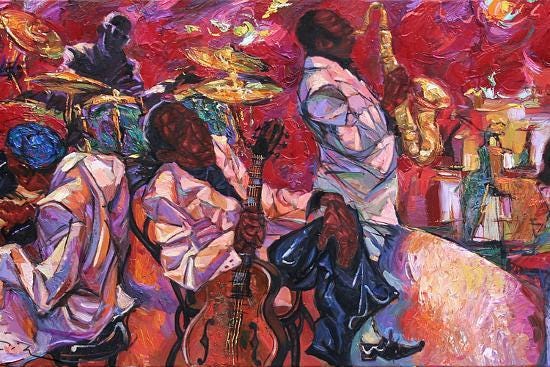
Nu jazz does not arrive from nowhere. It arrives from Miles Davis recording Kind of Blue in a single session in 1959 with musicians who were paid a flat fee and signed away the recording’s future earnings to Columbia Records. It arrives from Herbie Hancock building the harmonic language of jazz fusion across a decade of Blue Note recordings, then watching Head Hunters become one of the best-selling jazz albums in history while the industry structure around him captured the majority of what that sale generated. It arrives from Weather Report, from Mahavishnu Orchestra, from the entire lineage of Black American musicians who invented the vocabulary — the specific chord voicings, the rhythmic displacement, the relationship between electric instrumentation and jazz improvisation — that makes a genre called nu jazz legible to a listener in 2025.
It arrives from UK acid jazz in the late 1980s and early 1990s — Galliano, the Brand New Heavies, Incognito, the Talkin’ Loud label roster — a movement built explicitly on the Black American jazz and soul tradition, translated into a British context, and released on independent labels whose ownership structures did not always flow back to the communities whose music had been translated. It arrives from the Brownswood Recordings catalogue, from Gilles Peterson’s decades of curation, from the specific cultural infrastructure that kept jazz alive as a living rather than archival form during the years when the mainstream music industry had largely written it off.
Oli Howe records nu jazz and jazz fusion. His music is intelligent, formally serious, and genuinely connected to this lineage — the playlist placements reflect it, the audience reflects it, the genre tags reflect it. None of this is a criticism of him or his work. It is a description of what his work stands on.
The question this article is asking is not whether he deserves the platform’s attention. He does, and it is giving it to him. The question is what the platform owes — and to whom — for the tradition that made his music possible.
What the Platform Was Built On
Spotify launched in 2008 on a catalog largely assembled through licensing deals with major labels — the same labels whose ownership structures had, for decades, systematically captured the value generated by Black American musicians while returning a fraction of it to the people who created it. The jazz catalog on Spotify is vast and extraordinary. Miles Davis. John Coltrane. Charles Mingus. Thelonious Monk. Herbie Hancock. Wayne Shorter. Many are available. Many generate streams. Many of those streams generate royalties.
The royalties flow to whoever owns the masters.
For recordings made before 1972 — which covers the majority of the foundational jazz canon — US copyright law did not protect sound recordings at the federal level. State laws applied inconsistently. The Music Modernization Act of 2018 extended some protections, but the ownership question was already settled long before 2018. The masters belong to whoever acquired them — which, for most of the twentieth century’s jazz recordings, means labels that acquired them through contracts that artists signed under conditions of limited bargaining power, incomplete legal representation, and an industry structure that had been explicitly designed to keep ownership out of the hands of the people whose creativity generated the value.
Miles Davis does not receive streaming royalties from Kind of Blue. His estate does not. Columbia Records — now Sony Music — does. The arithmetic that this series has spent four articles explaining, the arithmetic that determines whether an independent artist in 2025 can build a career from streaming income, was built on top of a foundation whose ownership was extracted from the people who laid it.
This is not Oli Howe’s fault. It is not Spotify’s fault in any simple sense, either — the platform licensed what existed and built what the market allowed. But it is the context inside which every conversation about algorithmic fairness, playlist coherence, and the democratization of music discovery has to be placed. The tools are more accessible than they have ever been. The tradition those tools draw on was built by people who never had access to the ownership structures the tools now reward.
What the Algorithm Can and Cannot Do
The collaborative filtering algorithm that is currently compounding Oli Howe’s audience is doing something genuinely useful. It is finding listeners in London and Los Angeles and Sydney who have self-selected for the sound he makes, generating behavioral signal that points toward more of them, building the kind of compounding audience trajectory that this series has argued is the difference between a career that grows and one that stalls.
It is doing this because enough genre-coherent playlist placements fed it the right signal. The Musinique Focus Score logic applies here exactly as it does in every previous article: genre-coherent audiences produce clean behavioral data, clean behavioral data produces useful collaborative filtering profiles, useful profiles produce compounding.
What the algorithm cannot do is reach back.
It cannot find the listeners who would have streamed Miles Davis’s electric period more if his estate had received the royalties that would have funded promotion. It cannot redirect a percentage of every nu jazz stream to the estates of the musicians whose harmonic vocabulary makes nu jazz possible. It cannot correct the ownership structures that determined, decades before streaming existed, who would benefit when the music finally became universally accessible. It is a recommendation engine. It recommends. It does not redistribute.
This is not a criticism of the algorithm. It is a description of its limits. The algorithm is a tool. Tools do what they are pointed at. The question of what the tools should be pointed at — of who benefits when the tradition becomes infrastructure — is not a question the algorithm is capable of answering. It is a question that requires people with power over funding, licensing, and platform policy to answer on purpose, or to leave unanswered by default.
Leaving it unanswered by default is itself a choice.
Two Platforms, Same Genre, Different Inheritance
Consider two streaming platforms launching a nu jazz editorial playlist with the same $50,000 promotional budget, the same algorithmic infrastructure, the same audience targeting capability.
Platform A builds the playlist from the contemporary catalog — living independent artists making nu jazz and jazz fusion in 2025, selected by Focus Score coherence, promoted to high per-stream markets, optimized for behavioral signal quality. The playlist compounds. The algorithm learns. The artists on it — including artists like Oli Howe — generate income that flows to people who own their masters. The tradition is served by its contemporary practitioners. The platform grows its nu jazz audience and monetizes it effectively.
Platform B does the same thing, and also allocates 20% of the editorial budget to a companion playlist built from the foundational catalog — the Herbie Hancock recordings whose ownership has been contested, the Miles Davis estates whose royalty flows have been documented as inequitable, the soul-jazz and acid jazz artists whose contributions to the genre are acknowledged in every nu jazz press kit ever written and compensated in almost none of them. Platform B uses its licensing leverage to negotiate better royalty terms for those estates. It treats the tradition as infrastructure worth maintaining rather than as a free resource to build contemporary value on top of.
Platform A is every streaming platform that has ever existed. Platform B does not yet exist. The difference between them is not algorithmic. It is intent. It is whether the people who control the platform decide that the tradition is their responsibility as well as their resource.
What Musinique Measures — and What It Cannot
The Musinique Curator Intelligence Database was built to answer the question that determines whether an independent artist’s career compounds or stalls: which playlists have the genre-coherent audiences whose behavioral responses will teach the algorithm the right things. It answers that question. For Oli Howe, the data shows an artist already well-positioned — 44.5% playlist-driven listeners, high per-stream markets, clean signal, real compounding. The Focus Score logic is working. The recommendation for his next release is to protect what is working, identify the highest-coherence placements in the existing 813 appearances, and target the playlists whose audiences are generating the strongest save rates rather than chasing follower count.
What the database cannot measure is the debt the genre carries. It can tell you which playlist has the most coherent nu jazz audience. It cannot tell you what is owed to the musicians whose recordings those audiences were trained on. It can optimize the signal. It cannot redistribute the value.
This is not a limitation of the database. It is a limitation of what data can do. Data can show you where the audience is and how to reach it. It cannot decide that reaching it creates an obligation to the tradition that made the audience possible. That decision requires something the algorithm does not have: a moral position.
The Honest Ceiling — and the Question Above It
This series has ended every article with the same honest ceiling: data access does not fix structural endogeneity, does not reverse geographic concentration in a single release cycle, does not close the gap between what the platform was built to reward and what it actually delivers to independent artists. The self-inflicted damage is fixable. The structural damage requires something more than a Focus Score.
This article has a different ceiling. The self-inflicted damage for Oli Howe is minimal — he is already doing the things this series recommends. The structural damage is not his to fix. What sits above the ceiling here is not a recommendation to an independent artist. It is a question for the platform, for the labels that control the foundational catalog, and for the curators and playlist builders who draw on the tradition every time they program a nu jazz playlist without asking what the tradition is owed.
The algorithm found Oli Howe. It is doing its job. The compounding is real. The career is building on solid signal in exactly the markets where it generates the most value.
The musicians who built the vocabulary he works in did not have access to the ownership structures that would have let them benefit from what they built. Some of their estates still do not. The platform that is currently serving Oli Howe so effectively is built, in part, on top of that.
The tools can be pointed more fairly. The only question is whether anyone with the power to point them decides that the tradition is worth more than the free resource it has always been treated as.
It is. And the artists who know it most intimately — the ones currently building careers on top of it — are the ones best positioned to say so.
Oli Howe’s streaming and listener data current as of April 2026, sourced from Chartmetric. Historical context regarding music industry ownership structures, pre-1972 sound recording copyright, and the Music Modernization Act of 2018 drawn from public record. Per-stream rate differentials by geography based on publicly available research into Spotify’s royalty pool distribution. The two-platform comparison is a hypothetical model constructed for illustrative purposes. All Musinique Focus Score statistics reflect the database as of March 2026 — 5,859 playlists, 84 curators, 36,000+ unique tracks.