

There is a moment — documented by forensic music industry analysts and named in the 2025–2026 fraud literature as the “Confusion Window” — that lasts somewhere between five and fifteen seconds. A listener, following a jazz pianist they have loved for years, opens Spotify on a Friday morning and sees a new release. The title is unfamiliar. The production sounds wrong. The tempo is off, the instrumentation alien, the voice not quite matching the voice they remember. And yet they wait. They give it thirty seconds. They assume the artist is experimenting.
That assumption is the crime.
Not metaphorically. The moment a listener crosses the thirty-second threshold on a fraudulent track attributed to an artist they follow, a royalty is triggered. Money moves. It moves away from the legitimate artist whose reputation drew the click, and toward whoever uploaded a file using that artist’s name. The Confusion Window is not a psychological curiosity. It is the engine of a fraud model generating returns exceeding 7,000 percent per release cycle.
And it is not an edge case. It is a documented, systematic exploitation of the architecture Spotify built to connect artists with the audiences who love them.
The Recipe: How to Steal From an Artist in Eight Steps
You do not need to be a programmer. You do not need to break into anything. You need an afternoon, a credit card, and the willingness to use a dead musician’s name.
Step 1. Open Spotify. Find an artist with 10,000 to 30,000 followers — a jazz pianist, a folk singer, a regional legend with a devoted older audience and no full-time digital manager. Copy their Spotify Artist URI from the URL bar. It is public. It costs nothing.
Step 2. Open Suno or Udio. Generate a track in a vaguely similar genre. It does not need to be good. It needs to be thirty-one seconds long.
Step 3. Open DistroKid. Pay the annual fee — approximately $25 for unlimited uploads. Create an account. No identity verification is required beyond an email address.
Step 4. Upload the track. When prompted to identify the artist, paste the URI you copied in Step 1. Check the Terms of Service box confirming you have the rights to release this material. You do not have those rights. Check the box anyway.
Step 5. Submit. DistroKid delivers the track to Spotify with the targeted artist’s metadata attached. Spotify’s ingestion engine treats the distributor as a trusted partner. The track appears in the artist’s discography within 24 to 72 hours.
Step 6. Do nothing. On Friday morning, Spotify’s Release Radar algorithm fires automatically. Between 2,500 and 6,000 followers of the artist you have never met receive a push notification: your artist released something new. They open it. They wait. They give it thirty seconds.
Step 7. Collect. At $0.004 per stream, 10,000 streams generates $40. Against your $0.50 amortized upload cost, your return on investment is 7,900 percent. Spotify’s royalty payout cycle runs on an eight-week delay. The average fraudulent track takes three to eight weeks to be reported and removed. The timing is, by design or accident, nearly perfect.
Step 8. Repeat. There are thousands of artist URIs. There is no limit on DistroKid uploads. There is no second checkbox.
This is not a hypothetical. This is the documented operational model of the 2025–2026 fraud wave, reconstructed from distributor policies, platform architecture, and forensic analysis of confirmed cases. Every step above is legal until Step 4, where it becomes fraud. Steps 5 through 8 are executed entirely by the platforms.
How a Notification Becomes a Theft
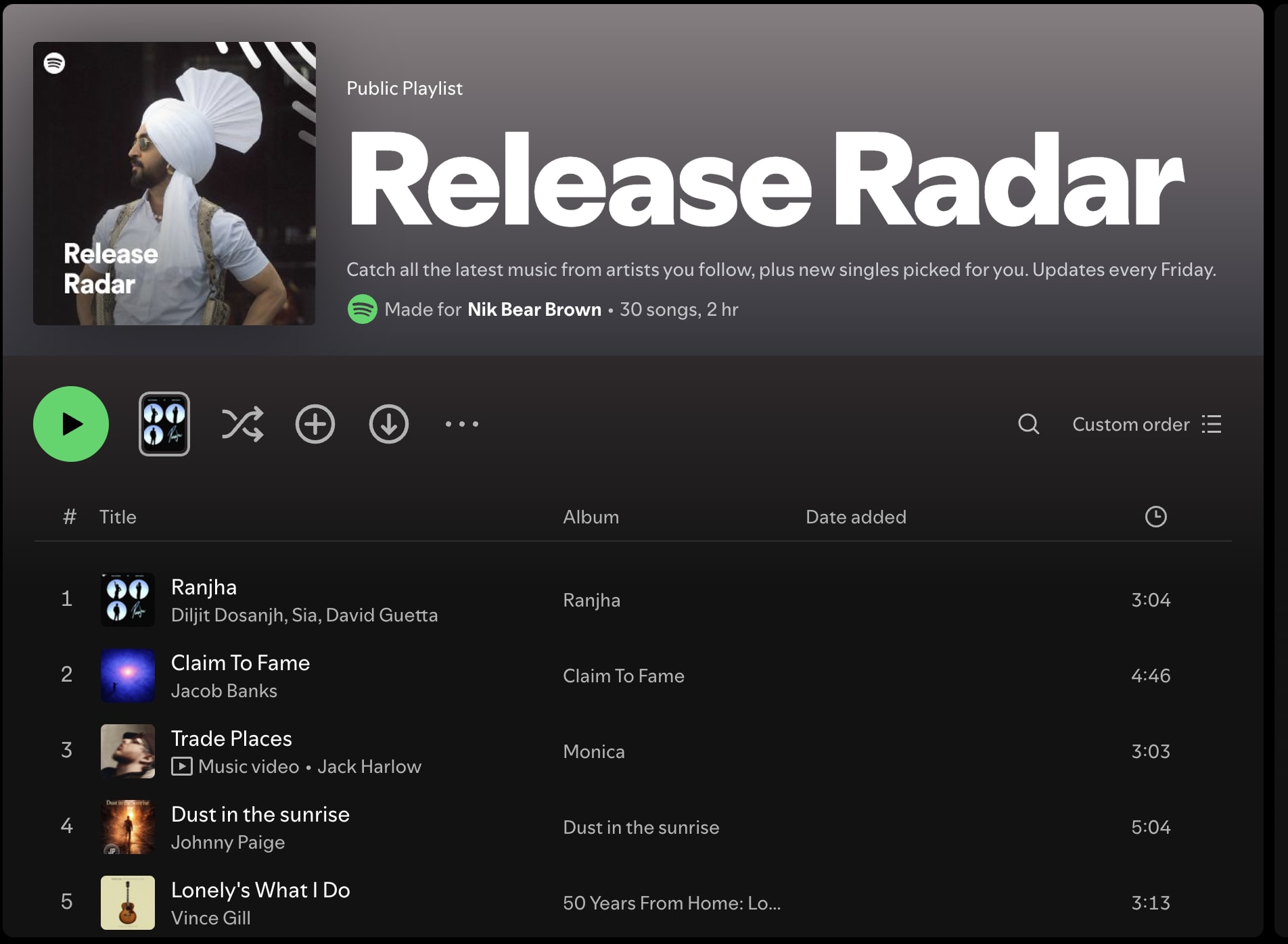
To understand how this works, you have to understand what Release Radar actually does. It is not a playlist in the conventional sense. It is an automated notification system: every Friday, every user who follows an artist receives a personalized feed of new releases from those artists. Unlike editorial playlists — New Music Friday, for instance — Release Radar requires no human curation. It fires automatically, algorithmically, the moment a new track is mapped to a followed artist’s profile.
The vulnerability is in that mapping. The distributor’s verification of that claim? A Terms of Service checkbox.
When a distributor like DistroKid or TuneCore delivers a track to Spotify, they submit metadata that includes what is called a Spotify Artist URI — a unique identifier for the artist’s profile. Spotify’s ingestion engine trusts the distributor. The URI is treated as authoritative. If the metadata says this track belongs to Benny Green, the platform adds it to Benny Green’s discography and queues it for Release Radar delivery to everyone who follows him. No cryptographic proof of identity. No comparison of the submitting account to the artist’s verified management. No human review. A checkbox. And once the track is in the system, the Release Radar wheel turns automatically, generating thousands of push notifications and emails to listeners who have no reason to doubt what the platform is telling them: your artist released something new.
For a jazz musician with 15,000 followers, that notification reaches between 2,500 and 6,000 listeners in the first week. At Spotify’s average payout of $0.003 to $0.005 per stream, 10,000 streams generates approximately $40. Against an amortized cost approaching $0.50 per upload in an industrial-scale operation, the return on investment exceeds 7,000 percent. And because Spotify’s royalty payout cycle runs on an eight-week delay, and because the average fraudulent track takes three to eight weeks to be identified and removed, the first wave of payments is often already processing before the takedown completes.
The math is not incidental. The math is the point.
The Platform That Was Designed to Be Exploited
It would be convenient to locate this problem entirely in the malice of individual bad actors. Scammers are real. Their operations are documented. But the scammers did not design this system. Spotify did. DistroKid did. The entire high-volume, low-friction distribution pipeline that transformed music publishing in the 2010s was built on the assumption that frictionlessness was a virtue — that removing barriers to upload was the same as democratizing music. What it actually removed was the accountability layer.
Consider the distributor incentive structure. DistroKid charges an annual subscription fee for unlimited uploads and takes zero percent of royalties. TuneCore takes a 20 percent commission on social platform revenue. Every new uploader is paying revenue. Every additional track generates no additional cost to the platform, and in some models, additional commission. The distributor has a structural financial interest in volume — which means a structural financial interest in not implementing identity verification that would slow the upload pipeline.
The platform wasn’t designed to be defrauded this way. It was designed in a way that makes fraud economically rational — which, at scale, produces identical results.
Spotify is not a passive victim, either. Under the pro-rata royalty model, fraudulent streams dilute the total payout pool rather than enlarging it — meaning legitimate artists lose, not Spotify directly. But there is a secondary metric that Spotify cares about deeply: engagement. A Release Radar notification sent to a follower of Benny Green that gets opened and results in thirty seconds of listening is thirty seconds of time-in-app, regardless of whether the track was real. That metric counts. In the perverse logic of engagement optimization, a fraudulent track that successfully captures thirty seconds of a genuine fan’s attention is, from the platform’s perspective, a successful interaction.
This is a description of incentive misalignment. The incentive structure selects for these outcomes — which means it selects, deliberately or not, for these victims.
The Artist Whose Name Is the Product
Abbey Lincoln is dead. She died in 2010. Nat Adderley died in 2000. These artists cannot monitor their own profiles. They cannot log into Spotify for Artists and review their discography for anomalies. They cannot file reports, revoke permissions, or update their metadata. Their estates may or may not have the capacity to engage in ongoing digital forensics across every streaming platform.
This is not a coincidence. The 2025–2026 fraud wave has specifically targeted jazz artists with high-authority brands — decades of critical reputation, devoted older audiences, the kind of listener who associates an artist’s name with a particular quality of experience — but limited digital infrastructure. A thirty-year-old with 50,000 TikTok followers has more real-time awareness of what is happening on their streaming profiles than the estate of a legendary recording artist with 25,000 Spotify followers and no full-time digital administrator.
The scammers know this. The targeting is not random. It is economically rational. You target the follower base that will generate the most streams with the least detection risk. You target the artists whose audiences will wait the longest before skipping — the listeners who have thirty years of earned trust to overcome before they hit the button. You target the dead, because the dead cannot file reports.
The system has been built, in practice, to require the victim to initiate their own protection. The platform delivers the fraudulent content. The distributor accepted the fraudulent claim. The listener was exploited. The artist’s estate discovers the problem through fan reports or their own Release Radar. Then the burden of removal falls on whoever can navigate a support portal and wait three to eight weeks for a response.
This is not a technical failure. It is a moral one, dressed up as a process gap.
What the Law Has Noticed and What It Has Not Fixed
The legislative response to the 2024–2026 fraud wave is real — and structurally insufficient.
Tennessee’s ELVIS Act, effective July 2024, was the first legislation to explicitly prohibit AI voice cloning without authorization. The NO FAKES Act, reintroduced federally in 2025, proposes a forty-eight-hour notice-and-takedown mechanism and potential strict liability for platforms designed or promoted to facilitate unauthorized replicas. These represent genuine recognition that personality rights — the right of an artist and their estate to control how their name and voice are used — require explicit legal protection in the streaming era.
But laws are reactive by definition. The ELVIS Act does not prevent a track from being uploaded, triggering Release Radar, crossing the thirty-second threshold, and generating royalties before it is reported. The NO FAKES Act’s forty-eight-hour takedown provision, if passed, would represent a significant improvement over the current removal window — but forty-eight hours is still forty-eight hours of an artist’s audience being served fraudulent content as though it were legitimate.
The regulatory conversation has, appropriately, focused on the product: the fake voice, the unauthorized likeness. What it has not fully addressed is the pipeline: the distributor’s role as an unverified gatekeeper, the platform’s role as an automatic delivery system, and the economic structure that makes neither party directly accountable for the harm caused. The proposed solutions worth taking seriously are technical, not legal: mandatory two-factor authentication for URI mappings; AI-based stylistic fingerprinting that compares a new upload against an artist’s existing profile before Release Radar fires; real-time estate authorization portals with approval and denial rights over new submissions. These are not complicated to implement. They are simply not yet required.
What Is Actually Being Stolen
The royalty capture is real. The economic model is documented. But the deeper loss is harder to quantify and more important to name.
Release Radar works because listeners trust it. They trust it because, for years, it has meant something: an artist I follow made something new, and this platform is telling me about it. That trust is not Spotify’s to own. It belongs to the relationship between the artist and the listener — to decades of Benny Green records, to the weight of Abbey Lincoln’s catalog, to the specific emotional investment a fan makes when they press follow. The fraud does not just steal royalties. It consumes that trust as fuel.
Every time a listener waits through fifteen seconds of an AI-generated country track on a bebop pianist’s profile, wondering if this is an experiment or an archive, something is spent. Not something they can name. But something. The Confusion Window is not just a payment mechanism. It is a small erosion of the confidence that tells you: the platform is showing you something real.
When enough of those erosions accumulate, something changes in how listeners relate to their own feeds. They become skeptical. They stop trusting the notification. And the thing that was actually valuable about Release Radar — the direct, low-friction connection between an artist and their audience — becomes the casualty.
The scammers found a vulnerability in a notification system. What they are actually exploiting is the residue of thirty years of an artist’s work. The thirty-second wait is trust. And it is being liquidated, systematically, at $0.004 per stream.
If you’ve encountered a fraudulent release under an artist you follow, report it through Spotify’s support portal — and share this piece with someone who needs to understand why it keeps happening. This is the first installment in the Musinique Research Trilogy’s public reporting series. The fraud model doesn’t end with Release Radar.
<iframe width=”560” height=”315” src=”
title=”YouTube video player” frameborder=”0” allow=”accelerometer; autoplay; clipboard-write; encrypted-media; gyroscope; picture-in-picture; web-share” referrerpolicy=”strict-origin-when-cross-origin” allowfullscreen></iframe>
<iframe data-testid=”embed-iframe” style=”border-radius:12px” src=”
width=”100%” height=”352” frameBorder=”0” allowfullscreen=”“ allow=”autoplay; clipboard-write; encrypted-media; fullscreen; picture-in-picture” loading=”lazy”></iframe>
Nik Bear Brown is Associate Teaching Professor of Computer Science and AI at Northeastern University and founder of Musinique LLC and Humanitarians AI (501(c)(3)). The Musical Endogeneity research trilogy — examining Spotify’s popularity score architecture, the perceptual boundary between human and AI music, and the economics of algorithmic momentum — is ongoing research conducted through Humanitarians AI. More of his work lives at skepticism.ai and theorist.ai.
Tags: Spotify, Music Industry, Streaming Fraud, Independent Artists, Platform Accountability