

The Song the Algorithm Chose
There is a moment in early childhood developmental psychologists have documented it, parents have felt it without being able to name it when a child stops being an audience for music and becomes a participant in it. Somewhere between eighteen months and three years, the passive listener who bobs their head becomes the small person who demands the same song seventeen times in a row, who melts down when you skip to the next track, who has opinions about which version is correct. This is not stubborn. It is the auditory cortex doing what it was built to do: find the pattern, locking onto the rhythm, demanding the repetition that builds the neural pathway.
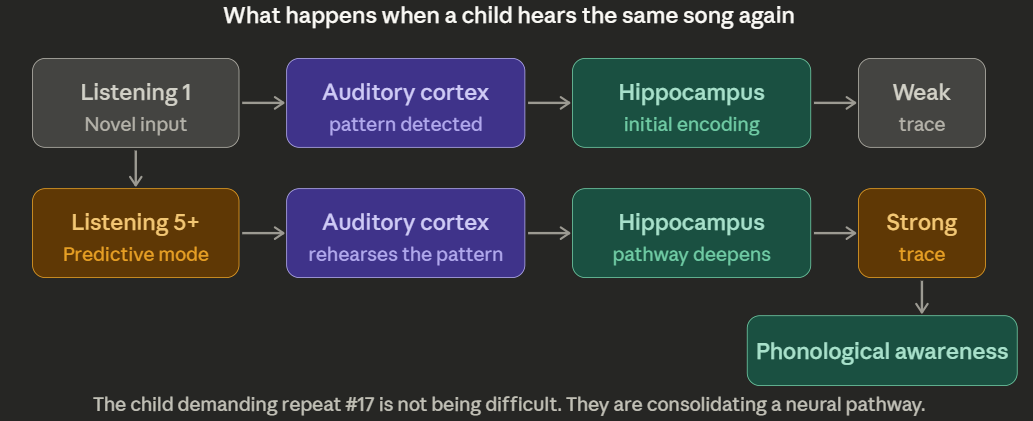
The child who insists on “Baby Shark” for the forty-third consecutive time is, neurologically speaking, doing their homework.
What the child is doing, and what the song is doing to the child, are questions the 2026 children’s music market has begun to take seriously more seriously, and with more scientific sophistication, than at any previous point in the medium’s history. The result is a landscape genuinely worth examining: not because it has solved the problem of what children need from music, but because it has gotten far enough to reveal, with unusual clarity, the problem it has not yet thought to ask.
What the Market Has Learned
The neurodevelopmental case for music in early childhood is not new. What is new is the industry’s willingness to build products from it. The 2 Hz rhythmic pattern that magnetoencephalography research has linked to optimal infant speech processing the delta pulse that, when present in music, correlates with larger vocabularies at 24 months has moved from academic paper to production decision. Jack Hartmann’s “Scientific Method Song” encodes the ASITCI inquiry sequence (Ask, State, Identify, Test, Collect, Interpret) into a groove precisely because melody bypasses the cognitive load of memorization. The handwashing songs calibrated to 20–30 seconds exist because someone did the microbiology and designed backward from the pathogen kill time.
Danny Go!’s dominance in the movement-music space is the most striking evidence that the market has absorbed the embodied cognition research. “Tiger Island” and “The Floor is Lava” are not simply entertaining; they require children to respond physically to auditory cues in real time, building bilateral coordination the crossing of the body’s midline that underlies hemisphere connectivity and training impulse control through freeze mechanics. When the song says stop, the child must stop. That is not a game. That is the prefrontal cortex being asked to override the motor system on a musical cue, which is precisely the neural workout that predicts self-regulation capacity years later. Danny Go! figured this out and built a YouTube channel around it. The children voted with their bodies.
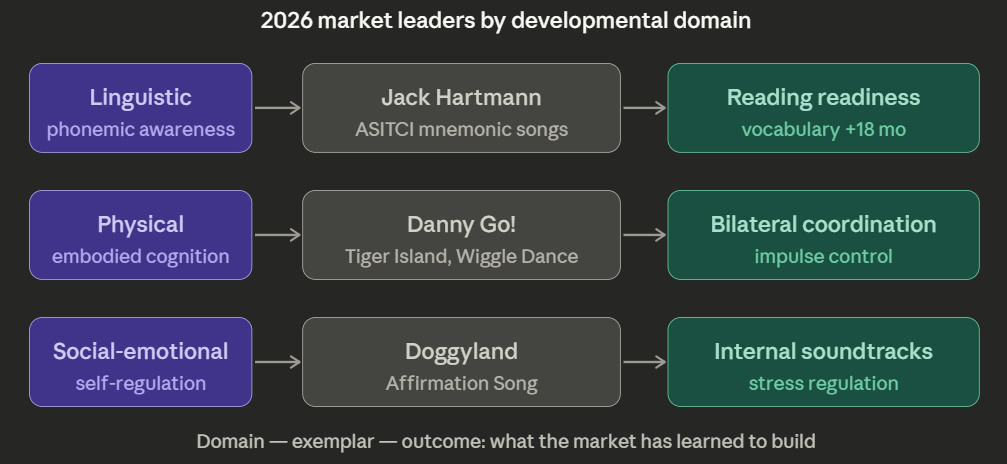
Snoop Dogg’s Doggyland catalog represents a different kind of sophistication: the recognition that social-emotional learning songs fail when they talk down to children and succeed when they treat the emotional content as seriously as any other curriculum. The “Affirmation Song” “I believe in myself, my feelings matter, I get better every single day” functions as what developmental psychologists call an internal soundtrack, a verbal sequence that children can replay during high-stress moments to regulate their own arousal. The production quality is deliberate: hip-hop rhythms, genuine vocal performances, visual diversity in the cast. The implicit argument is that a preschooler’s emotional education deserves the same production investment as their language acquisition.
Baby Shark, meanwhile, is neither an accident nor a cynical marketing exercise. Its 115 BPM tempo sits close enough to a resting child’s heart rate that entrainment is nearly automatic. Its cumulative structure Baby, Mommy, Daddy, Grandma, Grandpa teaches sequencing and family hierarchy through a mechanism that requires no instruction. It is, in a narrow technical sense, a nearly perfect preschool song.
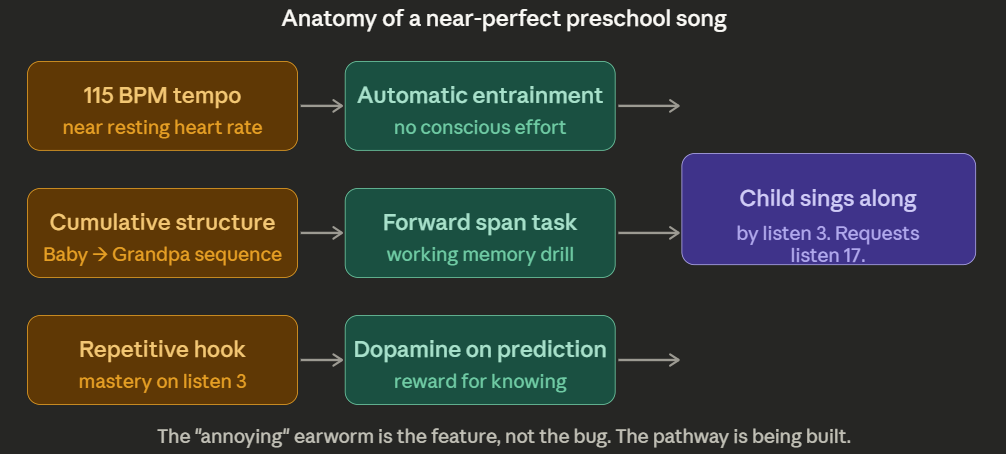
The fact that it became the most-viewed video in YouTube history is not a mystery. It is an experiment that ran at global scale and produced a result.
What Repetition Actually Does
The 3–5 year old’s famous insistence on hearing the same song again is the hinge on which this entire body of work turns, and it is worth pausing on what is actually happening neurologically when a child demands repetition that adults find punishing.
Repetition in early childhood music is not boredom; it is consolidation. Each pass through a familiar melody activates the hippocampus in a predictive mode the brain is not receiving new information, it is rehearsing the pattern it has already begun to encode, deepening the groove. This is why the research on phonemic awareness and musical exposure is so robust: the /sp/ cluster in “speckled,” the /gl/ in “glug,” the alternating consonant pairs in nursery rhyme structures these sounds, repeated hundreds of times across dozens of listenings, build the amplitude rise-time processing capacity that underlies phonological awareness, which remains the strongest single predictor of reading ability at school age. The child is not listening to “Five Little Speckled Frogs” for entertainment. The child is learning to read.
The cumulative structure that makes “Old MacDonald Had a Farm” endure across generations is doing cognitive work that looks nothing like the song’s cheerful surface. As the animal list lengthens, the child must hold the entire sequence in working memory, update it with each new addition, and retrieve it in order. This is a forward span task dressed as a farm song. The neurological demand is real. The joy is also real. The pedagogical achievement is that the two are indistinguishable.
What the contemporary market has gotten right is recognizing that the “annoying” quality of preschool music the earworm, the repetition, the impossibly simple melody that lodges in the adult brain and will not leave is not a bug in the design. It is the feature. A song that a child can master completely, that holds no more surprises after the tenth listen, is a song that has done its job. The neural pathway is built. The parent’s suffering is the cost of their child’s language acquisition.
The Question the Market Has Not Asked
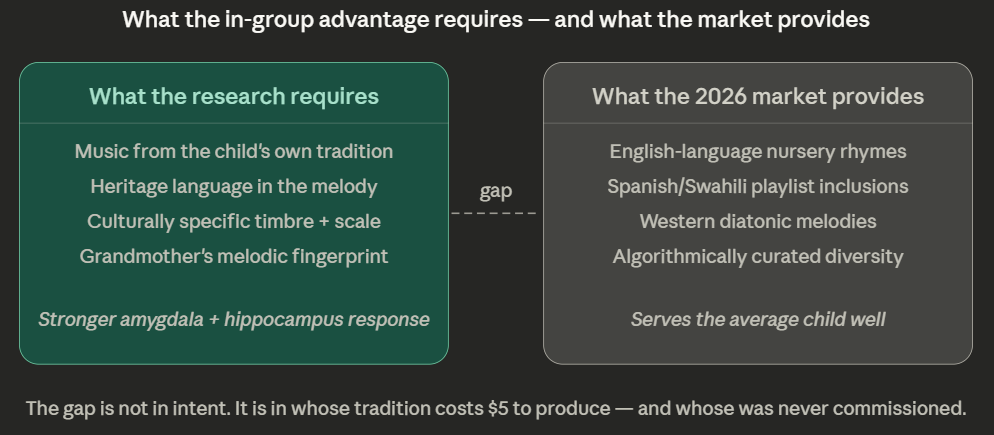
The 2026 children’s music landscape has made a serious and partially successful attempt to serve what the research identifies as the universal requirements of early musical development: rhythmic predictability, embodied engagement, phonemic diversity, narrative resolution, emotional validation. Sesame Street’s research methodology the fifty-year body of work demonstrating that educational multimedia built from developmental science could deliver measurable cognitive gains at scale has finally found a streaming-era heir.
The gap is not in the science. The gap is in a finding the market has noted but not yet acted on with full seriousness: cultural specificity produces measurably stronger neurological responses than equivalent culturally generic content. The in-group limbic advantage the documented difference in amygdala and hippocampal activation when a child encounters music from their own cultural tradition versus an unfamiliar one is not a soft preference finding. It is the difference between music that reaches the nervous system and music that reaches only the ear.
The 2026 market has gestured toward this. Dual-language songs where verses alternate between English and Spanish appear on curated playlists. Swahili greeting songs show up in inclusive classroom collections. These are not nothing. They are acknowledgments that the problem exists.
They are not solutions to the problem. A playlist that includes “Jambo Bwana” alongside forty English-language tracks is not the same as a body of professionally produced educational music engineered from the Swahili oral tradition. The child of the Kikuyu-speaking grandmother in Nairobi is not served by the former. The child of the Tagalog-speaking grandmother in Manila is not served by the former. The child whose family carries a musical tradition that the Western children’s music industry never had reason to fund is not served by gestures toward global inclusion.
The economics, until very recently, made this an unanswerable problem. A single professionally produced educational track cost between $75,000 and $150,000 to commission at broadcast quality figures that represent the institutional minimums that organizations like Sesame Workshop or the BBC could justify, and that no individual family, community music program, or cultural preservation project could approach. The cost was not a barrier that required effort to overcome. It was a wall.
The wall has come down. AI music production tools now generate professional-quality tracks at approximately $5 per song. This is not an incremental improvement. It is the removal of the economic argument for exclusion and with it, the exposure of the question the market’s economics previously allowed it to avoid: whose children were we always willing to serve, and whose were we waiting until it was affordable?
The answer, it turns out, was never about cost. The market has had years since the cost collapsed to flood the gap with culturally specific educational music for the traditions the Western industry left behind. The songs that could finally be produced that could give the child whose grandmother sings in Patois the same research-grade musical infrastructure as the child whose grandmother sings in English have not materialized from the industry at scale. What has materialized, in isolated and remarkable instances, is the work of researchers and nonprofits who understood what the cost collapse meant and pointed the new tools accordingly.
This is the unfinished sentence at the center of an otherwise impressive body of work. The market knows what makes a great preschool song. It has built several. The question of whose great preschool song gets built, and whose grandmother’s lullaby gets reconstructed, and which children sit in the back row staring at the wall because the music on the playlist is not their music that question has not been answered by the industry’s scientific sophistication.
It has only been made more visible.
Tags: preschool educational music 2026 analysis, cultural specificity in-group limbic advantage children, Baby Shark neurological design repetition, AI cost collapse children’s music equity, Danny Go! Doggyland embodied cognition SEL