

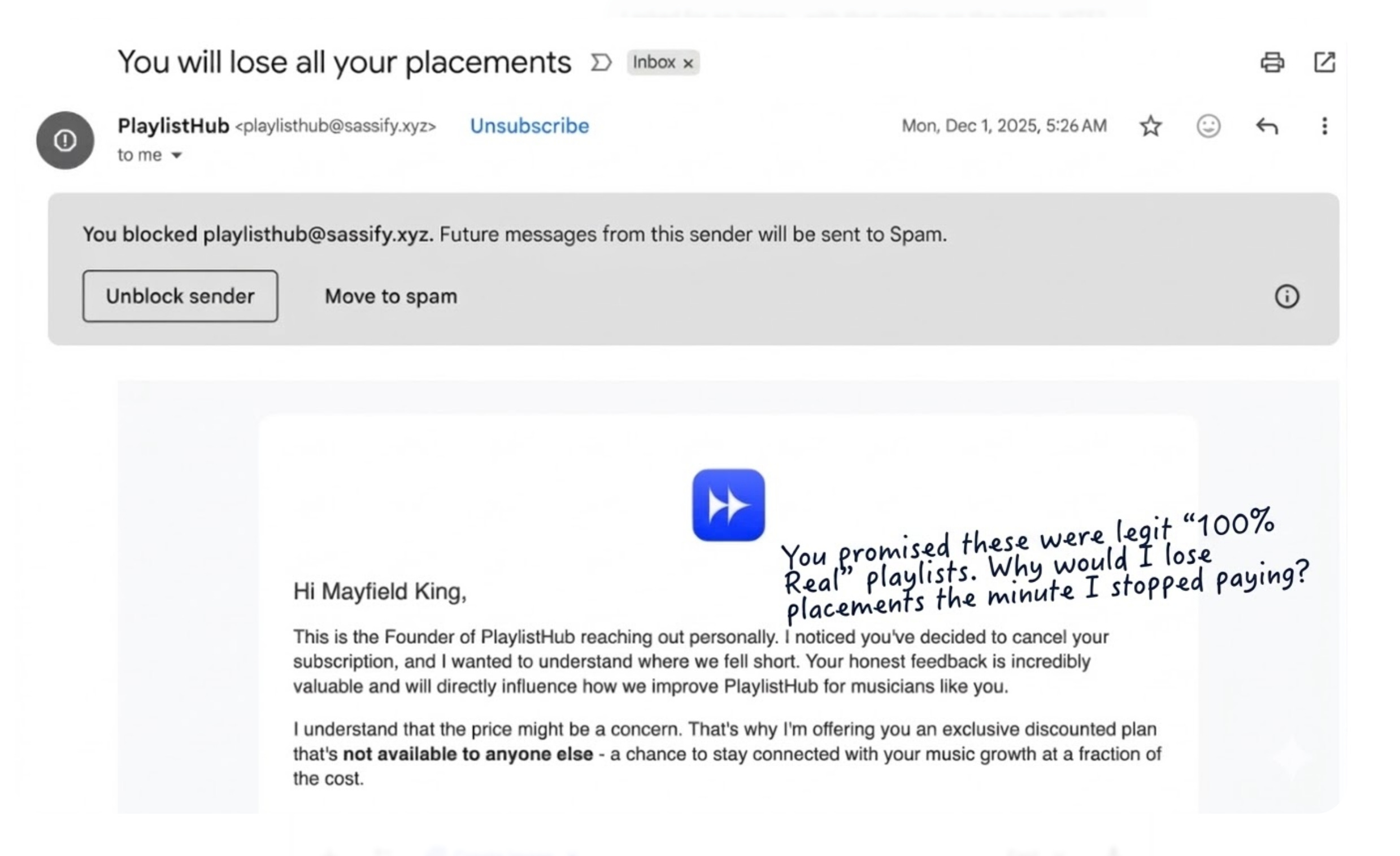
There is a specific kind of industry grift that works precisely because it arrives at the right moment. You have real music. You have built something. You want it heard — not by bots, not by ghosts clicking through a queue in Brazil while no one listens, but by a human being who might save the track, come back to it, tell a friend. That is not an unreasonable thing to want. It is, in fact, the entire point of making music.
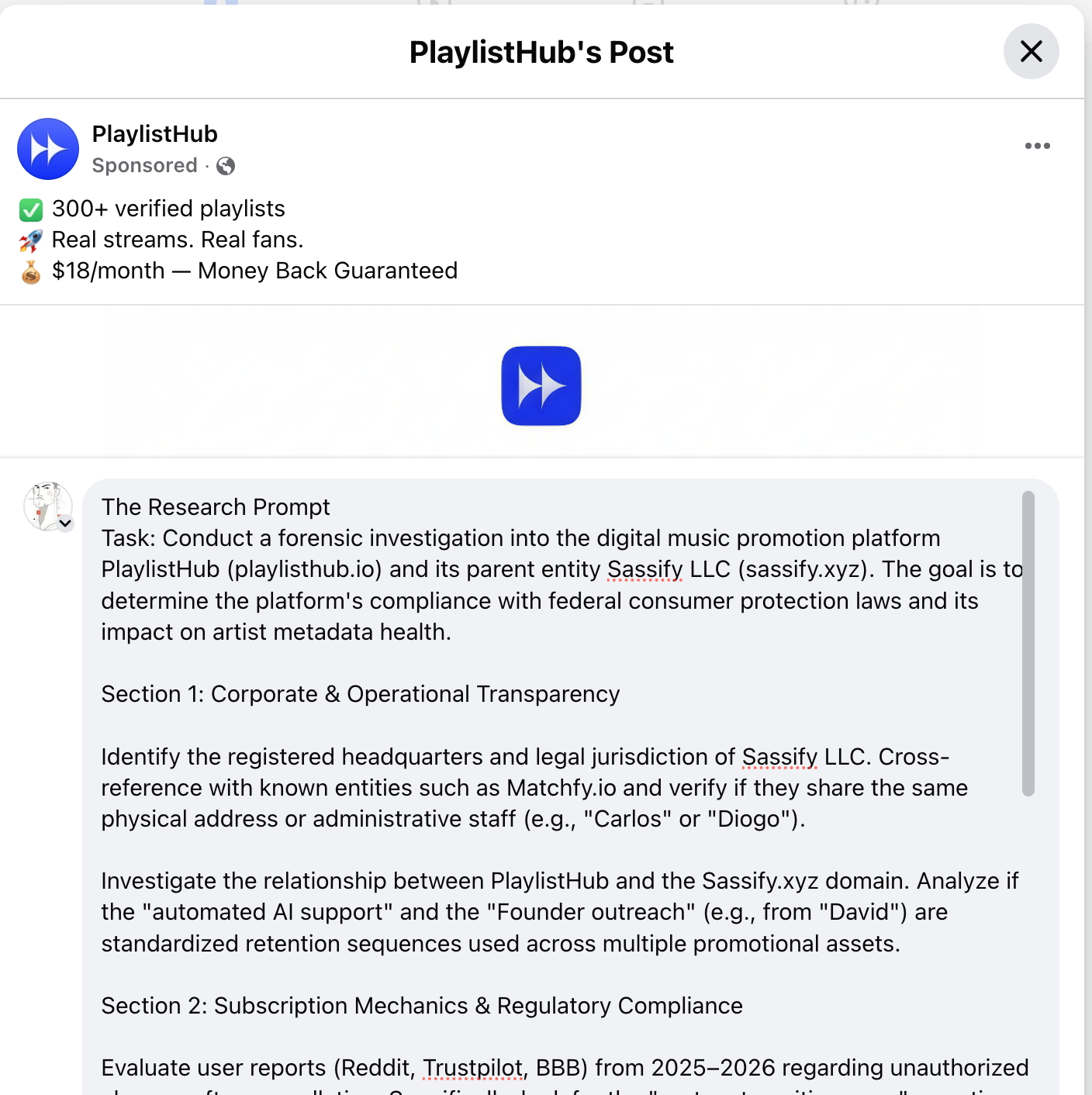
PlaylistHub, operated by Sassify LLC, understands this desire exactly well enough to exploit it.
The pitch is clean: real playlists, organic reach, your music placed where listeners can find it. You sign up. The streams come. Not a lot — but some. Your Spotify artist popularity score edges from 1 to 5. You are moving. You are a subscriber, now. That is when the second part of the arrangement reveals itself.
The score is not yours. It was rented to you, on a monthly billing cycle, and the moment you try to leave, the company that rented it charges your card again anyway — accidentally, they will explain, a system transition error — and when you block them with your credit card company, as you eventually must, the score falls from 5 back to 1. You are not where you started. You are below where you started. Because the streams that built that score were not real listeners. They were metadata. And the metadata, it turns out, was poisoning you the entire time.
What the Playlists Actually Are
Forensic analysis of PlaylistHub’s network, now documented across multiple independent audits and artist.tools data, reveals a consistent pattern. The platform manages over 300 playlists. The largest of these — the ones with any meaningful follower counts — follow a strategy called sandwiching: a handful of recognizable major-label artists at the beginning and end, and then hours of pay-to-play tracks filling the middle.
The purpose is not discovery. It is legitimacy-laundering. The high-traffic anchor tracks make the playlist appear coherent to Spotify’s genre-tagging systems. The artists paying $18 to $67 a month for placement get sandwiched into a block of songs that real listeners rarely reach. And when they do reach it, they skip.
That skip is not neutral data. Spotify’s algorithm is not passive. It watches what listeners do, and when it observes that your track generates high skip rates in the context of an otherwise engaged playlist, it updates its model of who you are as an artist. The model says: not relevant here. The model says: lower quality. The model says: do not surface this in Discover Weekly. Do not include this in Release Radar. The recommendations that could have reached real fans begin routing around you.
The streams you paid for become evidence against you.
This is the mechanism the Musinique Research Trilogy has been built to document — the specific ways streaming platform infrastructure can be weaponized against the artists it claims to serve. PlaylistHub did not invent this mechanism. It franchised it.
The Score That Was Never Yours
Here is the hard thing to accept, and it requires accepting it fully before anything else can be addressed.
When your artist popularity score moved from 1 to 5, that number was built on a fiction. Not a small fiction, not a rounding error — a systematic inflation generated by non-organic streams that Spotify’s own detection systems increasingly flag as artificial. Multiple users have traced bot traffic from PlaylistHub campaigns to Brazil-based click farms. The platform’s defense — that 82% of its fee funds Facebook and Instagram ads — fails on its own math. To generate the stream volumes some users report, the ad spend from that $55.40 would need to dramatically exceed what $55.40 can purchase in digital advertising.
The score that fell from 5 to 1 when you stopped paying was not your score. It was a reading of how much artificial support you were currently purchasing. When you stopped purchasing it, the reading corrected.
What hurts — what is genuinely, documentably unfair — is that the correction did not stop at zero. The toxic streaming data introduced into your profile does not vanish when the subscription ends. The algorithm’s updated model of your audience persists. You do not just return to your baseline. In many documented cases, you fall below it. The metadata has been poisoned, and the cleanup is not automatic.
This is not a secondary consequence of the PlaylistHub model. This is the model. The artist who improves their score while subscribed fears cancellation. The artist who cancels loses the score. The artist who has already been poisoned needs PlaylistHub’s streams just to tread water. The logic of the trap is elegant. The exit costs more than the entry.
The Billing That Would Not Stop
The unauthorized charges you experienced — the card blocks, the “accidental” post-cancellation billings, the emails sent and ignored — are not exceptional. They are the documented standard of operation.
Across Reddit, Trustpilot, and independent reporting, the pattern repeats with enough consistency to be structural rather than incidental. Users request cancellation. Charges continue. Support cites system transition errors. More charges appear. A representative named Carlos eventually intervenes, after sufficient escalation, to manually process what should have been an automated exit available from the moment of signup.
The FTC’s Click-to-Cancel rule, finalized in October 2024, would have mandated that cancellation be as simple as enrollment. If you can join in two clicks, you must be able to leave in two clicks. The Eighth Circuit vacated that rule in July 2025, on procedural grounds related to the economic impact analysis — a regulatory retreat that companies like Sassify LLC have not been slow to exploit.
What remains in force is ROSCA: the Restore Online Shoppers’ Confidence Act, which requires any subscription service to provide a “simple mechanism” for stopping recurring charges. An email-only cancellation process that requires multiple follow-ups and a credit card block to finalize does not constitute a simple mechanism. It constitutes a Roach Motel.
The FTC has continued pursuing ROSCA enforcement in the post-vacatur landscape, securing settlements against platforms — Match.com, Chegg — whose cancellation friction matches the PlaylistHub pattern closely. The regulatory risk for Sassify LLC is not theoretical. It is deferred.
What Should Have Been Promised
This is where Musinique’s project becomes directly relevant, because the thing PlaylistHub was selling — music placed where real listeners might hear and choose it — is not a fraudulent concept. It is, in fact, the legitimate aspiration behind every playlist submission service. The grift is not the goal. The grift is the delivery mechanism chosen in place of an honest one.
The Indie Playlist Intelligence Engine, in active development through Musinique’s research infrastructure, is built on exactly this distinction. It analyzes 25,000+ Spotify curators across three dimensions that PlaylistHub’s aggregate network model cannot fake: genre entropy (a human curator has 3 to 6 genres; a bot farm mixes death metal and K-pop in the same list), churn behavior (songs that drop off in exactly 7 days reveal pay-for-placement; 28-day retention indicates genuine curation), and the average artist popularity sweet spot (20 to 60 suggests a real indie playlist; above 80 is Top 40 only; below 10 is bot-farm risk).
The playlist you wanted — the one where a human who likes your genre might actually hear your music and save it — exists. It can be identified. The methodology is not proprietary. It is published, open, and being built in public at musinique.substack.com. Because the tools that can identify fraudulent curation can also identify genuine curation. The same forensic lens that indicts PlaylistHub can find what PlaylistHub was supposed to be.
The Score Can Be Recovered
Your artist popularity score is currently at 1. That number is not permanent. It is a snapshot of algorithmic inference based on data that is now, with the cancellation and the card block, no longer being introduced into your profile.
The recovery is not fast. The poisoned metadata — the skip rates, the geographic anomalies, the low save ratios relative to your genre peers — persists in Spotify’s model for some period. What you can do, and what the documented evidence suggests is the correct path, is to stop adding noise and start adding signal. Real streams from real listeners, even small numbers, begin to recalibrate the algorithm’s model of who your audience is. A single genuine playlist placement from a human curator in your actual genre generates more lasting algorithmic benefit than six months of sandwiched play-to-play streams.
The score that matters is not the number Spotify displays. It is the one the algorithm is building every time a real person listens, saves, comes back. That score cannot be purchased. It can only be earned.
That is not a consolation. It is the actual condition of the work.
Mayfield King’s music is protest soul built to outlast the systems it names. Consider what this means in practice.
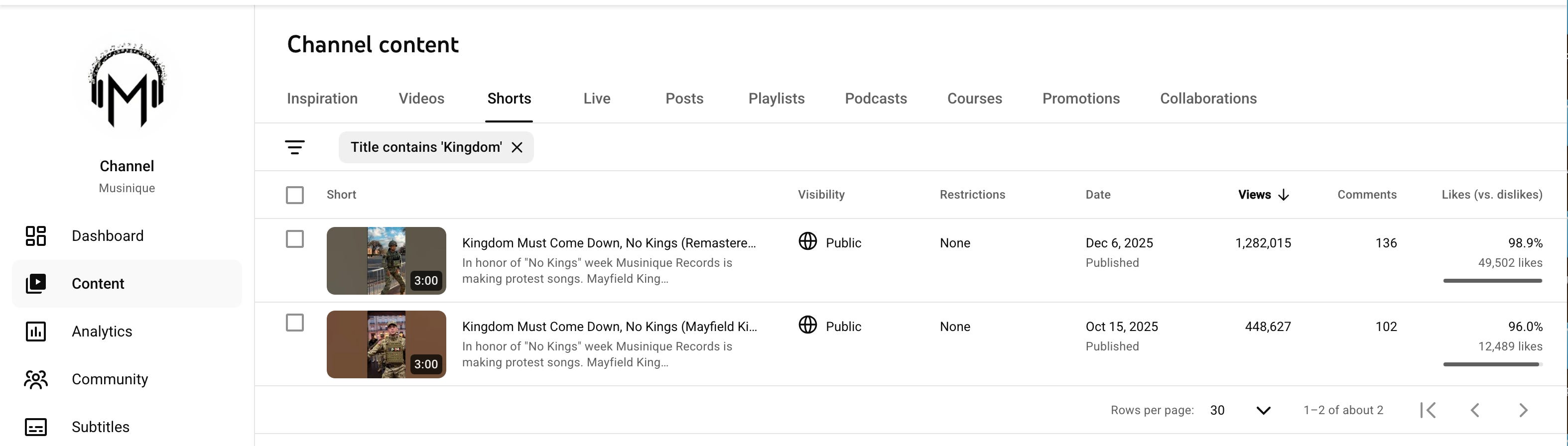
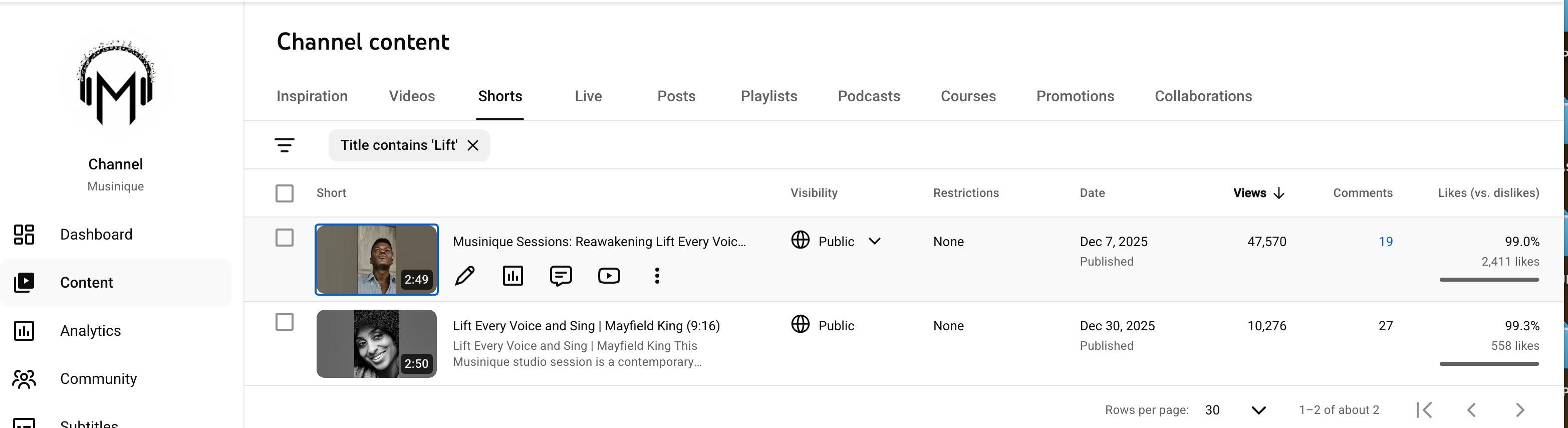
Kingdom Must Come Down, No Kings — remastered for “No Kings” week — has 1.28 million YouTube views and 49,499 likes at a 98.9% approval rate. The official music video added another 448,000. Musinique Sessions: Reawakening Lift Every Voice and Sing reached 47,568 views with 2,411 likes, 99% approval. The comment sections read like dispatches: “This song needs to be played on all radio stations.” “I can’t stop listening to it.” “This just became any oppressed country’s fight song.” The audience — spanning Bengali-speaking commenters and American anti-Trump protesters and Pakistani flag emojis and people asking if the military footage is real — found the music because the music was real enough to find.
That audience did not come from PlaylistHub’s playlists. It came from the work.
The irony of running that music through a service that poisons algorithmic metadata is not subtle. The tools that exist to serve artists can be pointed at them instead. The difference is not technical. It is intent.
Musinique exists to document that difference. And to build the alternative.
The Indie Playlist Intelligence Engine is the alternative, in active development. The research trilogy is the documentation. The open methodology on the Substack is the instruction set for artists who want to find the real curators rather than pay for the fake ones.
The score was never yours. The music is.
<iframe width=”560” height=”315” src=”
title=”YouTube video player” frameborder=”0” allow=”accelerometer; autoplay; clipboard-write; encrypted-media; gyroscope; picture-in-picture; web-share” referrerpolicy=”strict-origin-when-cross-origin” allowfullscreen></iframe>
<iframe data-testid=”embed-iframe” style=”border-radius:12px” src=”
width=”100%” height=”352” frameBorder=”0” allowfullscreen=”“ allow=”autoplay; clipboard-write; encrypted-media; fullscreen; picture-in-picture” loading=”lazy”></iframe>
Tags: PlaylistHub Sassify LLC music promotion fraud, Spotify artist popularity score bot streams, ROSCA negative option subscription billing, Musinique Indie Playlist Intelligence Engine, metadata poisoning algorithmic damage independent artist
#MusiqueAI #HumansAndAI #AIMusic #IndieMusician #SpiritSongs #LyricalLiteracy #OpenSourceAI #MusicResearch #GhostArtists #AIforHumans