

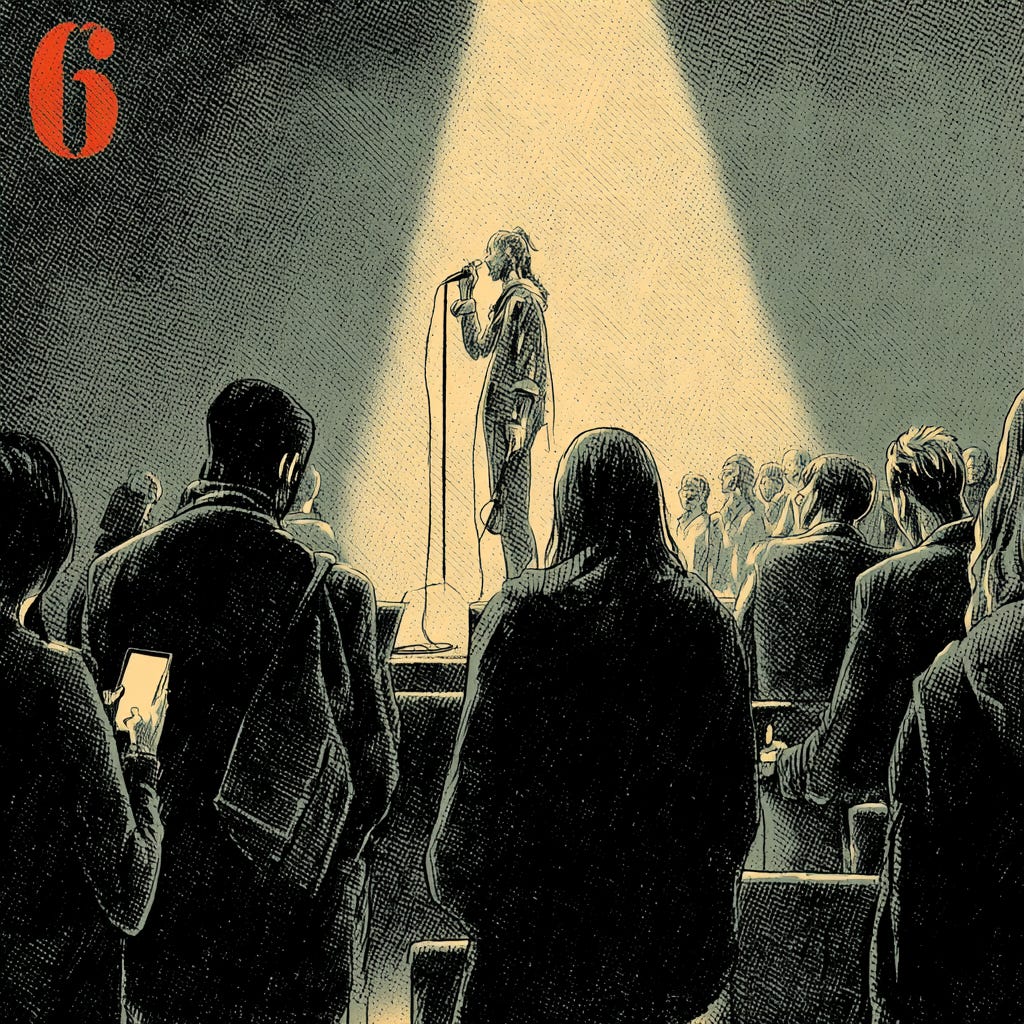
Brian Hazard has been making music under the name Color Theory since the early 1990s. Synthpop. Meticulous production. He runs a mastering studio in Huntington Beach and has released over a dozen albums. He also does something almost no independent artist does: he publishes every promotion campaign he runs, in full, with the numbers. Every platform, every dollar spent, every stream generated, every algorithmic consequence that followed.
In a post that became a reference point across independent music communities, he described what happened after a campaign that placed Color Theory on several high-follower playlists with broad genre mixes. The stream counts went up. Then, over the following weeks, his Release Radar went quiet. Discover Weekly stopped surfacing his tracks. The audiences on those playlists had no particular affinity for synthpop. They had subscribed to something called “Chill Mix” or “Indie Vibes” that had drifted across multiple genres as it grew. When Color Theory appeared in their feed, many of those listeners hit next before the song had time to establish itself.
What Hazard had documented, without naming it as such, is the skip rate problem. The most consequential thing that happens in the first six seconds of a stream is not whether the listener likes the song. It is whether the listener was the right person to receive it at all. The algorithm does not know the playlist was genre-incoherent. It knows a listener skipped. It updates its model accordingly. And that update travels forward into every recommendation Spotify makes for that track going forward.
What the Algorithm Actually Measures
Spotify’s recommendation engine, internally called BaRT, measures the success of a recommendation by whether the listener stayed past thirty seconds. Spotify’s product director Matthew Ogle described this threshold publicly as the sweet spot for determining whether a person likes a song. A stream that ends before thirty seconds is tracked as a failed recommendation. The algorithm learns from it and deprioritizes the track for similar listeners.
But thirty seconds is the threshold for a stream to count toward royalties. The signal shaping algorithmic behavior starts earlier, and the consequences compound faster than most artists realize.
Listeners who hit next within the first six to ten seconds are sending the algorithm a specific message: wrong recommendation. Not wrong because the song is bad. Wrong because this listener was not the right person for this sound. The algorithm does not distinguish between those two readings. It sees a listener who skipped and adjusts the track’s recommendation weight downward. The more often that pattern repeats, the more the track is deprioritized across the recommendation engine.
This is why where a stream comes from matters as much as the stream itself. A thousand streams from the wrong audience can cost more, in algorithmic terms, than five hundred streams from the right one.
What a Skip Actually Costs
A skip before thirty seconds costs the artist twice. Spotify does not record a paid stream, so the royalty is lost. And Spotify records a failed recommendation, so the track’s future algorithmic placement is damaged. The artist paid the campaign fee, received no royalty from that interaction, and accumulated negative signal that will suppress future recommendations.
The ongoing damage is harder to quantify than the campaign fee and harder to reverse. Ditto Music documented this directly in their guidance for artists: genre metadata tagged incorrectly causes tracks to appear to the wrong people and get skipped, and skips before thirty seconds are bad news in the all-seeing eye of the algorithm. The same mechanism applies when the genre mismatch comes not from the artist’s metadata but from the playlist’s incoherence. The algorithm sees the skip either way.
Hazard captured the practical consequence plainly: reaching listeners who had no interest in his sound produced streams that failed to convert into saves, follows, or Release Radar inclusion. The streams looked like progress. The algorithm had read them as something else entirely. His Spotify for Artists data showed the divergence in real time, stream counts rising while the metrics that matter for algorithmic health, save rate and repeat listen rate, stayed flat.
This is the information asymmetry at the center of the playlist promotion industry. Promotion services publish acceptance rates. They publish follower counts. They do not publish the genre coherence of the playlists in their network, because that coherence is the variable that determines whether their product produces algorithmic value or algorithmic damage. The artist buying the campaign sees the stream number. They do not see the skip rate breakdown by playlist. They do not see what the algorithm learned from those streams.
The Playlist Audience Problem
When a track lands on a high-follower playlist with low genre coherence, a substantial portion of that playlist’s audience has no affinity for the genre the artist makes. They subscribed to something that has drifted. The playlist title says “Indie” but the content has expanded to include hip-hop, ambient, folk, and bedroom pop. The audience is heterogeneous. When a new track appears, some listeners stay. Many skip. Some skip immediately.
Each skip is a data point attaching the track to a listener profile that does not fit the music. Discover Weekly uses collaborative filtering, constantly building and updating clusters of listeners who share taste profiles, then matching tracks to those clusters. If the taste profile that encountered the track early was wrong for the genre because the playlist was incoherent, the collaborative filtering data the track has accumulated is contaminated. The track gets recommended to more people who resemble the listeners who already skipped it, who then also skip, which confirms to the algorithm that it should reach fewer and fewer people.
The cycle is self-reinforcing and not immediately visible to the artist. Stream counts may stay steady or even grow while the algorithmic health of the release deteriorates underneath.
A save tells Spotify the opposite: this listener wants this track again. That is a durable signal. It tells the algorithm not just that the listener heard the track but that they intend to come back to it. A track with 1,000 streams and a 20 percent save rate will outperform a track with 10,000 streams and a 1 percent save rate in Discover Weekly placement. The difference in save rate reflects a difference in audience quality, not track quality. The save rate is higher when the audience is right. The audience is right when the playlist that delivered them chose it specifically for that genre.
Genre Coherence as Algorithmic Protection
When a track lands on a playlist whose audience chose it specifically for a sound, the early retention is higher. Listeners stay past six seconds because the track belongs in the context they selected. They stay past thirty seconds because they are actually the right audience. Some save. Some follow. Some add the track to their own personal playlists.
Each of those actions is a positive signal to Spotify’s recommendation engine. Each one compounds. The track accumulates a taste profile pointing toward a specific listener cluster. Discover Weekly finds more listeners who resemble that cluster and introduces the track to them. Those introductions produce more saves from people who fit the profile, which finds more people who fit the profile. The momentum builds from a coherent foundation.
Hazard identified this pattern through comparison across dozens of campaigns over two decades. The campaigns that produced genuine downstream algorithmic movement were not necessarily the most expensive or the ones with the highest follower reach. They were the ones where the audience of the playlists matched the sound. Genre-specific playlists with smaller audiences consistently outperformed broad-reach playlists with large audiences on every metric that mattered for long-term algorithmic health, even when they underperformed on raw stream count in the short term.
What the Musinique Focus Score Measures
This is what the Musinique Focus Score was built to detect. A playlist with a high Focus Score has genre coherence, consistent artist selection, and track density in a specific niche. The listeners on that playlist chose it for a reason. Their skip rates are lower not because the tracks are better but because the audience is right for the tracks.
In the Musinique database, Filtr US, the Sony-owned playlist operator, has an average Focus Score of 33.8 across 96 playlists and 9.19 million combined followers. That is the largest single-entity reach in our database by a substantial margin. For an artist whose sound is genre-specific, landing on a Filtr playlist might generate impressive stream numbers and simultaneously produce damaging algorithmic signal. The streams arrive from an audience that has no consistent genre identity. The saves do not follow at the same rate. The algorithm reads the ratio and adjusts the track’s recommendation weight downward.
The top 59 playlists in our database, one percent of the catalog, control 65 percent of total follower reach. Most of that concentration is in low-focus, high-follower playlists operated by major label infrastructure. These are the playlists that look most attractive to an artist or a manager evaluating a promotion campaign. They are also the playlists most likely to produce genre-contaminated collaborative filtering data.
The indie-accessible range, between 1,000 and 50,000 followers, accounts for 30 percent of our database reach and shows significantly higher average Focus Scores. Smaller audience. Cleaner signal. Better downstream algorithmic outcome per stream generated.
The Counterargument That Does Not Hold
The standard response to this analysis is that follower count and raw stream numbers are what build the momentum needed to get Spotify editorial attention, and that editorial attention is the real prize. This is worth examining carefully because it is partially true and mostly misleading.
Editorial playlist consideration does partly depend on track performance in the weeks surrounding a release. Tracks with strong engagement metrics, high save rates, low skip rates, and organic playlist adds, are more likely to attract editorial attention. But the engagement metrics that matter are the quality metrics, not the volume metrics. A track with 5,000 streams and a 25 percent save rate is a stronger editorial candidate than a track with 50,000 streams and a 2 percent save rate, because the former demonstrates genuine listener resonance and the latter demonstrates that most listeners who encountered the track did not find it worth keeping.
The campaign that generates 50,000 streams from genre-incoherent playlists has not built editorial momentum. It has built a track record of low engagement that will be visible to Spotify’s editorial team and to the algorithm simultaneously.
The Focus Score is a filter, not a guarantee. Landing on a high-focus playlist does not guarantee algorithmic success. It guarantees that the streams the campaign generates will be interpreted by Spotify’s recommendation engine as evidence that the track belongs in a coherent genre ecosystem rather than evidence that it does not. That is the foundation everything else requires.
The Audition Is Not With the Curator
The standard advice for independent artists is to pitch to the biggest playlists available. Follower count as the primary metric, placement on a large list as the goal.
The skip rate data runs the other way. A placement on a 500-follower playlist whose audience chose it specifically for a genre will generate cleaner algorithmic signal than a placement on a 50,000-follower playlist whose audience is mixed and passive. The 500-follower placement produces fewer streams. It produces better data about those streams. That data shapes every subsequent Spotify recommendation for that track.
Brian Hazard has been running the experiment for over twenty years and publishing every result. The campaigns that produced genuine algorithmic follow-through were the ones where the audience matched the sound. Not the biggest playlists. The right ones.
The six-second audition is not with the curator. It is with the listener the curator’s playlist has attracted. If that listener is not the right person for the sound, passing the curator’s audition is the beginning of an algorithmic problem, not a solution to one.
The Focus Score tells you which playlists have attracted the right audience. The skip rate does the rest.