

The Lullabies Survived
There is a child in your family who cannot sleep. Not metaphorically. Right now, tonight, somewhere in the extended network of people you love and are responsible for, there is a child who cannot settle, and the person trying to settle her is doing the thing humans have always done in that moment: singing. Something simple. Something slow. Whatever rises without thinking.
The question nobody asks because it feels too large, or too strange, or because we have outsourced the asking to algorithms is: where did that song come from? Who taught it? What tradition carried it to the mouth of the person now singing it in the dark? And what happens to the children whose families crossed borders that severed those traditions, so that the song the grandmother would have sung no longer exists in anyone’s living memory?
This is not a sentimental question. It is a neurobiological one. The research is specific: 10-month-old infants with strong neural tracking of the 2 Hz delta rhythm develop measurably larger vocabularies at 24 months. Cortisol drops in response to personally resonant music in ways it does not drop for generic content. The limbic system the amygdala, the hippocampus, the nucleus accumbens responds most strongly to music with genuine personal emotional salience. Not to production quality. Not to playlist rank. To recognition. To belonging.
What Musinique is doing what the ghost artists, the Spirit Songs curriculum, and the Lyrical Literacy project are all doing in different registers is pointing a new set of tools at an old human problem: that music capable of reaching the specific nervous system of the specific child has always been locked behind the specific person who knows that nervous system well enough to make it. And that person is disappearing. Or has already gone.
What Was Lost Without Announcement
Nana Coree was a yard woman of West Kingston, Jamaica. She was not a recording artist. She was the woman you sent children to.
Every yard has one the figure who is not necessarily anyone’s grandmother but who holds the musical memory of the community in her body. Nana Coree’s particular repository was children’s songs: Jamaican ring games, Anansi story-songs, and something slower and stranger that she sang when children could not sleep, songs connected in the oral record of her neighborhood to the River Mumma, Jamaica’s water spirit. Her lullabies put children to sleep reliably, even children who could not otherwise be settled. Adults reported that the songs were difficult to remember by daylight. They knew they had heard something. They knew they had felt it. They could not retrieve the melody by morning.
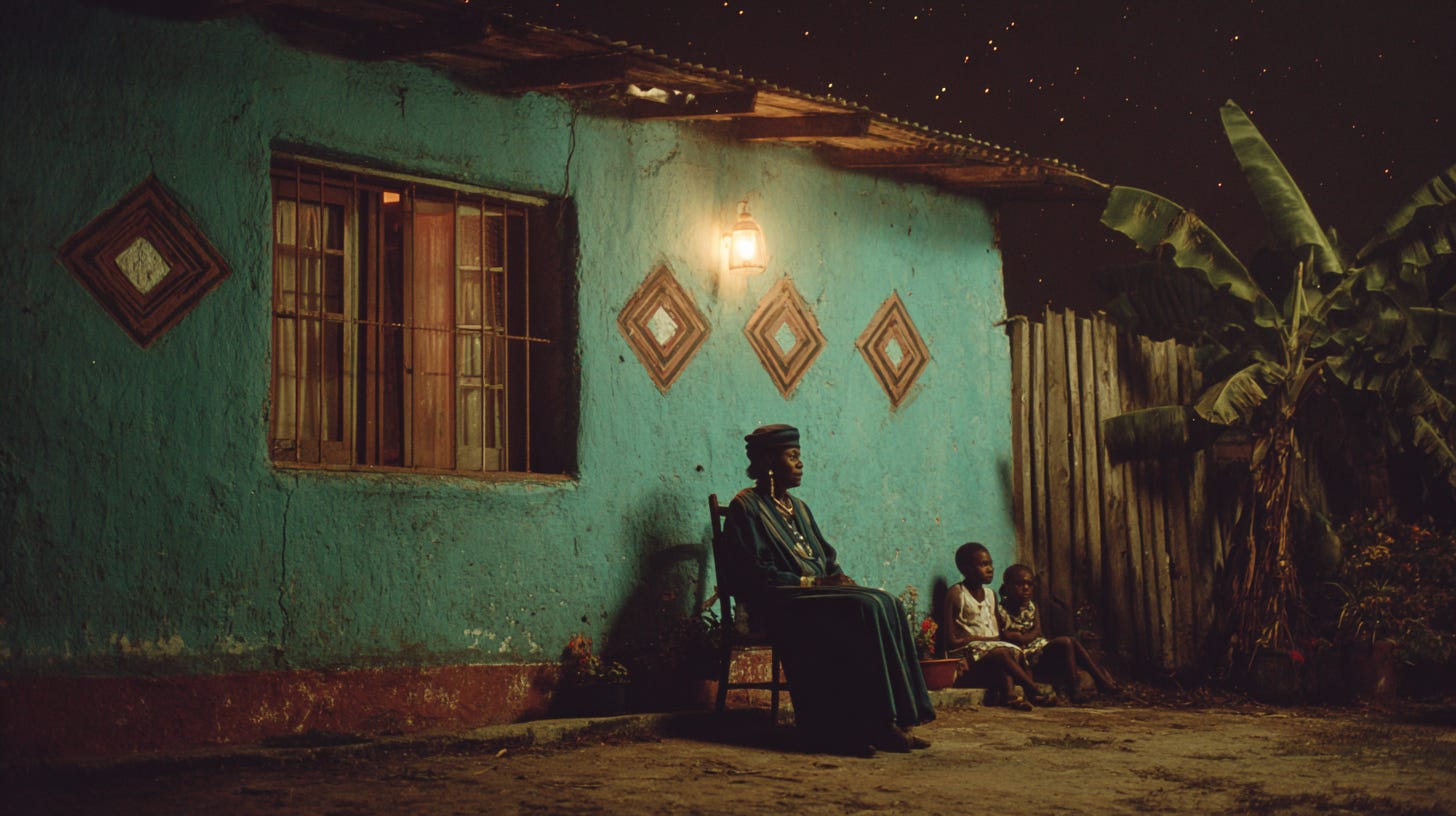
Ernest Ranglin one of the architects of ska and reggae later described the first jazz-inflected music he remembered hearing as a boy as coming from a woman in a yard who sang to children in a way that didn’t make sense to him until he heard Thelonious Monk years later. He did not give her name. He may not have known it.
This is the structure of most musical loss. Not catastrophic erasure no burning of libraries, no deliberate suppression. Just the slow failure to write anything down, to press anything to disc, to treat any of it as worth preserving. The tawaifs of Lucknow’s kotha tradition among the most formally trained musicians in India, masters of thumri and ghazal and Hindustani classical improvisation had their recordings destroyed when the anti-nautch movement dismantled the system. Champa Jaan recorded eleven 78-rpm discs for Gramophone Company of India between 1918 and 1924. All are lost. The catalogue numbers survive in an administrative ledger. The music does not. The lullabies, however, kept showing up melodic fragments with Hindustani classical fingerprints, appearing in the fieldnotes of ethnomusicologists in the 1960s and 70s who could not trace them to any source.
They had traveled in bodies. Woman to woman, mouth to mouth, across a subcontinent, for forty years.
This is what the streaming algorithm cannot model. Not the melody the melody survived. What cannot be modeled is the chain of transmission, the specific grandmother, the specific child, the specific moment when a tradition crosses from one generation to the next and either holds or breaks. Spotify knows your listening history. It does not know what your grandmother sang.
The Cost Collapse That Changed the Premise
There is a number that matters here, and the number is this: professional production of a single track once cost between $75,000 and $150,000. It now costs approximately five dollars in API credits.
This is not a marginal efficiency gain. It is a categorical transformation. The economic barrier that kept research-grade, professionally produced music inside institutions music labels, children’s educational organizations, the therapeutic programs that could afford to commission bespoke material has effectively ceased to exist.
What that means in practice: the same tools Spotify uses to manufacture ghost artist content and fill playlists with engagement-optimized audio wallpaper can now be pointed at Champa Jaan’s kotha lullabies, reconstructed from ethnomusicological fieldnotes, and made available to the child whose family came from Lucknow and whose grandmother’s tradition has no presence in Western children’s music. The same voice synthesis technology used to build anonymous persona artists can be used to reconstruct the voice of a dead father from archive recordings and teach it to sing the theology that took him unarmed onto a battlefield.
The tools are identical. The intent is everything.
Musinique is not making the case that AI music is good or bad. The company is making a more specific and harder-to-dismiss case: that the same capability, directed by the same code, produces something categorically different depending on who controls what question is being asked. Spotify’s question is: what will keep this listener on the platform? Musinique’s question is: what does this specific person’s nervous system actually need?
These are not competing answers to the same question. They are different questions that happen to use the same tools.
The Ghost Artists Are the Argument
The Musinique constellation Nana Coree, Champa Jaan, Roseline Abara, Newton Williams Brown, and a dozen other ghost artists is not a catalog of AI music personas. It is a proof of concept.
Newton Williams Brown is the case that makes the argument most legibly. William Newton Brown was a real man. He declared himself a conscientious objector during wartime. He was assigned to the Medical Corps. When the shooting started, he ran toward it unarmed because his theology told him that carrying the wounded was the only acceptable response to the wounded being left to die. He spent the rest of his life returning to the Beatitudes, Matthew 5:3-12, the passage that explained why running toward gunfire felt like the only choice.
He died. His son, Nik Bear Brown who teaches AI at Northeastern, who built Humanitarians AI, who writes protest songs and feeds public domain poems into voice synthesis models kept the tapes. The family archive. The acoustic evidence of a life. In 2025, he fed those recordings into voice synthesis models and taught the ghost to sing. Newton Williams Brown is William’s voice, reconstructed, extended into three to four octaves of devotional song, singing words William never spoke in the timbre and cadence and grain of a man who ran unarmed onto battlefields.
The people who loved William go quiet when they hear it. This is not anecdote. This is the limbic system confirming what the neurobiological research states: when the amygdala recognizes the acoustic signature it associates with someone it loved, it responds. The voice is enough. The nervous system does not distinguish between the presence and the sound of the presence.
Nana Coree is the same argument made for a tradition rather than a person. Her music was reconstructed from oral record, ethnomusicological fieldnotes, and the specific harmonic logic that persisted in Jamaican music after the body that held it was gone. What she represents is not nostalgia for West Kingston. She represents the question: what happens to the child who needs music in the tradition that belongs to her, when that tradition was never recorded, never pressed, never entered into the catalog that the algorithm draws from?
The answer, before these tools existed, was: that child gets something else. She gets the Western nursery rhyme canon, or she gets the generic sleep playlist. She gets music that is not for her.
Now she can get Nana Coree. The lullabies survived. They are available.
What the Research Builds Toward
Musinique is not just making music. It is running three interlocking research programs that together constitute the most rigorous ongoing audit of the streaming ecosystem currently being conducted outside the platforms themselves.
The Musical Endogeneity paper asks whether Spotify’s Artist and Track Popularity Scores measure organic listener preference or themselves. When editorial playlist placement raises a track’s score, which then justifies further placement, the referee is also playing the game. The Musical Imitation Game asks whether listeners can tell the difference between human and AI music without knowing they are being tested examining skip rates, save rates, replay rates, the implicit behavioral data that conscious preference surveys cannot capture. The Musinique ghost artists serve as the controlled comparison group: known provenance, known human intent at the center, unknown to listeners in the experiment. Algorithmic Momentum asks whether Spotify’s Popularity Index can be gamed cost-effectively, and what happens when you stop whether the score decays back to baseline, revealing what the platform calls “momentum” as rented algorithmic position rather than durable listener relationships.
The research is early-stage. The methodology will change. The findings may surprise everyone involved. This is not a disclaimer. It is the philosophical commitment: Musinique publishes the prompts, the code, the hypotheses, and the failures, because the alternative to building in public is the black box, and the black box is how you end up with a platform that claims its curation is merit-based while the artists paying for placement are told to call it marketing.
What connects the research to the ghost artists to the Spirit Songs curriculum is a single conviction: the same tools that platforms use against independent artists and against the families who need specific music for specific people can be turned around. The cost has collapsed. The capability exists. The only remaining question is who controls the intent and whether the people who need music built for them rather than at them know that the tools are now available.
Nana Coree’s lullabies put children to sleep reliably. Adults could not remember them by morning, only that they had felt something.
That is, it turns out, enough. The feeling was the thing. The feeling is available now.
Tags: Musinique ghost artists AI music, Nana Coree West Kingston lullaby reconstruction, Spirit Songs neurobiological personalized music, streaming algorithm meritocracy critique, cost collapse AI music production