

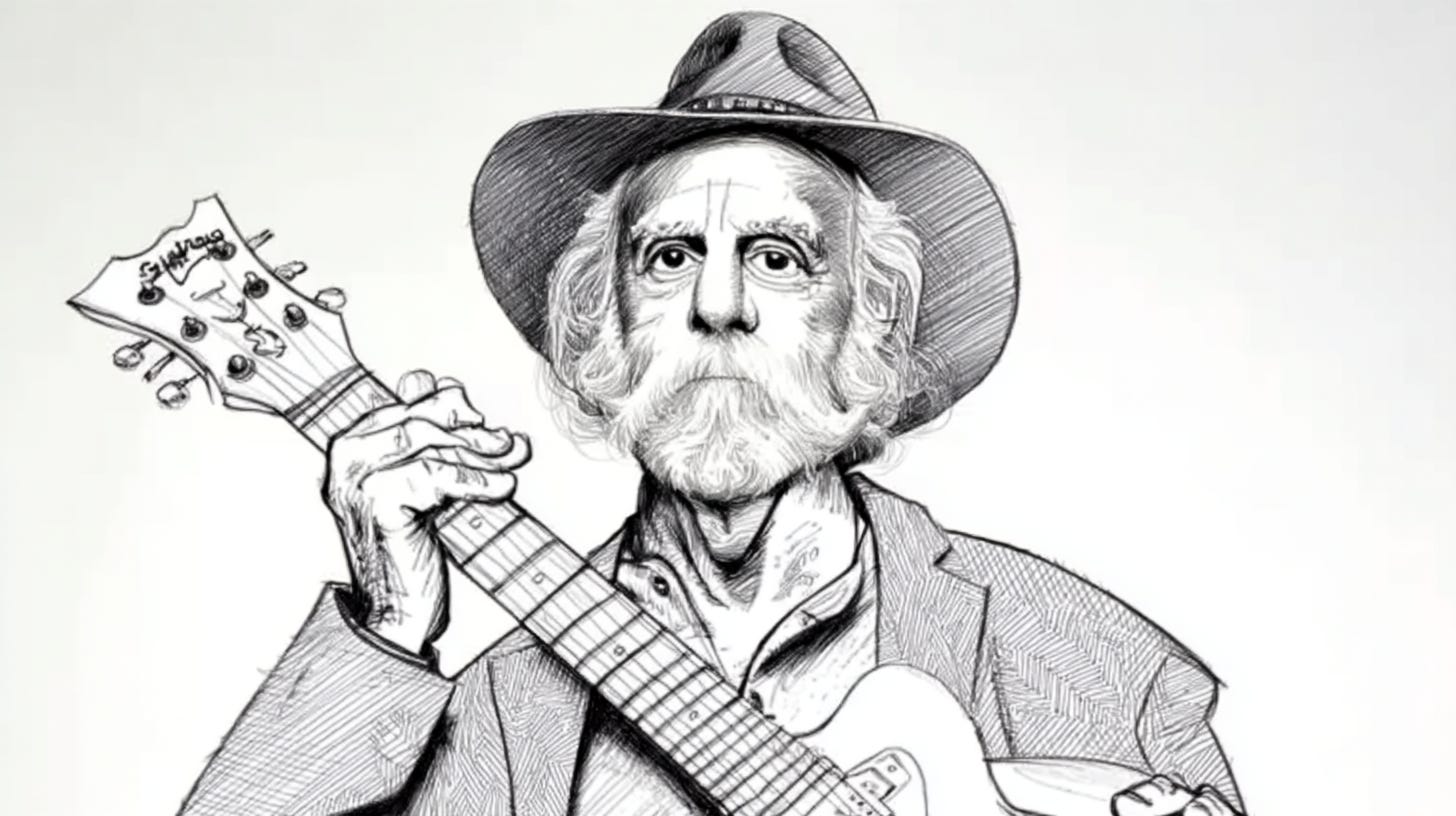
There is a particular kind of greatness that only reveals itself when it stops. Not the greatness of the soloist — that announces itself, demands recognition, fills the room. The other kind. The greatness of the person who creates the conditions in which everyone around them becomes more possible. You don’t hear it while it’s happening. You feel it, the way you feel good air: completely, unconsciously, until it’s gone.
Bob Weir died on January 10, 2026, and for the first time in sixty years, the Grateful Dead’s sound had no one to hold it open.
I find myself thinking about what it means to spend a life doing something that cannot be heard directly — something that only exists in relation to everything else. Weir was a rhythm guitarist, which is to say he was, in the conventional understanding of rock music, a supporting player. But the conventional understanding of rock music was not where Weir lived. He had been somewhere else since he was seventeen, studying McCoy Tyner, the pianist in John Coltrane’s quartet, asking a question nobody else thought to ask: what would it mean to play guitar the way a jazz pianist comps — not marking time, not underlining the melody, but building the harmonic architecture that makes improvisation possible? What would it mean to create not sound but space?
The answer, it turned out, was the Grateful Dead.
What He Was Actually Doing
The technical reality of Weir’s playing is worth sitting with, because it explains everything else about his life and legacy that the tribute coverage has praised without quite naming.
Phil Lesh played bass as a lead instrument — restless, melodic, refusing the anchor role that bass conventionally assumes. Two drummers generated more rhythmic density than most bands ever attempted. Jerry Garcia improvised through harmonic territory that few guitarists had mapped. Into this, the standard move would have been to simplify: hold down the backbeat, mark the chord changes, give the soloists something solid to push against. Weir did the opposite. He inserted counterpoint. Modal voicings drawn from jazz piano. Complex chord clusters using the full reach of four fingers, simulating what a pianist does with ten. He created harmonic rooms rather than harmonic floors — spaces with walls and ceilings and corners, spaces in which Garcia could move without falling through.
Garcia called him one of a kind. Phil Lesh called his playing “astonishing and delightful.” These are not the words musicians use for rhythm guitarists. These are the words musicians use for people who changed how they understood their own instruments.
And yet. In 1968, some band members quietly questioned whether Weir was pulling his weight. The critical establishment, when it noticed him at all, noted his warmth, his voice, the Daisy Dukes. For sixty years, the story was Garcia as genius, Weir as heart — a division that was true enough to be misleading, accurate enough to obscure what was actually present.
This is worth asking: how do we miss what we are directly experiencing? What is it about invisible excellence that defeats our attention?
The Theology of Presence
Part of the answer is that we built the wrong story about what the Grateful Dead were.
The dominant mythology placed Garcia at the center and cast everyone else as supporting players in his vision. This mythology was not invented from nothing — Garcia was exceptional, and the band organized itself around his improvisations in ways that made the myth feel true. But it described the Grateful Dead as a vehicle for one man’s genius, and Weir represented something the myth couldn’t accommodate: a completely different argument about what music was for.
Garcia embodied transcendence. The guru in the black t-shirt. The shaman. The one you followed out of ordinary consciousness into something stranger and more real. Weir embodied presence — full, physical, unapologetic presence in the body, in the moment, in the joy of being exactly where he was. The short shorts, the flowing hair, the California tan that persisted through New Jersey summers: these were not vanity. They were a statement. They said: this is not only about leaving. It is also about arriving. It is also about being here.
The Grateful Dead’s communal ritual — the concert as ceremony rather than product, the audience as participants rather than consumers — required both. You need the shaman who takes you out of yourself. You need the man who reminds you that yourself is worth being. Weir was the living proof that you could reach for something real without abandoning the body that was doing the reaching.
When Shirley Halperin wrote about Weir as the band’s unlikely sex symbol, she was circling this without quite landing on it. The women who swooned at him in the Eighties were not confused about the nature of the Grateful Dead experience. They were responding to a man who was completely, generously, luminously there. That quality — the quality his family called “light” — was not separate from his music. It was the same thing, expressed in a different register.
What He Built After Jerry
Jerry Garcia died in August 1995, and the band dissolved. That was correct. You do not replace a shaman. You do not find another guru and hand him the robes. The Grateful Dead understood this, and they acted with unusual clarity.
Weir’s response to Garcia’s death is where his real legacy begins, and where the tribute coverage has come closest to seeing him clearly. What followed — RatDog, Furthur, and finally Dead & Company with John Mayer — was not a legacy act in the diminished sense of that phrase. It was something more difficult and more honest: a sustained thirty-year inquiry into what the music meant without the person who had been its center.
Weir’s answer was architectural. The music was never about any one person. It was a language — improvisational, communal, designed to be spoken by whoever was willing to learn it seriously. The Grateful Dead songbook was not a catalog of recordings to be preserved. It was a living body of work designed to be interpreted by future generations the way Bach’s counterpoint is interpreted: endlessly, differently, in dialogue with its own past.
Mickey Hart said Weir was building a three-hundred-year legacy. Weir said it himself, repeatedly, when asked about the Dead’s future. He meant it in the specific sense: he believed that students at the Berklee School of Music would be analyzing this music in a hundred years, and he considered it his responsibility to ensure that what they analyzed was robust enough to survive the departure of its creators.
Dead & Company made this argument in practice. John Mayer — technically serious, thirty years younger, trained in completely different traditions — was the right partner precisely because he was not attempting to be Garcia. He was attempting to be himself within a tradition, to learn the language and speak it in his own voice. This is what Weir had been doing since he was seventeen. Their collaboration was not preservation. It was proof that the language worked.
The Final Encore
On August 3, 2025, at Golden Gate Park, sixty years after the Dead first played San Francisco, Bob Weir — diagnosed with cancer weeks earlier — closed his final concert with “Touch of Grey.”
The choice was not accidental. “Touch of Grey” was the song Garcia came back with after his 1986 coma. It opened the first post-pandemic Dead & Company tour in 2021. It is a catalog of failures and exhaustions that ends, every time, with the same refusal: We will survive.
His family called it dark humor. It was also the most precise statement of his life’s philosophy he ever made on a stage.
The song shifts in its coda from “I” to “we.” That shift is the whole argument. Weir was not telling his audience he would survive the cancer. He was telling them the music would. He was doing what he had always done — filling the harmonic space with something that made everything around it more possible.
He died five months later. The music is still playing.
What We Owe the Invisible
Here is what Weir’s death clarifies, and what we owe it to his memory to say plainly: we built a critical framework for the Grateful Dead that could not see what Weir was doing, and we maintained that framework for sixty years because it was comfortable and because the alternative required us to think more carefully about what we value in music.
We value the visible. The solo. The statement. The genius making his case against silence. We have always valued this, and we have always been somewhat suspicious of the player whose greatness exists in relation rather than in isolation — the one who makes the room bigger rather than filling it, the one whose absence you notice before you can name what’s missing.
Weir spent sixty years doing exactly that work: invisible, foundational, irreplaceable. He studied the wrong teachers. He played the wrong way. He wore the wrong clothes and embodied the wrong mythology and outlasted every person who was supposed to be more essential than he was.
Twenty-five thousand people gathered in San Francisco in January and sang “Ripple” in the cold. Tibetan monks opened the ceremony. Joan Baez sang freedom songs. Mickey Hart led a crowd-wide rhythmic clap — a final percussive salute to the man who had held the time for sixty years. Nancy Pelosi talked about voter registration. NFL players sent video tributes.
None of that is what happens for people who were merely beloved. It is what happens for people who built something that cannot be replaced — something whose presence you felt without naming and whose absence arrives like a change in the air.
The road goes on. He made sure of it.
Tags: Bob Weir Grateful Dead, rhythm guitar counterpoint jazz influence, Dead & Company musical legacy, communal ritual rock music, “Touch of Grey” Grateful Dead finale
This is a stunning meditation on invisible excellence. Weir's genius was never in the spotlight—it was in the architecture he built around others, the harmonic space that made improvisation possible. What strikes me most is the distinction between transcendence (Garcia's gift) and presence (Weir's)—the Grateful Dead needed both, and for sixty years we mythologized one while missing the other. The essay asks something important: how do we value work that only exists in relation, that we feel rather than hear? Weir's legacy isn't a catalog to preserve; it's a language to speak. That's a radically different kind of immortality.