

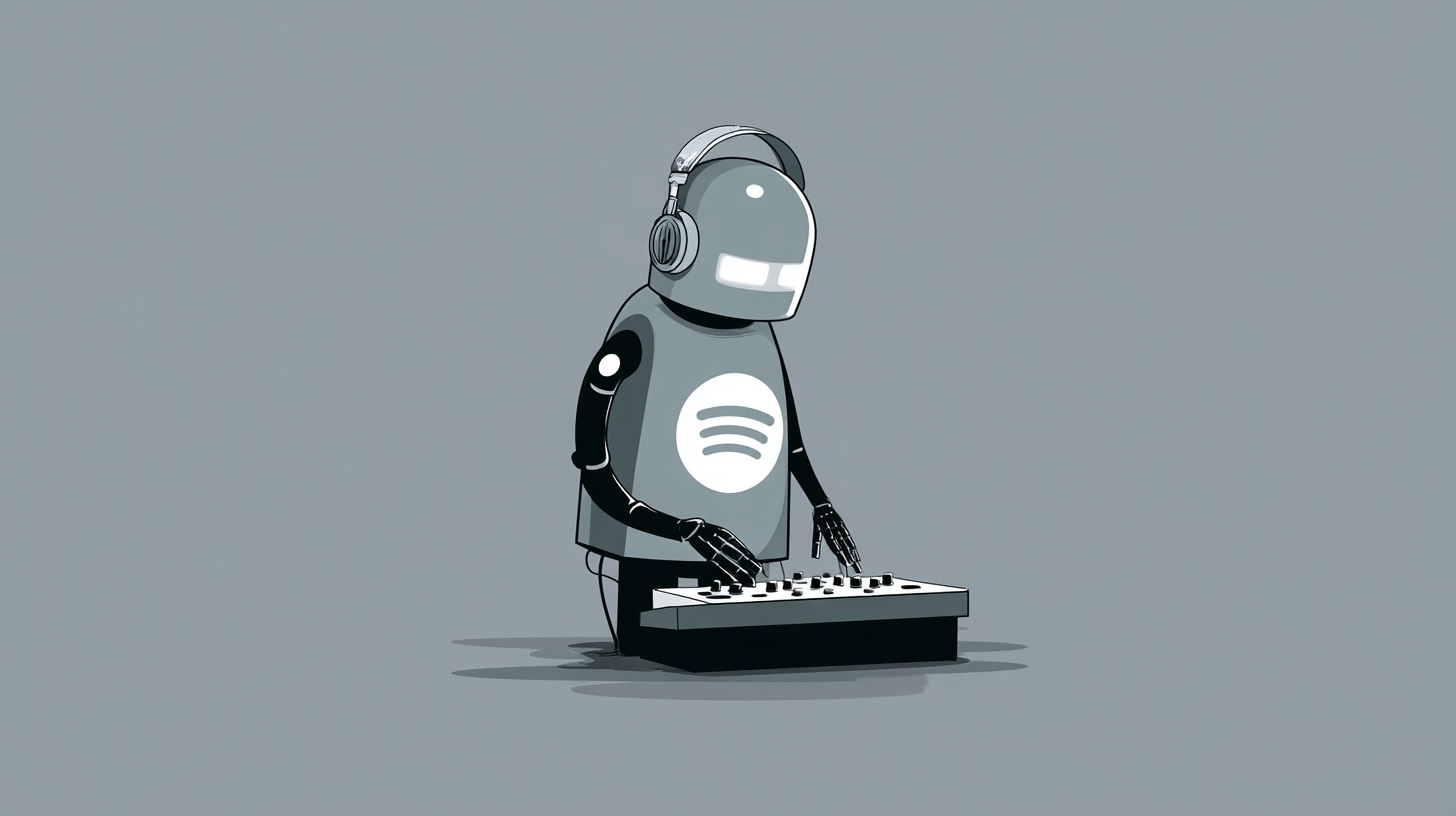
here is a moment in every successful deception when the deceiver convinces themselves they are being strategic. Spotify reached that moment sometime in 2025, when its engineers and brand managers realized the lesson from the previous year’s catastrophe: users did not object to artificial intelligence running their music experience. They objected to knowing about it. This distinction—between improving a product and concealing its nature—is the fulcrum on which this entire story turns. The analysis before us documents the recovery with care and real data. What it cannot quite bring itself to say is that the recovery and the fraud are the same operation.
Begin where the documents begin: the collapse.
What 2024 Actually Broke
In late 2024, Spotify’s annual Wrapped campaign—a decade-long ritual in which the platform converts twelve months of listening data into shareable identity cards—failed publicly and visibly. An AI podcast recap built on Google’s NotebookLM generated user descriptions that fell somewhere between “robotic” and “hallucinatory”: top artists the user had never heard, genre classifications of sufficient absurdity to inspire mockery rather than recognition. “Pink Pilates Princess Strut Pop” is not a genre. It is evidence of a system producing output without understanding.
The platform had, in December 2023, laid off approximately 1,500 employees—seventeen percent of staff—including the data scientists, motion designers, and curatorial architects who had built Wrapped’s emotional intelligence over years. Glenn McDonald, whose genre taxonomy work at “Every Noise at Once” represented something close to genuine thinking about music’s interior landscape, departed. What replaced human judgment was automation that could replicate the form of Wrapped without grasping its function. Wrapped was never really about data. It was about the user seeing themselves reflected back with enough accuracy to feel known. The AI saw the data. It did not see the person.
This is the causal chain the analysis presents, and it is plausible. I find myself less certain than the document that the layoffs caused the failure—the compressed development timeline, vendor limitations in NotebookLM, and misaligned product strategy all deserve examination as alternative explanations—but the correlation is damning enough that the distinction may not matter practically. When you eliminate the people who understood what the product was for, you should not be surprised when their replacements understand only what it does.
The Concealment Pivot
What followed in 2025 is documented with metrics the analysis treats as conclusive: 200 million engaged users reached in 24 hours versus 62 hours the previous year; 500 million social shares versus an estimated 354 million; a 19% year-over-year engagement increase. The platform replaced its AI-branded features with what the industry now calls “stealth AI”—the same machine learning infrastructure, operating invisibly, wrapped in a visual aesthetic borrowed from the cassette and mixtape culture of the 1980s. The analog nostalgia was not incidental to the strategy. It was the strategy. The AI did not leave. The AI branding did.
Here is what co-CEO Gustav Söderström said on the Q4 2025 earnings call, as documented: Spotify’s most experienced engineers had “not written a single line of code since December,” instead directing AI-generated code through prompts. And here is the limiting factor Söderström named for further AI integration: “the amount of change that consumers are comfortable with.”
Read that twice. The constraint is not product quality. The constraint is consumer tolerance. These are different problems with different solutions, and Spotify chose to optimize for the second rather than the first. The question the document never quite asks: is that a recovery, or is it a more sophisticated version of the same failure?
The Infrastructure the Brand Narrative Cannot See
This is where the analysis, thorough as it is on Spotify’s consumer-facing strategy, requires the harder evidence from the ghost artist data.
Spring Euphemia has 245,008 monthly listeners and 529 followers. That ratio—0.00215—means that for every 100,000 people who heard this music, 215 cared enough to click follow. A DIY artist with organic following shows ratios between 5% and 15%. Spring Euphemia’s ratio is twenty-three times lower than the floor of organic engagement. The top track has 51 million plays. Fifty-one million times, someone heard this music and felt zero connection to whoever made it. That is not a coincidence. That is a design specification.
Garcíia: 1,489,275 monthly listeners. 680 followers. The ratio is 0.00045—a 99.7% failure rate at converting streams to engagement. Red Ripples: 227,032 monthly listeners. 13 followers. Vinícius Énnae: 629,105 monthly listeners, 108 followers, publisher listed as Firefly Entertainment AB of Stockholm. ISRC codes trace the compositions to Swedish producers Robert Par Norberg and Anders Sven Wigelius, registered with the Swedish collection society STIM. “Vinícius Énnae” has no Instagram, no Wikipedia, no press history, no tour dates, no verifiable identity outside Spotify’s own promotional copy.
These numbers are not anomalies. They are the statistical signature of music that exists to generate royalty capture, not human connection. Forty artists in the documented sample show identical patterns. The follower-to-listener divergence—45 to 135 times lower than organic patterns—is diagnostic. This is not artist music with a small fanbase. This is content with consumers.
The Pro-Rata Mechanism
Understanding why these statistics exist requires examining what happens to money on the platform. Spotify operates on a pro-rata model: pool all revenue, distribute based on percentage of total platform streams each rights holder captures. A 30-second stream of ambient piano equals a 30-second stream of a Nina Simone recording. Same value. This creates a massive structural incentive for functional music—music designed to be heard rather than noticed, streamed rather than sought.
A listener running “Sleep” playlist streams eight to ten hours of ambient content nightly. Even a devoted fan of a working musician might listen to a new album twice daily. When production companies place hundreds of ghost artist profiles on high-volume mood playlists, they capture disproportionate royalty share relative to actual fandom. Spring Euphemia’s 51 million plays represent roughly $102,000 to $255,000 in gross royalties. For a fabricated identity. Commissioned from session musicians on buyout deals. Licensed to the platform at below-standard rates. Every dollar flowing to Spring Euphemia is a dollar not flowing to the independent artists displaced from those same playlists when Firefly Entertainment arrived.
The analysis documents that Spotify removed 75 million tracks in 2025 as evidence of creator-protective policy. But if that figure approaches 75% of total platform catalog—as the numbers suggest—it means the platform allowed industrial-scale algorithmic pollution to operate for years before addressing it. Removing spam corrects a condition Spotify itself created by building financial incentives that rewarded upload volume over human artistry. It is not the same as compensating the artists whose royalty pools the spam had diluted.
What the Recovery Metrics Cannot Measure
The analysis documents Spotify’s 2025 financial performance with appropriate precision: 751 million monthly active users, 10% premium subscriber growth, $20.4 billion annual revenue, 8.2% year-over-year increase. It concludes from these numbers that “the cultural backlash did not materially affect the business.”
This conclusion requires examination. Spotify operates with substantial network effects. Users who have built years of listening history, curated playlists, and algorithmic preferences face real switching costs. An unhappy subscriber who cannot rebuild their musical identity on Apple Music in a weekend may remain a Spotify subscriber while being significantly less engaged. Subscriber retention is a lagging indicator of satisfaction; it measures lock-in as readily as it measures loyalty. The platform’s financial metrics are the most verifiable data in the analysis. The interpretive conclusions they support are weaker than the document acknowledges.
More importantly: the 500 million Wrapped shares measure distribution velocity for the consumer-facing product. They cannot detect, and do not attempt to detect, what is happening in the infrastructure those users are actually hearing. A user sharing their Wrapped 2025 card is expressing engagement with Spotify’s identity product. That same user has been hearing Spring Euphemia on “Peaceful Piano” for years and has never followed the artist, never known the artist doesn’t exist, never known the royalties went to a Swedish production company through a reduced-rate licensing deal.
The metrics validate the surface. They are silent about the foundation.
The Question 2026 Will Answer
The 2025 Wrapped campaign succeeded by making the algorithm feel like a mixtape from a friend. Creative director Payman Kassaie explicitly stated his team did “the opposite” of looking to AI for inspiration. The analog aesthetic was sincere in its execution, even if the infrastructure beneath it was not analog at all. Users responded. The shares accumulated. The engagement metrics hit records.
What Söderström acknowledged—and what the 2026 roadmap of “Prompted Playlists” and “human editors as context providers” will test—is whether transparency performs as well as concealment. The Prompted Playlist feature tells users they are steering an algorithm. The one-liner explanations for each recommended track are themselves AI-generated. The “human editors” designing entry prompts are framing an automated system, not replacing it.
If users respond as well to disclosed AI as they did to hidden AI, then 2025 was a necessary transitional year and the “stealth” approach was a bridge to genuine product evolution. If users respond less well—if the analog aesthetic derived its power specifically from the absence of visible machinery—then Spotify has not solved its problem. It has delayed it.
The ghost artist infrastructure offers the darker version of this trajectory. The ghost artist program proved users do not revolt when fabricated identities replace real musicians. AI eliminates even the session musicians. Boomi has already generated 14.5 million AI-produced songs. Endel has a Warner Music Group partnership generating mood remixes algorithmically. When the session musicians inside Firefly are replaced by prompts, nothing in the consumer-facing experience changes. Spring Euphemia remains. The bio remains. The 51 million plays remain. The real artists displaced when Firefly arrived are already gone.
The balance sheet will report the result of this experiment before any brand analysis does. What the balance sheet cannot report is what was lost in the years it took to run it.
Tags: Spotify ghost artist Perfect Fit Content, stealth AI brand recovery strategy, music streaming royalty pro-rata displacement, algorithmic curation vs human editorial trust, Wrapped 2024 2025 comparative analysis