

Before you decide what the ghost artist economy is, consider what it has always been.
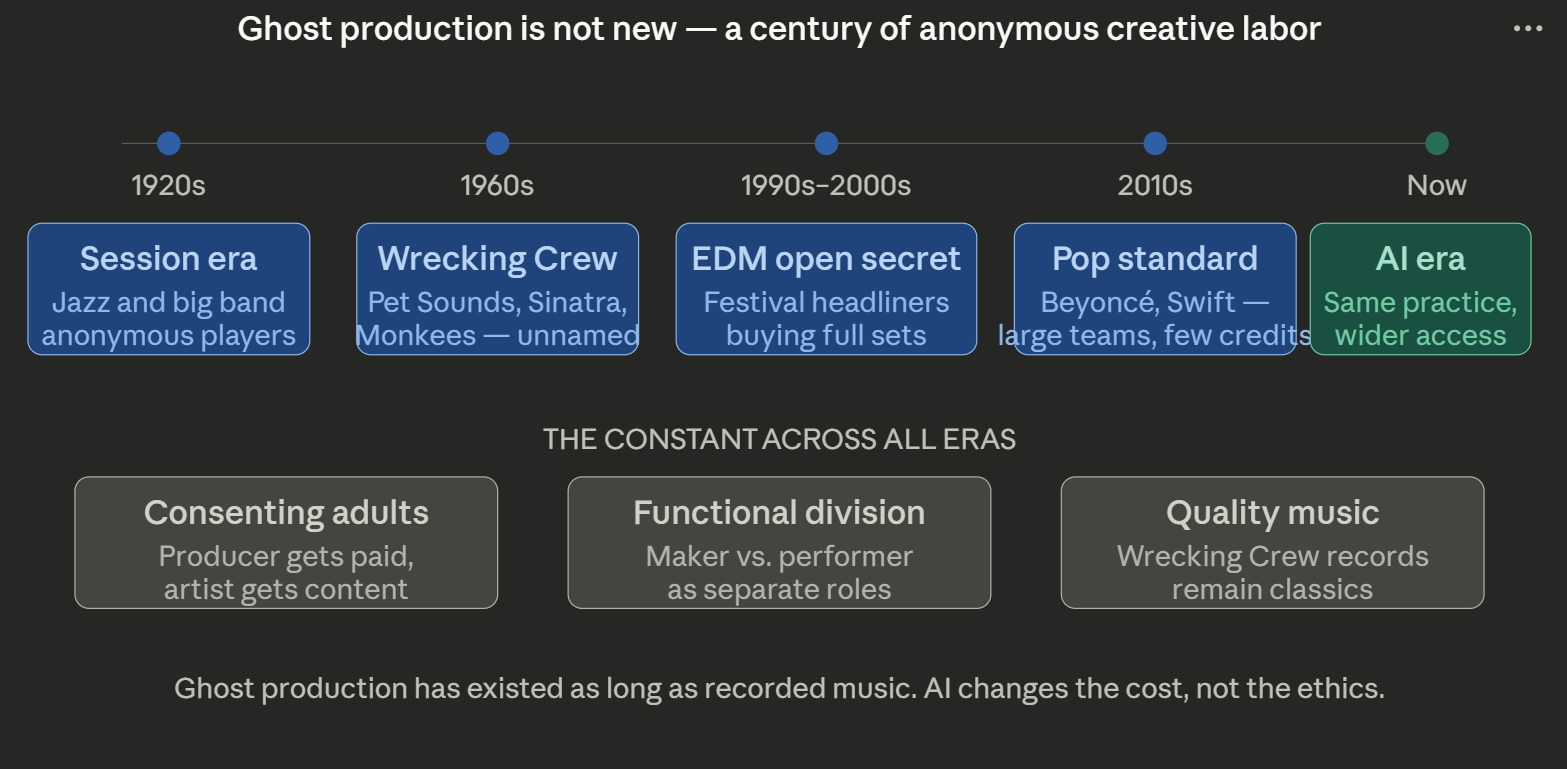
The Wrecking Crew played on hundreds of records you know by heart the Beach Boys’ Pet Sounds, Frank Sinatra’s Strangers in the Night, the Monkees, the Mamas and the Papas. Most listeners had no idea. The credits named the artist on the marquee. The musicians who built the sound behind them worked quietly, professionally, and by mutual agreement. Were those records fraudulent? Was that music less real?
The answer shapes everything that follows.
The Myth the Industry Sold You
The lone genius is a marketing invention.
It has always been more useful for labels, for managers, for the machinery of celebrity to present music as the singular vision of a single compelling person. The listener bonds with the artist. The artist sells tickets, merchandise, streaming subscriptions. The collaborators behind the curtain get paid and go home. This arrangement predates AI by a century. It predates the recording industry itself.
Beyoncé has a room full of collaborators on every album. Taylor Swift co-writes with a rotating cast of producers. Every major EDM act at every major festival has, at some point, purchased material from anonymous producers grinding away in home studios. These are not scandals awaiting exposure. They are functional creative economies arrangements between consenting adults where everyone gets something they need.
Ghost production is collaboration with the credits removed. That is a contractual decision. It is not a moral crisis.
The Person Nobody Talks About
Every conversation about ghost artists focuses on the artist deploying the ghost. Almost none of them focus on the ghost.
Consider the producer who does not want to be famous. Not everyone capable of making extraordinary music wants to manage a social media presence, build a personal brand, book tours, or perform for cameras. Some of the most gifted producers alive are people who want to spend their lives in a studio not on a stage. Ghost production gives those people a legitimate, sustainable way to do what they love. They make music. Someone else handles the performance and promotion. Both parties get what they want.
That is not exploitation. That is a functional division of labor the same division that has characterized creative industries from the beginning.
And for producers early in their careers, ghost work is a genuine on-ramp: a way to build craft, income, and industry relationships while developing the portfolio that will eventually support a project under their own name. The anonymity is temporary. The experience is real.
The Artist Under Impossible Pressure
A touring artist on a grueling schedule who wants to keep releasing music for their audience cannot be in the studio simultaneously. A singer with a clear artistic vision and limited technical production skills is filling a gap, not committing a crime. An artist recovering from burnout, illness, or a creative block who uses a trusted collaborator to keep their project alive is making a practical, human decision about sustainability.
The streaming era demands a pace that would break any single human creative. An artist who goes quiet for eighteen months risks losing algorithmic momentum, fan engagement, and the institutional support that makes a career viable. Ghost production is one of the tools that makes the math of a sustainable career possible. Listeners get music they love. Artists maintain their connection with their audience. Producers get paid for their labor.
The harm, in this version of the arrangement, is not obvious because it may not exist.
The Democratization Nobody Admits
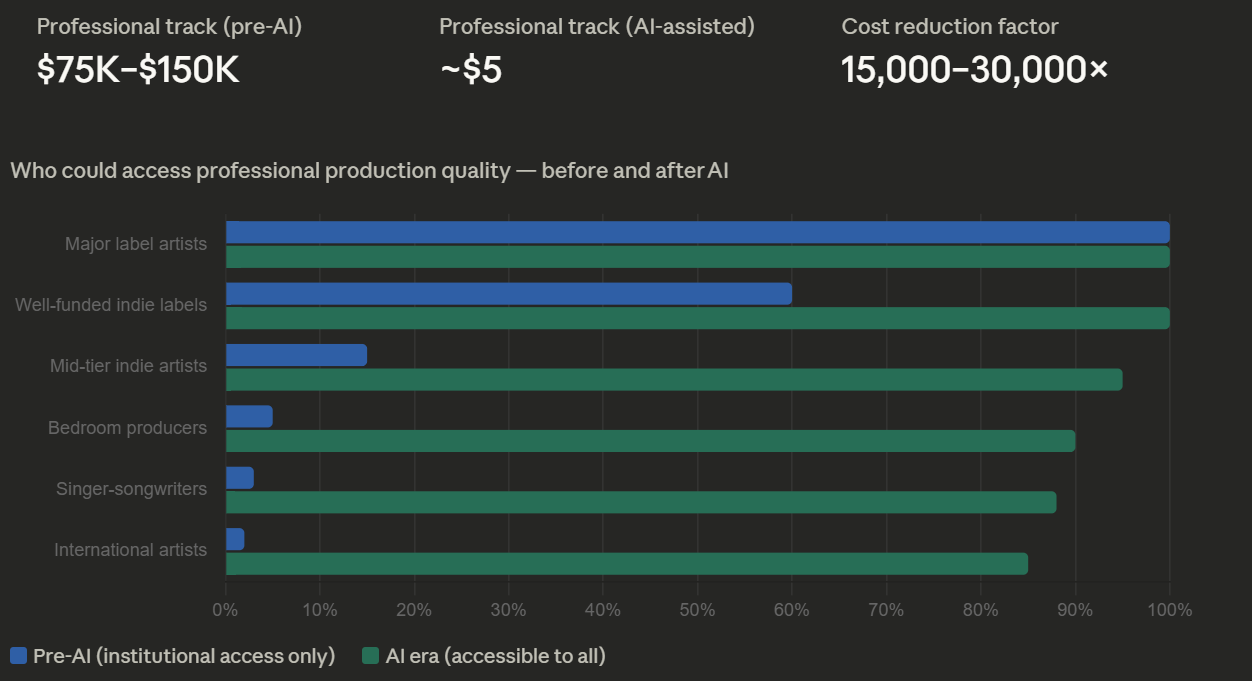
For most of recording history, ghost production was a privilege of the well-resourced. You needed the right connections, the budget for professional producers, and access to an industry network that was not designed to be accessible. The arrangement was available to artists who had already made it and largely unavailable to the independent musicians who needed it most.
AI is dismantling that gate.
A singer-songwriter with a melody and no production skills can now bring a professional-sounding track to life without signing away a significant portion of their royalties to a professional intermediary. The same tools that large content operations use to generate material at scale are available to the solo artist working in a bedroom. In the right hands, that is not a threat to independent music. It is the first time independent music has had access to production resources that the major label system has always taken for granted.
The tool is not the problem. The tool is neutral. The question is always who controls the intent.
Anonymity as Artistic Choice
Daft Punk wore helmets for thirty years. MF DOOM performed in a mask. Burial released one of the most celebrated electronic albums of its decade before anyone knew who he was. Banksy built an entire cultural conversation around the refusal to attach a name to the work.
These are not edge cases. They are part of a long and serious tradition the understanding that anonymity can be a form of artistic integrity, a way of insisting that the work stand on its own without the noise of biography, persona, and press narrative. A ghost artist or producer operating under an alias is participating in that tradition. The music gets to be evaluated entirely on what it is.
That is not dishonesty. For many creators, it is the most honest thing they can do.
Where the Real Problems Live
None of this is an argument that the current ecosystem is without fault. There are real problems worth solving. They are simply more specific than the broad indictment of ghost production itself.
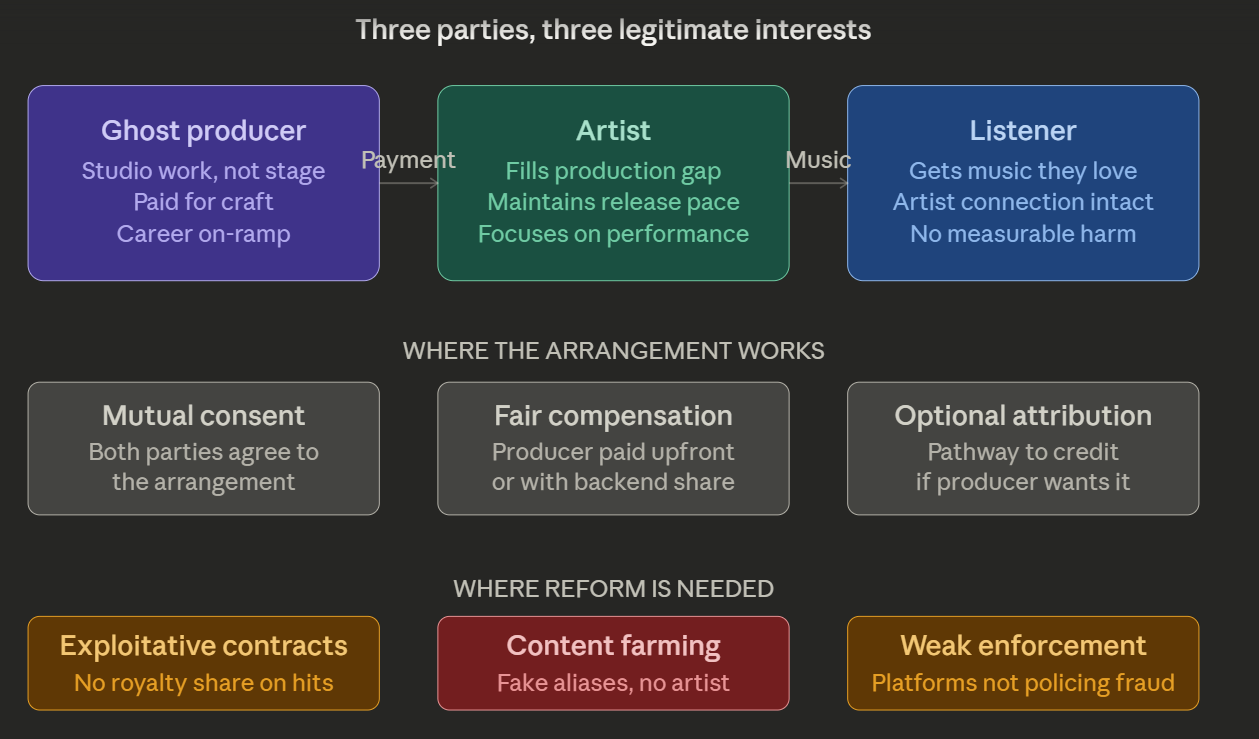
Work-for-hire arrangements that sign away all future royalties, with no backend participation when a track becomes a hit, can be genuinely exploitative. Better contract norms would benefit everyone in the chain. Producers who want optional attribution who want the right to claim their work without dismantling their client’s career need better industry pathways to negotiate for it.
And the content farms are a real and separate problem: hundreds of fake ambient profiles uploading algorithmically generated material to capture passive playlist streams is a platform integrity failure. It is not a ghost production problem. It is a fraud problem. The solution is better platform enforcement not moral panic about anonymous music creation.
The ghost economy is not the enemy of independent music. Predatory contracts are. Fake playlist schemes are. Pay-to-play exploitation is. Those are worth fighting. Consensual, skilled, anonymous creative collaboration the kind that built the Motown catalog and the EDM festival circuit and half the records you love is the industry doing what it has always done, now with better tools and wider access.
The artists who will navigate the next decade most effectively are the ones who understand the full toolkit available to them. Music has never been made by one person alone. It never will be. The only question is who gets to participate and on whose terms.
Musinique builds AI tools to support and protect independent artists including helping them find legitimate production collaborations and playlist placements that serve their careers rather than extract from them.