

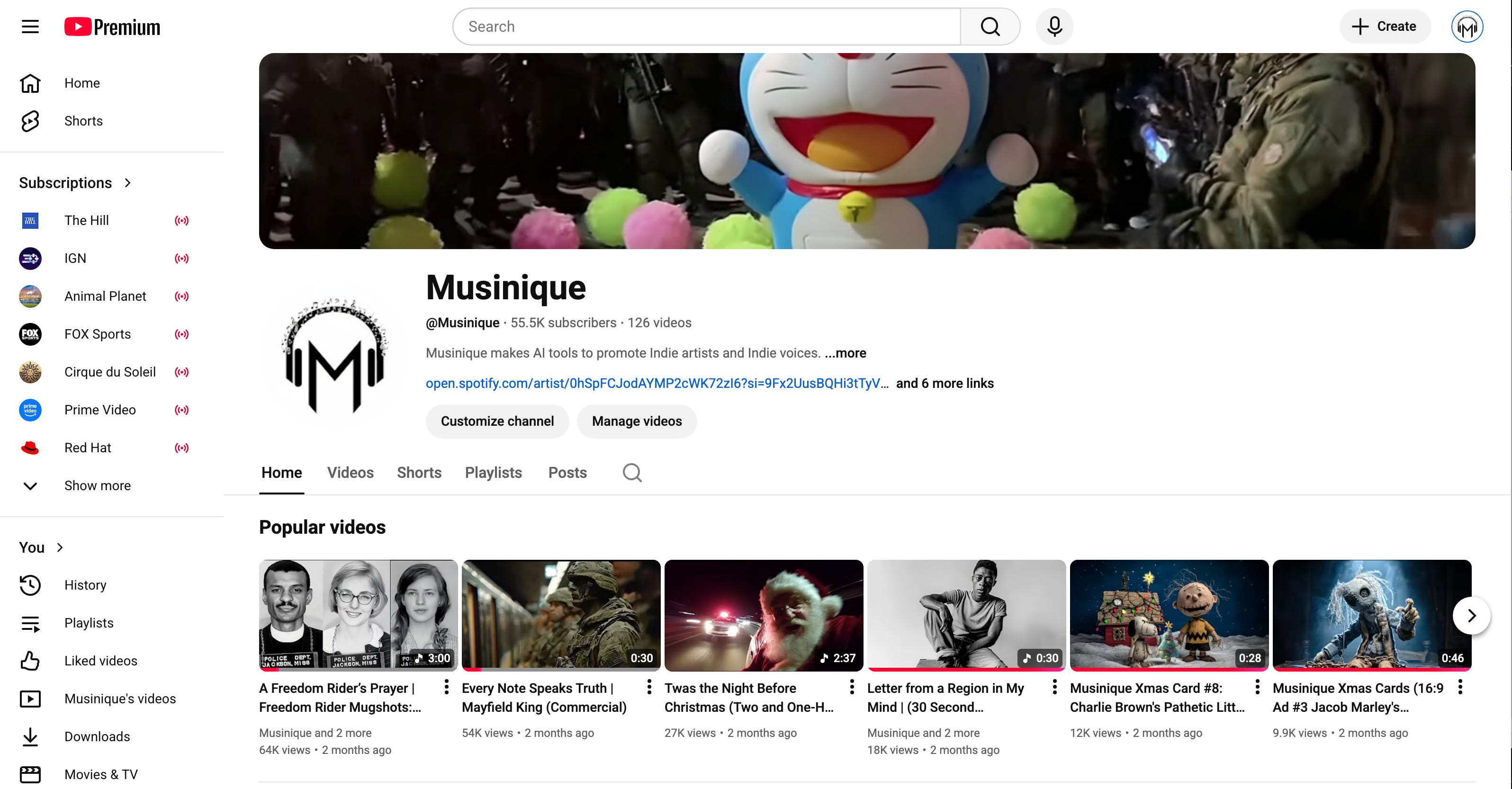
I ran the Ogilvy ‘brandvoice‘ command on Musinique LLC — the AI music label, research operation, and nonprofit music arm I’ve been building since November 2024. What came back wasn’t a tagline. It was a diagnosis. The command strips a project down to its load-bearing walls: who you’re actually talking to, what they fear, what they dream about, and the one sentence that holds the whole thing together. For Musinique, that sentence landed as: Musinique points the same tools the platforms use against you — back at you, in your favor. That’s not marketing language. That’s the argument. Every project in the constellation — the ghost artists, the research trilogy, the Spirit Songs curriculum, the Lyrical Literacy catalog — exists inside that sentence.
The output built five distinct audience profiles, each with their own fear and their own dream. The independent musician who suspects the game is rigged. The non-musician who has a grandmother’s lullaby almost gone. The researcher watching AI reshape culture and needing someone doing rigorous published work on what’s actually happening. The command also produced tone rails I didn’t expect: do not sentimentalize the ghost artists — they are neurobiological phenomena and profound human acts, and they don’t need softening. Let the data indict, not the outrage. That one is worth printing and taping to a wall.
The thing the Ogilvy command does that most brand exercises don’t: it forces you to say what you never sound like. Musinique never sounds like a Silicon Valley pitch deck that discovered music. Never sounds like a nonprofit that leads with guilt. Never sounds like a protest that forgot to be beautiful. Those negatives are as load-bearing as the positives. They tell you where the walls are. The brand voice profile that came out of this run is now the document I hand to every collaborator before they write a word for any Musinique project. The methodology is on Substack. The output is below.
Tags: Musinique brand voice, Ogilvy copywriting framework, AI music label positioning, independent musician marketing, ghost artist neurobiological music
Musinique LLC — Brand Voice Profile
Generated by Ogilvy Copywriting Coach
Brand Personality
Adjectives: Rigorous, Intimate, Defiant, Generous, Alive
This is not a music company that uses AI. This is a human project that refuses to let AI be used against humans.
The One-Sentence Truth
Musinique points the same tools the platforms use against you — back at you, in your favor.
Audience Profiles
Primary — The Independent Musician Who Suspects the Game Is Rigged Ages 22–45. Making real music, getting real streams, wondering why nothing compounds. Technically curious. Emotionally invested. Tired of paying for placement and calling it marketing. They don’t need inspiration — they need someone to confirm what they already feel and give them the data to act on it.
Secondary — The Non-Musician Who Has a Song They Need to Make They are not in the industry. They have a grandmother’s lullaby that is almost gone. A father’s voice on a tape. A child who deserves a birthday song that is actually theirs. They didn’t know this was possible until five minutes ago. Now they can’t stop thinking about it.
Secondary — The Researcher, Educator, and Ethicist They are watching AI reshape music and culture and need someone doing rigorous, published, peer-reviewed work on what’s actually happening. Nik Bear Brown is that person. Musinique is where the work lives.
Tertiary — The Conscious Listener Who Wants to Support Something Real 6 million views means they exist. They found “Kingdom Must Come Down” or “Blessed the Broken” and felt something. They want to know what they’re supporting and why it matters. They will become subscribers, donors, and evangelists if given a reason.
What they fear: Being commodified. Their culture being flattened into a mood playlist. Their grief being served an algorithm. Their music career being quietly strangled by a system designed to look like meritocracy.
What they dream about: Music that belongs to them. Tools that serve them, not the platform. A career that doesn’t require selling out to survive. Hearing their father’s voice again.
Tone Guide
DO
Lead with the human, arrive at the technology
Name specific people, specific songs, specific moments — generality is the enemy
Let the research speak loudly; let the emotion speak quietly
Write like someone who has earned the right to say hard true things
Use “we” when it means the whole project; use “you” when it means the reader’s life
Be direct about what the platforms are doing — but let the data indict, not the outrage
Honor grief without performing it
Make the complex feel inevitable, not complicated
DON’T
Sound like a tech startup that discovered social impact
Use “disruptive,” “innovative,” “cutting-edge,” or “game-changing”
Overclaim on the research — it’s early-stage, and the honesty IS the credibility
Sentimentalize the ghost artists — they are neurobiological phenomena AND profound human acts; they don’t need softening
Write about AI as the hero — AI is the tool; the human is always the hero
Perform humility — Musinique has 6 million views, rigorous research, and a genuinely original thesis; state it plainly
Use fear as the primary motivator — the work speaks; let it
Voice Pillars
1. 🔬 The Tools Are Not the Point. The Intent Is Everything.
Spotify uses the same tools Musinique uses. One manufactures audio wallpaper to keep you on the platform. The other reconstructs a dead man’s voice so his son can hear him sing the theology that took him unarmed onto a battlefield. Same tools. Different intent. That difference is everything Musinique is.
2. 🎵 Music Is a Neurological Technology — and It Belongs to Everyone
Not metaphorically. Literally. The right tempo, the right voice, the right cultural specificity produce measurable changes in cortisol, HRV, dopamine, and oxytocin. This is not mystical. It is empirical. And the tools to deploy it are now accessible to the family who needs their grandmother’s lullaby back — not just to institutions with six-figure production budgets.
3. 📊 We Build in Public and We Show Our Work
The research is early-stage. The methodology will change. The findings may surprise us. That’s not a disclaimer — that’s the philosophy. Musinique publishes the prompts, the code, the hypotheses, and the failures, because the alternative is the black box. Musinique is not a black box.
4. 🌍 The Margin Is the Center
The traditions the Western music industry did not preserve, the voices the record labels did not sign, the communities the streaming algorithm cannot serve — these are not edge cases. They are the majority of human musical culture. Champa Jaan’s lullabies survived. Nana Coree’s melodies survived. Roseline Abara’s one album survived. Musinique makes them available.
The Projects — What They Are and How to Talk About Them
🎓 Lyrical Literacy
For Humanitarians AI — Educational music production
What it is: Professionally produced educational music for children, engineered from neurobiological research rather than intuition. The 2 Hz delta rhythm for infant speech processing. Backward counting for prefrontal development. Phonemic diversity for phonological awareness. Cultural specificity for the in-group limbic advantage. Every production decision is grounded in fifty years of educational multimedia research — the same research that validated Sesame Street’s effectiveness at $5 per child per year. The difference: AI tools have collapsed the production cost from $75,000–$150,000 per track to approximately $5 in API credits. A 15,000–30,000× reduction, at equivalent professional quality.
How to talk about it: This is not children’s music that happens to use AI. It is the elimination of the economic barrier that kept research-grade educational music inside institutions. Lead with the cost collapse. Lead with the neuroscience. Lead with the specific children and families it reaches. Top catalog: Five Little Speckled Frogs — 248K views. Lyrical Literacy: How Singing Unlocks Your Brain — 377K views.
Voice note: When writing about Lyrical Literacy, the audience is educators, parents, and nonprofit funders. The register is warmer than the research trilogy copy but just as specific. Never vague. Always grounded in a child’s brain, not an abstract concept.
🌙 Spirit Songs
Research and curriculum — Early-stage development
What it is: A research and curriculum project teaching non-musicians to create deeply personalized AI music for sleep, grief, heritage, focus, and celebration. The neurobiological case is unambiguous: the most therapeutically effective music is not the most sophisticated music — it is the music made by someone who loves you. The limbic system responds most strongly to personal emotional salience. Spotify’s “personalization” is behavioral inference. It optimizes for time-on-platform, not wellbeing. Spirit Songs reclaims the same tools for the family who needs their grandmother’s lullaby back, the person who cannot sleep because the person they needed is gone, the child who deserves a birthday song that is actually theirs. Five curriculum modules: Your Sleep Song, Songs for Your Children, Cultural and Heritage Songs, Emotional Expression Songs, Family Music Practice. The ghost artists are the proof of concept — Newton Williams Brown demonstrates a father’s voice can be reconstructed from archive recordings and still produce measurable limbic response in the people who loved him.
How to talk about it: Spirit Songs is the counterweight to the research trilogy. The trilogy documents what is broken. Spirit Songs asks: given all of that, what should people do instead? The answer is not to abandon AI music. It is to reclaim it. When writing Spirit Songs copy, anchor every abstract claim in a specific person’s specific need — the person who cannot sleep, the grandmother whose language is disappearing, the child who needs to hear a name they recognize in a song.
Voice note: This is the most emotionally resonant project in the portfolio. Resist the urge to over-sentimentalize. The neuroscience IS the love story. Let the specificity carry the emotion — don’t add emotional language on top of it.
🔍 Musinique Curator Intelligence Database (Indie)
Playlist intelligence engine — Tool for independent artists
What it is: A search engine for independent artists that identifies legitimate Spotify curators and exposes pay-for-placement scams using proprietary AI analysis of 25,000+ playlists. Two core analytical tools: the Musinique Focus Score (genre entropy analysis — a focused, human playlist has 3–6 genres; a chaotic bot farm mixes Death Metal and K-Pop in the same list) and Churn Analysis (songs that drop off a playlist in exactly 7 days reveal a pay-for-placement model; songs retained 28+ days indicate genuine curation). The dataset splits into three relational files: The Playlisters (contact intelligence — emails, Instagram handles, submission forms), The Playlists (content and quality analysis), and The Churn (behavioral fraud detection). Think of it as PageRank for playlist integrity.
How to talk about it: The emotional hook is outrage on behalf of independent artists who have paid for placement and received nothing durable in return. The intellectual hook is the data methodology — entropy and churn analysis as fraud detection. Lead with the problem (”Most playlist promotion services are black boxes. You pay money, and you hope for streams.”), then introduce the dataset as the x-ray vision the artist always needed. The Trust Score and bot-farm flags are probabilistic estimates — not legal judgments. Always include the appropriate disclaimer in any public-facing copy about this product.
Voice note: This is the most B2B-adjacent copy in the portfolio. The tone is direct, data-forward, and slightly adversarial toward the platforms — but the anger stays in the data, not the rhetoric. Independent artists are smart. They don’t need to be told they’ve been cheated. They need the evidence.
📊 The Research Trilogy
Academic research — Humanitarians AI / Northeastern University
What it is: Three interconnected papers constituting a complete audit of Spotify’s claim to meritocracy.
Musical Endogeneity asks whether Spotify’s Artist and Track Popularity Scores measure organic listener preference — or themselves. When editorial playlist placement raises a track’s score, which then justifies further placement, the platform is both the referee and a player in the game. The research tests whether editorial and business signals predict score movement better than audio quality or genuine organic engagement. If so, the Two Score Architecture is partially endogenous and cannot function as a neutral measure of cultural traction.
Musical Imitation Game asks whether listeners can tell the difference between human and AI music — not under controlled experimental conditions where they know they’re being tested, but in natural streaming behavior. Skip rates, save rates, replays, shares, playlist adds: does behavioral data reveal implicit perceptual discrimination that conscious evaluation cannot? The Musinique ghost artists (Champa Jaan, Nana Coree) serve as controlled comparison group with known provenance. Either result is publishable: if listeners discriminate implicitly, Musical Endogeneity has an organic ground truth. If they don’t, the platform’s algorithmic choices become even harder to justify.
Algorithmic Momentum asks whether Spotify’s Popularity Index can be gamed cost-effectively — and what happens when you stop. The Intellijend/Jend Strategy claims $300–500 per release can reach 100,000 streams and a PI of 45–55 within 12 months through geographic arbitrage (Trigger Cities), front-loaded velocity spending, and release cadence. The research tests whether score decay after campaign cessation returns artists to baseline — revealing the “asset” as rented algorithmic position rather than durable listener relationships.
How to talk about the trilogy: These three papers are a complete argument in sequence. Endogeneity shows the score architecture is structurally compromised. Imitation Game asks whether organic preference can even be detected in behavioral data. Algorithmic Momentum shows the practical cost of manufacturing the signals the architecture rewards. Together: the algorithm is not a meritocracy. It is a pay-to-play system wearing a meritocracy costume — and now there is data. Always note that this research is preliminary and the methodology is evolving. The honesty is the credibility.
Voice note: Trilogy copy speaks to researchers, music industry professionals, journalists, and policy advocates. The register is precise and measured — this is not polemic, it is scholarship. The data indicts. Let it.
🎸 From Catalog to Circuit
Research paper — Independent artist economics
What it is: A paper arguing that for performing artists below superstar level, the recording has become marketing collateral for the live experience. The song is the ad. The show is the product. At $0.003–$0.005 per stream, one million streams generates $3,000–5,000 in royalties. A single mid-tier venue show generates comparable revenue in one night. The paper develops the Brewery Circuit Model: 9,700 craft breweries in the US, most with taprooms seating 50–100 people, most underutilized on weeknights. The brewery wants a full room and a bar tab. The artist wants ticket revenue. Neither party negotiates against the other. The paper also identifies the missing infrastructure — a financial pre-commitment platform where fans pledge before the artist travels, making booking decisions mathematical rather than speculative. AI’s role: recording quality is now a commodity. What cannot be commoditized is the experience of being in a room with a human who made something real.
How to talk about it: The emotional hook is validation — independent artists already sense this is true and need the evidence to act on it. The intellectual hook is the brewery model and the pre-commitment math. Lead with the core inversion (”The song is the ad. The show is the product.”) and let the numbers prove it. The comedian comparison (Netflix special as advertisement, touring as product) is a useful bridge for audiences who don’t think of themselves as business people.
Voice note: This is practical, economic, and hopeful — the counterpart to the trilogy’s diagnosis. The trilogy tells musicians what is broken. This paper tells them what to build instead.
🎙️ The Substack — musinique.substack.com
Open methodology, prompts, and code
What it is: The place where Musinique builds in public. Paid subscribers get the prompts and code behind every Musinique project as they develop — the ghost artist workflows, the Spirit Songs curriculum, the Lyrical Literacy production methodology. Free tier offers occasional prompts and code for anyone who wants to test the approach before committing. This is not a course. There is no certificate. It is the actual work, open and evolving.
How to talk about it: The Substack is the philosophical commitment made visible. Musinique believes the tools should belong to everyone who can use them well. The paid tier is for people who want to be inside the process — not downstream from it. The free tier is for people who want to see if the approach fits before they decide. Both are valid. Neither is charity. When writing Substack promotion copy, anchor it in a specific project or tool — “the prompt that built Newton Williams Brown” lands harder than “AI music prompts.”
Signature Phrases
Written in Musinique voice:
“Great music is humans plus AI. Not AI alone. Not humans afraid of AI. The partnership.”
“Spotify knows your listening history. It doesn’t know your father’s voice.”
“The tools that built Newton Williams Brown are on Substack. The methodology is not a secret.”
“We don’t pay for playlist placement. We document the people who do — and publish the data.”
“Six million views started with a prompt, a tape, and a son who needed to hear his father sing.”
“The grief container can be constructed. The neuroscience is unambiguous. Here’s how.”
“AI music built for platforms keeps you on the platform. AI music built for people keeps you alive.”
“The song is the ad. The show is the product. The algorithm is not your friend.”
“The lullabies survived. Champa Jaan is available now.”
Tone by Platform
YouTube — Educational authority with emotional depth. The professor who also grieves. The researcher who also makes music. Long enough to earn the argument; specific enough to make it matter.
Substack — The open lab notebook. Rigorous, first-person, honest about what’s still unproven. The place where the prompts and the process live alongside the thinking.
LinkedIn — The research voice. Data-forward, credentialed, connecting Musinique’s work to the industry’s structural problems. Nik Bear Brown, Associate Teaching Professor at Northeastern, speaking to people who need to understand why this matters institutionally.
X/Twitter — The provocation and the proof point. Short. Sharp. Always grounded in a specific finding or a specific song. Never abstract outrage — always a data point or a name.
Instagram/Reels — The emotional anchor. The ghost artist stories. The family at the center. The moment someone hears their father’s voice again. Show the human; let the technology be implied.
What Musinique Never Sounds Like
A Silicon Valley pitch deck that discovered music
An academic paper that forgot people exist
A nonprofit that leads with guilt
A protest that forgot to be beautiful
A music company that thinks AI is the product
Primary CTA Hierarchy
Subscribe to Substack — get the prompts, the code, the methodology as it develops
Watch / Listen — the YouTube channel and streaming catalog are the proof of concept
Follow the Research — Musical Endogeneity, Imitation Game, Algorithmic Momentum
Try the Tools — Spirit Songs workflows for your own family music
Support the Mission — Humanitarians AI nonprofit connection
Evergreen Hashtag Set
#MusiqueAI #HumansAndAI #AIMusic #IndieMusician #SpiritSongs #LyricalLiteracy #OpenSourceAI #MusicResearch #GhostArtists #AIforHumans
Brand Voice in One Sentence
Musinique speaks like the most rigorous, most grieving, most alive person in the room — the one who did the research AND made the music AND will show you exactly how, because the tools should belong to everyone.
The Ogilvy Note
What makes this brand voice rare:
Most music brands choose between credibility and emotion. Musinique does not choose. The neuroscience IS the love story. The research IS the protest. The ghost artists ARE the methodology. The copy that works for Musinique is the copy that holds both at once — the specific data point and the specific human moment, in the same sentence, without apologizing for either.
Write like Newton Williams Brown sounds: the father’s voice, the son’s grief, and the theology that explains both — all in one song.
Brand Voice Profile v1.1 | Musinique LLC | Generated by Ogilvy Copywriting Coach