

They were enemies. They bled the same.
Strange Brothers is a song written the day after 60 children died in a school in Minab.
Two soldiers. Two poets. One war they didn’t choose.
Inspired by Wilfred Owen. Recorded in grief. Released because silence felt like complicity.
If I killed you, then I killed myself.
Watch the full video. Read why it was written. Then decide if silence is enough.
The song begins with a descent.
I walked down through the dark to find the dead / Through a tunnel carved by every war we fed.
That’s not a metaphor you illustrate with explosions. That’s a metaphor you illustrate with faces. Specifically: with the kind of faces that look like they already know what’s coming. The kind of face a man makes when he understands, with perfect clarity, that the person he was told to kill is the same person he is.
The visual problem I was trying to solve wasn’t “how do I make war imagery.” It was: how do I make images that feel like the inside of that tunnel?
Robert Mapplethorpe had already solved it. He just didn’t know he was solving it for a protest video made a century after the wars that inspired the lyrics.
What Mapplethorpe Actually Did
Mapplethorpe is usually discussed in terms of controversy — the content of his most notorious work. That’s accurate but incomplete. What he actually built, technically, was something more precise: a system for treating the human body as sculpture.
Three-point lighting is the foundation. One key light, one fill light, one backlight. This is standard studio technique. What Mapplethorpe did with it was non-standard: he used the backlight not to separate his subject from the background but to rim the subject — to trace their outline in light the way a sculptor traces edge in shadow. The result is that his subjects appear to exist in a different physical space than the background. They’re present in a way flat photography isn’t. They have weight.
The second element is tonal compression. Mapplethorpe shot in black and white not because he was nostalgic but because color photography in the 1970s and 80s introduced noise into the emotional signal he was trying to send. Color tells you where you are. Black and white tells you who someone is. He optimized for the second.
The third element is frontality. Mapplethorpe’s subjects almost always face you directly, and they almost always hold still. Not posed-still. Decided-still. The stillness of someone who has made up their mind about something and is waiting to see if you’ll understand.
That combination — rim lighting, tonal compression, decided frontality — produces an image that functions less like a photograph and more like an accusation. The subject is looking at you. You are being asked to reckon with them.
That’s the exact visual grammar the lyrics demand.
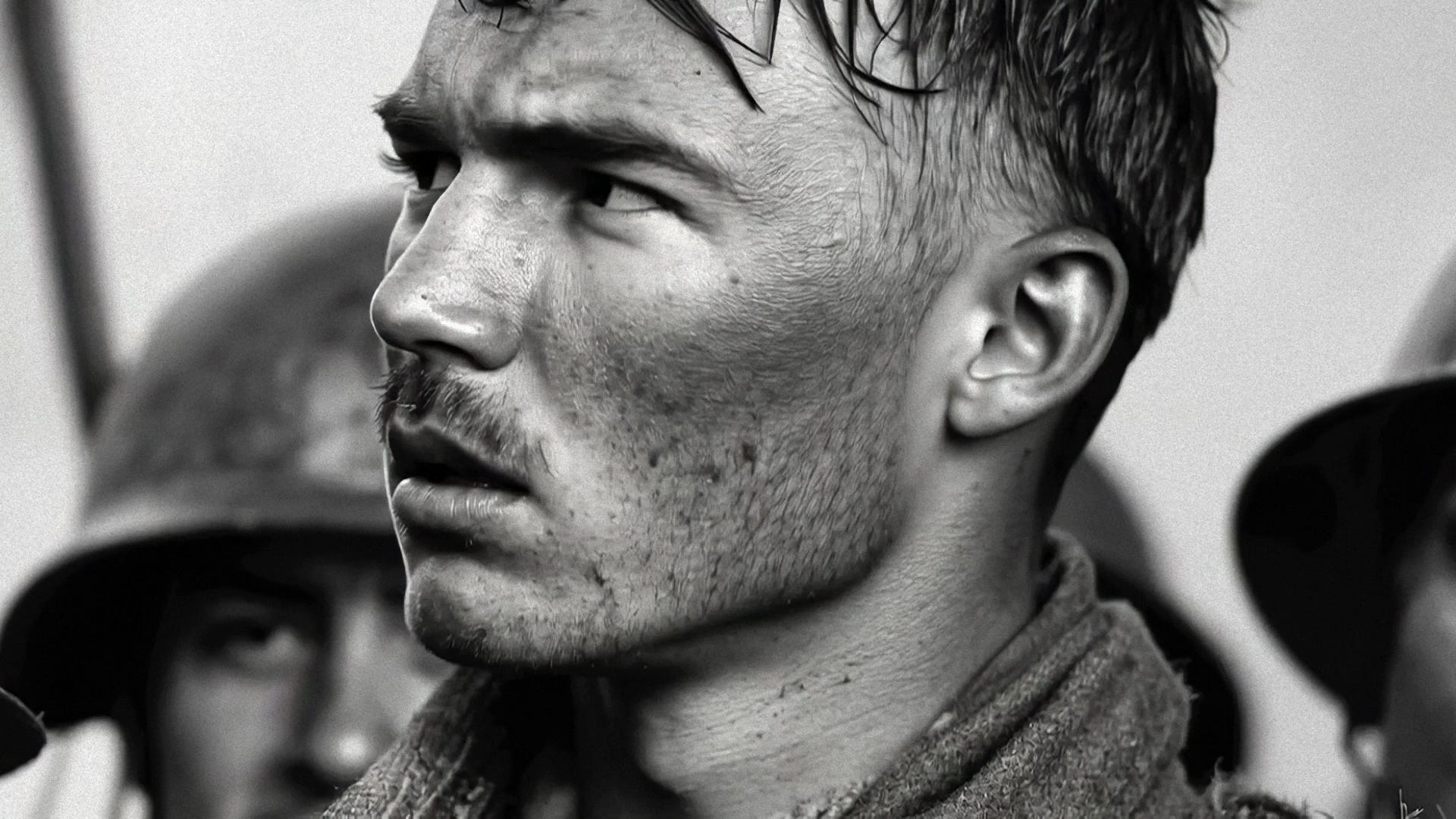
Matching the Prompt to the Poem
The prompt I built was:
[SUBJECT] black and white photograph, 1910s vintage style, military uniform,
Robert Mapplethorpe, hyperrealist, Three point lighting, epic dramatic,
editorial, action movement motion drama, front view full body shot,
Leica M11 60MP, low noise, richness, sharp
Each element is doing specific work against the lyrics.
“1910s vintage style, military uniform” — The song is about the First World War’s particular moral catastrophe: soldiers on opposite sides of a trench who were, in every way that matters, the same person. Wilfred Owen understood this in 1918. The uniform grounds the image in that specific historical argument without illustrating it literally.
“Robert Mapplethorpe” — This isn’t a style tag in the way “cinematic” or “moody” is a style tag. It’s an instruction to the model about a specific visual philosophy: treat this person as sculpture. Make the lighting do the philosophical work. Give me accusatory frontality.
“hyperrealist, Three point lighting, epic dramatic” — These reinforce the Mapplethorpe instruction while pushing toward a specific sub-register: the portrait that feels like it belongs in a museum but was found in a battlefield archive. Real enough to be a document. Lit too carefully to be accidental.
“front view full body shot” — The song’s central argument is I had his hands, I had his heart. A face alone doesn’t show you hands. A full body portrait shows you the whole person — the person who is, the lyric insists, the same as the person they killed.
“Leica M11 60MP, low noise, richness, sharp” — These are the technical parameters that tell the model what kind of black-and-white to render. Not grainy vintage. Not soft-focus nostalgia. Sharp, rich, high-resolution black-and-white — the kind that makes skin look like it has geological depth.
The Feedback Loop, Same Process
The method here is identical to building a pcode, except instead of encoding the style into a reusable string, you’re encoding it in the text prompt itself — through the artist reference and the technical specifications.
The first batch of generations gives you maybe five images out of fifty that have something. The particular quality is hard to name before you see it: a gravity in the face, a quality of light that makes the subject feel permanent. Those five go into a moodboard. You generate fifty more. Seven might belong this time. You keep building.
By the time the moodboard reaches fifty to a hundred images, the ratio has inverted. Forty out of fifty are arriving in the right register. The prompt has been refined by exposure to its own best outputs — each selection teaching you more precisely what you were reaching for.
What you’re training is not the model. You can’t save that learning into a pcode here because you’re working from a named artist reference rather than a custom style profile. What you’re training is your own eye. By the hundredth image, you can look at a generation in the first half-second and know whether it belongs. You’ve internalized what Mapplethorpe’s visual grammar looks like when it’s been successfully borrowed.
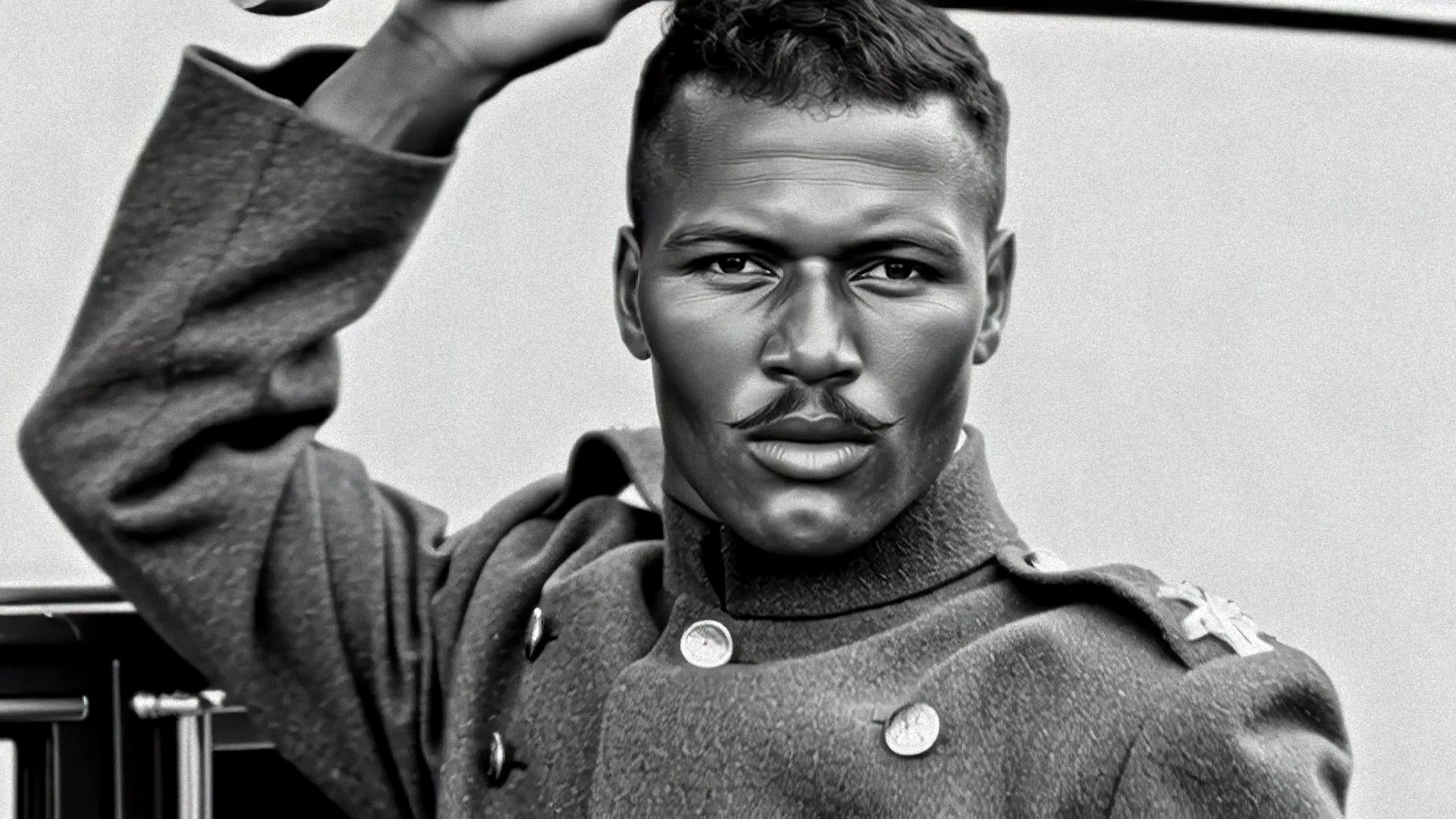
What the Images Do to the Lyrics
Look at image one: the Black soldier in formal military dress, direct gaze, the lighting carving his face into something that feels like a monument. The wrinkles on his skin have the texture of weathered stone. He is looking at you the way the song’s dead soldier looks at the speaker in the tunnel — with recognition, with accusation, with something that is not quite grief and not quite anger but contains both.
The lyric that image is serving: He said I had his hands, I had his heart / We were the same dream torn apart.
Now look at image three: multiple Black soldiers clustered together, their faces layered, their eyes all landing on you simultaneously. This is the chorus made visual — Strange brothers, same blood in the dust. Not one man. The argument multiplied. Every face making the same claim.
Image six does something different and harder. The column of soldiers marching through snow, different races in the same line, moving in the same direction toward the same thing. The oblique framing means you’re watching them from inside the column, not observing it. You are also in this line. Strange brothers — hear the drums / Strange brothers — kingdom come.
The visual grammar Mapplethorpe built — that quality of decided stillness, of subjects who have made up their minds — works here because the song is about people who have already arrived at an understanding that the living haven’t reached yet. The dead in Owen’s poem are not frantic. They are waiting. They know something. Mapplethorpe’s lighting is the lighting of people who know something.
The Futility Embedded in the Work
I want to name what the song names directly, because it’s the honest frame for the entire project.
Making protest videos knowing that the act is futile.
That line isn’t defeat. It’s a specific kind of moral clarity. The soldiers in these images have been dead for a hundred years. The wars that killed them produced the logic that produced subsequent wars. Wilfred Owen wrote “Strange Meeting” in 1918 and was killed one week before the Armistice. The poem didn’t stop anything. Neither will this video.
But that’s not why you make it.
You make it because the truth, as the lyric says, is sealed inside silent ground — and the act of making the image, building the moodboard, refining the prompt until Mapplethorpe’s accusatory gaze is properly present, is the act of refusing to let it stay sealed. Not because it will work. Because refusing is the thing itself.
The images cost less than a dollar to generate. The understanding they required cost a great deal more than that, and was paid by people who aren’t here to collect.
<iframe data-testid=”embed-iframe” style=”border-radius:12px” src=”
width=”100%” height=”352” frameBorder=”0” allowfullscreen=”“ allow=”autoplay; clipboard-write; encrypted-media; fullscreen; picture-in-picture” loading=”lazy”></iframe>
<iframe width=”560” height=”315” src=”
title=”YouTube video player” frameborder=”0” allow=”accelerometer; autoplay; clipboard-write; encrypted-media; gyroscope; picture-in-picture; web-share” referrerpolicy=”strict-origin-when-cross-origin” allowfullscreen></iframe>
Strange Brothers (feat. Mayfield King) is available on Spotify. Inspired by Wilfred Owen’s “Strange Meeting,” Matthew 6:10, and Jeremiah 13:16. Full prompts and workflow at musinique.substack.com


