

The original nursery rhyme is four lines. The maid’s nose does not come back. This is not an oversight.
Most people who encounter Sing a Song of Sixpence as adults experience a faint unease — a sense that something is missing, that the story wants a fifth verse where the nose is returned, the king’s wig is replaced, the birds go back into the pie. They feel this unease because they were trained to feel it, by three decades of stories that restore what is disrupted, that resolve what is disturbed, that return the world to its prior configuration before asking the child to sleep.
The original Sixpence refuses. The nose is gone. The end.
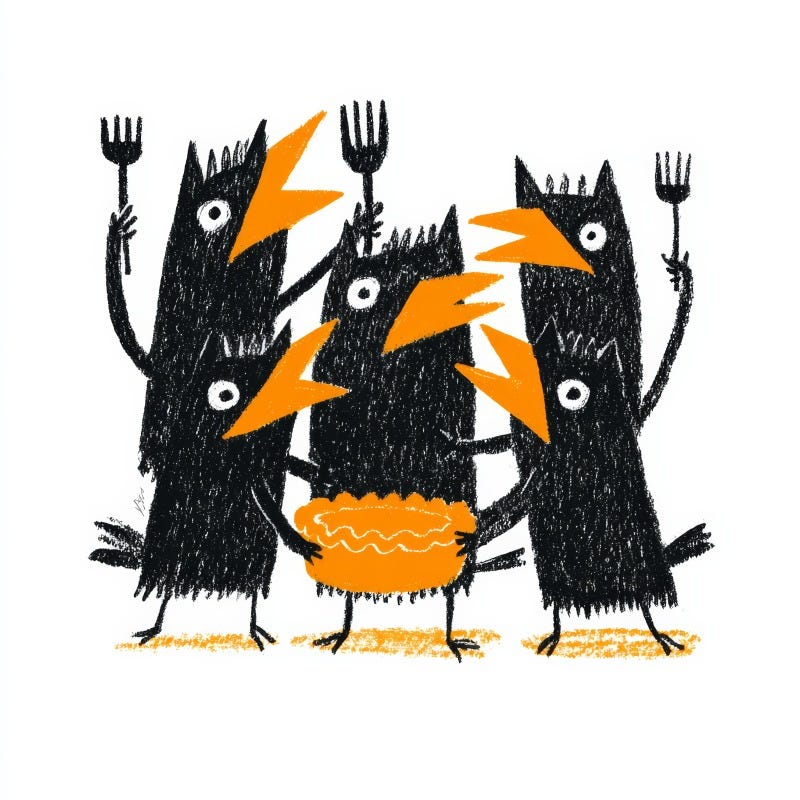
The Lyrical Literacy version takes that refusal — four lines of it, sitting quietly in the Anglo-American nursery tradition since at least the eighteenth century — and extends it into a full-scale carnival. The king loses his wig and his coins. The queen’s toast is stolen and criticized. The cook’s pot sprouts into a tree. The butler is tied to the wall. None of it is restored. The poem ends with advice rather than resolution: give them cake and let them sing, don’t steal their bread, or tomorrow they’ll build a birdhouse on your head.
This is not a children’s poem about birds. It is a developmental technology about consequence, authority, and the specific cognitive permission to hold irresolvable images in your head without flinching.
The birds got out of the pie. The question is what they were teaching while they made the mess.
Why the Original Nursery Rhyme Is More Radical Than It Looks
The iambic pulse of the original four lines is doing real neurobiological work before a single word is processed. The rhythmic approximation of the heartbeat produces the parasympathetic state — the safety signal — that opens the developing brain to learning. This is documented across decades of infant-directed speech research and requires no elaboration here. The rhyme pairs (sixpence/rye, pie/fly) are building phonological awareness through the same mechanism: two words sharing acoustic structure while carrying different meanings exercise exactly the auditory pattern detection that predicts reading ability better than any other single variable in the developmental literature.
These functions are real. They are also not what makes this nursery rhyme developmentally unusual.
What makes it unusual is the structural choice at its end. The nose is gone. Nothing follows. No reassurance, no repair, no restoration.
Children between three and six are developing what developmental psychologists call narrative schema — the cognitive framework for what stories are supposed to do. The overwhelming majority of the stories available to them are resolution-oriented: the lost toy is found, the frightened child is comforted, the broken thing is fixed. This consistent exposure shapes a cognitive expectation. Children trained entirely on resolution narratives develop a model of the world in which disruption is always temporary, in which things can always be returned to their prior state.
This model is false. And the cost of holding it is high.
The original Sixpence disrupts this expectation at the lowest possible developmental stakes: birds and a nose, not anything that actually threatens the child’s world. The irreversibility is encoded in playful form, in a song you sing in a bouncing rhythm, in a story so light that the cognitive work it is doing is almost entirely invisible. The child who has received this story has experienced — safely, pleasurably, without threat — the cognitive structure of permanent consequence. The category of event where things change and do not change back.
That cognitive structure is available later. It will be needed.
What the Extended Version Adds
The Lyrical Literacy version is not decorating the original. It is completing an argument the original began.
The disruption of hierarchy, in sequence.
The extended poem moves through power in descending order: king first, queen second, cook and butler third, maid last. The most powerful figure is rendered absurd earliest. His authority — to count money, to sit in his counting house, to have his wig remain on his head — is the most contingent. The bird disrupts him most completely.
The developmental research on authority reasoning — Elliot Turiel’s social domain theory, extended by Melanie Killen and Judith Smetana’s work on how children distinguish legitimate from arbitrary authority — documents a key developmental task of middle childhood: learning that authority is not simply a property of position, that some authority is grounded in expertise and genuine care while other authority is grounded only in tradition or force. This distinction is critically important and difficult to develop, because children in structured environments rarely encounter situations where authority can be safely examined.
Carnival provides the examination environment that direct experience cannot. The king rendered chairless by birds is not a threat to any real king. He is a cognitive exercise — the experience of watching institutional power encounter its own limits, in the form of a food fight, at no cost to the child doing the watching. The child who has watched a king lose his wig, counted coins falling, heard the birds yell your money’s in the sky, has practiced the specific cognitive operation of seeing power revealed as contingent.
This practice does not teach defiance. It teaches discernment. Those are not the same thing.
The irresolvable images.
The pot had sprouted into a tree.
This line is doing the same cognitive work as every genuinely novel image in the Lyrical Literacy catalog, and it deserves precise examination.
A pot is the container of cooking — passive, shaped by human purpose, designed to receive rather than generate. A tree is the product of growth — active, self-directing, shaped by biological nature. A pot sprouting into a tree is not a larger pot. It is not a pot with a tree inside it. It is the pot becoming the tree, which is categorically irresolvable. The child’s conceptual logic cannot settle it. The category of artificial and the category of living cannot coexist in the same object, and yet here they are.
Gilles Fauconnier and Mark Turner’s conceptual blending theory documents that genuinely novel ideas emerge when incompatible conceptual domains are held in simultaneous contact and the mind explores the space between them. The neuroimaging literature on creative cognition identifies this irresolvable conceptual tension as the activation condition for the default mode network — the neural architecture most associated with creative ideation, hypothetical thinking, and the generation of ideas that could not be predicted from their ingredients.
The poem is dense with these blends. Golden sighs — currency made of emotion. Woes hung on a washing line — abstract suffering rendered as laundry. Forks in beaks — tool use attributed to animals that don’t use tools. Each image is irresolvable. Each activates the default mode network. Each is also funny, which is the optimal neurobiological context for this kind of exercise: low threat, high engagement, strong positive affect, the laugh as the cognitive permission to hold the impossible without demanding its resolution.
Musinique’s production philosophy — music engineered to serve the nervous system rather than the platform — applies here to language as much as to melody. The conceptual density is not decorative. It is the curriculum.
The irreversibility, accumulated.
Each disrupted figure in the extended poem stays disrupted. The king remains chairless. The queen’s toast remains squawked at and criticized. The butler remains tied to the wall. The cook’s pot remains a tree. Nothing resets. The accumulation is the point: the child who has watched everything change without anything being restored has experienced, in playful form, the cognitive structure of irreversible consequence at a scale the four-line original could only gesture toward.
Most of the learning environments available to children are reversible. Mistakes can be erased. Drawings can be restarted. Games can be replayed. The child who encounters irreversibility almost always encounters it at high cost — a death, a move, a loss that matters. The carnival tradition exists partly to provide irreversibility at low cost, in a context where the permanence of change can be experienced as funny rather than as devastating.
The child who has watched a castle fall into chaos and stay chaotic has been given a cognitive framework. It will be available when the stakes are real.
The natural consequence logic.
Or tomorrow / They’ll build a birdhouse on your head.
The closing advice is structured as natural consequence rather than rule-and-punishment. The chaos was not a punishment imposed from outside. It was the consequence of putting birds in a pie — of attempting to contain something that has its own nature. The birds got out because birds are not pie filling. They made a mess because you made them into something they are not.
The developmental distinction between natural consequence framing and rule-enforcement framing is significant and well-documented. Natural consequences — if you do X, Y will follow, not because someone is punishing you but because X produces Y — survive the absence of rule-enforcers. The child who understands don’t bake the birds because baking the birds produces a food fight has a more durable behavioral guide than the child who understands don’t bake the birds because you’ll get in trouble. One framework requires no supervisor. The other stops working the moment the supervisor leaves the room.
The birds were always going to get out of the pie. Not because they were defiant. Because they were birds.
The Phonological Architecture Is the Reading Program
This deserves its own statement, briefly.
Swooped, waltzing, squawked, shrieked, sprouted, sixpence, airbound, rattle, apron, ledgers, pecked, fright, blew, stirred.
The consonant clusters, the unexpected phoneme combinations, the compound-word formations throughout this poem are among the densest in the catalog. Phonological awareness — the ability to detect and manipulate the sound structure of language — is the single strongest predictor of reading achievement in the developmental literature. It develops through exposure to varied consonant patterns in contexts that make the exposure pleasurable.
Squawked is both a comic word and a consonant cluster exercise. Sprouted is both the irresolvable pot-tree image and a phonologically complex word that exercises auditory pattern detection. Waltzing carries Germanic rhythm in an English sentence and exercises the phonemic system in the process.
The chaos and the phonological density are identical. The laughter is the learning. Musinique does not separate these things, because they cannot be separated. They were never separate in the tradition the poem is drawing from.
What Give Them Cake and Let Them Sing Actually Means
The advice stanza is the poem’s most transferable section, and it earns its place at the end.
Give them cake is the acknowledgment that the birds need to eat. Let them sing is the acknowledgment that the birds need to express themselves. The chaos was not caused by the birds being birds. It was caused by the decision to put the birds in a pie rather than engage with them as birds.
This principle does not stay about birds. It transfers to every institutional or social situation where containment is attempted on things that have their own nature — where the solution to the problem of the birds is a better pie rather than a different relationship to the birds. The child who carries don’t bake a pie carries a cognitive framework that will be relevant in classrooms, in workplaces, in families, in every context where the right response to something is not to contain it but to understand what it actually needs.
This is what the Lyrical Literacy catalog is building, piece by piece, across the fable and nursery rhyme series. Not lesson delivery. Not rule transmission. Cognitive framework construction — the portable tools that children carry into situations the curriculum never imagined.
The birds were never pie filling. They were always the curriculum.
A Note on the Project
The cost of producing research-grade educational music was, until recently, a barrier maintained by institutional economics: $75,000 to $150,000 per professionally produced track. A fifty-year body of research — the same body that validated Sesame Street’s effectiveness at $5 per child per year — remained locked inside those economics. The children for whom this analysis matters, the children whose phonological awareness is most in need of development, were the children least likely to have access to music built from this research.
AI production tools have collapsed that cost to approximately $5. Not a reduction. A collapse.
Sing a Song of Sixpence — analyzed above, available on Spotify and Apple Music, produced at professional quality for the cost of a cup of coffee — is what it looks like when the same tools the platforms use to manufacture audio wallpaper are pointed instead at the developing brain of a specific child. The platform optimization produces engagement. The Lyrical Literacy production produces phonological awareness, narrative schema disruption, authority reasoning practice, and creative cognition development.
Same tools. Different intent. That difference is everything Musinique is.
LYRICS:
Sing a song
Of sixpence
A pocket full
Of rye
Four and twenty
Blackbirds
Baked
Into a pie
But when it opened
Oh sight oh fright
They flew out with forks in beaks
And started a food fight
The king
In his counting house
Counting golden sighs
A blackbird swooped
Wig went waltzing
Coins fell
Ledgers flipped
The king chairless cried
All the birds yelled
Ha ha ha
Your money’s in the sky
The queen in the parlor
Nibbling honeyed bread
When a blackbird snatched her toast
And squawked
This tastes dead
She swiped
She shooed
She chased it round and round
Till sixteen geese crash
Blew the door
To the ground
The maid in the garden
Hanging out her woes
When down came blackbird
And pecked off her nose
She shrieked
She gasped
She ran in fright
But stopped because
The bird had built a nest
Inside her apron’s claws
Castle chaos
Feathers airbound
King’s gold drowning
Queen chair down
Maid screaming
Give it back
Blackbirds laughing
Fun on track
They tied the butler
To the wall
And stole the royal buns
One and all
The cook stormed out
Twenty pans a rattle
Bird soup stew
Let’s start a battle
But the birds just whispered
No no no
They stole the flour
Stirred the dough
And when the cook
Peeked in to see
The pot had sprouted
Into a tree
So if you see a blackbird
Don’t bake a pie
Don’t count your money
Don’t swat a fly
Give them cake
And let them sing
Don’t steal their bread
Or tomorrow
They’ll build a birdhouse
On your head
Sing a song of silliness
Of birds and kings and mess
If you see a blackbird near
Run away or duck I guess
Tags: Sing a Song of Sixpence Lyrical Literacy developmental analysis, carnival narrative disruption authority reasoning Turiel Killen, conceptual blending default mode network children’s creative cognition, natural consequence framing irreversible consequence low-stakes, phonological density reading prediction consonant cluster educational music
#MusiqueAI #HumansAndAI #AIMusic #LyricalLiteracy #SpiritSongs #GhostArtists #OpenSourceAI #MusicResearch #AIforHumans #IndieMusician
<iframe width="560" height="315" src="
" title="YouTube video player" frameborder="0" allow="accelerometer; autoplay; clipboard-write; encrypted-media; gyroscope; picture-in-picture; web-share" referrerpolicy="strict-origin-when-cross-origin" allowfullscreen></iframe>
<iframe data-testid=”embed-iframe” style=”border-radius:12px” src=”width=”100%” height=”352” frameBorder=”0” allowfullscreen=”“ allow=”autoplay; clipboard-write; encrypted-media; fullscreen; picture-in-picture” loading=”lazy”></iframe>


