

What Oral Survival Proves
Every fairy tale in the Grimm collection passed a test before it was written down. The test was not literary quality or narrative elegance. It was use. The stories that survived in oral tradition across generations did so because people kept finding them necessary — because something in them did work that nothing else could do, work that mattered enough that the story was told again rather than forgotten.
The Travelling Musicians passed this test across centuries. This is evidence. Not evidence that it is pleasant, or poetic, or well-structured — though it is all of those — but evidence that it contains something durable. Something that people recognized as necessary to pass on.
What the story contains, examined precisely, is instruction in three cognitive frameworks that appear nowhere in formal education and that research in developmental psychology, social psychology, and purpose science have since identified as foundational to human flourishing. The instruction is not stated. It is encoded. The frameworks are not explained. They are experienced. By the time the listener’s analytical mind arrives to evaluate what they heard, the content is already in.
This is what oral tradition was always doing, and what Tuzi Brown’s voice does, and what the Lyrical Literacy methodology names as the mechanism by which stories teach what instruction cannot: encoding before evaluation, experience before concept, the framework arriving in the body before the mind has prepared a defense against it.
The Most Important Sentence in the Story
Suppose you go with me.
The donkey says this four times, to four different animals, in four different situations. It is the sentence the story is built around, and it deserves more attention than it typically receives.
The donkey has nothing to offer. He is an old ass who ran from a farmer who was going to kill him. He has no resources, no plan, no certainty about the destination or whether the destination will want what he has to bring. He has not been to the great city. He does not know if musicians are wanted there. He does not know, when he meets the dog, what the dog can do. He guesses the cat is a good night singer, but this is speculation, not assessment. By the time he reaches the cock, he has given up pretending to know: who knows? If we care to sing in tune, we may get up some kind of a concert. The invitation is issued before any value has been demonstrated, before any utility has been established, before the invitee has proven themselves worth inviting.
Developmental psychology distinguishes between two fundamentally different types of social relationship based on what precedes the connection. The first type is utility-prior: relationship forms because each party has demonstrated value to the other. The second type is recognition-prior: relationship forms because someone extends an invitation before knowing what the other person can offer. The distinction matters because these two types of community have different stability profiles under stress.
Utility-prior community dissolves when the utility ends. The farmer no longer needs the donkey. The relationship ends. The donkey runs. This is the setup of every verse before the invitation: a relationship that formed around usefulness, terminating when the usefulness expired. Utility-prior community is the default model for most adult social organization — professional networks, transactional friendships, team memberships organized around shared projects. It is functional and it is fragile.
Recognition-prior community — the kind built from suppose you go with me extended to someone who is panting by the road with no obvious value to offer — has a different structural quality. It forms around shared condition rather than shared utility: we are all in the same precarious situation, we are all walking toward an uncertain destination, and someone thought to invite us. The cohesion is not dependent on continued utility. It preceded utility. It will survive utility’s end.
Most children are never explicitly taught this distinction. They encounter the utility-prior model constantly — in schools that organize social groups around projects and grades, in families that organize value around contribution and performance — and absorb it as the default model for human connection. The child who hears The Travelling Musicians has heard, before the default model is fully installed, that community can form differently. The donkey’s question is a template. The child who has it will recognize the genuine invitation when she encounters it and will be capable of extending it herself.
Suppose you go with me is teachable social knowledge. It is more useful than most of what social skills curricula contain. It arrives here encoded in a story, in a voice that knows it from the inside, before the analytical mind is ready to screen it.
The Robber’s Report as a Lesson in Perception Under Threat
The robber who returns to the house reports what he experienced with perfect sincerity and complete inaccuracy. A horrid witch scratched his face with long bony fingers. A man with a knife stabbed him behind the door. A black monster in the yard struck him with a club. The devil on the roof cried throw the rascal up here.
He has described a cat, a dog, a donkey, and a cock.
The gap between what happened and what he reported is not evidence of stupidity. It is evidence of a specific and well-documented cognitive phenomenon: category threat response, the process by which a mind under threat organizes anomalous experience into the available categories that best preserve the perceiver’s existing self-concept.
The robbers’ self-concept was organized around dominance: they had the house, the food, the weapons, the numbers. A successful challenge to their dominance by a gang of armed rivals would have been comprehensible within this self-concept — rivals are a known category, losing to rivals is a survivable narrative, the robbers could reorganize and return. But a successful challenge by four old animals who were supposed to be dead is not a category the robbers’ minds can accommodate without structural damage to the dominance narrative. The mind faces a choice: accurately perceive what happened and lose the narrative, or recategorize the experience into the supernatural and preserve the narrative. The robbers chose the witch.
This is not unique to robbers in fairy tales. It is a feature of every power structure that has organized its perception around assumptions of its own dominance. When challenge comes from a source that the structure has dismissed or discarded, the structure’s first response is perceptual — it categorizes the challenge in ways that prevent accurate recognition. The witch is safer than the donkey because the witch belongs to a category in which robbers can reasonably be helpless. The donkey does not.
Social psychologists studying intergroup perception have documented this pattern extensively in contexts ranging from organizational behavior to political movements: groups in power consistently misidentify challenges from dismissed groups by assigning them to threat categories that preserve the power narrative. The dismissed group is cast as external, supernatural, criminal, or pathological — anything but what it actually is, which is the group that was dismissed and came back.
Children who have encountered this pattern in the Grimm tale have a cognitive framework for recognizing it when it appears in more consequential contexts. The robbers couldn’t see the donkey. This is not a fairy tale problem. It is a perennial human problem. The child who has heard it encoded in a story, before she has any stake in the power structures that will later ask her to not-see, has a framework she can apply.
The donkey and his friends were incomprehensible to the robbers. This is, the story suggests, a form of power. Not the power of force or numbers or weapons, but the power of being something that the existing categorization system cannot accommodate. The discarded are frequently incomprehensible to the structures that discarded them. The story treats this as an asset, not a liability.
Bremen Was Never the Point
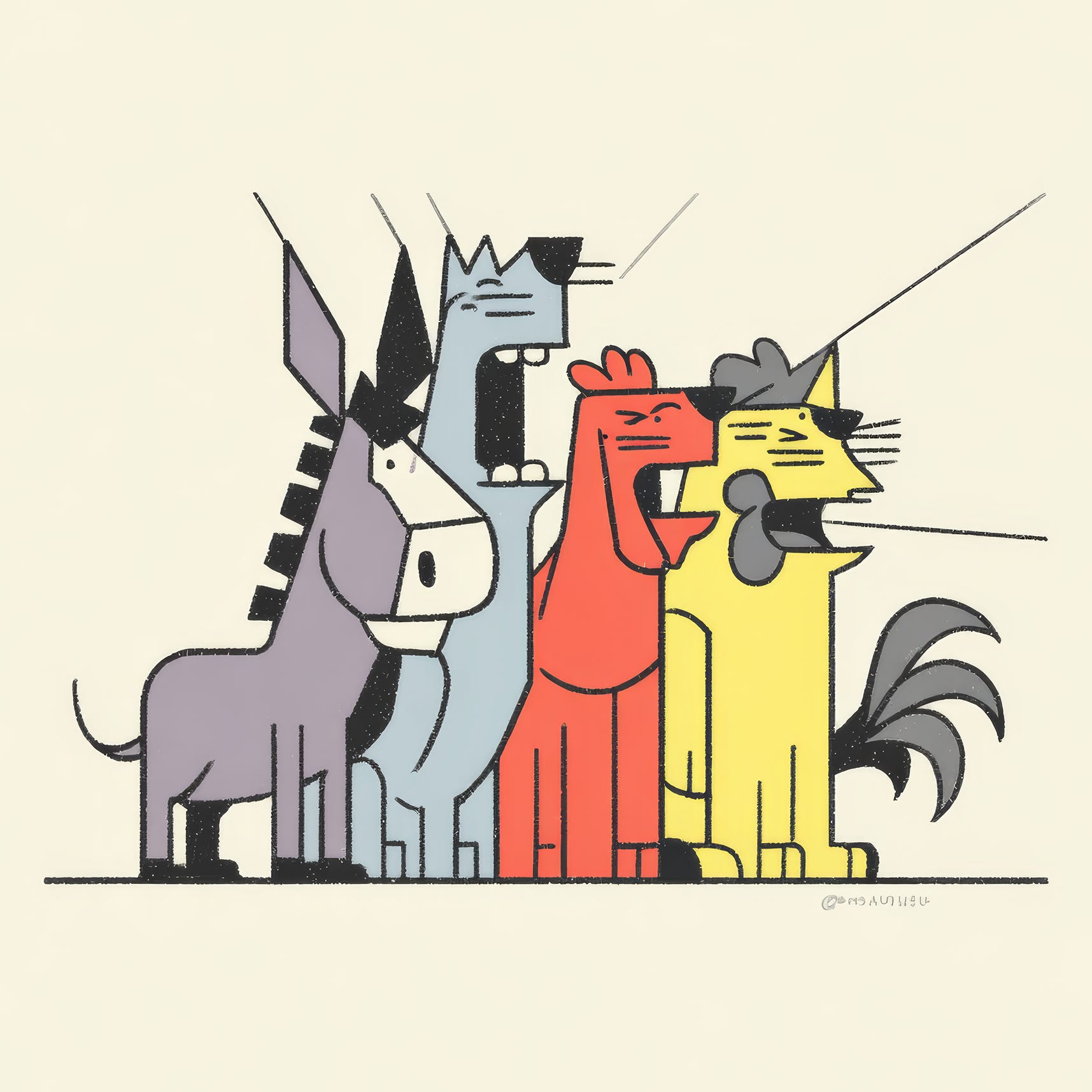
The ass sets out for the great city in the story’s first sentence. He never arrives. The great city is never mentioned again after the animals find the robbers’ house. The story ends in a farmhouse in the woods with four animals who have arranged themselves according to their own natures — the donkey in the straw, the dog on the mat, the cat by the warm ashes, the cock on the beam — and who are, the narrator asserts with total confidence, still there at this very day.
The destination was abandoned. The narrator is not bothered by this. The story is not bothered by this. The animals are not bothered by this. The farmhouse is presented as a complete and satisfying ending, which it is.
Understanding why requires understanding a distinction that purpose researchers have made between goal-purpose and need-purpose. Goal-purpose is purpose organized around a specific external objective: become a musician in the great city, win the competition, get the job, reach the destination. Need-purpose is purpose organized around an underlying need that any number of goals might serve: have a context in which what you offer is valued, belong to a community that knows you, find a place arranged according to your own nature.
Goal-purpose and need-purpose frequently feel identical from the inside, which is why losing a goal so often feels like losing meaning rather than losing one particular path to meaning. The donkey, setting out for the great city, was not aware that his goal-purpose (music in the city) was a specific expression of his need-purpose (a context where what he has to offer is valued, with companions who know him). The farmhouse satisfies the need-purpose completely. Whether it satisfies the goal-purpose is irrelevant.
The ability to recognize when a need-purpose is being served by a different goal than the one originally specified — to say this is what I needed, even though it is not what I planned — is what purpose researchers call purpose flexibility, and it is strongly associated with resilience across major life transitions. People who are rigidly attached to a specific goal-purpose tend to experience the loss of the goal as the loss of meaning, even when the underlying need is still available to be served. People with purpose flexibility recognize the need-purpose underneath the goal and can redirect toward it when the goal is no longer available.
The Travelling Musicians encodes purpose flexibility before the child has the vocabulary to name it. The donkey never reaches Bremen. He ends up in a place arranged according to his own nature, with companions who know him, past the end of the story. The narrator’s confidence — at this very day — is the confidence of a story that knows its characters found what they needed rather than what they planned. This is the correct response to a redirected journey. The story models it without explaining it, and the child who has heard it has a model before she has encountered the experience it prepares her for.
The Voice as Pedagogical Condition
Source credibility is not a secondary concern in narrative learning. It is a primary one.
Research on story-based learning consistently identifies the listener’s assessment of whether the storyteller has earned the right to tell the story as a significant predictor of encoding depth. The content of a story told by a credible source — a source the nervous system recognizes as someone who has been through what the story describes — is encoded differently, more deeply, more durably, than the same content told by a voice that is performing rather than testifying.
Tuzi Brown’s smoky alto carries the Grimm tale in the Holiday tradition: behind the beat, each word given exactly its weight, the vibrato appearing as emotional consequence. This is the voice of testimony — not the performance of someone who has read about the donkey’s situation but the carrying of someone who has been in it, who knows the road from the inside, who has found her company and is telling you about it from the house.
When she delivers and there they are, I dare say, at this very day, the line carries first-person witness credibility. She is not reporting what the story says. She is telling you what she knows. The listener’s nervous system receives this differently than it receives narration. The framework content — the recognition-prior community, the category threat response, the purpose flexibility — is encoded in the context of a voice the nervous system trusts because the voice has earned that trust through the quality of its presence.
The pedagogical implication is direct: the story’s three cognitive frameworks are available from the text. The depth at which they are encoded is a function of the voice. Tuzi Brown’s voice produces deep encoding. This is not an aesthetic judgment. It is a learning outcome claim, grounded in the research on source credibility and narrative encoding.
Three Frameworks, Each Transferable
The story delivers three cognitive frameworks that transfer across domains and persist across the developmental span from early childhood to adulthood.
Recognition-prior community. The invitation extended before utility is established. The connection formed in shared precariousness rather than shared purpose. The ass’s question as a template for extending and recognizing the genuine invitation. The child who has this template will encounter it again in every context where community forms — school, work, friendship, creative collaboration — and will have a framework for distinguishing the recognition-prior connection from the utility-prior one.
Category threat response. The mind’s tendency, under threat, to organize anomalous experience into categories that preserve the self-concept rather than accurately perceive the source of the challenge. The robbers saw a witch and a devil because seeing a donkey and a cock would have been more threatening to their narrative. This pattern recurs in every power structure the child will encounter. The framework, encoded before the child has a stake in any particular power narrative, is available as an analytical tool when it becomes consequential.
Purpose flexibility. The ability to recognize when a need-purpose is being served by an unexpected goal — to find the farmhouse and know it is what was needed, even though it is not what was planned. The child who has absorbed at this very day has a model for purpose flexibility that most adults acquire late, through painful redirection, without a framework for naming what happened to them.
These frameworks do not arrive as instruction. They arrive encoded in events, in the texture of the story, in a voice that has earned the right to carry them. The analytical mind will organize them later, when it has the vocabulary and the experience to do so. The encoding happens now. That is the oldest pedagogy in the human record.
Stream The Travelling Musicians and the full Tuzi Brown catalog:
<iframe width="560" height="315" src="
" title="YouTube video player" frameborder="0" allow="accelerometer; autoplay; clipboard-write; encrypted-media; gyroscope; picture-in-picture; web-share" referrerpolicy="strict-origin-when-cross-origin" allowfullscreen></iframe>
Tags: Travelling Musicians Grimm recognition-prior community utility-prior social belonging developmental, category threat response power perception intergroup social psychology pedagogy, purpose flexibility goal-purpose need-purpose resilience purpose transfer oral tradition, Tuzi Brown source credibility narrative encoding Holiday tradition testimony, oral tradition survival test fairy tale cognitive frameworks transferable learning
#MusiqueAI #HumansAndAI #TuziBrown #GhostArtists #SpiritSongs #SpokenWord #LyricalLiteracy #MusicResearch #AIforHumans #OpenSourceAI


