

Watch a six-year-old lose a game they cared about. Watch them not win the prize they wanted. Watch them fail to reach the thing that was just slightly too high.
Then watch what happens next.
The grapes were probably bitter anyway. I didn’t really want it. It wasn’t that important. The move is fast — sometimes seconds from the failure to the revaluation. It produces immediate relief. It is nearly invisible from the outside, and from the inside it feels less like a lie than like a discovery: the thing I failed to get wasn’t worth getting. The desire retroactively reclassified as not-desire. The failure retroactively reclassified as non-failure because the goal was never real.
Psychologists call this retroactive revaluation. It is one of three strategies the brain deploys to resolve the discomfort of cognitive dissonance — the psychological friction produced when two inconsistent cognitions are held simultaneously. I wanted those grapes and I couldn’t reach those grapes create friction. The brain resolves friction. Revaluation is the fastest, cheapest, and most complete resolution available. The fox walks away feeling fine.
The problem is cumulative. A child who resolves this friction through revaluation at six does it more readily at eight. More automatically at ten. By adolescence, when the goals are higher and the failures are more consequential and the alternative responses require more psychological resources to maintain, the habit is deeply grooved. The name, when it finally arrives — if it arrives — cannot interrupt a pattern that has been running for a decade.
The Fox and the Sour Grapes provides the name at six. That is the entire intervention.
The Three-Part Learning Problem This Song Is Solving
Educational music about failure typically addresses one of three things: the emotional experience of failing (it’s okay to be sad), the external response to failure (try again), or the moral valuation of persistence (quitters never win). These are not wrong. They are incomplete.
What they do not address is the internal cognitive move that precedes the external response — the moment between failure and behavior when the brain makes the fastest available choice about how to resolve the discomfort. That is where the habit lives. That is where the intervention needs to happen. And that is precisely what is hardest to reach through direct instruction, because the move is pre-verbal, automatic, and dressed as insight rather than defense.
The song solves this three-part problem through three distinct mechanisms that must operate in sequence:
First: make the internal move visible. You cannot intervene in a cognitive habit you cannot see. Abstract instruction about cognitive dissonance produces intellectual understanding and behavioral inertia — the child knows what sour grapes means as a concept while continuing to produce sour grapes as a response. What produces behavioral change is pattern recognition: the felt familiarity of having seen this specific move performed by a specific character in a specific emotional register, so that when the child encounters the impulse in themselves, something clicks. This is the fox’s thing. The song must make the fox’s move visible and recognizable before it can be named.
Second: provide the name. Pretendin he’d never wanted them in. This single word — pretendin — is what converts pattern recognition into metacognitive capacity. It labels the cognitive move from inside the narrative, from the narrator who can see both what the fox is doing and what the fox is telling himself about what he’s doing. A child who has this word attached to this image has a label available for internal application. I’m pretendin I never wanted that. Naming is the precondition for choice. The habit that cannot be named cannot be interrupted.
Third: install the alternative. The warning against sour grapes is not a complete lesson. A child who has been told don’t do what the fox does and has not been given a viable alternative will, under the pressure of actual failure, do what the fox does anyway — because the brain needs somewhere to put the discomfort, and the fox’s move is faster and cheaper than any other option until the other option has been practiced. Dreams don’t spoil from bein too high / Only from quittin before you try installs the alternative not as instruction but as aspiration: the desire preserved rather than revalued away, acknowledged honestly rather than reclassified as not-desire.
What Each Structural Element of the Song Is Doing
The escalating failure sequence (stanzas 1–4) is not preamble. It is the lesson’s neurological prerequisite.
The fox does not fail once. He fails four times, each attempt more committed and more complete in its failure than the last: the brush of the vine, the mighty leap that falls short, the soaring charge that ends in a grunt and a sigh, the full-speed run ending in broken roots. This escalation serves a precise function in the learning sequence.
The hippocampus — the brain’s primary memory consolidation structure — encodes most durably what the amygdala has already processed emotionally. For the stump scene to encode, the child must have been made to care about the fox’s attempts before the stump scene arrives. Four stanzas of escalating physical comedy accomplish this. By the time the fox sits on the stump, the child has been rooting for him, laughing at him, and sharing something of his investment in the grapes. The emotional architecture is in place. When the verdict comes — they’re prob’ly bitter not ripe too dry — it lands in a brain that has been chemically prepared to receive and retain it.
The comedy is not decoration. It is the mechanism.
The rationalization in the fox’s exact words (stanza 5) shows the move rather than naming it.
Too tart for a fox as fine as I. The fox’s revaluation is delivered in first person, in the emotional register of wounded pride performing disdain. This specificity is pedagogically essential.
Abstract description of cognitive dissonance produces recognition that evaporates. Concrete demonstration of the emotional texture of cognitive dissonance — the stump, the pride licked, the retroactive dismissal of what was visibly and urgently desired three stanzas earlier — produces a felt pattern. The child who has inhabited the fox’s rationalization through narrative will later, when the analogous impulse arises in their own experience, encounter something familiar. This feeling. The fox’s words become the internal label for the child’s own impulse. That familiarity is the lesson operating. You cannot catch a habit you cannot feel coming.
The word pretendin (stanza 6) converts pattern recognition to metacognitive capacity.
Then strutted off with a wounded grin / Pretendin he’d never wanted them in.
Metacognitive awareness — the capacity to observe one’s own cognitive processes from a slight remove — is among the highest-leverage developmental capacities available to children, predicting outcomes across academic performance, emotional regulation, and long-term wellbeing more robustly than IQ alone. It develops through exposure to metacognitive language: words that name cognitive acts rather than simply performing them.
Pretendin is that word for this cognitive act. It names the self-deception as self-deception — from the narrator who can see the gap between what the fox is doing and what the fox is telling himself. The child who has this word available has an internal observation point. When the impulse to declare the grapes bitter arises, the child equipped with pretendin can observe it: that’s what I’m doing right now. The observation creates the gap between impulse and action in which choice lives. Without the word, there is no gap. There is only the automatic resolution.
The closing stanza (stanza 7) installs the alternative through aspiration rather than prohibition.
So don’t talk trash when your reach falls short / You can’t always change the final report / But dreams don’t spoil from bein too high / Only from quittin before you try.
The self-determination theory literature is consistent on the structure of effective developmental instruction: aspirational frameworks — telling children what to move toward — outperform prohibitive frameworks — telling children what to avoid — for behavioral change and internalization. “Don’t do what the fox did” is a prohibition. Dreams don’t spoil from being too high is an aspiration. The first produces self-monitoring. The second produces orientation.
The deeper developmental gift in this stanza is the practical consequence it implies: the fox who revalues the grapes as bitter cannot go back for them tomorrow without contradicting himself. The desire has been closed. But the fox who acknowledges honestly — I couldn’t reach them today — retains the desire, the accurate self-assessment, and the option. Retroactive revaluation doesn’t just eliminate the discomfort. It forecloses the goal. The child who understands this distinction understands why the alternative is worth the greater psychological effort.
The phonemic density of the lyric builds reading infrastructure in parallel.
Phonological awareness — the capacity to hear, segment, and manipulate the sound structures of language — is the strongest single predictor of reading ability identified across the developmental literature. The Lyrical Literacy catalog builds it as a first-order production requirement. The consonant architecture of this lyric is dense and varied: growlin, crouched, charged, strutted, sprawled, brushed, swingin, quittin, broken, preacher, leaped. Every child who learns this song is simultaneously building the auditory processing infrastructure that decoding written language requires — not as a separate lesson, but as an inseparable property of the blues groove. The reading scaffolding and the musical engagement are the same object.
Why the Fox Must Be Beside the Child, Not Below Them
The most consequential production decision in this song is the fox’s dignity.
He is hungry. Genuinely hungry — his belly was growlin for somethin to eat. The grapes are genuinely beautiful — like heaven’s smile. His attempts are genuinely committed — four of them, escalating, ending in broken roots. He earns both the desire and the failure before the stump. This matters because the lesson requires identification, and identification requires sympathy, and sympathy requires that the child not be positioned above the fox.
A fox who is foolish from the start, whose attempts are buffoonish rather than earnest, whose pride was never earned — this fox produces a child who watches from a safe distance. That is not me. That is a fox who was never going to succeed. The lesson applies to someone else.
A fox who wanted something real and tried genuinely and failed and then did the fastest available thing — this fox produces a child who leans forward. That is me. Or more precisely: That is me the next time I land in the dirt. The lesson is available for self-application because the child can feel the fox’s position from the inside.
The gentle irony of too tart for a fox as fine as I is funny precisely because the child can hold both sides simultaneously: the fox’s wounded pride performing disdain, and the grapes swinging indifferently in the sunlight, untouched and unchanged by the fox’s verdict on them. The comedy of the gap between the fox’s self-presentation and reality is the gap the child needs to see — not to mock the fox, but to recognize it when it operates in themselves.
Identification without endorsement. That is the posture the song creates. That is the posture from which the child can choose differently — not from above the failure, not from outside the impulse, but from beside the fox, having felt what he felt, having been given the name for what he did, and having heard the alternative offered without shame.
LYRICS:
Hot sun beatin and the fox felt beat
His belly was growlin for somethin to eat
Said lord above I’d eat a boot
A bug a bone or a chunk of fruit
But there they were like heaven’s smile
Purple grapes hangin high in style
A vine full of sugar just outta reach
A fox’s dream on a preacher’s speech
He jumped once nearly brushed the vine
Said I’ll get em next time they’ll soon be mine
Crouched down low gave a mighty leap
But the grapes just laughed and stayed up deep
He zipped and soared made the dust fly
But landed flat with a grunt and sigh
Backed up charged like a fire in boots
And hit the dirt with broken roots
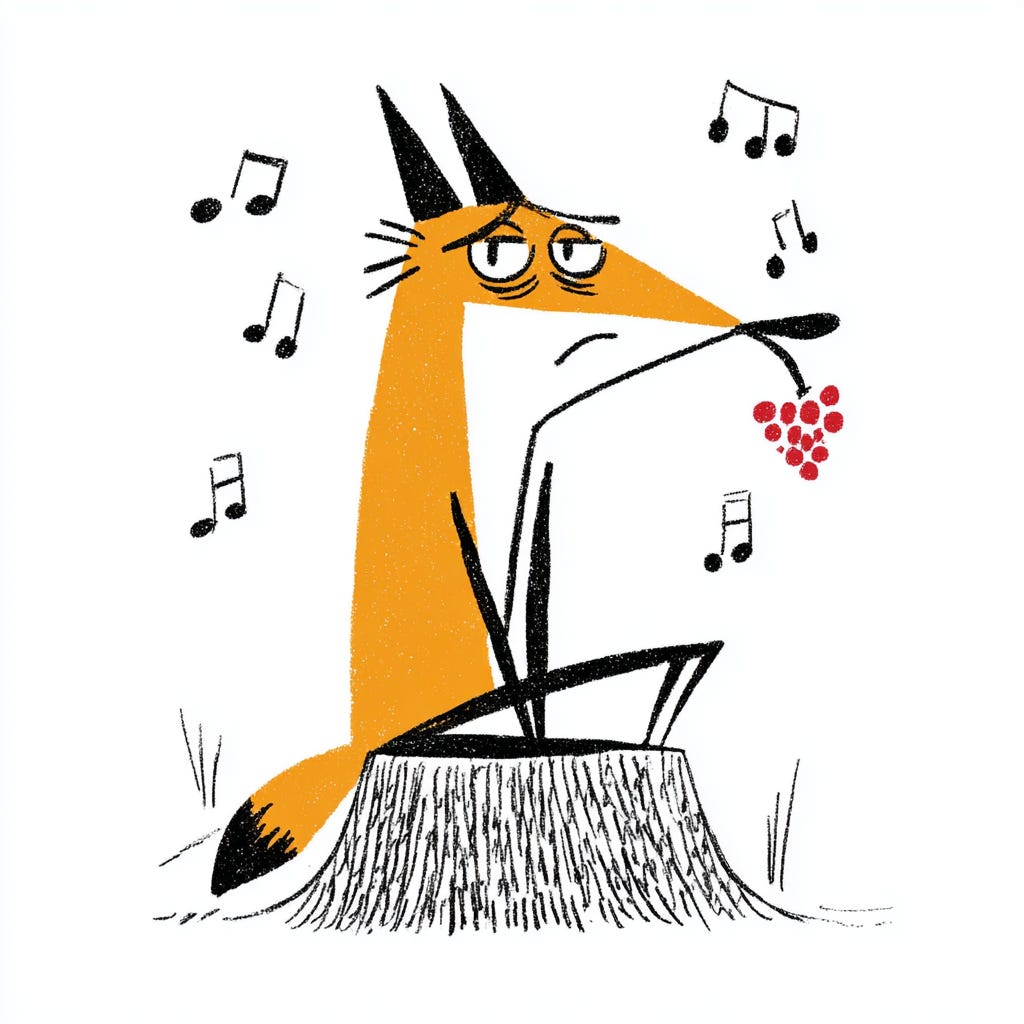
He sat on a stump licked his pride
Those grapes still swingin side to side
Said they’re probly bitter not ripe too dry
Too tart for a fox as fine as I
Then strutted off with a wounded grin
Pretendin he’d never wanted them in
Sometimes when you miss your prize
You make up lies to soothe your cries
So don’t talk trash when your reach falls short
You can’t always change the final report
But dreams don’t spoil from bein too high
Only from quittin before you try
Tags: retroactive revaluation cognitive dissonance early intervention habit formation, metacognitive word pretendin internal labeling choice gap, three-part learning problem visible name alternative failure response, identification without endorsement sympathetic character developmental posture, goal foreclosure desire preserved honest acknowledgment self-determination
#MusiqueAI #HumansAndAI #AIMusic #LyricalLiteracy #SpiritSongs #GhostArtists #OpenSourceAI #MusicResearch #AIforHumans #IndieMusician
<iframe width="560" height="315" src="
" title="YouTube video player" frameborder="0" allow="accelerometer; autoplay; clipboard-write; encrypted-media; gyroscope; picture-in-picture; web-share" referrerpolicy="strict-origin-when-cross-origin" allowfullscreen></iframe>
<iframe data-testid=”embed-iframe” style=”border-radius:12px” src=”width=”100%” height=”352” frameBorder=”0” allowfullscreen=”“ allow=”autoplay; clipboard-write; encrypted-media; fullscreen; picture-in-picture” loading=”lazy”></iframe>


