

Don’t Fear That Roar
What Aesop Knew About the Brain
The Experiment That Ran for 2,600 Years
Aesop did not have a laboratory. He had a story. But the story was doing exactly what a laboratory does — isolating a single variable, running it through controlled conditions, and reporting the result with enough precision that every generation since has recognized it as true.
The variable was fear. The conditions were three meetings with the same lion. The result: familiarity reduced the threat response until the fox could approach without fleeing.
Modern neuroscience calls this habituation. The amygdala — the brain’s threat-detection system — reduces its alarm signal when a stimulus appears repeatedly without causing harm. The roar does not become quieter. The lion does not become smaller. What changes is the brain’s interpretation of the evidence. Loud and lethal are not the same thing, and the brain, given enough safe exposure, learns to tell them apart.
Aesop published these findings around 600 BCE. Peer review took approximately 2,600 years. The fox already knew.
Don’t Fear That Roar is a folk-blues song built from that fable, performed in the voice of Parvati Patel Brown through the Lyrical Literacy framework — educational music engineered from neurobiological research, delivered through culturally specific artist voices. The song encodes four distinct lessons about how fear works and how the brain learns to manage it. Each verse is a step in the process. The process is the curriculum.
Lesson One: The Alarm Goes Off Before You Decide
Fox hit the dirt tail stiff as bone / Eyes wide open heart like stone / Whispered low with a tremblin lip / That roar could sink a battleship
Before the fox decides anything, the fox has already responded. This sequence — stimulus, then body response, then conscious awareness — is not a character flaw. It is the architecture of the nervous system.
The amygdala operates faster than conscious thought. When the roar arrives, the amygdala processes it as potential threat and triggers the adrenal glands before the fox’s prefrontal cortex — the rational, deliberating part of the brain — has finished processing the sound. Cortisol and adrenaline flood the system. Muscles tense. Eyes widen to capture more information. Heart rate spikes to move blood to the limbs. The digestive system pauses. The prefrontal cortex goes partially offline, because in a genuine emergency, thinking is slower than reacting.
Tail stiff as bone. Eyes wide open. Heart like stone. The lyric renders the physiology with precision, naming the body’s state in the specific rather than the abstract. A child reading this is not reading about fear in general. They are reading about what fear does to a specific body in a specific moment — and recognizing it.
Then the inflation: that roar could sink a battleship. The amygdala, flooded with alarm signals, assigns maximum danger to ambiguous stimuli. This is threat inflation — a documented feature of anxiety. The brain under threat is not estimating probability. It is imagining the worst outcome and treating that imagination as current reality.
The lyric does not mock this. The fox is not being foolish. The fox is doing exactly what nervous systems do when the information is incomplete and the stakes feel total.
What a child learns: Your body’s alarm goes off before you choose it. That is not weakness. That is design. The pounding heart and the stiff muscles are your brain trying to protect you. The first lesson is not to stop the alarm — it is to understand what the alarm is.
Lesson Two: Staying Is the Whole Skill
But days go on fear fades some / Lion walked by beatin no drum / Fox still twitched but stayed in view / Just noddin soft like brave folks do
Four lines. The most important four lines in the song.
Days go on. Not a revelation. Not a decision. Time passing while the fox keeps showing up. Each uneventful encounter is a data point the brain is quietly recording — the lion walked by and nothing happened, the lion walked by again and nothing happened, the lion walked by a third time and nothing happened — and the accumulation of those data points is slowly revising the threat model downward. This is habituation in practice: not forgetting the fear, but building a body of evidence that the fear was overcalibrated.
Fox still twitched but stayed in view. This is the honest line. The one that tells the truth about bravery that most stories about bravery omit. The fox is still twitching. The body has not forgotten the alarm. The amygdala is still firing. But the fox has made a choice that overrides the body’s first instruction, which was run. The staying is not the result of the fear going away. The staying is what happens when the decision to remain is stronger than the impulse to flee — and repeated enough times, it becomes who you are.
Psychologists call this distress tolerance: the capacity to remain present with discomfort without letting the discomfort make the decision. It is among the most important skills in emotional and cognitive development. It cannot be acquired through explanation. It has to be practiced, encounter by encounter, twich by twitch, until the evidence accumulates and the alarm recalibrates.
Just noddin soft like brave folks do. Brave folks twitch. They nod anyway. The nod is the whole curriculum.
What a child learns: Courage is not the absence of the twitch. It is the decision to stay while the twitch continues. Every time you face something frightening and nothing terrible happens, your brain is updating its model. You are teaching your amygdala to be accurate. That is not a feeling. It is a practice.
Lesson Three: Asking Is an Act of Neuroscience
Then one bright mornin cool and clear / Fox stood tall dropped that fear / Said why you roar you feelin bad / Lion just blinked didn’t even get mad
The fox does not confront the lion. The fox asks it a question.
This is a more sophisticated move than it first appears, and the sophistication is neurobiological. When we treat something as a threat, we are relating to it as a force aimed at us — and the amygdala stays activated, because the force is still present. When we treat something as a subject with an interior life, we are doing something cognitively different: we are exercising perspective-taking, the capacity to imagine another’s reasons, context, and experience.
Perspective-taking activates the prefrontal cortex and the temporoparietal junction — the brain regions associated with social cognition and empathy. This activation competes directly with the amygdala’s alarm response. In plain language: the question why are you roaring, are you hurting? recruits the rational brain back online and reduces the emergency signal. The fox does not know this. The fox just asks. But the asking is the act that makes approach possible.
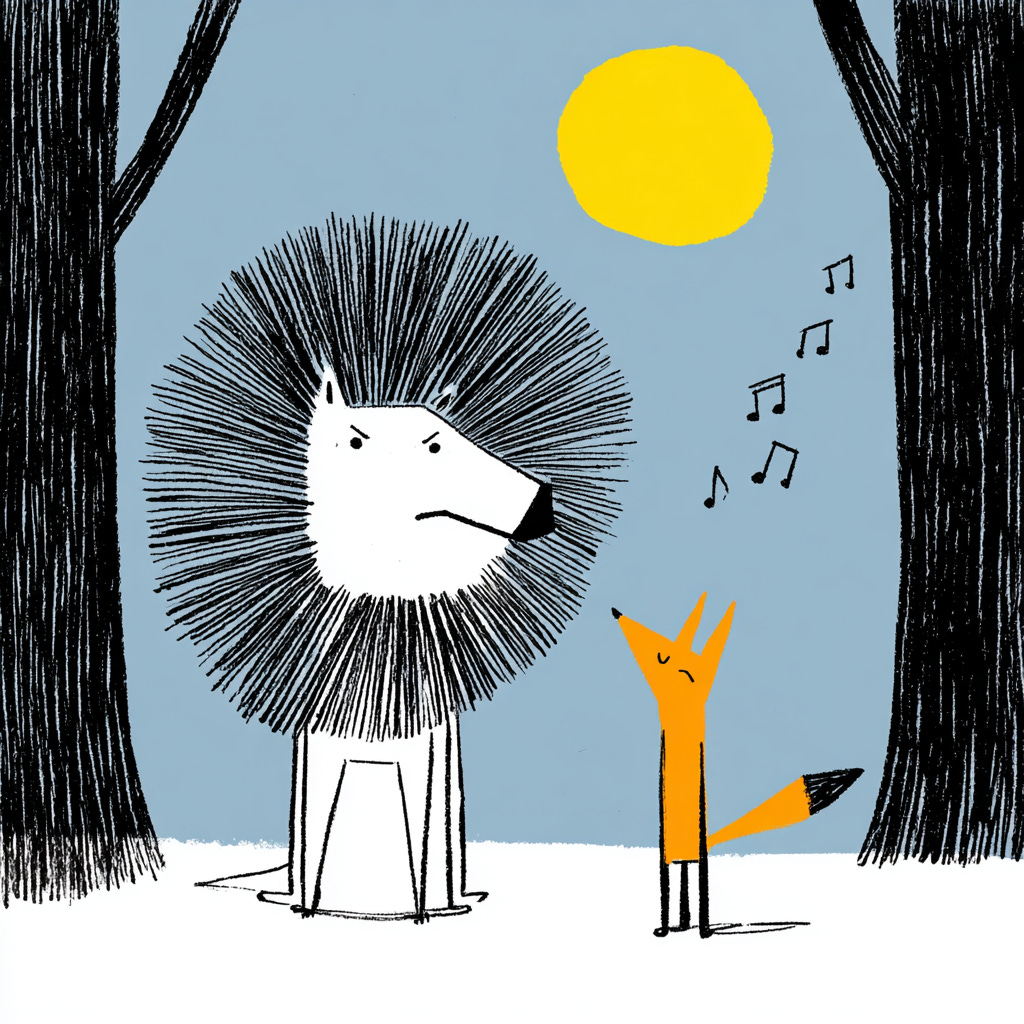
And the lion just blinks. No claws. No attack. Just a stare from a mane leanin back. The roar was never the attack. The enormous sound that had flattened the fox and inflated into a battleship-sinking catastrophe was — this lion, these meetings — not aimed at the fox at all.
Fox turned slow with a little grin. The grin is the signature of post-anxiety recalibration: the specific quality of relief that arrives when you discover the thing you feared was not what you thought it was. Not vindication of the fear — the fear was reasonable given incomplete information. Not mockery of the past — the fox was right to be cautious. The grin is the update. The model revising itself. The brain doing the thing it was built to do when given accurate evidence.
Sometimes the danger is just the wind.
What a child learns: When something frightens you, try asking why. Not to be reckless — to be curious. Curiosity recruits the thinking brain. It reframes the threat as a subject. And sometimes the most terrifying thing in your path was not aimed at you, was not coming for you, and will not get mad if you ask it a question.
Lesson Four: Fear Is Information, Not Truth
Fear’s a fire you can’t always trust / Burns down brave when it turns to dust / Half the monsters ain’t real at all / And what you thought was death and flame / Might just be thunder with no name
The lyric is precise here, and the precision is the lesson. Can’t always trust — not never trust. Half the monsters — not all the monsters.
This distinction matters. Aesop is not telling the fox that lions are safe. He is reporting what happened with this lion, in these encounters, under these conditions. That is actionable information. It is not a universal warranty.
What the song is teaching is calibration — the difference between a fear response proportional to actual evidence and a fear response running on catastrophic inference. The fox’s initial response was disproportionate: the roar became a battleship-sinker, the lion became maximum danger. The fox’s final response is calibrated: the lion is a large creature that roars, has not attacked in multiple encounters, and may have its own reasons for making noise. Same fox. Different model. Better information.
The fire metaphor carries the lesson in compressed form. Fire is useful. It is also destructive when left unexamined, when allowed to burn beyond the evidence that warranted it. Fear is the same: it exists for a reason, it protects against real dangers, and it also burns down the brave thing you were building when it inflates into territory the evidence does not support.
The skill is not to extinguish the fire. The skill is to keep it accurate.
What a child learns: Fear is information. The question is whether the information is accurate. Some things are genuinely dangerous — and your fear about those things is correct and necessary. But much of what feels like a lethal lion is thunder with no name: enormous, disorienting, and not coming for you. The fox’s method is the method: show up, observe, stay, ask, update. That is not a one-time act. It is a practice that takes a lifetime to build and starts the first time you choose to stay in view.
Why Parvati Patel Brown Carries This Fable
The Lyrical Literacy framework does not assign artist voices for aesthetic reasons. The match between fable and artist has to be structurally necessary — the voice has to carry the content at the level of cultural logic and thematic world, not just sonic texture.
Parvati Patel Brown’s catalog is built around a single organizing principle: the practice of moving toward light rather than the destination of arriving there. Walkin’ Into the Light. Jyot Diva. I’m Gonna Study War No More. Each one is about the commitment to a direction before the outcome is guaranteed, the daily act of tending the flame before you know whether the flame will hold.
This is the fox’s curriculum exactly. Not one heroic moment. Three meetings, each built on the last, each one requiring the fox to show up before it knows it will be okay. Walkin’ Into the Light and Don’t Fear That Roar are the same lesson encoded in different registers: the light does not arrive, you walk toward it; the courage does not arrive, you show up in view of the lion until showing up becomes who you are.
Parvati’s warm luminous soprano — floating slightly above the beat, the Hindustani inflections surfacing in the way a note arrives rather than how it is held, the gospel warmth in how phrases resolve — enacts the fox’s journey in the architecture of the sound itself. The voice moves toward. It does not drive. It does not push. It approaches, steadily, the way the fox approaches the lion on that bright cool morning: not with certainty, but with the accumulated evidence of having survived the previous meetings.
For a child who knows what it feels like for a heart to turn to stone — who has their own lion, their own roar, their own battleship-sinking catastrophe that the amygdala has been building since the first encounter — hearing that approach modeled in the voice before the words even arrive is its own form of instruction. The nervous system learns from the sound as the mind learns from the lesson.
The Lesson Map
What the fox doesWhat the brain is doingWhat the child learnsHits the dirt at the roarAmygdala triggers fight-or-flight before conscious thoughtFear is a body response, not a character flawReturns the next day, still twitchingHabituation begins: each safe encounter updates the threat modelBravery is staying, not not-being-scaredAsks the lion why it roarsPerspective-taking activates prefrontal cortex, reduces alarm signalCuriosity is a neuroscience strategy, not just a virtueGrins when the lion just blinksPost-anxiety recalibration: the model updates to match the evidenceSome of what frightened you was wind — and now you know how to find out whichCarries the moral forwardNarrative and melody encode learning in long-term memoryHalf the monsters aren’t real. Here is the method for telling them apart.
LYRICS:
Little ol fox with a curious nose
Prancin round where the wild wind blows
Till a lion let loose with a deep down roar
Shook the ground and the forest floor
Fox hit the dirt tail stiff as bone
Eyes wide open heart like stone
Whispered low with a tremblin lip
That roar could sink a battleship
But days go on fear fades some
Lion walked by beatin no drum
Fox still twitched but stayed in view
Just noddin soft like brave folks do
Then one bright mornin cool and clear
Fox stood tall dropped that fear
Said why you roar you feelin bad
Lion just blinked didn’t even get mad
No claws flashin no wild attack
Just a stare from a mane leanin back
Fox turned slow with a little grin
Sometimes the danger is just the wind
Don’t go runnin from every sound
Some beasts bark but don’t come round
Fears a fire you can’t always trust
Burns down brave when it turns to dust
So lift your chin don’t shake don’t stall
Half the monsters ain’t real at all
And what you thought was death and flame
Might just be thunder with no name
Tags: Aesop Fox and Lion amygdala habituation children’s learning, threat inflation distress tolerance educational fable song, Lyrical Literacy Parvati Patel Brown fear neuroscience, calibration anxiety management folk-blues pedagogy, Humanitarians AI social emotional learning musical fable
#LyricalLiteracy #DontFearThatRoar #FoxAndLion #AesopBlues #OvercomingFear #FablesInMusic #CourageLessons #FolkWisdom #BluesParables #HumanitariansAI #MusiqueAI #HumansAndAI #AIMusic #GhostArtists
<iframe width="560" height="315" src="
" title="YouTube video player" frameborder="0" allow="accelerometer; autoplay; clipboard-write; encrypted-media; gyroscope; picture-in-picture; web-share" referrerpolicy="strict-origin-when-cross-origin" allowfullscreen></iframe>
<iframe data-testid=”embed-iframe” style=”border-radius:12px” src=”width=”100%” height=”352” frameBorder=”0” allowfullscreen=”“ allow=”autoplay; clipboard-write; encrypted-media; fullscreen; picture-in-picture” loading=”lazy”></iframe>


