

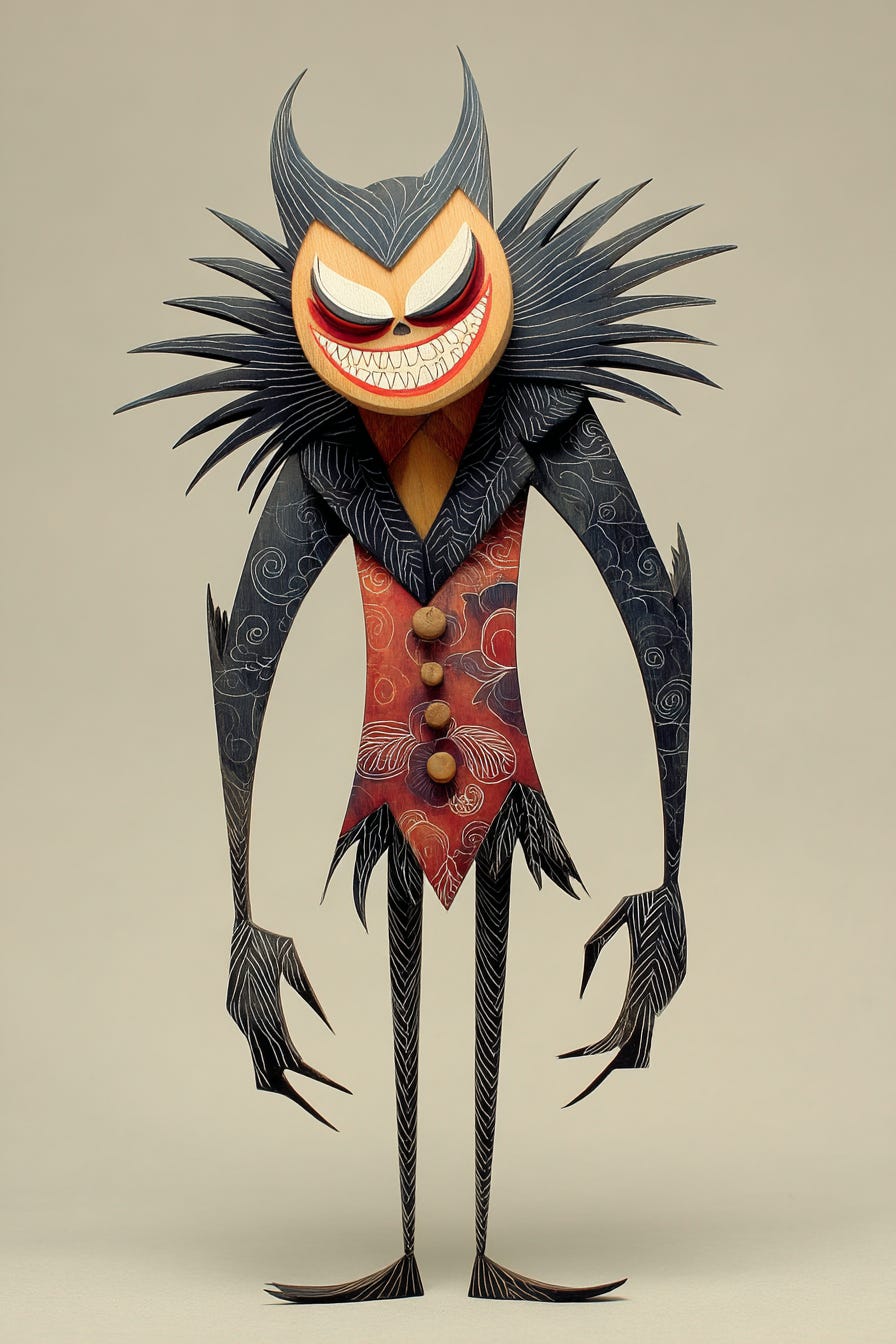
The Boogeyman has a consistent job description across six thousand years of recorded human child-rearing.
He arrives at bedtime. He watches for specific infractions — unwashed teeth, uncleaned rooms, uneaten vegetables. He enforces behavioral norms that parents have been unable to enforce through instruction alone. He leaves when the child complies. He returns when they don’t.
Every culture has built him. The Boogeyman in English. El Cuco in Spanish. Baba Yaga in Russian. The Namahage in Japanese — men in oni masks who arrive on New Year’s Eve demanding from parents a full accounting of their children’s misbehavior. The Krampus in Alpine Europe, who arrives with Saint Nicholas as the explicit consequence of the saint’s reward: good behavior earns gifts, bad behavior earns the Krampus. The specific form varies. The behavioral technology is universal.
When a tool appears independently in every human culture that has ever documented its child-rearing practices, that tool is doing something that human development actually requires. The question is not whether the Boogeyman works. It works. The question is what, precisely, it teaches — through which mechanisms, to what developmental ends, with which limitations — and how a song built inside this tradition can extend the figure’s pedagogical reach beyond what the figure alone achieves.
The Boogeyman Suggests You Brush Your Teeth, produced through Humanitarians AI’s Lyrical Literacy project and performed by Newton Williams Brown, is built inside this tradition and extends it deliberately. Four distinct learning mechanisms are operating simultaneously in this song. Each is worth examining on its own terms.
The First Lesson: Behavior Has Consequences Before It Has Values
The foundational mechanism of the Boogeyman figure is behavioral conditioning. The child performs the target behavior — tooth-brushing, room-cleaning, vegetable-eating — to avoid the aversive consequence associated with non-compliance. The Boogeyman watches. The Boogeyman comes for children who do not comply. Compliance removes the threat.
Developmental psychologists classify this as external regulation: the most basic position on the motivation continuum. The behavior is real. The motivation is entirely external. The child is not brushing their teeth because they understand dental health, or because they have internalized a value around self-care, or because they find the behavior intrinsically satisfying. They are brushing their teeth because the Boogeyman is watching.
External regulation is where behavioral learning must begin when internal motivation for a behavior does not yet exist. This is the legitimate developmental function the Boogeyman serves. Values cannot be installed directly. They develop through a process: behavior first, association second, understanding third, internalization last. The Boogeyman produces the first step. It creates the behavior before the value exists. The behavior, repeated consistently in a relationship context where explanation and modeling also occur, eventually produces the value. The compliance is scaffolding. It holds the structure until the child can support it internally.
Self-determination theory identifies the developmental trajectory explicitly: external regulation leads to introjection (the child feels guilty when they don’t brush, regardless of whether anyone is watching), which leads to identification (the child personally values dental health), which leads to integration (tooth-brushing is simply part of who they are). The Boogeyman initiates the first stage. The parent who explains, models, and maintains relationship while also invoking the figure creates the conditions for the subsequent stages.
The limitation is equally precise: external regulation does not transfer across time when the external regulator is removed. The child who brushes their teeth only because the Boogeyman watches stops brushing when they stop believing in the Boogeyman — unless the behavior has been moved up the motivation continuum by other means during the years of the figure’s believability. The compliance was real. The ownership was never transferred. The song holds this tension without false resolution: “Teaching lessons across every land.” The figure teaches. What it teaches, and whether the teaching lasts, depends on what surrounds it.
The Second Lesson: Other Minds Have Knowledge and Intentions
The Boogeyman does something cognitively demanding that the developing child must match to be motivated by him at all.
He knows things. He watches. He has intentions toward the child based on what he has observed. “But one thing’s consistent, his mysterious plan / To sneak into dreams, as only a Boogeyman can.” To be influenced by this figure, the child must represent it as a minded being with beliefs, knowledge states, and purposes that differ from their own. The child must model: the Boogeyman observed my behavior, the Boogeyman knows I did not brush my teeth, the Boogeyman will act based on this knowledge.
This is theory of mind — the cognitive capacity to attribute mental states to others and to predict behavior based on those attributed states. Theory of mind typically consolidates between ages three and five and is one of the most significant cognitive achievements of early childhood. Its development predicts social competence, moral reasoning capacity, and — specifically and documentably — literacy comprehension.
The connection to reading comprehension is precise. Understanding narrative requires tracking what characters know, want, believe, and intend — and predicting their actions from attributed mental states. A reader who cannot model a character’s knowledge state cannot follow the story’s logic. They can decode the words. They cannot comprehend the narrative. Theory of mind is the cognitive infrastructure that narrative comprehension runs on.
The child modeling the Boogeyman’s intentions is practicing the identical cognitive operation as the reader tracking a character’s motivations. Both require: representing another being’s beliefs, recognizing that those beliefs may differ from the child’s/reader’s own knowledge, and predicting behavior from the attributed beliefs. The Boogeyman is a theory of mind exercise with stakes the child finds motivating. The motivation is behavioral compliance. The cognitive exercise is pre-literacy instruction.
“He lurks in the darkness, keeping away the light.” The child who can model what the Boogeyman wants, knows, and intends — who can represent the figure’s mind accurately enough to predict its behavior — has built exactly the cognitive machinery they will need to track the villain’s plan, the protagonist’s hope, the secondary character’s secret knowledge, in every story they will ever read.
The Third Lesson: Social Norms Are Contextual, Not Arbitrary
The poem’s chorus structure encodes a sophisticated lesson about how social norms function, and it encodes it through the variation-within-repetition architecture that the Lyrical Literacy framework borrows from the nursery rhyme tradition.
The chorus appears twice. The frame is identical both times: “Boogeyman, Boogeyman, hidden so grand / Teaching lessons across every land.” The behavioral content changes: first, eat vegetables and say prayers; then, clean your room and stop whining. Same figure. Same consequences. Different specific behaviors.
A child who encounters this structure repeatedly is learning something true and non-trivial about behavioral norms: they are contextual. The same accountability principle — this figure watches for compliance with behavioral expectations — applies across different specific behaviors in different specific contexts. What is expected varies. The expectation of behavioral compliance remains constant.
This is the actual structure of social norm systems. Social expectations vary by context, relationship, institution, and role. The underlying principle — that contexts have expectations and membership in a context entails accountability to those expectations — is invariant. A child who grasps this distinction has understood something foundational about social participation. Rules are not arbitrary. They vary for reasons. The reasons can be understood. Understanding them is the beginning of moral reasoning.
The variation-within-repetition format also serves the Lyrical Literacy framework’s phonemic and mnemonic functions. The repeating frame creates predictability that allows the auditory cortex to allocate processing resources to the variable element. The child who has heard the chorus once anticipates the frame on the second encounter. The freed cognitive resources process the new content — the different behavioral expectations — more deeply than they would if the entire chorus were novel. Predictable structure enables deeper processing of variation. This is why mnemonic devices work. This is why the nursery rhyme tradition has used the format for centuries.
The Fourth Lesson: The Phonemic Architecture of the Threatening Voice
The Lyrical Literacy framework builds phonemic diversity and rhythmic structure into every production, and the Boogeyman song delivers both through mechanisms that operate independently of the child’s engagement with the figure’s content.
The poem is written in ballad meter — the alternating four-beat and three-beat line pattern of English folk verse. “In the shadowy corners, where the cobwebs weave” is four beats. “Lives the Boogeyman, so they believe” is three. Four. Three. Four. Three. This alternating pattern delivers an approximately 2 Hz rhythmic pulse — two stressed beats per second — that matches the delta-band oscillation frequency the developing auditory cortex uses as a scaffold for speech segmentation.
A 2014 MEG study found that 10-month-old infants with strong neural synchronization to a 2 Hz auditory rhythm developed measurably larger expressive vocabularies at 24 months than infants with weaker synchronization. The proposed mechanism: delta-band oscillations provide a temporal framework that the auditory cortex uses to parse continuous speech into syllable-sized processing units. Ballad meter, with its consistent stress alternation, delivers this pulse reliably across the poem’s six stanzas. The child’s motor cortex synchronizes to the beat. The auditory cortex receives the scaffold. The language processing runs on it.
The phonemic inventory across the poem’s verses is wide. Onset consonant clusters present in the lyrics include: /bl/ in “believe,” /sh/ in “shadowy” and “shade,” /cr/ in “crafted,” /cl/ in “closets,” /sn/ in “sneak,” /wh/ in “whisper,” /gr/ in “grand,” /br/ in “brush,” /ch/ in “children.” These are distinct consonant cluster types, each with distinct amplitude rise times — the acoustic transition speed from silence to voiced sound that the auditory cortex uses to locate phoneme boundaries. Phonological awareness, built through exposure to this range of onset types in motivating, metrically predictable contexts, is the single strongest predictor of reading ability in fifty years of early childhood research.
The child processing these onset clusters is not engaged in phonics instruction. They are listening to a song about a monster they may or may not believe in. The phonemic processing happens at the auditory cortex level, below conscious attention, because the auditory cortex does not distinguish between phonemes it receives in educational contexts and phonemes it receives in entertaining ones. It processes what it receives. The song provides the inventory. The cortex builds the discrimination capacity. The reading follows years later, in a different context, with no visible connection to the Boogeyman who lurked in the cobwebs.
The Voice That Completes the Lesson
Newton Williams Brown’s voice is the fifth thing the song teaches, and it is not in the lyrics.
Newton Williams Brown is the reconstructed voice of William Newton Brown — a man who declared himself a conscientious objector during wartime, was assigned to the Medical Corps, and ran unarmed onto active battlefields to carry the wounded. His persona across the Musinique catalog is built from a specific theological position: faith that moves toward difficulty rather than away from it. The meek who are not passive. The mercy that costs something. This is not a voice with a history of threat. It is a voice with a history of moving toward threat on behalf of others.
When this voice delivers “Or the Boogeyman will catch you unawares,” the warmth in the baritone structurally undermines the menace in the words. The parent becomes audible behind the monster. The pedagogical costume becomes visible as a costume. What the child receives is not a genuine threat but a recognizable love trying to produce a good outcome through the available tools.
This is the correct neurobiological calibration for behavioral instruction through mild threat. The amygdala activation that produces durable memory encoding also, at higher intensities, produces the sustained threat response that impairs learning, disrupts sleep, and damages the relationship context in which values are eventually transferred. The optimal zone is mild emotional arousal — enough to enhance encoding, not enough to activate the full stress response. Newton Williams Brown’s warm delivery keeps the song in this zone. The Boogeyman whispers. The voice belongs to someone who wants you to be okay.
A Boogeyman that sounds like someone who loves you teaches something the genuinely frightening Boogeyman cannot: that the adult behind the monster is present, warm, and on your side. The compliance is the beginning. The relationship that surrounds it is how the value eventually transfers. Both are in the song. The child receives both.
LYRICS:
In the shadowy corners,where the cobwebs weave,
Lives the Boogeyman,so they believe.
Under beds,in closets,just out of sight,
He lurks in the darkness,keeping away the light.
No face to see,he changes his look,
From a shadowy figure to the monster in your book.
In every home,he’s a different shade,
Crafted by the fears that night has made.
Boogeyman,Boogeyman,hidden so grand,
Teaching lessons across every land.
Eat your veggies,say your prayers,
Or the Boogeyman will catch you unawares.
Some nights he’s tall,some days he’s small,
Sometimes he’s not even scary at all.
But one thing’s consistent,his mysterious plan,
To sneak into dreams,as only a Boogeyman can.
He’s there to remind,with a nudge or a fright,
To brush your teeth and say goodnight.
Parents whisper,children heed,
The Boogeyman’s watching,so do good deeds.
Boogeyman,Boogeyman,hidden so grand,
Teaching lessons across every land.
Clean your room,don’t you whine,
Or the Boogeyman will come at bedtime
Tags: external regulation self-determination theory motivation continuum behavioral scaffolding, theory of mind narrative comprehension literacy prediction attributed mental states, ballad meter 2Hz delta oscillation phonemic diversity onset clusters auditory cortex, variation-within-repetition social norm contextual accountability nursery rhyme mnemonic, amygdala optimal arousal zone memory encoding Newton Williams Brown warm threat
#LyricalLiteracy #MusicEducation #HumansAndAI #ChildhoodFolklore #Boogeyman #NeuroscienceOfMusic #CognitiveDevelopment #OpenSourceAI #HumanitariansAI #AIforHumans
<iframe width="560" height="315" src="
" title="YouTube video player" frameborder="0" allow="accelerometer; autoplay; clipboard-write; encrypted-media; gyroscope; picture-in-picture; web-share" referrerpolicy="strict-origin-when-cross-origin" allowfullscreen></iframe>
<iframe data-testid=”embed-iframe” style=”border-radius:12px” src=”width=”100%” height=”352” frameBorder=”0” allowfullscreen=”“ allow=”autoplay; clipboard-write; encrypted-media; fullscreen; picture-in-picture” loading=”lazy”></iframe>


