

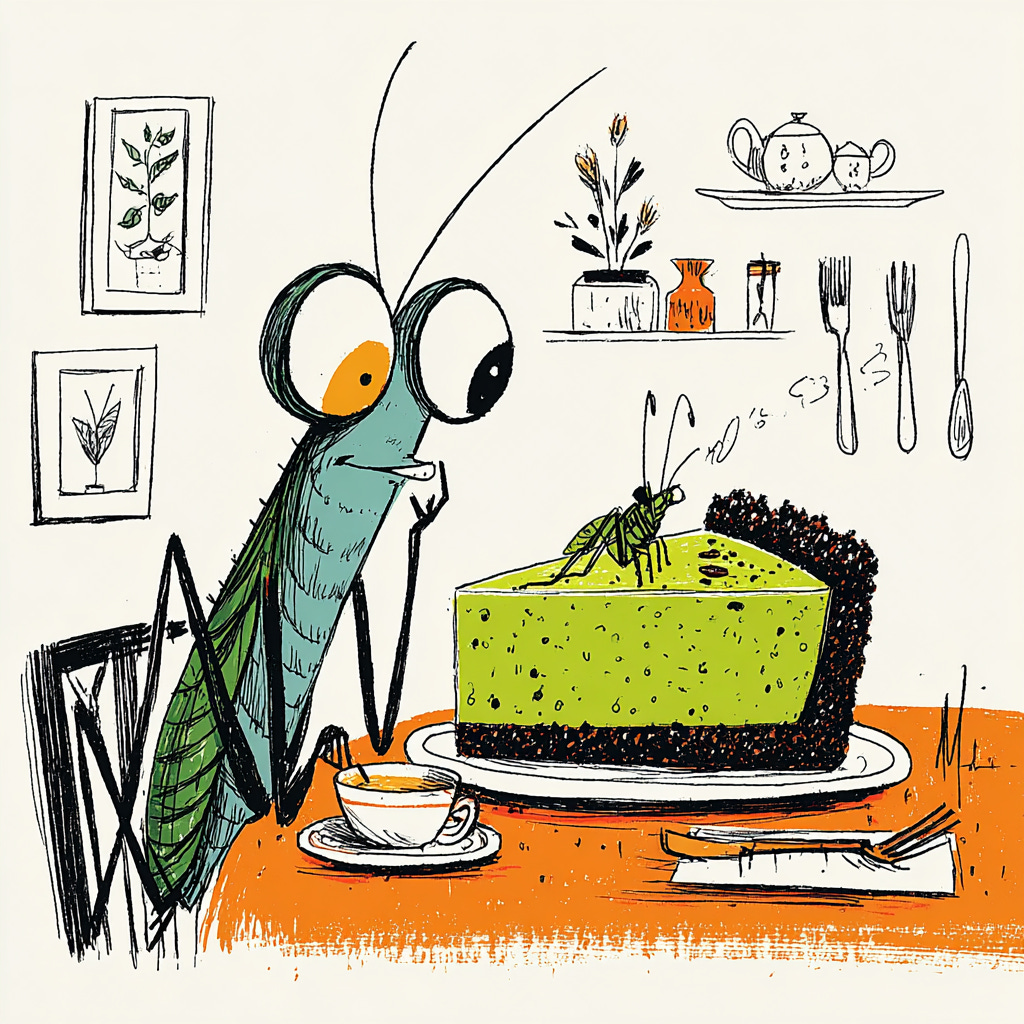
There is a pie named after a grasshopper. It contains no grasshoppers.
A child hears this and immediately needs to know why.
That need — the itch of a named contradiction, the refusal to accept “it just is” — is the most important thing a children’s song can produce. Not the memorized fact. The activated curiosity. The question that follows the song out of the room and into dinner conversation and onto the internet three days later when the child types who invented grasshopper pie into a search bar and discovers that a man named Philibert Guichet existed in New Orleans in 1918 and that history is hiding inside everything they have ever eaten.
Grasshopper Pie, performed by Parvati Patel Brown for the Lyrical Literacy podcast, was built for that child. Not the obedient child who accepts the answer. The one who follows up.
The Song the Brain Was Waiting For
The Lyrical Literacy framework rests on a finding that fifty years of educational multimedia research has confirmed repeatedly and that remains underutilized in almost every children’s music product on the market:
Music is the most efficient encoding system the developing brain has access to.
Not because it is entertaining. Because of how it recruits neural architecture that speech alone cannot reach. The rhythmic pulse activates the motor cortex, which keeps the auditory cortex engaged longer than passive listening. The melody creates expectation and resolution, which activates the dopaminergic reward system. The lyrics, carried by both systems simultaneously, encode in the hippocampus more durably than spoken instruction delivered at equivalent volume and duration.
This is why you still know the alphabet. Not because someone drilled it into you. Because someone put it in a song.
Grasshopper Pie applies this architecture to food history. Every production decision maps to a specific mechanism.
The 2 Hz rhythmic foundation — felt in the melodic pulse, not foregrounded in the percussion — matches the delta rhythm frequency that magnetoencephalography identifies as optimal for infant and early-childhood speech processing. Ten-month-olds whose neural tracking locks onto this frequency develop measurably larger vocabularies at 24 months. The child singing the chorus is doing speech-processing work whose results will show up in their reading scores two years from now.
Phonemic diversity is the strongest documented predictor of reading ability — stronger than letter recognition, stronger than vocabulary size in isolation. It is the capacity to hear and manipulate the sound units of language. Songs build it through pleasurable repetition of varied phoneme combinations. In Grasshopper Pie: “nary,” “originating,” “cocktail,” “vibrant,” “Philibert.” None of these are simple words. That is the design. The slightly-too-hard word, embedded in a melody the child wants to sing, is the word that gets acquired. The child does not study it. The child absorbs it, asks what it means, uses it wrong once, uses it right twice, and owns it by the third week.
Narrative resolution is not a storytelling preference. It is a neurobiological requirement. Research on pre-verbal mother-infant interaction demonstrates that infants as young as four months respond measurably to story arcs that complete — positive affect, sustained attention — versus those that don’t. A song that finishes its story does something to the brain that an unresolved song cannot. Grasshopper Pie completes: 1918 cocktail, 1950s party dessert, spring celebration, invitation to remember. The child’s brain rewards this shape. The child associates that reward with the act of learning. This is the mechanism. Build for it deliberately.
The proper noun as memory hook. Generic language produces weak encoding. “Someone invented it a long time ago” gives the brain nothing to attach to. Specific language — Philibert Guichet was the man with the plan, creating a drink that inspired the pie in your hand — gives the hippocampus an anchor. The name has rhythm. The name has an unusual sound that makes the child’s ear prick up. The child who cannot yet locate New Orleans on a map now has a reason to find it. That is not trivia. That is the beginning of a relationship with history.
Why This Voice, For This Song
In Lyrical Literacy, voice selection is not aesthetic preference. It is delivery-system engineering.
The content of Grasshopper Pie requires a specific acoustic environment: warm, inviting, neither authoritative nor silly. The voice that signals authority — flat, instructional, clipped — activates the amygdala’s threat-assessment processes. A child in threat-assessment mode is not in learning mode. The amygdala and the hippocampus are competing for resources, and the amygdala wins.
Parvati Patel Brown’s warm luminous soprano keeps the amygdala quiet. This is not metaphor. A voice that signals safety and delight — floating slightly above the beat, phrasing with the ease of someone sharing a discovery rather than delivering a lesson — allows the hippocampus and language-processing centers to operate without competition. The child who feels safe in the sonic environment encodes more efficiently than the child who feels assessed.
Her slightly-behind-the-beat phrasing — characteristic of her R&B-inflected gospel warmth — creates space between syllables. The child’s ear has room to catch every word. The Hindustani inflections surfacing naturally alongside her soprano warmth signal a voice that belongs to multiple traditions simultaneously, none announced, all present. This is Parvati’s core proposition as a persona: all of it is worth singing. The liberation spiritual and the Punjabi lamp-prayer and the food history song about a green dessert — these are not separate categories. They are the same devotion to the world being worth understanding.
That devotion is audible. Children hear it. It is why the voice works.
The Lyrics as Spell
The song opens with the contradiction:
In a world where bugs might grace a plate, Here’s a dish with a twist of fate. A pie named grasshopper, green and sweet, With nary an insect inside to meet.
“Nary” is doing three things simultaneously. It is phonemically interesting — the child’s ear catches it as slightly unusual. It is semantically clear from context — no insects, zero, none. And it is vocabulary the child will not encounter on a screen. The song introduces it in a frame that makes the meaning unmistakable and the word memorable. This is the mechanism the Lyrical Literacy pedagogy is built on: the slightly-too-hard word, in context, in melody, is the word that gets acquired.
The chorus locks the core facts in singable form:
Grasshopper pie, oh, leap so high, No bugs to eat, so give it a try. With mint and chocolate, a creamy delight, It’s a dessert that will lift your spirits to flight.
By the second listen, the child is singing this. By the fifth, they own the information inside it: mint, chocolate, creamy, no bugs, green, worth trying. The chorus is the vehicle. The information is the cargo. The earworm is not manipulation — it is memorability in service of encoding. This is the difference between a jingle and a Lyrical Literacy song. The jingle sells a product. The chorus encodes a fact so thoroughly that the child produces it unprompted at dinner.
The third verse is where the history lands:
Originating from a cocktail so grand, In New Orleans, it took a stand. Philibert Guichet was the man with the plan, Creating a drink that inspired the pie in your hand.
Philibert Guichet. The song says his name. This is not decoration. This is the moment the history becomes real — not “it was invented by someone” but this specific man, this specific restaurant, this specific year. The child who hears this name will ask how to say it. Will ask who he was. Will ask what Tujague’s looks like now. A good song does not close the inquiry. It opens the next question.
The narrative completes:
In the ‘50s it rose to fame, A dessert with a cocktail’s name. Served at parties, springtime events, Its color as vibrant as floral scents.
1950s. Spring. The child has a timeline without being told they are learning one. The shape of the story — origin, popularization, cultural meaning — satisfies the brain’s appetite for completed arcs. The child feels the pleasure of a thing that was explained. That pleasure is the learning.
The Dementor This Song Protects Against
Every Patronus has a Dementor. The Dementor in educational children’s music is not ignorance. It is condescension.
Condescension is the song that talks at children rather than alongside them. That simplifies until the simplification becomes an insult. That assumes a child cannot hold both the absurdity of a bug-named pie and the actual history of New Orleans simultaneously.
The child can. The child wants exactly this. The child who asks four questions after one song is not confused — they are demonstrating that the song trusted their intelligence and their intelligence responded.
The Lyrical Literacy standard is not “appropriate for age.” It is “appropriate for the child who is paying full attention.” Those are different standards. The first produces songs that talk down. The second produces songs that open up.
Grasshopper Pie talks to the child who is paying full attention. It gives them Philibert Guichet and crème de menthe and New Orleans and 1918. It trusts them with the real story.
The real story is always more interesting than the simplified one.
The Questions Are the Proof
The child who finishes this song does not recite: Grasshopper Pie originated from a cocktail created by Philibert Guichet at Tujague’s restaurant in New Orleans in 1918 and was popularized in American homes during the 1950s.
The child says: Can we have grasshopper pie? Is it really green? Why is it called that? Who was that man?
Four questions. Each one evidence that the encoding worked. Each one a door that opens onto more. The question about the man leads to New Orleans. New Orleans leads to Louisiana. Louisiana leads to the Mississippi River, to the French Quarter, to jazz, to Mardi Gras, to the entire history of a city that has been producing improbable delights since before anyone named a dessert after a bug.
The song did not teach all of that. The song made the child want to know all of that.
That is the difference between a fact delivered and a curiosity ignited.
The incantation was concentrating on the child who asks why.
The Patronus is everything that follows the question.
LYRICS:
In a world where bugs might grace a plate,
Here’s a dish with a twist of fate.
A pie named grasshopper, green and sweet,
With nary an insect inside to meet.
Grasshopper pie, oh, leap so high,
No bugs to eat, so give it a try.
With mint and chocolate, a creamy delight,
It’s a dessert that will lift your spirits to flight.
Don’t be fooled by its buggy name,
For this pie is far from the insect game.
It’s got a crust that’s crunchy and neat,
And a filling that’s a minty treat.
Originating from a cocktail so grand,
In New Orleans, it took a stand.
Philibert Guichet was the man with the plan,
Creating a drink that inspired the pie in your hand.
Grasshopper pie, oh, leap so high,
No bugs to eat, so give it a try.
With mint and chocolate, a creamy delight,
It’s a dessert that will lift your spirits to flight.
In the ‘50s it rose to fame,
A dessert with a cocktail’s name.
Served at parties, springtime events,
Its color as vibrant as floral scents.
Grasshopper pie, oh, leap so high,
No bugs to eat, so give it a try.
With mint and chocolate, a creamy delight,
It’s a dessert that will lift your spirits to flight.
So next time you hear of grasshopper pie,
Remember, it’s a treat for the eye.
A minty slice of history’s page,
A dessert that’s perfect for any age.
Grasshopper pie, oh, leap so high,
No bugs to eat, so give it a try.
With mint and chocolate, a creamy delight,
It’s a dessert that will lift your spirits to flight.
#LyricalLiteracy #GrasshopperPie #FoodHistory #MusicalStorytelling #MintChocolate #ChildrensEducation #CulinaryTales #DessertHistory #NewOrleansCuisine #NoRealBugs
<iframe width="560" height="315" src="
" title="YouTube video player" frameborder="0" allow="accelerometer; autoplay; clipboard-write; encrypted-media; gyroscope; picture-in-picture; web-share" referrerpolicy="strict-origin-when-cross-origin" allowfullscreen></iframe>
<iframe data-testid=”embed-iframe” style=”border-radius:12px” src=”width=”100%” height=”352” frameBorder=”0” allowfullscreen=”“ allow=”autoplay; clipboard-write; encrypted-media; fullscreen; picture-in-picture” loading=”lazy”></iframe>


