


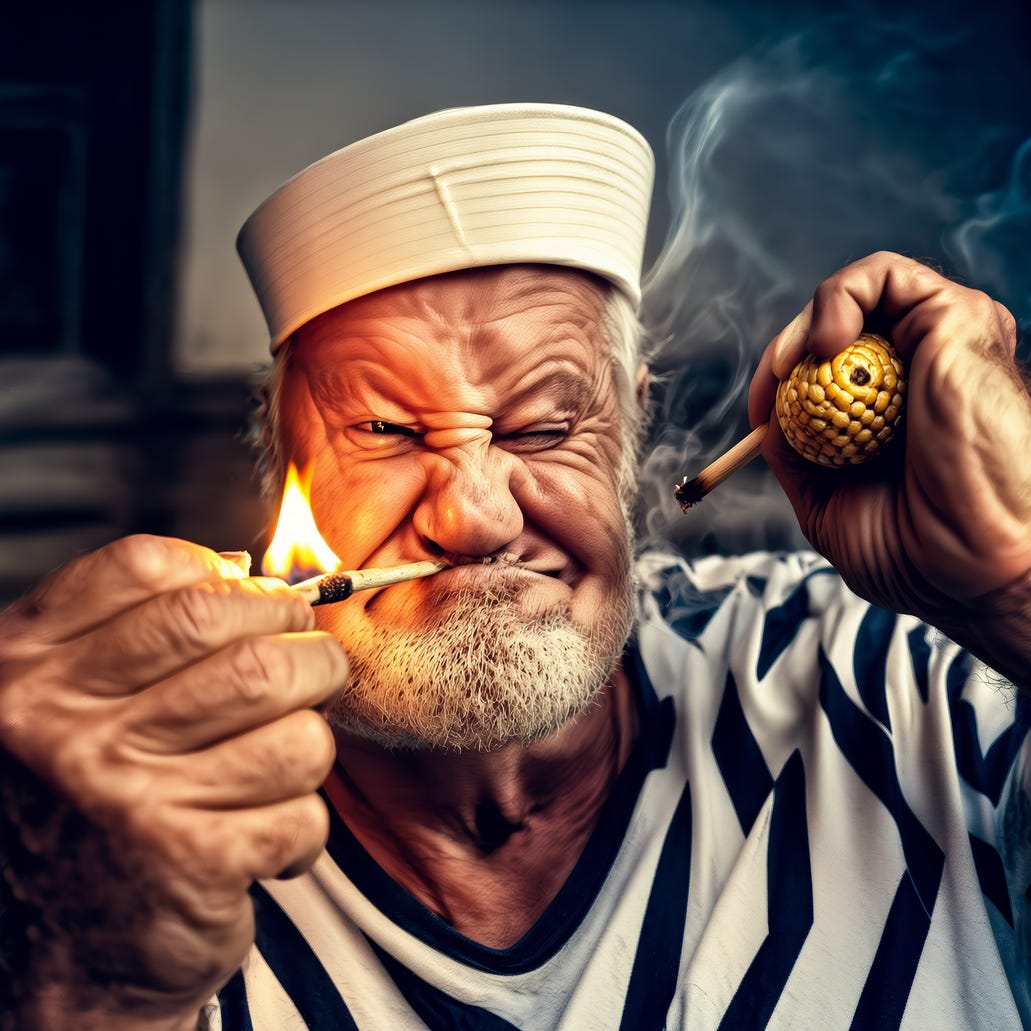
The Incantation Is Hitting Play
In Harry Potter, you say Expecto Patronum and the guardian appears. You concentrate on your happiest memory — specific, embodied, irreducibly yours — and something silver emerges to stand between you and the thing that drains the warmth from the world.
In Spirit Songs, the spell has already been cast. The incantation happened when someone looked at a ninety-year-old cartoon sailor and asked: what language is this character pointing at that children have never been given? What would Popeye sound like if the song trusted children with the vocabulary of what resilience actually costs?
When a child hears power grows quiet in the bones of a man and feels something they cannot yet name — when the phrase lodges somewhere they cannot quite locate — that is not the spell beginning.
That is the spell landing.
And the learning has already started.
What the Original Withheld
The original Popeye theme is seventeen words. Efficient. Functional. It identifies the character, states the premise, delivers the hook. It has been doing exactly this since 1933 without asking anything more of itself.
But efficiency is not the same as trust. The original theme trusts children to recognize the character. It does not trust them with the vocabulary of what the character actually is — what the strength to the finish costs, where it comes from, what kind of interior resource the spinach was always standing in for.
This version does.
He been carved by the tide where the moon runs thin / Where the salt hits the wound and the strength begins / Every wave been a teacher with a quiet demand / Saying rise with the power only soul can command.
Carved. Tide. Quiet demand. Soul can command. These are not simplified words. They are not the vocabulary of the average children’s song. They are the vocabulary of what resilience actually looks like from the inside — the specific language that a child who has been through difficulty needs, and that most children’s content systematically withholds because it mistakes simplification for accessibility.
The spell is the trust. The learning is what the trust makes possible.
The Grammar of Being Shaped
He been carved by the tide.
Not built. Not trained. Not developed. Carved — and passive.
The passive construction is a grammatical choice doing specific pedagogical work. Most children’s content about resilience uses the active voice: you can do it, you are brave, you choose to keep going. Active voice is useful. It describes the resilience that comes from decision. It does not describe — cannot describe — the resilience that forms in a person through what happens to them.
Carved by the tide names the second kind. Popeye did not choose his strength. The tide chose him. He was shaped by forces larger than himself, in the dark where the moon runs thin, at the precise moment where damage and resilience are simultaneous. Where the salt hits the wound and the strength begins. Not after healing. At contact. The wound and the strength occupy the same location.
For a child working through difficulty they did not choose — the difficulty that arrived like a tide, without asking — the passive construction is the accurate grammar. The active-voice resilience story (you are strong, you can decide to be brave) describes someone else’s experience. The passive construction describes theirs.
The child who acquires carved by the tide as a phrase has been given language for an experience that active-voice children’s content structurally cannot hold. The phrase will wait in the filing system. When the experience requires naming — when the child needs to explain to themselves what happened and what it made in them — the phrase will be there.
This is how vocabulary for interior experience builds: not through direct instruction but through the emotionally resonant context that makes the word stick before it can be defined.
Metaphor as Cognitive Architecture
But courage is a compass you can hold in your hand.
Abstract concepts are among the hardest vocabulary for children to acquire precisely because they cannot be pointed at. You can demonstrate red. You can show running. You cannot show courage — you can only describe it, which leaves the concept floating without a body to anchor it in memory.
Metaphor solves this by mapping the abstract onto the concrete. Courage is a compass gives courage a shape, a size, a weight, a function. It is small enough to hold. It fits in the palm. It tells you direction when you cannot see clearly. It works in the dark. You carry it with you rather than finding it somewhere outside yourself.
This is a more precise and more useful definition of courage than most children’s content offers — and it arrives not as a definition but as an image. The brain encodes images more durably than propositions. The child who has been told courage means being brave has a proposition. The child who has been given courage is a compass you can hold in your hand has an object. Objects persist.
Every heart got a sail in its hand operates the same way. The sail does not control the storm. It uses the wind. The metaphor encodes a distinction that direct instruction struggles to make: the difference between enduring difficulty and navigating it. Endurance is passive — you wait for the storm to pass. Navigation is active — you use what the storm gives you to go somewhere. The sail is the capacity to navigate rather than simply survive.
The child who carries this metaphor has a tool. Not the comfort that the storm will end. A tool. Something to hold. Something to use.
The Vocabulary of Interior Experience
The power only soul can command. A spirit that refuses to fold. Power grows quiet in the bones of a man.
These three phrases are constructing a vocabulary for interior experience — for the inner life, for the resources that are not visible from the outside, for the strength that accumulates without announcing itself. This vocabulary is among the most difficult to acquire because it refers to things that cannot be demonstrated or pointed at. You cannot show a child soul-power. You cannot exhibit quiet in the bones.
What you can do is give them the language before they have the experience to fill it. The container is built now. Life will fill it in later.
The power only soul can command distinguishes two kinds of strength: the physical kind (which Popeye has always had, which the spinach joke has always been about) and the interior kind — the resource that is not muscular, not external, not edible. The distinction arrives in a children’s song without being explained, which is exactly how the most durable vocabulary arrives. The child files the distinction before they can articulate it. The articulation comes later, when the distinction becomes necessary.
Power grows quiet in the bones is the song’s most sophisticated contribution to this vocabulary. Quiet here is not describing sound. It is describing the mode of a force — the way something powerful can exist without performing itself. In the bones is the location of the deepest, most structural kind of knowing — not in the mind where it can be doubted, not in the muscles where it can be depleted, but in the bones, which do not forget. The child who acquires this phrase has language for the accumulated evidence of their own survival — the record of every time the tide carved and the wound began the strength — before they have a theory of it.
The song gave them the words. The experience will give them the meaning.
The Bridge and What Direct Address Teaches
Stand up in the storm when your voice feels thin / Let the tide pull the doubt from within / Every wave got a lesson for the land / Every heart got a sail in its hand.
The bridge shifts grammatical person. Everything before this moment is third person — about Popeye, the mythology of the character, the observation of a sailor shaped by the sea. The bridge addresses the listener directly.
Your voice. Within you. Every heart — including yours.
This shift is a pedagogical move with documented learning effects. Research on narrative learning consistently shows that second-person address produces stronger personal identification and more durable retention than third-person observation. The child who was following Popeye’s story has become a participant in it. The mythology now applies to them specifically. What the waves taught him, they are teaching you. What the tide made in him, it can make in you.
Every wave got a lesson for the land / Every heart got a sail in its hand is also doing syntactic work. The parallel construction — every wave / every heart — builds a grammatical pattern the child files before they can name it: that parallel structures make parallel claims. What is true of waves (they carry lessons) is structurally asserted to be true of hearts (they carry sails). The form argues the content. The child learning to hear parallel syntax as a signal of parallel meaning is acquiring one of the fundamental instruments of reading comprehension, delivered through a bridge verse about a cartoon sailor.
The Chorus as Semantic Transformation
He’s Popeye the Sailor Man / He’s strong to the finich / ‘Cause he eats his spinach / He’s Popeye the Sailor Man!
The original chorus is preserved intact, and its position in the learning arc matters.
The chorus appears twice. First, after the carving and the waves and the soul-power. Second, after the spirit that refuses to fold and the shimmer when the wild winds call.
Each time, strong to the finich lands differently. At the first chorus, the child has just been told what the finish costs — the carving, the moon running thin, the salt at the wound. Strong to the finich is now a phrase with a history attached. The words are identical. The semantic content has expanded. At the second chorus, the child has acquired he don’t bend when the shadows fall and the whisper in the deep and the humble grace that painted thunder across his face. The same words again, carrying more weight again.
This is among the most important reading skills a child can develop: the understanding that context is cumulative, that meaning builds across a text, that the same phrase can mean different things depending on what preceded it. The Popeye chorus teaches this without naming it. The child who has sung both choruses has practiced semantic accumulation — the process by which a word or phrase deepens across a reading — without a lesson in literary analysis. The practice is the lesson.
The spinach was never about spinach. By the second chorus, the child’s filing system knows this, even if they cannot yet say why.
The Making
Someone concentrated on what children actually need from a resilience vocabulary.
Not the active-voice assurances. Not the simplified language that trusts children to recognize a character but not to carry harder words. Not the story that promises the difficulty was worth it. The specific vocabulary for the other kind of resilience — the kind that forms in the dark, through the passive construction, where the salt hits the wound and the strength begins simultaneously.
The AI preserved the original — chorus intact, meter honored, Popeye recognizably himself. What the AI could not do was make the pedagogical judgments: that carved needed to be passive, that the compass metaphor was giving courage a body, that quiet in the bones was building a container the child would need before they knew they needed it, that the bridge’s second-person shift was the moment the mythology had to become instruction.
Those judgments required a maker who understood both what the character was and what language the child was missing.
The making was the incantation.
The child who carries every heart got a sail in its hand and power grows quiet in the bones into the storms that are coming — that child is the spell delivered.
LYRICS:
He’s Popeye the Sailor Man
The sea don’t fear the storm
And neither does he when the truth gets warm
He been carved by the tide where the moon runs thin
Where the salt hits the wound and the strength begins
Every wave been a teacher with a quiet demand
Saying rise with the power only soul can command
He been walking on the edges where the brave don’t land
But courage is a compass you can hold in your hand
He’s Popeye the Sailor Man
He’s Popeye the Sailor Man
He’s strong to the finich
‘Cause he eats his spinach
He’s Popeye the Sailor Man!
There’s a whisper in the deep when the night turns cold
It’s the sound of a spirit that refuses to fold
He been fed by the earth with a humble grace
And it painted its thunder right across his face
You can see that shimmer when the wild winds call
He don’t bend when the shadows fall
He’s Popeye the Sailor Man
He’s Popeye the Sailor Man
He’s strong to the finich
‘Cause he eats his spinach
He’s Popeye the Sailor Man!
Stand up in the storm when your voice feels thin
Let the tide pull the doubt from within
Every wave got a lesson for the land
Every heart got a sail in its hand
He rises when the dark runs long
Strong to the finish when the night feels strong
He rises with the tide again and again
’Cause power grows quiet in the bones of a man
<iframe width="560" height="315" src="
" title="YouTube video player" frameborder="0" allow="accelerometer; autoplay; clipboard-write; encrypted-media; gyroscope; picture-in-picture; web-share" referrerpolicy="strict-origin-when-cross-origin" allowfullscreen></iframe>
<iframe data-testid=”embed-iframe” style=”border-radius:12px” src=”width=”100%” height=”352” frameBorder=”0” allowfullscreen=”“ allow=”autoplay; clipboard-write; encrypted-media; fullscreen; picture-in-picture” loading=”lazy”></iframe>


