

The Song That Grows With the Child
Most children’s songs have a lifespan. The cumulative song is mastered and left behind. The food history song delivers its facts and is complete. The fairy tale song tells its arc and closes.
The symbol-teaching song does not close.
A four-year-old hears “We Three Kings” and receives: journeys matter, gifts carry meaning, stars can guide you. A ten-year-old hears it and begins to understand: gold is tribute for a king, frankincense is incense for a god, myrrh is burial ointment for the one who will die. An adult hears it and holds all three simultaneously — a newborn receiving the ointment for his burial at the beginning of his life, joy and grief arriving together in the same manger.
The child cannot process all three registers at first hearing. The song does not require them to. What it requires is that the surface be genuinely accessible and that the depth be genuinely present, waiting for the child to grow into it.
This is the design challenge the symbol-teaching song solves: building two things at once. The entry point. The depth beneath it. When you understand how to engineer both simultaneously, you can make songs that a child carries for thirty years, returning to them with different understanding at each return.
That is the goal of this guide.
What a Symbol-Teaching Song Is
A symbol-teaching song teaches through objects — specific, culturally meaningful objects whose full significance the child grows into over time rather than receiving all at once.
It is distinct from the other Lyrical Literacy song types in one specific way: the depth is intentionally withheld from the surface. Not because the child isn’t trusted — precisely because they are. The child is trusted to carry the question the symbol opens, to return to it, to grow into the answer over years.
“We Three Kings of Orient Are” is the clearest example in the American Christmas canon because its three objects — gold, frankincense, myrrh — are explicitly graded in accessibility. Gold is the simplest to understand. Frankincense requires more cultural knowledge. Myrrh is the hardest, and the song does not resolve it. A child who hears the myrrh verse is sitting at the edge of something they cannot yet fully comprehend. The song holds them there. The music tells them the weight is real, that this is not the moment to look away, that the meaning will arrive when they are ready for it.
That holding is the teaching.
Three Mechanisms in One Song
Before building, understand what “We Three Kings” is doing structurally.
Journey structure as cognitive template. The song follows departure → travel → arrival → offering → transformation. This is the hero’s journey compressed into a carol, and its cognitive function here is identical to what it does in fairy tales: it gives the child a template for purposeful movement through difficulty toward meaning. The brain rewards completed arcs — the journey completes, the star arrives at the stable, the gifts are given. The reward fires. The template is encoded.
Three verses as escalating complexity. John Henry Hopkins Jr. gave each king a separate verse rather than listing all three gifts together. This is a pedagogical decision. Separation allows each symbol to be held individually before all three must be carried simultaneously. The child who has processed “gold means king” can then add “frankincense means god” and eventually hold “myrrh means the one who will die.” The cognitive load is managed by the form. Accumulation is gradual. Each verse is a small completion before the next one begins.
Minor tonality as emotional preparation. Most Christmas carols run toward major-key brightness. “We Three Kings” runs minor. This is not incidental. The minor key is doing load-bearing work: it prepares the child’s ear for the weight of the myrrh verse. By the time the hardest symbol arrives, the music has already established that this song acknowledges difficulty. The darkness does not arrive as a surprise. It arrives into a space the key already prepared.
This is what honest music does. It matches its sonic character to its emotional content. The key must earn the hardest verse. Build your symbol-teaching song in the key its most difficult symbol requires.
The Triptych: Three Design Principles from Three Gifts
Each gift in “We Three Kings” demonstrates a different technique for building a symbol-teaching verse. These three techniques are transferable to any symbol from any tradition.
Gold: Show the Symbol Through Action
Born a King on Bethlehem’s plain, gold I bring to crown Him again.
Hopkins does not define gold. He shows what gold does: it crowns. The gift is the crowning. The crowning is the recognition. The child does not need to know that gold represents wealth or royalty — the verse shows the action gold performs, and the meaning arrives through the demonstration.
The principle: symbols teach most durably when shown in action, not defined in abstraction. “Gold means royalty” is a definition. A child can receive it and forget it. “Gold I bring to crown him” is a demonstration. A child can feel it.
When writing your accessible symbol-verse: identify the action the symbol performs. Build the verse around that action. Do not define. Demonstrate.
Frankincense: Show the Symbol Through Trajectory
Frankincense to offer have I; incense owns a Deity nigh.
A child cannot smell frankincense through a song. Hopkins solves this by tracing the movement of the offering: it goes toward a Deity nigh — upward, toward the divine. The verse does not require the child to know what frankincense is. It requires only that the child feel the direction the symbol moves.
The principle: for symbols the child cannot directly experience, use trajectory and direction. Show where the symbol goes, what it moves toward, what kind of attention its use performs. The child who cannot experience the incense can feel the upward movement, the acknowledgment that something is being addressed differently than ordinary things.
When writing your harder symbol-verse: identify where the symbol moves. What does it reach toward? What does its use acknowledge? Build the verse around that movement.
Myrrh: Hold the Symbol Without Resolution
Myrrh is mine; its bitter perfume breathes a life of gathering gloom.
This is the most sophisticated verse in the carol because it does not resolve. A birth and a burial in the same moment. Joy and grief arriving simultaneously. The beginning of a life carrying the ointment for its ending. The verse does not explain why these arrive together. It holds them and lets the child sit in the space between.
The principle: the most powerful symbols do not resolve — they hold tension the child grows into. The unresolved tension is not a design flaw. It is the design. The child who carries the question “why did they bring burial ointment to a birth?” is doing the developmental work that builds theory of mind, moral reasoning, and emotional maturity. That work requires the question to remain open.
When writing your hardest symbol-verse: name the two registers that arrive together without explanation. End the verse without resolving the tension. If the verse accidentally provides comfort that erases the difficulty, rewrite it. The holding is the teaching.
The Framing Chorus: What Holds the Triptych Together
The three gift-verses need a frame that makes them feel like a journey rather than a list. In “We Three Kings,” that frame is the chorus:
Star of wonder, star of night, Star with royal beauty bright. Westward leading, still proceeding, Guide us to thy perfect light.
The chorus does three things simultaneously. It provides a consolidation moment between symbols — a space for the child to settle before the next verse begins. It maintains the journey logic with still proceeding — the movement continues, the following continues, the arrival is not yet complete. And it names the goal without explaining it: perfect light, which is specific enough to feel real and general enough to remain open.
The framing chorus question for your own song: What is the journey, and what is the light being followed?
The journey does not need to be literal travel. It can be a search, a growing, an accumulation of understanding across a life. The light can be a question, a tradition, a relationship, a calling. What the chorus must establish is continued movement — still proceeding — so that each symbol-verse feels like another step in a purposeful direction rather than another item on a list.
Design the chorus before the verses. The chorus is the container. The verses are what it holds.
Building for the Specific Child: The Diaspora Triptych
The Humanitarians AI catalog exists for the child whose cultural tradition is not represented in the Western children’s music canon. “We Three Kings” belongs in it for a reason the song names explicitly.
We three kings of Orient are.
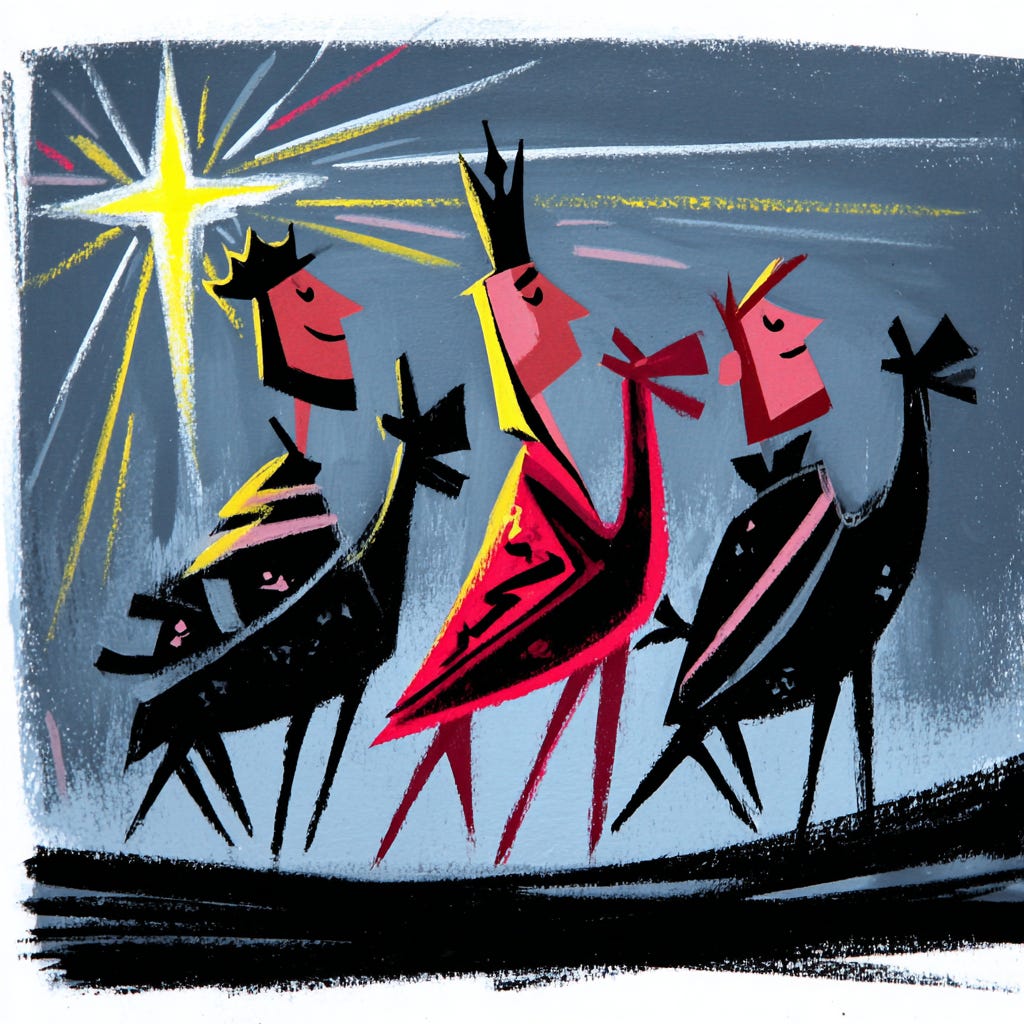
The Magi are not from the culture that receives the child. They are travelers from elsewhere, following a different knowledge system — astronomy, the reading of stars — carrying the gifts of their own tradition. They are the first Gentiles in Matthew’s gospel to acknowledge the child. Their distance from the center was not a disqualification. It was the credential.
For the child whose family came from elsewhere — whose grandmother sings in a language the school doesn’t teach, whose tradition is not the default tradition — this is not an interpretation imposed on the text. It is the text. The ones who followed the star from the East were always already part of the story.
When building a symbol-teaching song for a specific cultural community, the question is: what is your tradition’s triptych?
Every tradition has objects that carry the same layered depth as gold, frankincense, and myrrh. Objects that move from social acknowledgment through spiritual meaning through existential weight. The rangoli and what it means at a threshold. The kente cloth and what its colors mean at a ceremony. The Diya lamp and what the flame means in devotion. The marigold and what its scent means at a grave.
These are worth building symbol-teaching songs around. Not because they are exotic — because they carry real depth, and the child who grows up hearing them in a song grows up knowing what they hold.
The Six-Step Workflow
Step 1: Map Your Triptych
Choose three symbols in escalating order of accessibility: accessible → harder → hardest, held without resolution.
For each symbol, answer five questions before writing:
What is the symbol?
What does it do (action / trajectory / direction)?
What register does it address (social, spiritual, existential)?
Does it resolve, or does it hold tension?
What question does it open in a child who hears it?
The fifth question is the most important. If a symbol doesn’t open a question, it is not a symbol — it is a fact. Facts belong in fact-teaching songs. Symbols belong here.
Step 2: Write the Framing Chorus First
LLM prompt:
Write a four-line chorus for a symbol-teaching song. The chorus must: (1) name the journey or search the characters are following; (2) include a phrase of continued movement — “still proceeding,” “still searching,” “still carrying,” or equivalent — that signals the arrival is not yet complete; (3) name the light or goal being followed without defining it; (4) hold gravity without despair — minor key tonality in the text, not funereal. The chorus returns between each symbol-verse and should function as a consolidation moment before the next symbol arrives.
Test before proceeding: read the chorus aloud. Does it feel like movement? Does still proceeding (or its equivalent) give the child a breathing moment and forward momentum simultaneously? Does the final line name the goal in a way that remains open? If yes, proceed.
Step 3: Write One Verse Per Symbol
For the accessible symbol (gold equivalent) — demonstrate through action:
Write one verse (four lines, AABB) for a symbol that represents [category]. The symbol is [name]. Show what the symbol does — the action it performs, what the giving of it means, what it accomplishes — rather than defining it. The child should feel the meaning arrive through watching the symbol in use. Emotional register: warm, reverent, joyful. Voice: unhurried, as if handing something precious to someone who will understand it.
For the harder symbol (frankincense equivalent) — show through trajectory:
Write one verse for a symbol that represents [category]. The symbol is [name]. Trace its movement — where it goes, what it reaches toward, what its use acknowledges. The child may not know this symbol directly but should feel its direction. Emotional register: awe, slightly elevated, devotional. Do not define the symbol. Show where it moves.
For the hardest symbol (myrrh equivalent) — hold without resolving:
Write one verse for a symbol that represents [category]. The symbol is [name]. This verse must hold two registers simultaneously without resolving the tension between them: [name both registers — joy and grief, beginning and ending, birth and death]. Do not explain why they coincide. End the verse without offering comfort that erases the difficulty. The child who hears this should feel that something real and heavy is being acknowledged. Emotional register: grave, tender, honest. The meaning arrives over years, not at first hearing.
Evaluation for the third verse only: Does the tension hold at the end of the verse? If the final line softens — if it resolves toward comfort — rewrite it. The unresolved verse must remain unresolved.
Step 4: Choose Voice and Key Together
These are not separate decisions.
The key first. If your triptych escalates to mortality or grief, the song must be in a minor key. The minor tonality prepares the child’s ear before the hardest verse arrives. A major-key song with a myrrh-equivalent verse creates cognitive dissonance — the darkness arrives unprepared. Build the sonic container before the hardest content requires it.
If your triptych is entirely joyful — no existential weight — major key is appropriate.
Then the voice:
Symbol contentVoiceWhyMulti-faith, heritage, diasporaAuntie BlessingMulti-faith register, sacred without doctrinalWestern religious traditionNewton Williams BrownConviction-rooted, testimony registerSouth Asian, devotionalParvati Patel BrownHindustani inflections, devotional warmthWest African, griot, oralRoseline Abara or Baba KwekuSymbol as story, oral tradition registerUniversal, multi-traditionThe Wandering BardInhabits multiple registers, narrator-vocalistLullaby with symbolic depthChampa Jaan or Nana CoreeHeritage voice, holds depth without explanation
Step 5: Build the Track
Style tags: folk hymn, minor key, acoustic, fingerpicked, warm voice, reverent, journey, sparse
Prompt:
A gentle folk hymn in a minor key. Acoustic guitar, fingerpicked — unhurried, serving the symbols rather than competing with them. The voice is warm and present, holding the symbolic content with gravity rather than performance. The chorus has a distinct, consistent melodic identity that returns unchanged between verses, so the child recognizes it as a consolidation space. Minor key throughout — not funereal, honest. The third verse must land without the production softening it: no major-key lift, no resolution the lyric did not earn, no added warmth that erases the weight. The symbols are the main event. The production is the container. Tempo: slow, steady, unhurried from first verse to last.
The one critical check: Play the third verse in isolation. Does it land with the weight the lyric carries? If the production adds comfort — a key change, a warmer tone, an orchestral swell — remove it. The unresolved verse must arrive unresolved.
Step 6: The Return Test
The symbol-teaching song has a different reception test than any other Lyrical Literacy type.
The cumulative song passes its test when the child recites the full chain. The fairy tale song passes when the child asks the moral questions. The symbol-teaching song passes when the child asks different questions at different ages.
First encounter: What is frankincense? What is myrrh? Why are they following a star? Surface questions. The accessible layer is working.
Second or third encounter: Why did they bring myrrh to a birth? Why does the song sound sad? These are the depth questions beginning to form. The second layer is engaging.
Years later: The child encounters the symbol outside the song — smells frankincense, reads about myrrh, hears the carol again at a different age — and feels the weight the song was already carrying. They knew it before they understood it. The song was holding the knowledge until the capacity to meet it arrived.
That is the symbol-teaching song working at its highest function. Not a single lesson delivered and received. A container held open for the understanding that is coming.
The One Thing You Must Not Do
Explain the myrrh.
Not fully. Not with reassurance. Not with “it’s for when someone dies, but it’s okay because—”
It is not okay yet. That is the teaching. The child who sits with the not-yet-okay of the myrrh verse is doing the work that builds the capacity to eventually hold it. Remove the not-yet-okay and you have removed the mechanism. You have given the child an answer to a question they needed to carry.
Gold explained as “it means he’s a king” is weaker than gold shown crowning. Frankincense explained as “it’s incense for worship” is weaker than frankincense traced rising toward the divine. Myrrh explained as “it’s for death but that’s okay” is a failure — it resolves the tension the verse is built to hold, it tells the child what to feel, it closes the space the music was working to keep open.
Children can carry questions they cannot yet answer. They do this better than adults. The symbol-teaching song trusts them with the open question.
Build it to hold the weight the question deserves.
Build it for the child who will return to it at ten, and at twenty, and at the moment they need it most — and find that it was already there, holding what they needed, waiting for them to grow into it.
#ChristmasCarol #WeThreeKings #LyricalLiteracy #ChristmasTradition #MusicEducation #HolidayMusic #BiblicalStory #TheMagi #ChildrensLiteracy #ClassicHymns
<iframe width="560" height="315" src="
" title="YouTube video player" frameborder="0" allow="accelerometer; autoplay; clipboard-write; encrypted-media; gyroscope; picture-in-picture; web-share" referrerpolicy="strict-origin-when-cross-origin" allowfullscreen></iframe>
<iframe data-testid=”embed-iframe” style=”border-radius:12px” src=”width=”100%” height=”352” frameBorder=”0” allowfullscreen=”“ allow=”autoplay; clipboard-write; encrypted-media; fullscreen; picture-in-picture” loading=”lazy”></iframe>


