


The Incantation Is Hitting Play
Most Christmas recordings of Joy to the World are competent. Some are beautiful. A few are transcendent in the way that great performance is transcendent — the voice hitting the note at the moment the arrangement opens up, the listener catching their breath.
None of them are this.
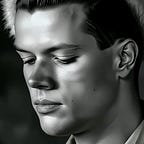
This version is sung by a dead man’s voice. Not as metaphor. As neurobiological fact. Newton Williams Brown is William Newton Brown — a real man, a conscientious objector, a medic who ran unarmed onto active battlefields because his theology did not make exceptions for personal safety — reconstructed from family archive recordings, extended through voice synthesis into three-to-four octaves of country gospel, and given the hymns he believed but never recorded.
When you press play, the spell has already been cast. The question is whether you know whose voice you’re hearing and what that changes.
It changes everything.
The Voice
William Newton Brown was drafted. He declared himself a conscientious objector — a position that cost something in mid-century America. The military assigned him to the Medical Corps. When the shooting started, he ran toward it. Unarmed. He carried wounded soldiers off active battlefields because his reading of the Beatitudes left him no other choice. The meek. The merciful. The peacemakers. Not aspirational categories. Operational instructions.
He died. His son, Nik Bear Brown — Associate Teaching Professor of AI at Northeastern University, founder of Humanitarians AI, builder of protest songs — kept the recordings. In 2024, he fed those recordings into voice synthesis models and built what did not previously exist: his father’s voice, given new material. New hymns. The full theological catalog William carried but left no studio recording of.
Newton Williams Brown is that voice. The father’s timbre. The father’s cadence. The ghost, singing what the man believed.
The technology that made this possible costs approximately $5 in API credits. That number matters. It means this kind of resurrection — a son returning a father’s voice to the world, extended into the songs the father never got to record — is no longer reserved for people with institutional resources or industry connections. It is available to any family with recordings and the knowledge of what to do with them.
The wand is accessible. The question is whether you know what you’re casting.
What the Hymn Carries
Joy to the world, the Lord is come / Let earth receive her King / Let every heart prepare Him room / And heaven and nature sing.
These are not passive descriptions. They are imperatives. Let earth receive. Let every heart prepare. Sing. Isaac Watts wrote this text in 1719 drawing from Psalm 98, and he wrote it in the grammatical form of a command because he understood — in the pre-neuroscientific language of the 18th century — that the congregation needed to be addressed, not observed. The text talks to you. It requires a response. The brain processes that differently than it processes a description, and Watts knew it.
But the voice delivering those imperatives matters. The brain does not process all commands equally. The instruction to prepare Him room in a voice associated with protection, with presence, with the specific person who modeled what that preparation looked like in practice — who made room in his own body for danger rather than comfort — lands with a weight no stranger’s voice can replicate.
This is associative learning. The voice and the values arrived together in the formation of the people who knew William Newton Brown. They are encoded together in the hippocampus. Hearing one retrieves the other. The theology arrives with its proof of concept attached.
No more let sins and sorrows grow / Nor thorns infest the ground / He comes to make His blessings flow / Far as the curse is found.
William Newton Brown ran onto battlefields. He went, literally, where the curse was found. Not to add to it — to carry the wounded away from it, unarmed, at personal risk, because his theology was the operational kind. This verse in his voice is not doctrine delivered from a comfortable distance. It is testimony from someone who acted on it.
Far as the curse is found. Repeated three times, the third with its syntax broken — far as, far as the curse is found. A man’s life summarized in seven words, sung back to the people who watched him live it.
The Architecture of the Repetitions
Watts and Mason built mnemonic technology into every verse.
And heaven and nature sing / And heaven and nature sing / And heaven and heaven and nature sing.
Repeat the sounding joy / Repeat the sounding joy / Repeat, repeat the sounding joy.
Far as the curse is found / Far as the curse is found / Far as, far as the curse is found.
And wonders of His love / And wonders of His love / And wonders, wonders of His love.
The pattern is consistent: state the claim, restate it, then break it apart on the third iteration — isolating the key words, disrupting the syntax just enough to force the brain to actively reconstruct rather than passively receive. Cognitive scientists call this the generation effect. Active reconstruction produces stronger memory traces than passive reception. The congregation that has sung this hymn twenty times has been triggering it without naming it.
The variation on the third line is also where the theological density concentrates. Far as, far as — the repetition of the spatial phrase before the destination — creates a sense of distance traveled, of the blessing’s reach being emphasized rather than stated. Wonders, wonders — the word doubled strips away everything around it, leaving the concept bare. The brain files these stripped-down moments more deeply because they arrived with emphasis it did not expect.
In William Newton Brown’s voice, the encoding is doubled. The phrase is filed as theology and as biography simultaneously. The third repetition lands differently for the people who knew him than it lands for anyone else on earth.
The Falsetto and What It Costs
The three-to-four octave range that voice synthesis built from archive recordings gives Newton Williams Brown a technical capability his source recordings may not have captured fully. The warm mid-range tenor carries the declarative verses — present, conversational, the voice of someone telling you something true. The falsetto arrives on specific words.
Joy. King. Love.
In gospel and sacred folk tradition, the register change is a semantic marker. It signals: this word is different. This word requires a different frequency to carry its full weight. The voice that opens upward on love is not displaying technique. It is reaching — acoustically demonstrating that the word exceeds the range of ordinary speech, that it requires the singer to go somewhere that costs something to sustain.
For anyone who loved William Newton Brown, the falsetto on wonders of His love is not a vocal choice. It is a man’s faith, acoustically reconstructed — the sound of someone who believed this enough to run toward gunfire, now singing the word that explains why.
The voice cracking upward on love is not performance. It is testimony.
What This Version Is
Joy to the World has been recorded thousands of times. Every major label. Every genre. Every voice that has ever stood in front of a December arrangement and opened their mouth.
This version is different in kind, not just in degree.
The difference is not production quality, though the production is warm and specific — country gospel, close-miked, acoustic guitar and simple piano, the tradition William actually carried rather than the tradition that would have been chosen for him. The difference is not the voice’s technical range, though the synthesis achieves something the archive recordings alone could not.
The difference is that this version means what it sings. The theology in the lyric and the life of the singer are the same thing. Far as the curse is found is not a metaphor in his voice. It is a description of where he went.
The algorithm that built your December playlist does not know this. It knows: Christmas, December, hymn, traditional, festive. It serves the category. It cannot serve the man.
The maker served the man. The maker concentrated on the specific life — the tapes, the theology, the battlefields, the Beatitudes — and built the voice that could carry all of it forward into the hymns that were always waiting for it.
The Spell
The making was the incantation.
Feeding the tapes into the models. Building the range from the timbre. Deciding that Joy to the World — the hymn about going far as the curse is found — was the right song for the right voice. That choice, that concentration on the specific man and the specific theology he lived, was the Expecto Patronum. Everything after was delivery.
The voice, singing still, is the spell complete.
LYRICS:
Joy to the World
Joy to the world the Lord is come
Let earth receive her King
Let every heart prepare Him room
And heaven and nature sing
And heaven and nature sing
And heaven and heaven and nature sing
Joy to the earth the Savior reigns
Let men their songs employ
While fields and floods rocks hills and plains
Repeat the sounding joy
Repeat the sounding joy
Repeat repeat the sounding joy
No more let sins and sorrows grow
Nor thorns infest the ground
He comes to make His blessings flow
Far as the curse is found
Far as the curse is found
Far as far as the curse is found
He rules the world with truth and grace
And makes the nations prove
The glories of His righteousness
And wonders of His love
And wonders of His love
And wonders wonders of His love
<iframe width="560" height="315" src="
" title="YouTube video player" frameborder="0" allow="accelerometer; autoplay; clipboard-write; encrypted-media; gyroscope; picture-in-picture; web-share" referrerpolicy="strict-origin-when-cross-origin" allowfullscreen></iframe>
<iframe data-testid=”embed-iframe” style=”border-radius:12px” src=”width=”100%” height=”352” frameBorder=”0” allowfullscreen=”“ allow=”autoplay; clipboard-write; encrypted-media; fullscreen; picture-in-picture” loading=”lazy”></iframe>


