

What Changes When the Subject Is Change
There is a category of knowledge that children’s educational music almost never attempts to deliver: the knowledge that the world has a past, that the past shaped the present, and that understanding the past changes how you see the present.
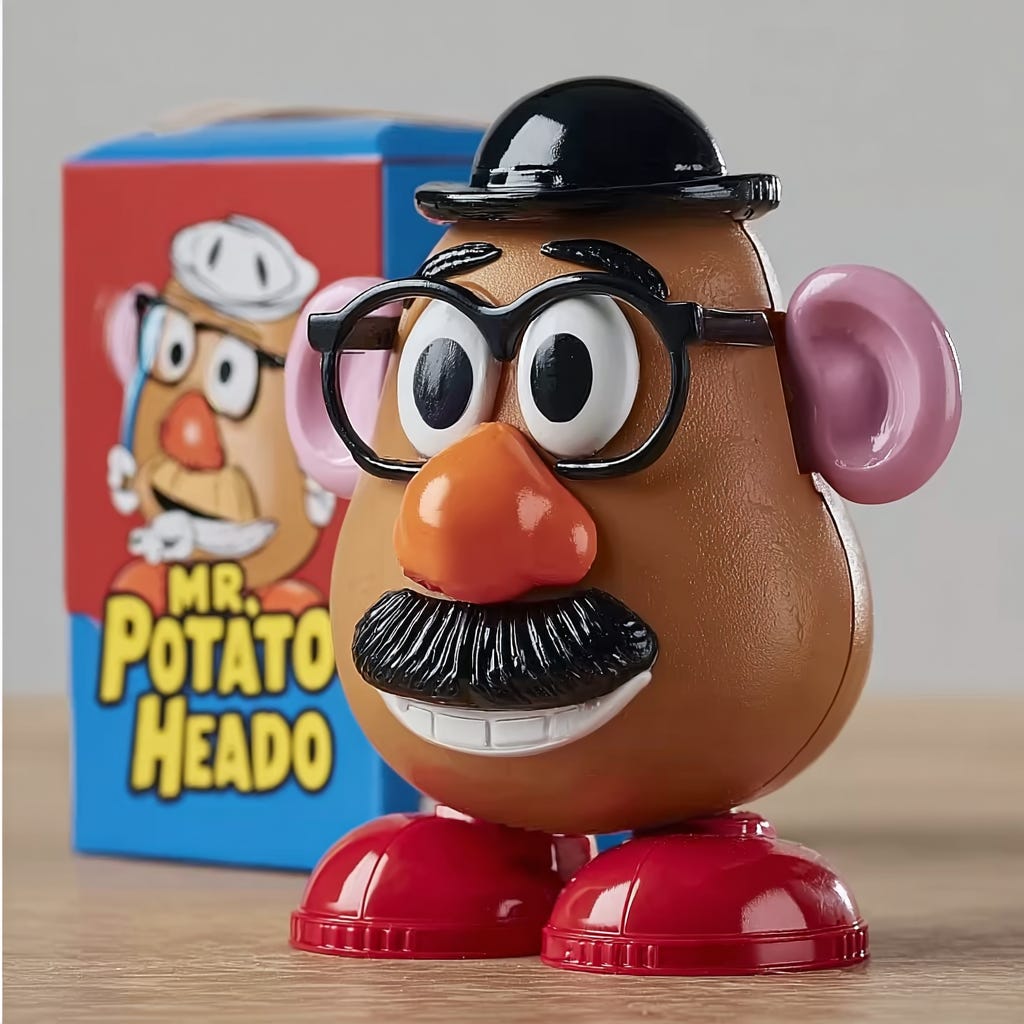
Mr. Potato Head attempts it.
The song is not about what Mr. Potato Head is. It is about what Mr. Potato Head became — and what it means that the becoming never stopped. The aluminum pins pressed into real potatoes in 1949. The Hasbro distribution deal in 1952. The plastic body in 1964. The removed pipe in 1987. The brand name simplified in 2021. Seven decades of documented change, organized chronologically, embedded in a melody children will carry without effort and without being asked to try.
This is what the Musinique Lyrical Literacy approach looks like when applied to history rather than phonemics or vocabulary: the same design principle, different content. The melody serves the material. The material trusts the child. The child carries forward what they are ready for and retrieves the rest when they need it.
The Chronological Structure as Cognitive Training
Most children’s educational songs are atemporal. Twinkle Twinkle does not have a before and after. The Alphabet Song does not unfold across decades. The content exists in a permanent present — true now, true always, without history.
Mr. Potato Head has a before. It has a during. It has an after that is still ongoing.
The structure of the song maps directly onto the cognitive skill of sequential reasoning: the ability to track events in order, to hold a developing narrative in working memory while new information arrives, to understand that cause precedes effect and that B happened because A happened before it. This is not a peripheral skill. Sequential reasoning underlies reading comprehension, historical thinking, mathematical problem-solving, and narrative understanding. The child who cannot follow a sequence cannot follow an argument. The child who cannot follow an argument will struggle to read with genuine comprehension rather than surface decoding.
The sequence the song delivers is real and specific. First a prize in cereal packs — Lerner’s original distribution strategy before Hasbro acquired the rights. Soon he found a home with stacks / Of children laughing, eager eyes — the retail expansion. With Mrs. Potato and kids in tow — the family line that followed commercial success. But changes came as years went past — the pivot to a plastic body. And in a move to be fair and right — the 2021 brand revision. Each step follows from the step before it. The child who tracks all of them is doing real sequential reasoning, applied to real historical content, without sitting in a history class.
The temporal markers embedded in the lyrics — first, soon, but changes came, and in a move — are the connective tissue of sequential argument. These are the words that signal: what follows occupies a different moment than what preceded. They are the words that make it possible to read a newspaper, follow a lecture, understand a legal argument. They arrive here as lyrics. The child acquires them as music. The cognitive infrastructure is being built either way.
The Specific Year and What It Does to Time
Changing looks since ‘54.
This line is the song’s most quietly radical pedagogical move.
Abstract temporal language — long ago, once upon a time, in the olden days — is the default register of children’s content because it is universally applicable and requires no historical knowledge to deploy. Its problem is that it conveys nothing. Long ago is not a location. It cannot be placed. It has no relationship to anything the child already knows.
Since ‘54 is a location. It is 1954. It is a point that can be positioned relative to real things: the child’s parents’ births, their grandparents’ childhoods, the century currently underway. A child who is told this toy is older than your grandparents were when they were children has received historical information that they can use. A child who is told a long time ago has received nothing they can locate.
The specific year also carries an argument about scale that abstract temporal language cannot make. Seventy years. The toy predates everyone in the child’s household. It predates their teachers, likely their school, possibly their neighborhood. The child who knows since ‘54 knows that some things in the present were made in a past that extends beyond the living memory of anyone they can ask about it — that the world has depth, that the present sits on top of a very long before.
This discovery — that time extends backward beyond the accessible past, that things exist now that existed before anyone currently alive can remember — is among the most important conceptual developments of middle childhood. The song deposits the data point. The conceptual development follows, as it always does, when the child is ready to make the connection.
Three Vocabulary Lessons in One Song
Fad arrives in the second line, applied to something that became a seventy-year institution. The irony is available to older children: the fad that wasn’t. Younger children carry the approximate meaning — something new and popular — without the irony, and will acquire the full semantic content when they encounter the word again in a context where the irony is legible. This is the correct sequence. The container is built before the content fills it.
Starchy is doing double work that the child may or may not notice explicitly but will register. Potatoes are starchy — biological fact. A starchy family is, idiomatically, formal and rigid. A starchy family, hand in hand uses the food register to describe a family unit, which is wordplay. Wordplay is metalinguistic awareness in its earliest form: the capacity to notice that words have properties beyond their referents, that the same word can operate in two registers simultaneously. The child who laughs at starchy family is beginning to see language, not just through it. That is a significant cognitive development arriving as a pun about potatoes.
Couch potato is the song’s most layered linguistic move: an idiom deployed, then inverted, then given civic application. The idiom — a sedentary person — is applied to a literal potato who has been recruited into fitness campaigns. The literal potato, the idiomatic couch potato, and the fitness-advocating Mr. Potato Head occupy the same moment. Younger children receive the humor. Older children see the inversion. Both responses represent real linguistic processing of a word operating at multiple levels simultaneously. The song is multi-generational in its vocabulary payload, and that is not an accident — it is the design.
Evaluative Language and Early Civic Thinking
And in a move to be fair and right / The brand’s name changed to just “Potato Head” one night.
Most children’s content describes the world. This line evaluates it.
A move to be fair and right is not neutral description. It is a judgment. The decision to simplify the brand name — dropping Mister to be more inclusive — is characterized as an act of fairness, as a movement in the direction of right. The child who acquires this phrase has acquired something more than vocabulary. They have acquired a model: that decisions can be evaluated on ethical grounds, that naming practices carry values, that institutions make choices and those choices can be assessed as more or less fair.
This is the beginning of civic reasoning — the capacity to evaluate institutions and their decisions on ethical grounds rather than simply accepting them as given. It is among the most important cognitive capacities a democratic society requires of its members, and it almost never appears in children’s educational music because it is considered too complex, too political, too far outside the alphabet-and-counting brief.
The Lyrical Literacy framework holds that children deserve music that addresses them with intelligence, not condescension. A move to be fair and right is the clearest example in this song of what that looks like in practice: a civic concept, fully intact, delivered in six words attached to a melody about a plastic potato. The child does not need to unpack all of it now. The shape of the idea is filed. The unpacking happens later, when the child is ready to ask what fair and right actually mean and how we know when a decision qualifies.
The Identity Argument the Song Is Making
So here’s to the toy that grew and changed / With each new decade, he rearranged.
The closing verse is an argument about identity that children in the early developmental stages are particularly positioned to need.
Young children are visibly, rapidly changing — in height, in capability, in interest, in relationship to the world. The continuity of self across that change is a genuine puzzle for the developing mind. If I am so different from who I was last year, what makes me the same person?
The Mr. Potato Head song offers a model. The toy changed its substrate (real potato to plastic), its safety profile (sharp pins to rounded pieces), its accessory set (pipe removed), its name (Mister dropped). At every step it remained recognizably itself — beloved, continuous, definitively Mr. Potato Head — because what it did never changed. The child’s creative authority over the face. The modular composition. The humor of a vegetable with opinions about its own appearance. Form changed. Function persisted.
The thing that makes something itself is not its material form. It is its essential function. The child who carries this model has a framework for understanding their own continuity across change — for answering, at least provisionally, the question of what makes me me even as everything about me keeps becoming something different.
The song did not announce this lesson. It demonstrated it. That is always the better method.
The Maker’s Judgment
The AI built the chronology into lyric form. It preserved the historical specificity. It fit the advocacy campaigns into verses that sit alongside the cereal box origin story without tonal disruption.
What required the maker was the judgment that this material — a plastic potato’s seventy-two-year evolution — was worth a song at all. That it carried enough sequential reasoning practice, enough vocabulary payload, enough civic content, enough implicit philosophy of identity to earn the full Lyrical Literacy treatment.
The algorithm serves the familiar: the toy, the nostalgia, the charm of a character children recognize. The maker served the arc. The child who follows the arc all the way through — from George Lerner’s idea being quite the fad to Potato Head, Mister dropped in the name of fairness — has followed a complete argument about how things change and remain themselves.
From a simple spud. Changing looks. Since ‘54.
That was always enough. It was always more than enough.
LYRICS:
Mr. Potato Head
In a world where playing with food is bad,
George Lerner’s idea was quite the fad.
Plastic faces,little pins,
Turn a spud into grins.
Oh,Mr. Potato Head,what a tale you tell,
From a simple spud you rose and swelled.
Faces,hats,and bits galore,
Changing looks since ‘54.
First a prize in cereal packs,
Soon he found a home with stacks
Of children laughing,eager eyes,
Potatoes turned to big surprise.
With Mrs. Potato and kids in tow,
Spud and Yam,all aglow,
They sold in millions,oh so grand,
A starchy family,hand in hand.
Oh,Mr. Potato Head,what a tale you tell,
From a simple spud you rose and swelled.
Faces,hats,and bits galore,
Changing looks since ‘54.
But changes came as years went past,
Sharp pieces gone,plastic at last.
No longer just for lads and misses,
Mr. Potato Head sends anti-smoking kisses.
A couch potato no more,he stands,
Promoting fitness across the lands.
And in a move to be fair and right,
The brand’s name changed to just “Potato Head” one night.
Oh,Mr. Potato Head,what a tale you tell,
From a simple spud you rose and swelled.
Faces,hats,and bits galore,
Changing looks since ‘54.
So here’s to the toy that grew and changed,
With each new decade,he rearranged.
A spud,a face,a family dear,
Mr. Potato Head,we cheer.
Oh,Mr. Potato Head,what a tale you tell,
From a simple spud you rose and swelled.
Faces,hats,and bits galore,
Changing looks since ‘54.
#MrPotatoHead #ClassicToys #ToyHistory #Hasbro #PopCultureIcons #ChildhoodNostalgia #LyricalLiteracy #ToyEvolution
<iframe width="560" height="315" src="
" title="YouTube video player" frameborder="0" allow="accelerometer; autoplay; clipboard-write; encrypted-media; gyroscope; picture-in-picture; web-share" referrerpolicy="strict-origin-when-cross-origin" allowfullscreen></iframe>
<iframe data-testid=”embed-iframe” style=”border-radius:12px” src=”width=”100%” height=”352” frameBorder=”0” allowfullscreen=”“ allow=”autoplay; clipboard-write; encrypted-media; fullscreen; picture-in-picture” loading=”lazy”></iframe>


