

Seven stanzas. Three stages of fear extinction. Six learning mechanisms operating simultaneously.
Every patronus essay in this catalog has mapped learning mechanisms across a whole song. This one goes further — stanza by stanza, line by line — because the Fox and the Lion is the song in the Lyrical Literacy catalog where the verse structure and the neurobiological learning sequence are most precisely aligned. Each stanza is doing something distinct. Each transition between stanzas is a documented stage in a documented process.
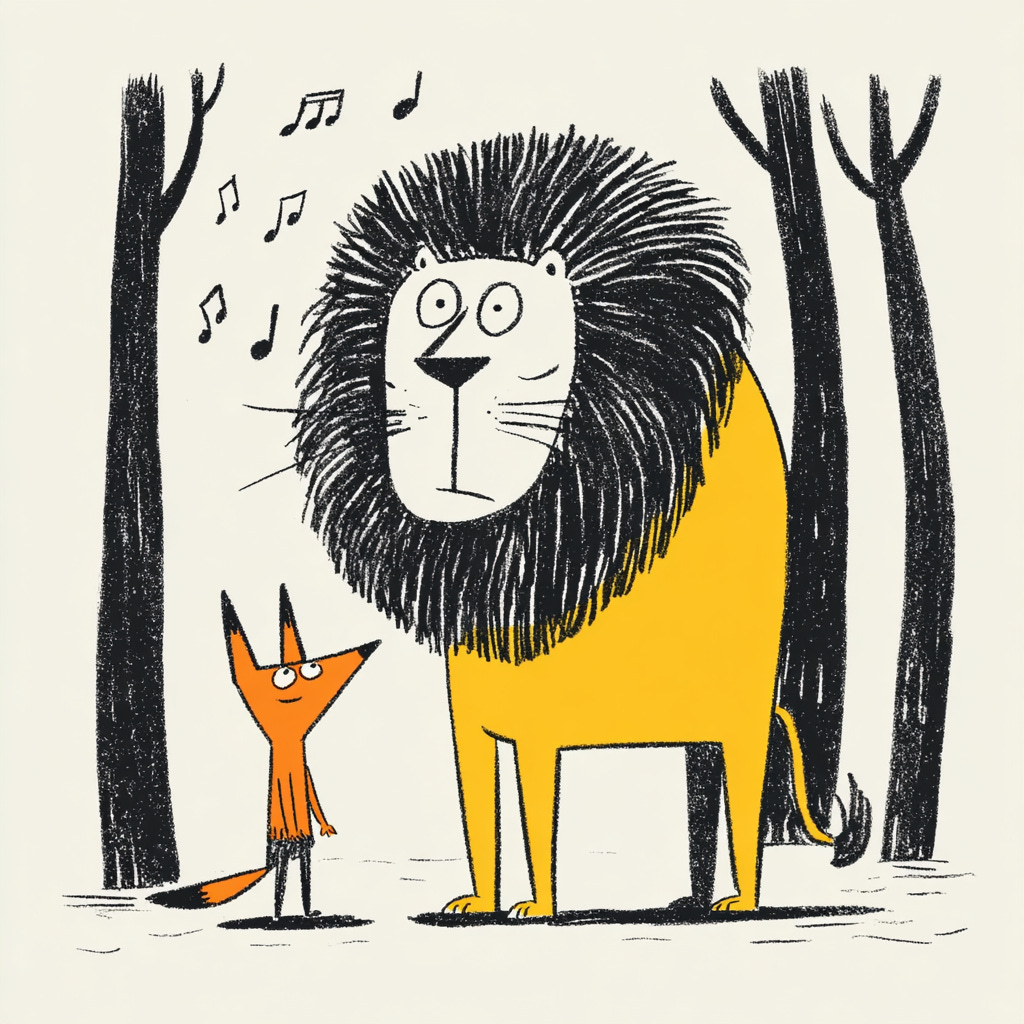
The Fox and the Lion, performed by Newton Williams Brown and produced through Humanitarians AI, teaches children something that most adults have to learn through painful experience: that courage is not the absence of fear but a process that operates through time, through exposure, through the accumulation of prediction errors that update a nervous system’s threat assessment. That process has three stages. The song shows all three. The intermediate stage — the twitching-but-staying-in-view stage — gets its own line.
What follows tracks the learning mechanisms stanza by stanza, with the neuroscience specified at each stage.
Stanza One: The Correct Initial Response
Little ol fox with a curious nose / Prancin round where the wild wind blows / Till a lion let loose with a deep down roar / Shook the ground and the forest floor.
The opening stanza establishes four things before the fear response arrives.
The fox has a curious nose. This is not decoration. Curiosity — the motivational state that drives exploration of novel stimuli — is the cognitive opposite of avoidance. The fox who prances with a curious nose is a fox in an approach orientation: open, investigative, moving toward new information rather than away from it. The child who registers this detail is receiving a character baseline: the fox’s natural state is curiosity, not fear. Fear is what happens when curiosity encounters something overwhelming. Fear is not this fox’s identity.
The iambic meter establishes the 2 Hz rhythmic pulse in the first two lines. “Lit-TLE ol FOX with a CU-rious NOSE / Pran-CIN round WHERE the wild WIND blows.” The stressed beats arrive at approximately two per second — the delta-band oscillation frequency that a 2014 MEG study found predicts vocabulary size at 24 months through speech segmentation scaffolding. The child’s motor cortex synchronizes before any semantic processing begins. The scaffold is in place.
The onset clusters begin: /pr/ in “prancin” — fricative into liquid, a distinct amplitude rise time from single-consonant onsets. /bl/ in “blows” — voiced stop into liquid. /gr/ in “ground” — voiced velar into liquid. Three distinct onset cluster types in four lines. The auditory cortex is building phoneme discrimination capacity through the same emotional engagement that holds the child’s attention on the story.
The roar arrives: “Till a lion let loose with a deep down roar / Shook the ground and the forest floor.” The threat stimulus is introduced. The conditioning event is about to occur.
Stanza Two: Optimal Initial Threat Response
Fox hit the dirt tail stiff as bone / Eyes wide open heart like stone / Whispered low with a tremblin lip / That roar could sink a battleship.
This stanza is the conditioning event, and the most important thing the song teaches about it is what it does not say: it does not say the fox was wrong to respond this way.
Fear conditioning is the amygdala doing its job. A single intense aversive experience — a roar that shook the ground — is sufficient to form a strong conditioned association: lion = danger. The amygdala encodes survival-relevant events with high potency on single exposure because single exposure may be all a nervous system gets before a predator kills it. The fox who hits the dirt is demonstrating optimal initial threat response: fast, automatic, survival-prioritizing. This is correct design.
The song renders the fear at full emotional weight — “eyes wide open heart like stone / whispered low with a tremblin lip” — without diminishing it and without attaching shame to it. This is the blues idiom doing its pedagogical work: the tradition that sings what is true rather than what is comfortable is the tradition that can hold fear as legitimate testimony rather than evidence of weakness. The child who hears their own experience of overwhelming fear accurately described receives an implicit developmental message — this state is real, this state is documented, this state is not a character flaw.
The phonemic inventory expands: /st/ in “stiff” — fricative into plosive. /tr/ in “tremblin” — voiced stop into liquid. /wh/ in “whispered” — fricative onset. Three more distinct cluster types. Seven lines in, the auditory cortex has processed five distinct onset cluster classes.
Stanza Three: The Intermediate Stage That Most Stories Skip
But days go on fear fades some / Lion walked by beatin no drum / Fox still twitched but stayed in view / Just noddin soft like brave folks do.
This is the most important stanza in the song, and the most important stanza in the Lyrical Literacy catalog for the specific developmental population it serves.
Most stories about courage move directly from fear to resolution. The character is afraid. Something happens. The character is no longer afraid, or acts decisively despite the fear without showing the process. The intermediate stage — where the fear has attenuated but not resolved, where the behavior has changed but the internal experience is still uncomfortable — is invisible in most courage narratives because it is the least dramatic stage and the hardest to render.
The Fox and the Lion renders it with clinical precision.
“Fox still twitched but stayed in view.”
The twitching is the amygdala response, attenuated but present. The amygdala has not stopped firing — the conditioned association is still intact — but the magnitude of the response has decreased because the prediction error has begun to accumulate. Repeated non-reinforced exposure (the lion walking by without attacking) is generating competing learning in the ventromedial prefrontal cortex: this stimulus, in this context, has not produced the predicted outcome. The conditioned response is being inhibited, incrementally, through the accumulation of safe exposures.
The fox stayed in view. This is the behavioral change that precedes the internal change. The behavioral response to the fear signal — full avoidance — has been decoupled from the internal experience of fear. The fox still feels the amygdala activation. The fox is not running. This is what graduated exposure therapy asks of anxious people: tolerate the presence of the feared stimulus at a level of arousal you can manage, without performing the avoidance behavior that would prevent the prediction error from accumulating.
“Just noddin soft like brave folks do.”
This line names the intermediate stage. Brave folks are not people whose amygdalas don’t fire. They are people who stay in view while twitching. The child who has heard this line — who has been in the twitching-but-staying-in-view stage and had no name for it — now has a name for it. Stage two. Expected. Survivable. What brave folks do.
The developmental psychology of self-efficacy documents why naming intermediate stages matters. Children who have explicit behavioral templates for the intermediate stages of difficult processes show stronger approach behavior and lower avoidance because the stage having a name makes the experience legible. They are not failing to be courageous. They are being exactly as courageous as the fox on day two.
Stanza Four: Voluntary Approach — The Clinical Milestone
Then one bright mornin cool and clear / Fox stood tall dropped that fear / Said why you roar you feelin bad / Lion just blinked didn’t even get mad.
Stanza four is the behavioral milestone that marks successful fear extinction: voluntary approach toward the previously feared stimulus.
The fox did not gradually inch closer. She stood tall. She initiated contact. She asked a question — “why you roar you feelin bad” — which required not just approach but active engagement with the feared stimulus, seeking information about its motivational state. This is the deepest form of extinction behavior: approach that gathers evidence about whether the original prediction was correct.
The lion blinked. He didn’t get mad. The prediction — danger — was wrong. This is the final prediction error, the confirming evidence that the inhibitory association the ventromedial prefrontal cortex has been building is accurate. The lion, in this context, was not a threat. The original fear was disproportionate to this particular stimulus.
The question “why you roar, you feelin bad?” is the most pedagogically important line in the song. It is not a script. It is a demonstrated behavioral possibility — an enacted example of the approach behavior that completes the extinction sequence. Children learn behavioral possibilities through observing them in narrative, and enacted possibilities in story have broader transfer than abstract instruction. The child who has heard the fox ask this question has the question available. Not as an obligation. As a possibility that has been demonstrated to be survivable.
The onset clusters continue: /cl/ in “clear” — velar into liquid. /dr/ in “dropped” — voiced stop into liquid. /fl/ in “flashin” (stanza five). The phonemic inventory grows with each stanza.
Stanza Five: The Reappraisal
No claws flashin no wild attack / Just a stare from a mane leanin back / Fox turned slow with a little grin / Sometimes the danger is just the wind.
Stanza five delivers cognitive reappraisal — the process by which the meaning of a stimulus is reconsidered in light of new evidence.
The fox gathered evidence through approach. The evidence contradicted the original assessment. “Sometimes the danger is just the wind.” The reappraisal is not a dismissal of the original fear — it is a contextually accurate update. The lion, in this context, was not dangerous. The conditioned association (lion = danger) was formed under conditions of genuine uncertainty. The update (this lion, in this context, is not currently a threat) does not erase the original caution. It adds accuracy.
This is the distinction between cognitive reappraisal — updating a threat assessment based on evidence — and emotion suppression — denying or overriding the fear signal without engagement. Reappraisal is associated with better emotional regulation outcomes. Suppression is associated with worse ones. The fox reappraised. She did not suppress. The little grin is not a claim that the lion was never scary. It is the expression of a nervous system that has completed an extinction cycle and updated its model.
The child who internalizes this stanza’s logic — gather evidence, update the assessment, the danger is sometimes just the wind — has been given the cognitive tool that clinical psychology calls emotional regulation rather than emotional suppression. The distinction is the most practically significant learning outcome in the song.
Stanzas Six and Seven: The Calibrated Moral
Don’t go runnin from every sound / Some beasts bark but don’t come round / Fears a fire you can’t always trust / Burns down brave when it turns to dust.
So lift your chin don’t shake don’t stall / Half the monsters ain’t real at all / And what you thought was death and flame / Might just be thunder with no name.
The closing stanzas deliver the moral with a precision that distinguishes this song from most courage narratives, and the precision is itself a learning outcome.
“Half the monsters ain’t real at all.” Not none. Half. The other half are real. The song does not say fear is wrong. It says fear cannot always be trusted — not never trust, but not always. This calibration is the accurate description of how the amygdala actually operates: it fires in response to threat signals, not verified threats. It is correct to fire. It is not always correct about what the firing means. The fox’s amygdala was doing its job. The fox’s amygdala was wrong about this particular lion.
A child who receives “all fear is wrong” has been given an inaccurate model of their own nervous system and a dangerous behavioral rule: ignore fear. A child who receives “fear cannot always be trusted” has an accurate model and a useful rule: investigate. The question is available. “Why you roar, you feelin’ bad?”
This calibration is most effective coming from Newton Williams Brown’s voice. He is the reconstructed voice of William Newton Brown — the conscientious objector who ran unarmed onto active battlefields because his theology told him the meek do not avoid suffering but move toward it. When this voice says half the monsters aren’t real, it is speaking from demonstrated knowledge of what real monsters are. The warmth in the delivery is the warmth of someone who encountered genuine danger and found that the walking was survivable. The calibration is trustworthy because the voice is trustworthy.
The phonemic inventory completes across the final stanzas: /sh/ in “shake,” /st/ in “stall,” /th/ in “thought,” /thr/ in “thunder” — fricative-nasal clusters that expand the onset cluster range to its fullest. By the song’s close, the child’s auditory cortex has processed fourteen distinct onset cluster types through seven stanzas of emotional engagement with a courage narrative. The phonological awareness built through this exposure is the foundation of reading. It was built through the story of a fox who stayed in view.
What Seven Stanzas Deliver
The child who has heard this song several times carries:
The neuroscience of fear extinction as a three-stage narrative sequence — terror, habituation while twitching, voluntary approach — available as a template when they are at stage two and do not know it.
“Just noddin soft like brave folks do” — a name for the intermediate stage that most stories skip, making the experience of twitching-while-staying legible rather than confusing.
The question — “why you roar, you feelin bad?” — as a demonstrated behavioral possibility, not a script but a modeled approach behavior that entered their repertoire through narrative.
The calibrated moral — half the monsters aren’t real, the other half are — delivered by a voice whose history makes it trustworthy. Fear deserves investigation. Not all fear is wrong.
The distinction between emotion suppression and cognitive reappraisal — the fox didn’t stop being afraid through willpower, she gathered evidence and updated her model. This is the right tool for the right job.
Fourteen onset cluster types built through emotional engagement, toward the phonological awareness that underlies reading.
The fox stayed in view. Her nervous system updated. The lion blinked. The child who has heard this song knows what that sequence looks like from the inside — and knows that stage two, the twitching stage, is the stage brave folks are in when they stay.
LYRICS:
Little ol fox with a curious nose
Prancin round where the wild wind blows
Till a lion let loose with a deep down roar
Shook the ground and the forest floor
Fox hit the dirt tail stiff as bone
Eyes wide open heart like stone
Whispered low with a tremblin lip
That roar could sink a battleship
But days go on fear fades some
Lion walked by beatin no drum
Fox still twitched but stayed in view
Just noddin soft like brave folks do
Then one bright mornin cool and clear
Fox stood tall dropped that fear
Said why you roar you feelin bad
Lion just blinked didn’t even get mad
No claws flashin no wild attack
Just a stare from a mane leanin back
Fox turned slow with a little grin
Sometimes the danger is just the wind
Don’t go runnin from every sound
Some beasts bark but don’t come round
Fears a fire you can’t always trust
Burns down brave when it turns to dust
So lift your chin don’t shake don’t stall
Half the monsters ain’t real at all
And what you thought was death and flame
Might just be thunder with no name
Tags: fear extinction three stages stanza-by-stanza conditioning habituation voluntary approach, intermediate stage twitching-while-staying self-efficacy naming brave folks template, cognitive reappraisal vs emotion suppression gather evidence update threat model, calibrated moral half monsters Newton Williams Brown earned authority trustworthy, phonemic inventory fourteen onset clusters folk-blues 2Hz delta oscillation
#LyricalLiteracy #DontFearThatRoar #FoxAndLion #MusicEducation #HumansAndAI #NeuroscienceOfMusic #CognitiveDevelopment #OpenSourceAI #HumanitariansAI #AIforHumans
<iframe width="560" height="315" src="
" title="YouTube video player" frameborder="0" allow="accelerometer; autoplay; clipboard-write; encrypted-media; gyroscope; picture-in-picture; web-share" referrerpolicy="strict-origin-when-cross-origin" allowfullscreen></iframe>
<iframe data-testid=”embed-iframe” style=”border-radius:12px” src=”width=”100%” height=”352” frameBorder=”0” allowfullscreen=”“ allow=”autoplay; clipboard-write; encrypted-media; fullscreen; picture-in-picture” loading=”lazy”></iframe>


