


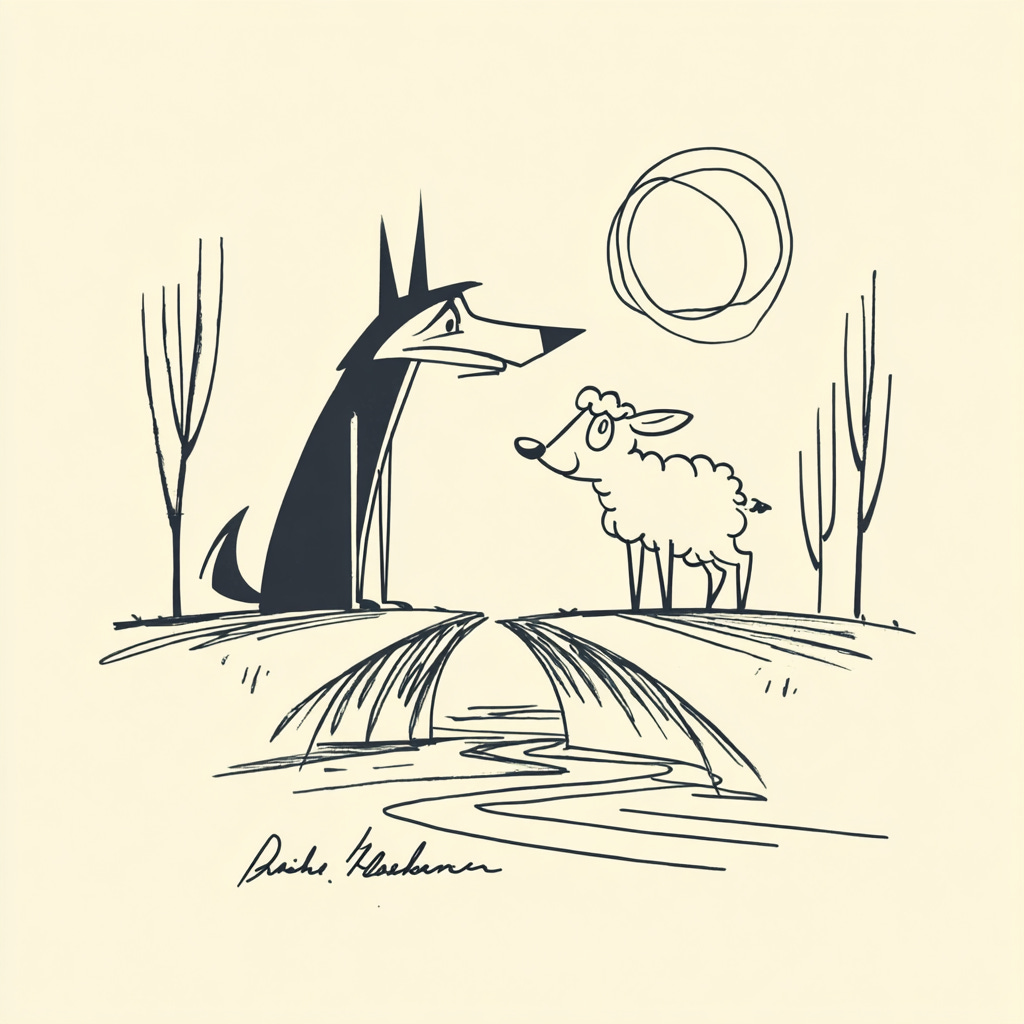
The lamb makes three arguments. Each one is correct.
The stream flows toward you, not me — correct. I wasn’t born last year when you claim I insulted you — correct. I have no family who would have done so either — correct. Three logically complete refutations, each more specific and definitive than the last, delivered to an audience that was never evaluating them.
The wolf eats the lamb and calls it justice.
Twenty-five centuries of educational tradition have used this fable, and the lesson has always been stated the same way: the powerful need no real excuse. Tyrants will find a pretext. Might makes right. These are true statements. They are also, as educational outcomes, incomplete — because naming what happens is not the same as building the cognitive capacity to recognize it in real time, before the lamb has already staked everything on a third argument that cannot help her.
The Lyrical Literacy dual-poem adaptation is designed to produce the second thing. Not understanding of a principle. The cognitive architecture for applying it.
The Developmental Problem: Why Most Children Cannot See What the Lamb Cannot See
To understand what the fable is trying to build, it helps to understand precisely what the developmental research says about why it needs building.
Erik Erikson’s developmental stage theory identifies the period from roughly age six to twelve as the stage of industry versus inferiority — the period when children are most invested in demonstrating competence through effortful work. This investment is productive for most learning tasks. It is specifically counterproductive in situations of pure power asymmetry, because it leads children to redouble effort — produce better arguments, try harder to reason — in exactly the situations where effort is not the operating variable.
Elliot Turiel’s social domain theory documents that children in this developmental stage reliably distinguish between moral rules (intrinsically binding, harm-based), social conventions (contextually binding, authority-based), and personal matters (individually determining). What they significantly underperform on is a fourth category that Turiel’s later work and extensions by Killen, Smetana, and others have begun to document: situations where an authority is framing a power exercise as if it were a moral or conventional rule while operating outside the constraints of either.
This is the wolf’s move. You muddied my water. It sounds like a rule violation claim. It has the grammar of legitimate grievance. The lamb correctly identifies it as factually wrong and responds with evidence. What the lamb cannot do is recognize that the factual wrongness is irrelevant — that the accusation is not a rule violation claim but a pretext structure, and that responding to the content of a pretext as if it were a genuine claim is exactly the strategic error the wolf’s framing was designed to produce.
Children encounter the pretext structure regularly — in peer conflicts, in institutional decisions, in the specific experience of an adult who has decided something and is explaining it. They rarely have language for it. They rarely have cognitive scaffolding that allows them to recognize it as a category rather than a particularly unfair instance of an otherwise fair system.
The fable’s two-poem structure is designed to install that scaffolding at the pre-analytic level — as resonance and felt pattern — before the full analytic framework is developmentally available.
What the First Poem Is Doing
A wolf came stomping down the hill / With grumbly guts he couldn’t fill. The iambic rhythm, the rhyme pairs, the clear narrative architecture — this is the container of the known form. The child who enters this poem enters with their narrative comprehension system engaged: building the story model, tracking causal chains, predicting how the fable’s logic will resolve.
The clarity is the mechanism. The first poem needs to be this clear because the child needs to understand the structure of the situation — the wolf’s bad faith, the lamb’s correct arguments, the predetermined outcome — with full narrative comprehension before the second poem can produce the felt knowledge that makes the lesson durable.
The first poem deposits the lesson in declarative, propositional memory. The wolf doesn’t need a real excuse. Correct arguments can fail. Power can override logic. These are stored as understood facts.
Understood facts are necessary. They are also the most fragile form of knowledge — stored in systems that require retrieval practice to persist, accessible through conscious effortful retrieval rather than automatic recognition response. In the real-time situations where this knowledge is most needed, conscious effortful retrieval is often unavailable: the child is frightened, cognitively loaded, emotionally activated. The knowledge needs to be available through a different system.
The second poem builds the different system.
What the Second Poem Is Doing That the First Cannot
A wolf came thunder thump down the hill / His belly a grumbling hole of never / Spied a drink and a lamb / Soft / Still / Wet lipped with spring.
Every formal feature has shifted. The rhythm is broken. The line breaks are arguments: Soft / Still / Wet — each word isolated, each waiting for the next, the lamb’s vulnerability performed in the poem’s shape rather than described in its content. Allan Paivio’s dual coding theory, refined through forty years of subsequent research, establishes precisely why this matters: information stored through multiple cognitive pathways — verbal-propositional and imagistic-affective — is more resistant to forgetting, more accessible under cognitive load, and more reliably activated by situational pattern recognition than information stored through a single pathway.
The second poem is building the imagistic-affective pathway. Soft / Still / Wet. These isolated words activate visual and sensory processing — the lamb rendered in sensation rather than description, stored in the memory systems that hold images and emotional patterns rather than the systems that hold narrative propositions.
You muddied up my sky he barked. The accusation has mutated from the first poem’s you muddy up my water into something that cannot even be factually refuted. The sky is not muddied by anyone standing downstream. The wolf’s claim has moved past inaccuracy into the grammar of pure pretext — an accusation whose content is irrelevant to its function, which is to produce an explanation that can be called justice later. The lamb cannot win an argument about muddying the sky because there is no argument to win. There is only the wolf’s decision, dressed in accusation grammar.
And lamb stood small as dusk / While reason cracked. Not the lamb’s reason. Reason. The poem is making a structural claim through the line break: the failure is not in the quality of the lamb’s thinking. It is in the operating system. Reason itself — the mechanism that the lamb has been trying to use — is not the mechanism the wolf is running. Reason cracked against the wolf’s context the way ice cracks against stone: not because the ice was weak, but because stone is not a surface where ice can hold.
This is the felt knowledge the second poem is building. The child who has inhabited this poem has been given a sensory, imagistic, emotionally encoded pattern: the shape of a situation where the argument is not the point, where the words have become wishes, where reason cracks not from being wrong but from being in the wrong context. That pattern is stored in the systems that have direct access to recognition response. The next time the child encounters a situation where their arguments are being received as if they were wishes, something will feel familiar. The familiarity is the protection.
The Three Phrases That Do the Cognitive Work
“They eat first, then think.“
This is the fable’s most educationally precise phrase because it names a cognitive mechanism — backward justification, or motivated reasoning — that children encounter regularly and almost never have language for. The social psychology literature, from Jonathan Haidt’s work on moral dumbfounding to Daniel Kahneman’s research on System 1 and System 2 thinking, consistently documents backward justification as near-universal: humans at every level of institutional authority regularly decide through desire or self-interest and construct reasoning afterward. The wolf did not reason to the conclusion that the lamb deserved to die. He wanted to eat the lamb and then produced whatever accusation came to hand.
The child who carries they eat first, then think carries an evaluative tool for every authority whose stated reasoning consistently arrives at convenient conclusions. It is a five-word version of the question: did this reasoning produce this conclusion, or did this conclusion produce this reasoning? Most adults cannot reliably ask this question in real time. The child who has had it installed pre-analytically, in the body, in the rhythm of the poem, has a head start on most adults.
“Lord of lawless law.“
The paradox names something specific and important: the structure of power that deploys justice vocabulary while operating outside justice constraints. The wolf doesn’t just eat the lamb. He calls it justice — which is the move that transforms individual predation into the appearance of legitimate process, that insulates the action from the accountability that legitimate process would impose, that produces in observers the confusion of this doesn’t seem right without the cognitive framework to explain why.
Children encounter reduced versions of this regularly. They feel the confusion — the rule invoked for some and not others, the explanation that sounds like reasoning but forecloses questions, the decision that is explained rather than justified. Without a framework, the confusion is paralyzing. With the phrase — even pre-analytically, as the resonance of something doesn’t add up between what is being said and what is happening — the confusion becomes recognizable. Pre-analytic resonance is the developmental precursor to analytic understanding. The poem installs the resonance at the age when the analytic capacity is still forming.
“Reason cracked.“
The fable’s most formally radical claim, delivered through line break rather than statement. Not the lamb failed. Not the argument was wrong. Reason cracked — the mechanism itself, in this context, under this kind of pressure. The phrase builds the single most important cognitive distinction the fable is trying to establish: the difference between my argument is insufficient (in which case I should argue better) and argument is not the operating mechanism here (in which case I should stop arguing and assess my situation differently). The child who cannot make this distinction will, in the second kind of situation, keep producing better arguments. The child who has felt reason cracked through the poem’s structure has the beginnings of the capacity to make it.
The Four Cognitive Capacities, Assembled
The four cognitive tools the fable is building are not independent competencies. They form a developmental sequence — each one building on the previous, each one necessary before the next is fully accessible.
Power structure recognition is the foundation: the capacity to ask, before committing to an argument strategy, whether argument quality is the operating mechanism in this situation or whether the outcome has already been determined. This is what the lamb lacked. This is what the first poem makes legible and the second poem makes felt.
Backward justification detection builds on it: once a child can recognize a predetermined-outcome context, the next capacity is recognizing how those contexts produce their appearance of legitimacy — through reasoning constructed after the conclusion. They eat first, then think is the label. The felt pattern from the second poem is the training data.
Lawless law recognition is the third layer: the ability to notice when justice vocabulary is performing a function other than producing justice — when explanation is substituting for justification, when the rule is being invoked to produce a specific outcome rather than to enforce a general principle. Lord of lawless law is the phrase. The wolf calling it justice is the demonstration.
Situational intelligence is the output: the capacity to assess which kind of situation you are in before choosing a response. This is not the decision to stop arguing — it is the decision to argue strategically, in situations where argument is the operating mechanism, rather than reflexively, in all situations regardless of structure.
None of these are the tools of a cynic. Cynicism is the belief that all situations are the second kind. These four capacities are the tools of a person who can tell the difference reliably enough to choose differently in each.
The lamb could not tell the difference. The fable has known this lesson for twenty-five centuries and has kept repeating it because children keep needing it. The dual-poem structure delivers it in the form the brain is most built to receive and retain. The child who carries all four capacities into the next wolf encounter is better prepared than the lamb was — not because the wolf might not eat them, but because they will know what kind of situation they are in before they give their third argument.
LYRICS:
A wolf came stomping down the hill
With grumbly guts he couldn’t fill
He found a brook so cool and clear
And saw a lamb was drinking near
You muddy up my water brat
Explain yourself explain all that
The lamb looked up with worried eyes
I think the stream flows your side guys
A wolf came thunder thump down the hill
His belly a grumbling hole of never
Spied a drink and a lamb
Soft
Still
Wet lipped with spring
You muddied up my sky he barked
Explain yourself
Stream runs your way
Whispered lamb with eyes like rain
The wolf bared truth a fang in heat
You whispered last year lies of me
Sir I was not even yet a me
Well then said wolf
You wear the face of guilt
Your twin your blood your breath will do
And lamb stood small as dusk
While reason cracked
She tried to word to wish
But wolves don’t pause to hear a song
Down came death with no applause
Just teeth
And he our lord of lawless law
Licked his lips
Called it justice
Beware little ones whose hearts are light
In woods where power growls
They eat
First
Then
Think
Tags: Erikson industry inferiority developmental stage effortful work power asymmetry, Turiel social domain theory pretext structure fourth category authority framing, dual coding Paivio imagistic affective verbal propositional two memory systems, backward justification Haidt Kahneman motivated reasoning system one two, four capacities developmental sequence power structure backward justification lawless law situational intelligence
#MusiqueAI #HumansAndAI #AIMusic #LyricalLiteracy #SpiritSongs #GhostArtists #OpenSourceAI #MusicResearch #AIforHumans #IndieMusician
<iframe width="560" height="315" src="
" title="YouTube video player" frameborder="0" allow="accelerometer; autoplay; clipboard-write; encrypted-media; gyroscope; picture-in-picture; web-share" referrerpolicy="strict-origin-when-cross-origin" allowfullscreen></iframe>
<iframe data-testid=”embed-iframe” style=”border-radius:12px” src=”width=”100%” height=”352” frameBorder=”0” allowfullscreen=”“ allow=”autoplay; clipboard-write; encrypted-media; fullscreen; picture-in-picture” loading=”lazy”></iframe>


