


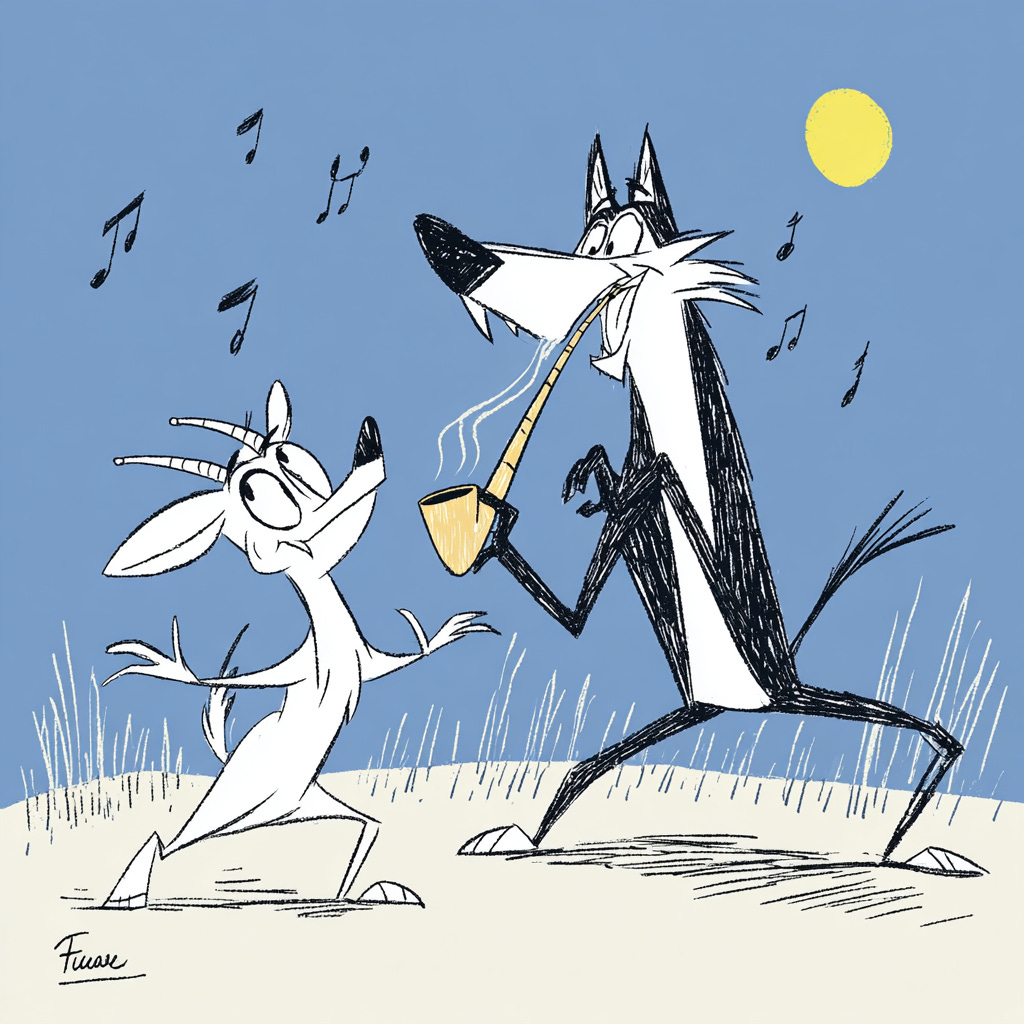
Oh no said kid I know my fate / You’re here to chew not to chat or wait.
Most characters in this situation spend their final moments arguing. The lamb made three arguments. Each was correct. None mattered. The wolf ate her and called it justice.
The kid makes zero arguments. The kid has read the situation accurately — you’re here to chew — and has already moved past the question of whether argument is useful. In the time it takes most characters to formulate a defense, the kid has assessed the constraint, identified the resource hidden inside it, modeled the environment the interaction is embedded in, and constructed a request that is simultaneously accurate, dismissible, and the mechanism of escape.
But please one tune a final song / So I can dance before I’m gone.
This is the cognitive move the fable is designed to examine. Not the bravery, not the cleverness as a general quality, but the specific sequence of reasoning that produced this specific request at this specific moment. Understanding that sequence — and why the song’s formal choices install it in the developing brain in a form that survives stress and remains available when needed — is the purpose of this essay.
Why the Kid’s Capacities Are Rare and Why They Must Be Installed Early
The developmental research on creative problem-solving identifies a consistent developmental window: the capacities that produce novel solutions under genuine constraint develop most robustly in middle childhood, between ages seven and eleven, through exposure to situations that require them — but only if those situations also provide the safety structure that allows genuine cognitive engagement rather than pure survival response.
This is the educational paradox the fable tradition has always navigated. Genuine constraint develops genuine creative capacity. But genuine constraint in real life often produces genuine threat, which activates the stress response that shuts down the prefrontal cortex processing that creative solutions require. A child under genuine life threat cannot produce creative solutions — not because the child lacks the capacity, but because the neurobiological stress response is using the available cognitive resources for threat management.
The fable is the solution to this paradox. It provides the emotional reality of genuine constraint — the wolf is real, the threat is real, the kid’s terror is real — inside the formal safety of a story. The child’s stress response is activated at a level sufficient to produce authentic engagement without overwhelming the prefrontal cortex. The child can think alongside the kid. The creative solutions, practiced in this register, encode in systems that remain available under the moderate stress levels of real life.
This is why fables are more effective for developing these capacities than either abstract instruction (too decontextualized, no authentic engagement) or real-world high-stakes situations (too threatening, prefrontal cortex offline). The fable is the pedagogical sweet spot.
Capacity One: What the Kid Does With the Constraint
Standard problem-solving asks: how do I overcome this obstacle? The obstacle (the wolf) is treated as external to the solution, and the solution consists of removing or bypassing it.
This approach is correct for most obstacles. It is wrong for the kid’s obstacle because the wolf cannot be removed. Every resource the kid might deploy to overcome the wolf — speed, strength, argument — is unavailable. The standard approach, applied here, produces no solution.
Constraint reframing asks a different question: what does this constraint make available that would not otherwise be available?
The kid’s answer is precise. The wolf’s absolute certainty that the kid cannot escape creates a specific cognitive availability: the wolf can afford to be generous. A predator who is certain of the outcome can afford small delays and harmless indulgences, because certainty means no cost. The wolf’s confidence — the constraint itself — is the resource. The last wish is possible only because the wolf is absolutely certain that a last wish changes nothing.
The kid is right. Under normal conditions — conditions of uncertainty, where the wolf might need to act quickly — no last wish would be granted. It is the wolf’s certainty that creates the opening. The certainty is the constraint. The certainty is the resource. They are the same thing, viewed from different frames.
The developmental research on divergent thinking in children identifies constraint reframing as emerging from a specific metacognitive capacity: the ability to notice when you are applying the wrong cognitive frame to a problem and deliberately switch frames. This metacognitive awareness develops most effectively through narrative exposure to situations where frame-switching is the visible mechanism of success. The fable demonstrates the mechanism. The child who inhabits the kid’s position has practiced noticing the constraint-as-resource frame in the most memorable form available: a small goat on the edge of being eaten who figures out that the wolf’s certainty is the door.
Capacity Two: The Five-Link Causal Chain Running Beneath the Dance
But music travels as music does / And dogs don’t like what a wolfman was.
The simplicity of this stanza is deceptive. The causal logic it encodes is five links long, and the kid is running it simultaneously with presenting as helpless and performing a clumsy dance.
Link one: the pipe makes music. Link two: music is sound that travels through space. Link three: dogs are in the surrounding environment within hearing distance. Link four: dogs and wolves are adversaries — dogs respond to wolf-presence and wolf-sounds as threats requiring response. Link five: dogs responding to wolf-music in the presence of a wolf creates a situation that is dangerous for the wolf and beneficial for the kid.
Holding five causal links simultaneously is a high-level executive function task even under calm conditions. The kid is holding them while terrified, while dancing, while performing the presentation of helplessness. This is multi-task causal reasoning under maximal cognitive load — exactly the condition the developmental research on real-world problem-solving identifies as most demanding and most rarely scaffolded in educational contexts.
As music does. The archaic confidence of this phrase is doing specific memory work. It sounds like a law — not music will travel (future, uncertain) or music travels (present, observation) but music does, which is the grammar of the already-known. The kid is not discovering that music travels. The kid has always known that music travels, the way you know a proverb, the way you know a rule of the world that arrived before you could analyze it.
The song encodes the causal chain in this confident, proverb-like form because proverbs encode in the same memory systems as nursery rhymes and folk sayings — the deepest-retention, most-automatic-retrieval systems available to the developing brain. The five-link chain is compacted into four words: music travels as music does. The child who carries those four words carries the chain in the system that will make it available when needed.
Capacity Three: The Wolf Sees What the Kid Is Presenting
Small and frail. The wolf’s assessment of the kid is accurate. The kid is small and frail. The request — a last dance before being eaten — is accurate in every observable dimension. It is exactly what it appears to be, observed at the surface level.
What it is, observed at the level of mechanism, is completely different. The presentation and the mechanism are simultaneously both real. This is not deception in the ordinary sense. The kid is not misrepresenting the observable facts. The kid is presenting true facts that conceal a non-observable structure.
The developmental literature on theory of mind identifies a specific developmental stage — second-order theory of mind, typically consolidating between ages seven and ten — in which children become capable of modeling not just what another person knows, but what another person thinks about what they themselves are doing. The kid must model not just what does the wolf see but what does the wolf think the kid is trying to do with what the wolf sees. The wolf must see: helpless kid making a pathetic last request. The wolf must think: the kid is trying to get a final dance. The wolf must not think: the kid is trying to activate the dogs through the wolf’s own piping.
Maintaining that two-level model while dancing clumsily and looking frightened is second-order theory of mind under pressure. It is the cognitive capacity that underlies social sophistication, strategic communication, and the ability to navigate complex social situations where what you present and what you are doing are not the same layer of reality.
Narrative situations that require the child to inhabit a character performing this two-level modeling are among the most effective developmental scaffolding for second-order theory of mind available in early childhood education. The fable provides the situation. The kid models the performance. The child who inhabits the kid is practicing the cognitive operation from the inside.
The Wolf’s Error: Am I About to Play the Pipe?
The wolf’s error is not stupidity. The wolf is confident because the wolf’s assessment is accurate: the kid cannot escape, the delay costs nothing, the outcome is certain. This is correct reasoning from correct premises.
The error is accepting a frame that requires operating as something the wolf is not. Why not he said you’re small and frail / let’s make this fun I’ve got the time. The frame the kid offers presents the wolf as: generous, entertaining, a granter of last wishes. This is not the wolf’s operational identity, which is: decisive predator, efficient, focused, operating in the logic of predation rather than the logic of entertainment.
The wolf accepts the frame without recognizing that accepting the frame requires temporarily suspending the operational identity — and that the temporary suspension is the mechanism of defeat. The wolf doesn’t become a musician. The wolf briefly stops being a predator. That brief stopping is everything.
Children encounter this structure in peer pressure situations with specific regularity. The request is framed as a small, harmless, temporary deviation from the child’s actual values and purposes: just this once, it’s not a big deal, you’re being too uptight, it doesn’t matter. The framing presents the deviation as the suspension of a preference rather than a violation of an identity. The wolf’s confident why not is the peer pressure grammar: your certainty about yourself is so complete that this small deviation costs nothing.
My job is chompin’ not this dance. The wolf’s belated self-knowledge is the question the fable is asking the child to be able to ask earlier: is this my job? Or am I about to play the pipe? Not as a rigid rule about never accepting invitations or never being flexible. As a specific check — a pause before accepting a frame that requires operating as something your actual purposes don’t support — that the wolf needed and did not have.
The child who carries the wolf’s rueful oh crumbs carries the consequence of not asking the question in time.
What This Fable and the Wolf and the Lamb Are Doing Together
These two fables teach the same territory from opposite directions, and the child who carries both has something neither teaches alone.
The Wolf and the Lamb teaches: argument quality is not always the relevant variable. Power can be absolute and predetermined, and the correct response is not better argument but accurate situational assessment — knowing what kind of situation you are in before deciding how to respond.
The Dancing Kid teaches: the certainty that makes power feel absolute also makes power vulnerable. The wolf’s confidence is the opening. The predetermined outcome is the resource. The kid does not overcome the wolf’s advantages — the kid exploits the specific cognitive state that those advantages produce.
Together they form a practical epistemology for navigating power asymmetry: is this a situation where my arguments will matter? (the lamb’s question) / If not, what does the wolf’s certainty make available? (the kid’s question). Neither question is useful without the other. A child who has only the lamb’s question knows when to stop arguing but doesn’t know what to do instead. A child who has only the kid’s question might try constraint reframing in situations where direct argument would serve better.
Both fables. Both questions. The complete toolkit.
LYRICS:
A little kid came skippin’ late
Past fences fields and the farmer’s gate
Then out from shadows teeth aglow
A wolf appeared and blocked the road
Oh no said kid I know my fate
You’re here to chew not to chat or wait
But please one tune a final song
So I can dance before I’m gone
The wolf sat back and wagged his tail
Why not he said you’re small and frail
Let’s make this fun I’ve got the time
A little dance before the crime
He grabbed a pipe left in the dirt
Blew once or twice his lips all hurt
The tune was squeaky sharp and thin
But kid just twirled with a clumsy spin
But music travels as music does
And dogs don’t like what a wolfman was
They heard the notes came charging near
With bark and bite and growl and leer
Oh crumbs said wolf I missed the cue
I’m not a piper it’s just not true
My job is chompin’ not this dance
I shoulda bit not played by chance
Tags: pedagogical paradox genuine constraint prefrontal cortex stress response fable sweet spot, constraint reframing metacognitive frame-switch divergent thinking resource extraction, five-link causal chain proverb grammar as-music-does automatic retrieval memory systems, second-order theory of mind two-level modeling kid wolf presentation mechanism separate, lamb question kid question together complete epistemology power asymmetry navigation
#MusiqueAI #HumansAndAI #AIMusic #LyricalLiteracy #SpiritSongs #GhostArtists #OpenSourceAI #MusicResearch #AIforHumans #IndieMusician


