
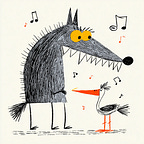

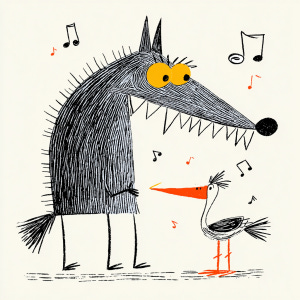
The wolf knows something the crane doesn’t.
He knows it before the bone lodges. He knows it while he’s promising riches and fame. He knows it while the crane is reaching past his teeth with practiced precision. He knows it when he stands up, recovered, and laughs. The knowledge is structural, not biographical. It isn’t that this particular wolf is cruel. It is that the wolf’s position — more powerful, less dependent the moment the crisis passes — creates a systematic relationship to promises that the crane’s position does not.
The crane knows ethics. The wolf knows power. They are operating from different rulebooks, and the crane doesn’t know there are two.
This is the concept The Bone Job Blues is designed to install in a child’s cognitive architecture before the child encounters a wolf who isn’t made of feathers and fur. Not cynicism. Not the withdrawal of good faith from every relationship. A specific, learnable, teachable distinction: the same promise carries different structural weight depending on who makes it, to whom, and under what conditions. The child who has this distinction before they need it is protected in ways the child without it is not.
The Developmental Gap This Song Is Designed to Close
Research on children’s moral reasoning identifies a consistent and consequential gap in how children extend trust across power differentials.
By age five, children have robust, neurologically grounded expectations about promise-keeping between peers. When a friend promises and doesn’t deliver, the five-year-old’s outrage is proportionate and developmentally appropriate — it reflects the accurate moral norm for symmetrical relationships, and cooperative social life depends on children having it. This expectation should be preserved. It is doing essential work.
The gap is not in the norm itself. The gap is in its scope. Children between five and eight typically apply peer-relationship trust norms universally — to adults, to institutions, to entities with significantly more power and significantly different structural incentives. They are not confused about ethics. They are applying the right framework to the wrong category of relationship. The wolf’s promise looks like a promise. The crane has no existing framework for the category of promise-that-is-actually-leverage.
Most adults, protectively, do not offer this framework early. They wait until the child has been the crane. The Lyrical Literacy position is that waiting is not protection. It is the withholding of a tool the child is already old enough to use and will certainly need before adulthood provides it the hard way.
What the Song’s Architecture Is Doing, Section by Section
The song is structured in four distinct phases, each performing a specific function in the learning sequence.
Phase one: the wolf’s desperation (stanzas 1–2). The wolf is established as genuinely helpless. He wheezed and fell on the forest floor / Clawed at his neck then looked once more. This is not decoration. It is the cognitive setup for the lesson’s core concept. For the child to understand that the promise is leverage rather than commitment, they must first understand the conditions under which it was made. Desperation. Helplessness. The temporary inversion of the power dynamic. The wolf has nothing in this moment — which is exactly and only why the promise exists. This is the fable’s most important structural fact, and the song encodes it visually and physically in the wolf’s body before the promise is ever made.
Phase two: the promise (stanza 3). I’ll pay you good I swear on my name / You’ll be rich you’ll rise to fame. The promise is extravagant, emphatic, sworn on identity. A child’s peer-relationship ethics would flag this as highly credible — oaths and named reputation are the strongest promise signals available in symmetrical social contexts. The song allows the child to receive the promise at face value here, because the learning depends on having genuinely believed it before discovering what it was. The child is positioned with the crane. Both believe the wolf’s desperation makes the promise real.
Phase three: the extraction and reversal (stanzas 4–6). Pulled that bone without a flaw. The crane performs exactly as promised, without error, without hesitation. This matters pedagogically. The lesson is not about whether the crane earned the payment. The crane unambiguously earned it. The lesson is about whether earning creates obligation when the earner has less power than the obligated. When Wolf stood up said ain’t that nice, the answer arrives. It does not. The reversal is swift and absolute. The child who has been positioned with the crane feels this in the body before they have processed it intellectually. That sequence — felt before understood — is the neurochemical prerequisite for durable memory formation.
Phase four: the incomplete sentence (stanza 7). A wolf remembers every debt except. The sentence withholds its object. This is the song’s most deliberate pedagogical decision, and it operates through one of the most robust principles in educational psychology: the generation effect. Information that learners generate themselves encodes significantly more durably than information they receive passively. A completed sentence delivers a lesson. An incomplete one requires the child to do the cognitive work of completion — and the child who finishes except in their own mind has not been told the lesson. They have derived it. That is a different kind of knowing. It is the kind that lasts.
Three Specific Learning Outcomes
Outcome one: pattern recognition for power-asymmetric promise situations.
The mirror neuron system processes emotionally invested narrative at near the same intensity as direct experience. The child who has run the crane’s scenario — promise accepted, task completed, payment denied — has rehearsed the pattern in a consequence-free environment. When an equivalent dynamic surfaces in their actual life, the pattern is already registered. Recognition comes faster. The cognitive framework is already in place: who made this promise, under what conditions, and what structural incentives do they have to honor it now that the need has passed?
This is not teaching children to distrust all promises. It is teaching them to assess the structural context of a promise before extending the same trust they would extend between peers. These are different skills. The first produces paralysis. The second produces navigation.
Outcome two: a vocabulary for a specific moral injury.
Affect labeling reduces amygdala activation and increases prefrontal engagement — the neuroscience is consistent on this point. A named experience is processable. An unnamed one is simply overwhelming.
The crane’s specific moral injury has a shape that children encounter frequently without language for it: the combination of genuine effort, good-faith trust, and the discovery that the promise was instrumental rather than obligatory. It is not ordinary disappointment. It is not simple betrayal. It occupies its own distinct emotional territory, and children who have no name for it are children who cannot process it when it arrives.
You lived bird ain’t that enough. Now flap away before things get rough. The wolf’s dismissal, set to blues phrasing, gives that injury its recognizable shape. The child who has heard this line and felt the crane’s situation has been given a framework they can reach for. The word — the pattern, the image, the felt sense of what this looks like — reduces the threat of encountering it. It does not prevent the encounter. It makes survival of the encounter more likely.
Outcome three: the kindness-assessment distinction.
The song calls the crane kind and a fool in the same breath. This juxtaposition is doing specific developmental work that must be handled with precision, because the wrong reading produces the wrong child.
The wrong reading is: kindness is foolishness, help no one, trust nothing. This is the reading that produces social isolation, the inability to cooperate, the forfeiture of the genuine goods that good-faith helping generates. It is also not what the fable teaches.
The correct reading: kindness and situational assessment are separable cognitive operations. The crane’s error is not the extraction. The crane’s error is failing to distinguish between the norms that apply to peer-relationship promises and the structural realities that apply to desperate-powerful-entity promises. The extraction is correct. The trust framework applied to the wolf’s promise is misapplied. These are two different things, and the song treats them as two different things.
So if you’re fixin to save a beast / Don’t expect a dinner feast. This is not a warning against helping. It is an instruction to calibrate expectation based on accurate situational assessment. Help the wolf if you choose. Know what you are helping. Know what the help will and will not generate. Kindness remains correct. Extending peer-relationship trust norms to asymmetric power situations does not.
Why the Generation Effect Is the Song’s Most Important Educational Decision
Return to the incomplete sentence. A wolf remembers every debt except.
In most children’s educational music, the moral is stated. Be kind. Share with others. Tell the truth. The lesson is delivered complete. The child receives it. The child may or may not remember it.
The testing effect — demonstrated across decades of educational psychology research in contexts from vocabulary acquisition to mathematical reasoning — shows that retrieval and generation consistently outperform reception for long-term encoding. What you have to work to remember, you remember. What you have to generate, you own.
The incomplete sentence is not a stylistic flourish. It is an application of this principle. The child’s brain reaches automatically for the completion — except the ones it owes, except the ones made under duress, except the ones to creatures with less power — and in reaching, performs the cognitive act that stamps the lesson into durable memory. The wolf’s structural exemptions are not a list to be memorized. They are a condition to be understood. The open sentence reflects the open, inexhaustible nature of that condition more honestly than a closed one would.
The child who finishes that sentence has not been taught the lesson. They have taught themselves. The distinction is everything.
The Blues as Pedagogical Container
This lesson required the blues. Not as aesthetic choice — as structural necessity.
The blues developed in the American South as a form for surviving and articulating the specific experience of operating at the wrong end of a structural power imbalance — of fulfilling obligations that were not reciprocated, of making good-faith contributions to relationships designed around asymmetric benefit, of learning through lived consequence what desperate promises from more powerful entities actually cost. This is not a metaphorical description of the blues tradition. It is a historical one.
A lesson about power-asymmetric promise-breaking delivered in a blues frame is not ironic or clever. It is accurate. The form was built for this content by people who had the most direct experience of the crane’s position. The child who receives this lesson through the blues receives it inside the tradition that survived by encoding it clearly.
Music encodes in the body. The blues encodes this particular lesson in the tradition that has always known it. That convergence is not incidental. It is the most important thing about the production decision.
The wolf already knew the lesson. The blues taught the crane how to survive it. Now it’s the child’s turn to learn it before they need it.
LYRICS:
That wolf was eatin like the end was near
Tore through meat with a grunt and a sneer
But a bone went wrong slid deep in his throat
He coughed and he gasped like a busted note
He wheezed and fell on the forest floor
Clawed at his neck then looked once more
Saw a crane with a neck so fine
Said come on over friend of mine
You got the tool you got the reach
Pull out this pain I’ll make a speech
I’ll pay you good I swear on my name
You’ll be rich you’ll rise to fame
Crane was kind a fool that day
Stuck his beak where wolves do play
Reached in deep past teeth and jaw
Pulled that bone without a flaw
Wolf stood up said ain’t that nice
You saved my life no need for price
Next time I’ll chew like a gentleman ought
Now get gone before you get caught
Crane stood tall said where’s my gold
Wolf just laughed eyes dark and cold
You lived bird ain’t that enough
Now flap away before things get rough
So if you’re fixin to save a beast
Don’t expect a dinner feast
Kindness counts but don’t forget
A wolf remembers every debt except
Tags: generation effect testing effect retrieval practice incomplete sentence children, power asymmetric promise structural leverage peer norms developmental gap, moral injury affect labeling unnamed experience prefrontal engagement, mirror neuron narrative simulation social pattern recognition fable, blues historical container structural knowledge Lyrical Literacy pedagogy
#MusiqueAI #HumansAndAI #AIMusic #LyricalLiteracy #SpiritSongs #GhostArtists #OpenSourceAI #MusicResearch #AIforHumans #IndieMusician
<iframe width="560" height="315" src="
" title="YouTube video player" frameborder="0" allow="accelerometer; autoplay; clipboard-write; encrypted-media; gyroscope; picture-in-picture; web-share" referrerpolicy="strict-origin-when-cross-origin" allowfullscreen></iframe>
<iframe data-testid=”embed-iframe” style=”border-radius:12px” src=”width=”100%” height=”352” frameBorder=”0” allowfullscreen=”“ allow=”autoplay; clipboard-write; encrypted-media; fullscreen; picture-in-picture” loading=”lazy”></iframe>


