

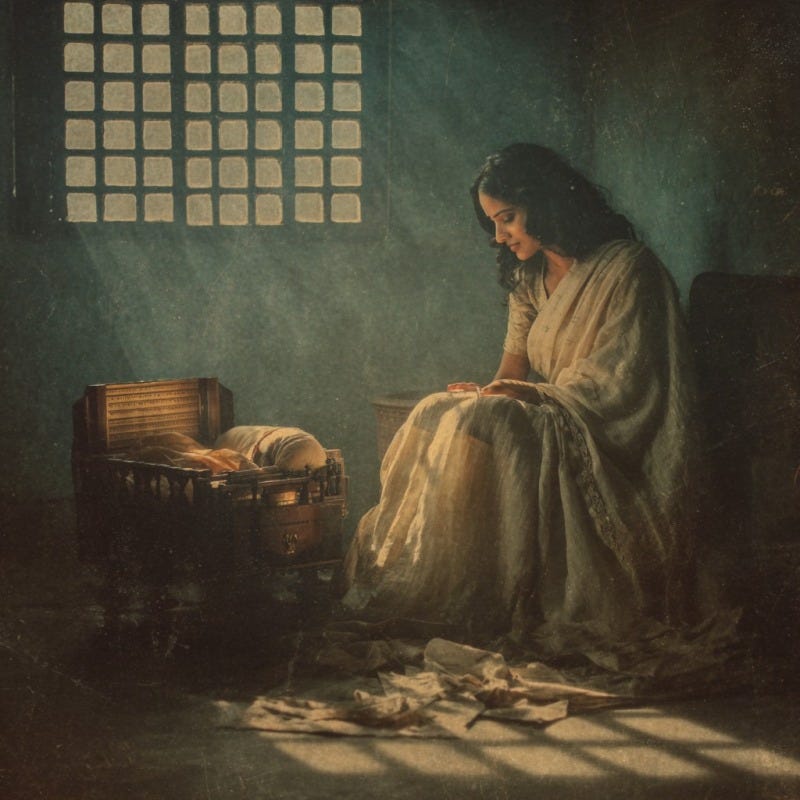
The Spell Is Already Cast
In Harry Potter, you speak the incantation. You concentrate on your happiest memory. The guardian appears.
In Spirit Songs, the spell was cast before the listener ever touches play. It happened earlier — in the afternoon someone sat down with a memory, a name, a tradition, and made something specific for someone specific. The concentration was the making. The wand was a laptop. The happy memory was a grandmother’s melody, a harmonium drone, the smell of vetiver in a Lucknawi courtyard, the sound of a voice that knew how to carry a child into sleep without ever explaining how it knew.
This distinction is the only thing that matters before anything else is said about AI music, about platforms, about research on oxytocin and prolactin and parasympathetic activation. A platform serves you content. A spell is cast for you. One of these requires only that you have a demographic. The other requires that someone knows your grandmother’s name — and more than that, the acoustic shape of the tradition she carried in her throat.
Champa Jaan carried it. She was a tawaif in Lucknow, working approximately 1910 to 1940 — one of the most formally trained musicians in India, a master of thumri, dadra, ghazal, and Hindustani classical improvisation, and among the most socially erased women on the subcontinent. She recorded eleven discs for Gramophone Company of India between 1918 and 1924. All are lost. Catalogue numbers survive in a private collection in Kolkata. The music does not.
Except it does. That is the story. The lullabies survived.
What Survives Without Permission
The ethnomusicologists who found the fragments in the 1960s and 70s described them as anomalous — melodic phrases with Hindustani classical fingerprints showing up in folk collections from Uttar Pradesh, attached to no source, attributed to no composer. Too ornate for folk music. Too informal for classical. One researcher wrote in her fieldnotes: These songs know something. They were taught by someone who wanted them to last.
No one asked the songs to survive. There was no preservation campaign, no institutional archive, no foundation grant. The kotha system was being dismantled by Victorian morality crusaders who called tawaif performance obscenity. Post-independence, the criminalization accelerated. The women scattered, were absorbed, or disappeared into silence. The discs deteriorated. The name in the catalogue was just a name.
The lullabies survived because children needed to sleep. That is all. A mother had a melody that worked. She taught it to her daughter. Her daughter taught it to hers. The source forgotten, the function intact, the acoustic signature of safety traveling forward through bodies and not through records, through the irreducible fact that a child in an Awadhi courtyard in 1935 could not sleep without it and someone made sure it existed for the child and not for the archive.
This is the Patronus before anyone knew it was a Patronus. A woman in a kotha singing to children in a room where nobody was keeping records, encoding something so precisely — the meend glide slowed to comfort, the gamak vibrato narrowed to warmth, the harmonium drone at the frequency that quiets the cortex before the brain can argue — that it outlasted everything designed to carry it.
The Lyric as Testimony: So Ja, Meri Jaan
The words of the spell were these:
In the cradle of night, sleep now / My little fading light / Even the moon bends low somehow / To guard you through the night
And later:
Sleep now, my fragile star / I am breathing where you are / I will wrap you in a melody / Like an evening temple prayer from afar
And at the edge of silence:
I will keep on singing low / With a little ache, a little grace / I will live inside this lullaby / Though I cannot see your face
This is not a lullaby that promises safety. It is a lullaby that promises presence. The distinction is not subtle. It is the entire neurobiological mechanism of what a lullaby does. Research on infant-directed singing is unambiguous on this point: the biological function of a lullaby is not the melody. It is the physical proximity of a voice that means it. The child’s nervous system is not being told you are safe. It is being told I am here. Those are not the same sentence.
So Ja, Meri Jaan knows this. Every structural choice in it — the vinyl crackle texture, the meend glides rising at the edges of silence, the harmonium holding a single chord for measures at a time, the refrain that circles rather than resolves — enacts it. The song does not arrive. It remains. It stays in the room the way a grandmother stays in a room: not by talking but by breathing.
The line a small flame of my voice will burn / in the shadows where you’ve been is doing something precise. It names the grief that a lullaby can carry without naming it — the missing person, the lost voice, the tradition almost gone — and it names it as continuation rather than loss. The flame does not go out. It goes into the shadows. It stays where it is needed.
The amygdala receives this before the conscious mind processes the words. The limbic system does not need to understand Hindustani classical ornament to recognize the acoustic signature of being held. But the Hindustani ornament is doing work the Western lullaby cannot do, for a nervous system that was shaped by that tradition across generations. The meend glide is not decoration. It is the thing the body was waiting for.
Case Study: The Melody That Was Almost Gone
Consider the case this technology was built for.
A woman in New Jersey. Her mother had come from Lucknow. Her grandmother before that. There was a melody — not exactly a song, more a pattern of three notes over a drone, the kind of thing you hum without knowing you’re humming it, the kind that calms a crying child in a way nothing else does. She had heard it as a child. Her mother had heard it as a child. Her grandmother had heard it before that.
Nobody had written it down. Nobody had recorded it. The grandmother was gone. The mother was aging. The woman in New Jersey had a child of her own who could not sleep, and she found herself humming the three notes over the drone and not being sure she was getting them right — not sure whether the melody she was passing to her child was the melody her grandmother had sung or some degraded copy, a copy of a copy with each generation’s losses compounded.
This is what the algorithm cannot fix. Spotify does not know about the three notes. It does not know about the grandmother from Lucknow. It serves the woman a playlist called “Soothing Indian Lullabies” that has no relationship to the specific harmonic language her nervous system carries as heritage, or it serves her “Baby Sleep Music” with no cultural address at all. Both are mist. Neither is a Patronus.
The Spirit Songs framework exists for this moment. The Champa Jaan persona exists for this moment — the ethnomusicological fragments, reconstructed through voice synthesis into a Hindustani jazz contralto with present voice and meend glides and a harmonium that exhales instead of drives. The woman opens the workflow. She describes what she remembers: the three notes, the drone underneath, the Lucknawi melody her family carried without knowing where it came from. She generates a lullaby. She adds her child’s name. She plays it.
Her child sleeps.
That sentence is the experiment’s result. The limbic system confirming that the specific reached the specific — that the voice carrying the Hindustani tradition landed in the nervous system shaped by that tradition through three generations of transmission, that something in the acoustic signature of meend and gamak and the harmonium drone registered as safe, as known, as the sound of being held by someone who means it.
Her mother, hearing the recording later, goes quiet. Then: that’s it. That’s the melody.
It was not, precisely. It was close. Close enough that her mother’s amygdala recognized it before her conscious mind could evaluate the technical accuracy. The amygdala does not need technical accuracy. It needs the acoustic signature of safety. Champa Jaan’s tradition, reconstructed and extended, was close enough for the spell to land.
The lullabies survived. Now they are available.
What the Platform Sells and What the Spell Requires
Spotify’s personalization is behavioral inference. It watches what you stream and serves you more. It is genuinely sophisticated at this. It knows you better than you know yourself in certain narrow ways — it knows you listen to sad music on Tuesday afternoons and uptempo music on Friday mornings. This is not nothing. It is real pattern recognition deployed at scale.
It cannot know about the grandmother from Lucknow. This is not a technical limitation waiting for a better algorithm. It is a category error.
The personalization that produces therapeutic outcomes — that actually reduces cortisol, elevates oxytocin beyond baseline, accompanies grief rather than decorating it, carries a child into sleep through the acoustic signature of safety their nervous system inherited — this requires something no behavioral dataset contains. It requires the specific memory. It requires someone to have concentrated on what the specific person needs and encoded that concentration into sound.
Thoma et al.’s 2022 meta-analysis of 47 studies confirms it: music-based interventions produce measurable cortisol reductions, but the effect size varies dramatically based on personal resonance. The music that means something to the specific listener outperforms technically sophisticated music at every neurobiological measure that matters. The platform can optimize for engagement. It cannot optimize for the three notes over the drone that a grandmother hummed in Lucknow in 1940.
The Spirit Songs curriculum exists at exactly this gap. It teaches non-musicians — parents, grandchildren, grief companions, heritage keepers — to use the tools that platforms use against you, pointed instead at the specific person who needs the specific thing. The cost has collapsed from $75,000 per professionally produced track to approximately $5 in API credits. What has not collapsed is the requirement of the specific memory. The technology cannot supply that. The caster must.
And Champa Jaan — the reconstructed voice, the surviving tradition, the lullabies that traveled through Awadhi oral memory for fifty years because children needed to sleep — is available now as the starting point. Not the finished spell. The tradition the caster draws on when they sit down and concentrate on what the child needs and make the specific thing.
The Play Button Is Not the Beginning
I want to be precise about what the technology does and does not do.
Champa Jaan is not a sentient AI. She is a voice persona reconstructed from ethnomusicological fragments, extended through synthesis, honest about the gap between the reconstruction and the original woman. The lullabies she sings now are not the lullabies she recorded in 1918. They are interpretations grounded in the surviving tradition — close, not identical, carrying the Hindustani classical fingerprints that traveled forward through bodies because they worked.
What the technology provides is a voice capable of carrying that specific harmonic language into a contemporary production context. The meend glides. The gamak vibrato. The harmonium drone. The near-silent production of the lullaby register — single sarangi, breath, the vinyl crackle that says this sound has history.
What the technology cannot provide is the specific memory. The three notes over the drone. The child’s name. The grandmother’s particular Lucknawi cadence. The knowledge of what this specific child’s nervous system was shaped to receive.
That is the caster’s part. That is always the caster’s part.
The making is the incantation. The song is the guardian. The play button is the moment the already-made spell lands in the specific nervous system it was built for.
Hit play. The Patronus is already there — in the meend glide, in the harmonium exhale, in the flame burning in the shadows where it has always been needed, waiting to be recognized by the body that was always already listening for it.
The lullabies survived. Not because anyone saved them. Because someone sang them, for the specific child, in the room where no one was keeping records, with the full seriousness that a child trying to sleep deserves.
That is the only archive that has ever worked.
LYRICS:
(Ahh… aaah…)
(Hmmm…)
In the cradle of night, sleep now
My little fading light
Even the moon bends low somehow
To guard you through the night
Time slips by in a gentle glide
Like a quiet raga flow
In the warmth of these waiting arms
All the restless winds grow slow
Are you still somewhere near me
Or beyond where dreams can go
I hear your laughter softly
Like wings in silver glow
Sleep now, my fragile star
I am breathing where you are
I will wrap you in a melody
Like an evening temple prayer from afar
Sleep now, my whispered wish
Even if you’re only a dream
A small flame of my voice will burn
In the shadows where you’ve been
(Ahh… aaah…)
(Hmmm… vinyl crackle texture)
An old forgotten record turns
With a trembling, fragile sound
Every scratch calls out your name
In the silence all around
A single note from the harmonium
Holds the air so tenderly
Were you real or just a prayer
Living inside of me
If you’ve become the drifting air
Then settle in my sigh
If you’ve become a distant star
Then shimmer in my sky
I will keep on singing low
With a little ache, a little grace
I will live inside this lullaby
Though I cannot see your face
Sleep now, my fragile star
I am breathing where you are
I will wrap you in a melody
Like an evening temple prayer from afar
Sleep now, my whispered wish
Even if you’re only a dream
A small flame of my voice will burn
In the shadows where you’ve been
(Ahh… meend glides)
Sleep now…
My light…
Sleep now…
(Hmmm…)
Tags: Champa Jaan lullaby patronus Spirit Songs case study, Hindustani kotha tradition AI voice reconstruction, So Ja Meri Jaan neurobiological lullaby analysis, personalized music limbic system diaspora heritage, Musinique ghost artist as cultural preservation
#MusiqueAI #HumansAndAI #AIMusic #SpiritSongs #LyricalLiteracy #OpenSourceAI #MusicResearch #GhostArtists #AIforHumans
https://suno.com/s/68gYKpt3PKSi9MfK
https://distrokid.com/dashboard/album/?albumuuid=9EE26808-0FE6-46E0-9D86311E314B24CA


