

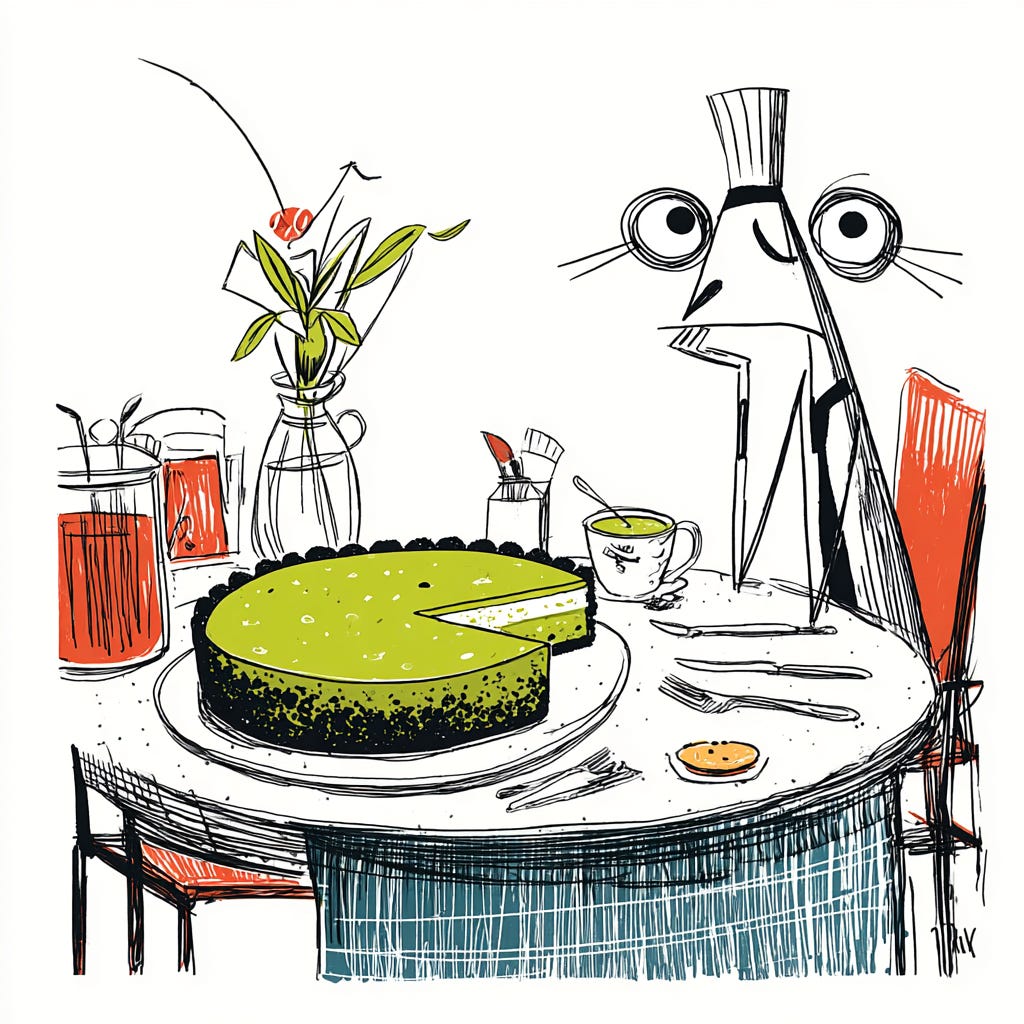
She asks at dinner, pointing at the menu.
Why is it called grasshopper pie?
The adult at the table — let’s say it’s you — gives one of three answers. You say I don’t know. You say It’s just a name, don’t worry about it. Or you say Good question and immediately change the subject, which is the most common answer and the least honest one.
What you almost certainly do not do is sit down and build her a four-minute song that validates the confusion, delivers the history, trains her phonological awareness, models cause-and-effect reasoning, and ends with the specific cognitive satisfaction of a question fully answered.
Musinique did.
The Real Lesson Is the Question Itself
Before we get to what Grasshopper Pie teaches, get clear on what the child is actually asking.
She is not asking about pie.
She is asking why names lie. Why adults build things that contradict themselves and then call that normal. Why the world contains a dessert named after an insect that contains no insect. This is not confusion. This is epistemology. This is a four-year-old doing philosophy without the vocabulary for it, noticing a gap between signifier and signified, holding the cognitive dissonance long enough to ask someone about it.
That is exactly the right thing to be doing. That is the cognitive move that leads, eventually, to media literacy, historical thinking, scientific skepticism, and the ability to read a contract. The child who notices that names can lie is developing the most important intellectual habit there is.
The question deserves a real answer. Not reassurance. Not a redirect. An answer that takes the question as seriously as it was asked.
In a world where bugs might grace a plate, here’s a dish with a twist of fate.
The song opens by taking the question seriously. Everything else follows from that.
Six Things the Song Is Teaching While the Child Thinks It’s About Dessert
1. Semantic Disambiguation: Names Are Not Things
A pie named grasshopper, green and sweet, with nary an insect inside to meet.
This is the lesson in semiotics that philosophers spend careers articulating, delivered in two lines. The name and the thing are not the same. A name is inherited, borrowed, metaphorical, historical. A thing is what you actually find on the plate. Learning to notice the gap between them is the first move of critical thinking.
The child who learns this from a pie will eventually apply it to brand names, political slogans, and the word free in a terms-of-service agreement. It starts here.
2. Cause-and-Effect Historical Reasoning
Philibert Guichet was the man with the plan, creating a drink that inspired the pie in your hand.
A man. A drink. A color. A pie. A name that crossed from one object to another across a century.
This is a three-step causal chain: origin → transformation → inheritance. The cocktail came first. The dessert came second. The name traveled with the color and the flavor. Children who follow this arc are practicing the logical structure they will later need to understand how diseases spread, how laws get made, how languages change. The song presents it as a story because stories are how the hippocampus encodes sequences. The logic arrives in narrative clothing. It stays.
3. Phonological Awareness: The Reading Prerequisite Hidden in Plain Sight
The strongest predictor of future reading ability is not letter recognition. It is not counting. It is phonological awareness — the capacity to hear, distinguish, and manipulate the sounds inside words. This capacity is built through exposure to phonemic diversity in the critical window before formal reading instruction begins.
Grasshopper Pie delivers it without announcing it.
Nary — a word most children have never heard, carrying the /n/ onset and the contracted negative. The unfamiliar word is a gift: it demands that the auditory cortex work to parse it. Crunchy — the /kr/ consonant cluster, which requires coordinated tongue placement that simpler words do not. Minty — /m/ nasal into /t/ stop, a transition the mouth must learn to make cleanly. Creamy — the /kr/ cluster again, this time with the long /e/ vowel extending behind it.
These choices are not accidental. They are the phonemic range that trains the ear to distinguish sounds at a level of precision that decoding — sounding out words — will later require. The child is not doing phonics. She is singing about pie. The auditory cortex does not know the difference.
4. Vocabulary Acquisition: Talking Across, Not Down
Philibert Guichet. Tujague’s. Crème de menthe.
These terms are not simplified. Not replaced. Not translated into easier stand-ins.
Richard Mayer’s cognitive theory of multimedia learning is specific on this point: presenting material below a learner’s capacity does not aid comprehension. It reduces engagement, limits vocabulary acquisition, and teaches the learner that she is not capable of the harder thing. A children’s song that simplifies everything it touches is not being kind to the child. It is being condescending to her.
The child who hears Philibert Guichet and cannot yet say it correctly is not failing. She is doing exactly what language acquisition requires: encountering a word at the edge of her current capacity, attempting it, hearing it again, attempting it again. Vocabulary is built at the edge, not in the middle.
Grasshopper Pie lives at the edge. That is where the learning happens.
5. Narrative Resolution and Dopaminergic Reward
So next time you hear of grasshopper pie, remember, it’s a treat for the eye. A minty slice of history’s page, a dessert that’s perfect for any age.
The song ends. The question is closed. The confusion introduced in line one — why is it called this? — has been fully resolved by the final verse. The child knows the origin. She knows the decade. She knows the man’s name. She knows why the color matches.
This matters neurologically. Narrative resolution triggers dopaminergic reward — the brain’s response to prediction confirmed, to a question answered, to a loop closed. The child feels, without knowing why, the specific satisfaction of understanding. That feeling is not incidental. It is the mechanism by which learning becomes something a child wants to repeat. The song teaches her that questions have answers and answers feel good.
That is not a small thing to teach.
6. Time Has Texture: The 1950s as Living History
In the ‘50s it rose to fame, a dessert with a cocktail’s name. Served at parties, springtime events, its color as vibrant as floral scents.
A decade. A real one. A specific period when a specific dessert became associated with specific social occasions in a specific American domestic culture. The child who absorbs this without knowing she is absorbing it is learning that the past is not a flat backdrop — it is a place where people made choices, hosted parties, set tables, and decided what colors meant spring.
This is the beginning of historical consciousness. The world was made by people. What people make can be unmade, changed, inherited, questioned. The child who understands this about grasshopper pie is, in a small but real way, practicing the thinking she will one day need for everything harder.
The Architecture of the Spell
The neurobiological structure of Grasshopper Pie is not intuition. It is design.
Validation before resolution. The song opens with the confusion, not the answer. Research on conceptual change — how children revise incorrect or incomplete beliefs — shows that the confusion must be named and honored before the correction can land. A child whose question is skipped over does not learn the answer. She learns that her questions are not worth asking. The song opens by taking the question seriously. The answer arrives after the child has been told: your confusion was reasonable. Here is why it was reasonable. Now here is what is actually true.
Spaced repetition through chorus structure. The core reassurance — No bugs to eat — appears four times. The hippocampus consolidates information through repetition distributed across time. A fact heard once is a candidate for memory. A fact heard four times, anchored to the same melody and rhythm, becomes encoded. By the fourth chorus, the child does not remember being told that grasshopper pie contains no grasshoppers. She simply knows it, the way she knows her own name.
Melody as mnemonic. Information attached to melody is retrieved more reliably than information presented as speech. This is not a folk observation — it is documented in neuroimaging studies showing that melodic encoding activates multiple memory systems simultaneously. The history of grasshopper pie, set to this melody, is more likely to be present when the child encounters grasshopper pie at Thanksgiving in three years than the same history presented as a paragraph. The song is the storage medium, not just the delivery vehicle.
The 2 Hz rhythmic foundation. Felt, not foregrounded — the pulse beneath the melody that research identifies as optimal for infant and early-childhood speech processing. Ten-month-olds with strong neural tracking of the 2 Hz rhythm develop measurably larger vocabularies at twenty-four months. The beat the child taps without knowing she is tapping is doing developmental work.
What the Platform Cannot Serve
Spotify’s children’s catalog is real. It is large. Some of it is good.
None of it answers this question.
The algorithm serves the average question because it was built to serve at scale. The average question is answerable with existing catalog. The child who asks why grasshopper pie is called grasshopper pie is not asking the average question. She is asking a specific question that required a specific person to sit down and build a specific answer in a form that a child’s nervous system could receive and encode.
This is the mechanism of Lyrical Literacy. Not the production of more content. The production of the specific spell for the specific question.
The cost collapse that made this possible — from $75,000 per professionally produced educational track to approximately $5 in API credits — is the mechanism, not the mission. The mission is the child. The economics make the mission possible at the scale where every question gets a song, not just the average question.
The platform did not know about Philibert Guichet. It did not know the child at the dinner table. It did not know the question was serious.
Musinique knew. Someone sat down and built the answer.
What Happens After the Song
The child who has heard Grasshopper Pie four times will, at some point, encounter grasshopper pie again. At a party. At a restaurant. On a dessert menu.
She will know things. She will know it contains no grasshoppers. She will know it comes from a cocktail. She will know a man named Philibert Guichet made the drink in New Orleans. She will know it rose to popularity in the 1950s. She will know the name traveled from the cocktail to the pie because the color matched.
She will know these things and she will not know how she knows them.
But she will also know something harder to name. She will know that the world contains objects with histories and names with origins and apparent contradictions that resolve when you know enough. She will know this in the body, before she knows it as a concept, because she learned it from a song about pie.
The child who learns that names can lie has taken the first step toward media literacy. The child who learns that ordinary objects have histories has taken the first step toward historical thinking. The child who holds a confusion long enough to receive its resolution has practiced the tolerance for cognitive complexity that is the foundation of all advanced learning.
These are not the outcomes of a song about dessert.
These are the outcomes of a spell, cast by someone who understood that the question at the dinner table was serious, and built the most delightful possible answer.
Grasshopper pie, oh, leap so high.
She already knows. She just doesn’t know she knows yet.
LYRICS:
In a world where bugs might grace a plate,
Here’s a dish with a twist of fate.
A pie named grasshopper, green and sweet,
With nary an insect inside to meet.
Grasshopper pie, oh, leap so high,
No bugs to eat, so give it a try.
With mint and chocolate, a creamy delight,
It’s a dessert that will lift your spirits to flight.
Don’t be fooled by its buggy name,
For this pie is far from the insect game.
It’s got a crust that’s crunchy and neat,
And a filling that’s a minty treat.
Originating from a cocktail so grand,
In New Orleans, it took a stand.
Philibert Guichet was the man with the plan,
Creating a drink that inspired the pie in your hand.
Grasshopper pie, oh, leap so high,
No bugs to eat, so give it a try.
With mint and chocolate, a creamy delight,
It’s a dessert that will lift your spirits to flight.
In the ‘50s it rose to fame,
A dessert with a cocktail’s name.
Served at parties, springtime events,
Its color as vibrant as floral scents.
Grasshopper pie, oh, leap so high,
No bugs to eat, so give it a try.
With mint and chocolate, a creamy delight,
It’s a dessert that will lift your spirits to flight.
So next time you hear of grasshopper pie,
Remember, it’s a treat for the eye.
A minty slice of history’s page,
A dessert that’s perfect for any age.
Grasshopper pie, oh, leap so high,
No bugs to eat, so give it a try.
With mint and chocolate, a creamy delight,
It’s a dessert that will lift your spirits to flight.
#LyricalLiteracy #GrasshopperPie #FoodHistory #MusicalStorytelling #MintChocolate #ChildrensEducation #CulinaryTales #DessertHistory #NewOrleansCuisine #NoRealBugs
<iframe width="560" height="315" src="
" title="YouTube video player" frameborder="0" allow="accelerometer; autoplay; clipboard-write; encrypted-media; gyroscope; picture-in-picture; web-share" referrerpolicy="strict-origin-when-cross-origin" allowfullscreen></iframe>
<iframe data-testid=”embed-iframe” style=”border-radius:12px” src=”width=”100%” height=”352” frameBorder=”0” allowfullscreen=”“ allow=”autoplay; clipboard-write; encrypted-media; fullscreen; picture-in-picture” loading=”lazy”></iframe>


