
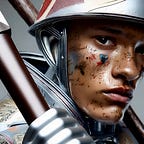


The Tin Man’s Heart
The Character Who Teaches Critical Thinking by Being Wrong About Himself
The Argument No One Corrected
The Tin Woodman spent the entire novel with a coherent, internally consistent argument about himself: he was made of tin, tin things cannot feel, therefore he had no heart and could not love. The logic was clean. No one challenged the premises. The wizard gave him a clock.
The clock worked — not because sawdust produces emotional capacity, but because the Tin Woodman had been waiting for permission to acknowledge what the evidence had been showing all along. He wept when he stepped on beetles. He worried about hurting insects. He cried at the thought of Dorothy leaving. He was more consistently emotionally responsive than any other character in the novel.
The argument was wrong. The first premise — tin things cannot feel — was false. And because no one challenged it, the most feeling character in the story spent the entire journey convinced he had no feelings.
This is not a lesson about self-discovery. It is a lesson about the relationship between deductive arguments and empirical evidence — and what happens when a coherent argument overrides observable data. The Tin Woodman’s story is a critical thinking problem that happens to be a fairy tale, and the poem teaches children to read it as both.
Argument vs. Evidence: The Core Logical Structure
They said I lacked a human heart / but pain still bloomed in every part.
The but is the pivot. This couplet has a specific logical structure: external theoretical claim (they said I lacked) followed by first-person empirical observation (pain still bloomed). These are in direct tension. The claim has deductive backing. The observation is experiential data.
In formal logical terms, the argument against the Tin Woodman runs: if tin, then no feeling; he is tin; therefore no feeling. This is valid — the conclusion follows from the premises. But validity is not the same as truth. A valid argument can have false premises and reach a false conclusion. The first premise (if tin, then no feeling) was false, and the pain that bloomed was the evidence that it was false.
The foundational intellectual move the poem teaches: when a valid argument produces a conclusion that contradicts observable evidence, one of the premises needs revision. Not the conclusion — the premise. The pain did not go away because the argument said it shouldn’t be there. The argument needed to be revised to account for the pain.
For every tear I could not shed / still shimmered in the words I said. The evidence found another form when its standard form was unavailable. The feeling that couldn’t be tears became words. Both are evidence of the same thing: the heart that was supposedly absent kept producing output in every available channel.
For a child learning to evaluate arguments, this is the most accessible demonstration available: when your observation contradicts the theory, trust your observation, and ask which premise in the theory is wrong.
Three Metaphors for the Same Blocked Channel
Each drop of rain, a threat to me / each joint a lock, no fluid free / I’d freeze mid-thought, mid-reach, mid-cry.
The poem gives the Tin Woodman’s predicament in three distinct physical metaphors, and each one describes a different mechanism of the same experience: feeling that is present and expression that is prevented.
Rain as threat via consequence. Rain does not hurt the Tin Woodman directly. It causes rusting, which causes joint-locking, which prevents action. The threat is not the thing itself but its downstream effect. The external stimulus is ordinary and would be harmless to anyone else; for him, the consequence makes it dangerous. This is the metaphor for the experience of a normal social expectation (cry here, this is when people cry) that is threatening not because of what it is but because of what it demands from someone who cannot comply.
The joint as lock. The locking happens mid-thought, mid-reach, mid-cry — not before the action begins but in its middle. The motion started. The motion could not complete. The joint failed at the hinge point, the exact place where movement becomes possible. This is the experience of emotional expression that is initiated and cannot finish: the reach toward connection that stops before arrival, the cry that catches mid-breath, the thought that starts and stalls. The locking is not the absence of the impulse. The impulse was present. The mechanism failed.
No fluid free. Tears, voice, breath, movement — emotional expression in the body is fluid. The Tin Woodman’s condition is a body in which the fluid is trapped. All the channels are there. None of them are open. The feeling exists in a body that cannot pass it through.
All three metaphors converge on the same analytical point: the blocked expression is not evidence that the feeling is absent. It is evidence that the channel is blocked. The distinction matters for reading characters in literature and for understanding people in life: the one who cannot cry is not necessarily the one who does not feel.
What “Dared” Teaches About Intellectual Courage
They wound my key, they heard my plea / they dared to say there’s hope for me.
The word dared carries a weight that chose or decided would not. Daring implies resistance overcome — something that required going against what the simpler or safer position would have been.
The safer position was available and philosophically defensible: the argument against the Tin Woodman was coherent. Tin things do not feel. He is tin. The hope he is expressing is therefore not grounded in an actual capacity. The easier response was to gently explain this.
The companions did not take the easier response. They heard my plea — they treated his self-report as testimony rather than as a claim to be evaluated against the theoretical framework. They dared to say there’s hope — in the presence of the argument that made hope seem unwarranted.
This is a specific intellectual virtue: the willingness to take someone’s account of their own experience seriously when a theoretical argument suggests the experience shouldn’t exist. It is daring because the theoretical argument is not obviously wrong. The framework that says tin things cannot feel is coherent. Overriding it requires trusting the empirical report over the deductive conclusion, which requires intellectual courage as well as compassion.
For a child learning to be a good listener and a good thinker, the poem names this as daring rather than natural or automatic. Being heard in the way that matters — having your self-report taken seriously against competing theoretical frameworks — is something that requires something from the listener.
The Though Clause as the Grammar of Unresolved Truth
And though I’m made of bolts and steel / I learned: to hope is to feel.
The Tin Woodman’s and the Lion’s poems both use though clauses at their climactic moments. This is not coincidence. It is the grammatical choice that the specific kind of truth both poems are telling requires.
Though holds two simultaneously true statements without resolving them into a single one. Though I’m made of bolts and steel — true, still true, has not changed. I learned: to hope is to feel — also true. The metal did not become un-metal when the feeling was acknowledged. The feeling did not become invalid because the metal remained. Both are real. Neither cancels the other.
The false resolution would satisfy the expectation that paradoxes get resolved: I discovered I have a real heart after all — the metal is just on the outside. This sounds like closure. It is a sidestep. The Tin Woodman is made of metal, and that is a genuine condition, and the feeling exists within that condition rather than despite the misidentification of it.
The though clause refuses the sidestep. It is the grammatical form for situations where the honest account requires holding two things at once: this constraint is real, and this capacity is also real, and neither one resolves the other.
Children who learn to write though clauses are acquiring the capacity for this kind of intellectual honesty in writing — the refusal to resolve everything into a single clean conclusion, the acknowledgment that some truths coexist without canceling each other.
“To Hope Is to Feel”: A Definition That Expands Eligibility
I learned: to hope is to feel.
This is a definition — specific in its logical form and specific in what it changes for the reader.
The conventional definition of feeling requires conventional evidence: tears, visible affect, physiological response, behavioral indicators recognizable as emotional expression. The Tin Woodman cannot produce most of these. Under the conventional definition, the argument against him has some purchase.
The definition to hope is to feel expands the eligibility criteria. Hoping requires: directing oneself toward a future that is not yet, caring whether that future comes about, being oriented toward an outcome that matters. These are available to the Tin Woodman. They were available throughout the journey. He hoped for Dorothy’s safety. He hoped for his own heart. He hoped the companions would survive. The hoping was present continuously.
The logical form is important: not to feel is to hope (which would make hope a subset of feeling, which is narrower) but to hope is to feel (which makes hoping a sufficient condition for feeling, regardless of what other forms feeling takes). The direction of the biconditional matters. This direction says: if you are hoping, you are feeling. Full stop.
For any child whose emotional expression does not take the expected forms — who is present and invested without being visibly moved, who cares deeply without the conventional signals — this definition is the one that includes them. You are hoping. Therefore you are feeling. The form of the evidence does not determine the validity of the experience.
Identity as Three Dimensions, Not One Label
Not just “Tin Man” — but something whole / a beating truth, a living soul.
The poem rejects the category name as an adequate description of identity and offers three alternative framings instead. Each one describes identity along a different dimension.
Something whole addresses integration: the parts that cohere into a continuous self rather than being separately replaceable. Nick Chopper’s transformation was piecemeal — limb by limb, until the whole body had been replaced. Wholeness is the integration that the piecemeal process destroyed. It is not a property of any material but of the relationship between parts.
A beating truth addresses vitality: the truth that is not a static proposition but an ongoing process, something that continues to happen, that can be interrupted but continues when the interruption ends. Beating is a verb masquerading as an adjective here — the truth is not just true but actively occurring. This distinguishes identity from mere description: a description can be accurate and static; identity continues to beat.
A living soul addresses irreducibility: the quality of mattering in a way that cannot be deduced from the materials. A tin body is fully described by its composition. A living soul is not — it has properties that emerge from the composition without being contained in it.
The three dimensions together constitute a working concept of identity: it is integrated, ongoing, and not reducible to its material substrate. The label Tin Man captures only the substrate. Identity requires all three dimensions to be described.
LYRICS:
I once was flesh with hands so sure
A woodsman strong, with love so pure
But curse and axe and rusted fate
Turned me to tin, to mourn and wait
Each drop of rain, a threat to me
Each joint a lock, no fluid free
I’d freeze mid-thought, mid-reach, mid-cry
And wonder if machines can sigh
They said I lacked a human heart
But pain still bloomed in every part
Not blood, but longing filled my core
For love I lost, and felt no more
Then came a girl with storm-lit eyes
And strangers bearing dreams and ties
They wound my key, they heard my plea
They dared to say there’s hope for me
Through haunted woods and witch’s flame
I clanked along in search of name
Not just “Tin Man”—but something whole
A beating truth, a living soul
At Oz I knelt, not for a crown
But for a heart to write love down
And what I found, or what was shown
Was that I’d never be alone
For every tear I could not shed
Still shimmered in the words I said
And though I’m made of bolts and steel
I learned: to hope is to feel
#WizardOfOz #TinMan #LiteraryAdaptation #ClassicFairytale #ChildrensLiterature #LyricalLiteracy #HeartAndIdentity #MusicEducation
<iframe width="560" height="315" src="
" title="YouTube video player" frameborder="0" allow="accelerometer; autoplay; clipboard-write; encrypted-media; gyroscope; picture-in-picture; web-share" referrerpolicy="strict-origin-when-cross-origin" allowfullscreen></iframe>
<iframe data-testid=”embed-iframe” style=”border-radius:12px” src=”width=”100%” height=”352” frameBorder=”0” allowfullscreen=”“ allow=”autoplay; clipboard-write; encrypted-media; fullscreen; picture-in-picture” loading=”lazy”></iframe>


