

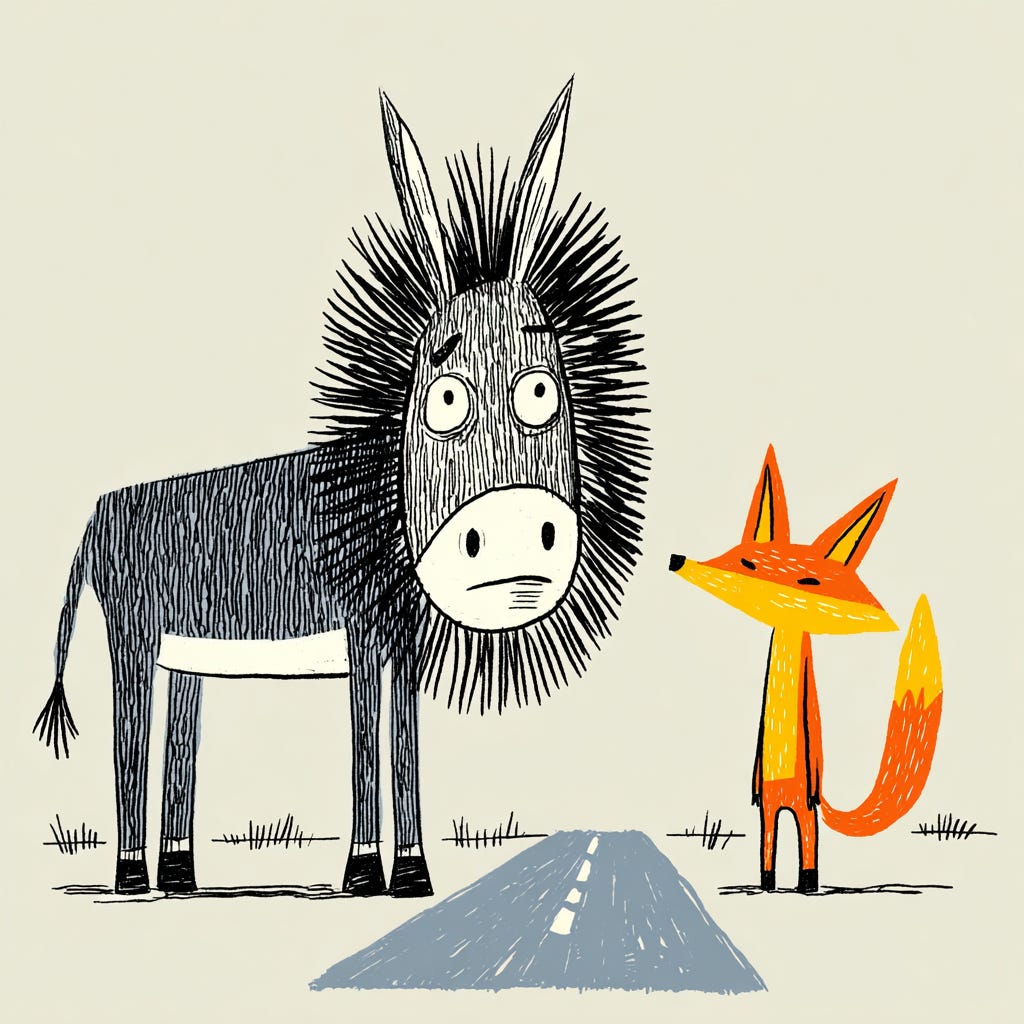
The lion’s skin fits perfectly until the donkey opens his mouth.
That is the entire lesson. Everything before it is setup. Everything after it is consequence. The setup runs three stanzas — discovery, disguise, scattered mice, the temporary intoxication of borrowed power. The consequence takes two lines. Oh look at me I’m king today / And then he tried to roar but brayed. The reversal is that fast. The lesson lands that hard.
This is not accidental. It is architecture. Aesop built the fable this way in 550 BCE because he understood, empirically if not neurobiologically, that a lesson must be felt before it can be learned — that the brain which has been made to share the donkey’s triumph is a brain that will remember what ended it. The Lyrical Literacy version of this fable works for the same reason, deployed in the form most durable to the developing brain: narrative, blues rhythm, high-affect collapse, and a fox who waits where the mice ran.
What follows is an accounting of what the song is actually doing, mechanism by mechanism, from the first line to the final stanza.
Why Children Are Ready for This Earlier Than Adults Think
The standard assumption is that abstract concepts like authenticity, pretense, and social performance are too sophisticated for young children. The developmental research disagrees.
By age four, children are already engaged in what researchers call theory of mind development — the growing capacity to understand that other people have mental states, beliefs, and intentions different from their own. By five, most children can distinguish between what someone knows and what someone is pretending to know. By six, the social comparison processes are well established: children are evaluating themselves against peers, flagging behavioral inconsistencies, and forming early versions of the authentic self concept.
They are doing all of this without vocabulary for it. They are observing the gap between costume and character in the adults and peers around them and carrying that observation as unprocessed experience — felt but unnamed, recognized but without framework.
The developmental gap is not conceptual readiness. It is language. Children are already living the situation the fable describes. What they are missing is a way to name what they are seeing, a model for how to respond to it, and permission to trust the knowledge they already have.
The Donkey in the Lion’s Skin is designed to provide all three.
The Architecture of a Three-Minute Identity Lesson
The setup is the longest part of the lesson, not the preamble to it.
This is the most commonly misunderstood structural decision in educational storytelling. The donkey’s triumph — three full stanzas of it, the coat slipping on like a rockstar’s coat, the critters scattering like thunder in a midnight train, the strut and growl of a beast on stage — is not filler before the real content. It is the real content’s neurological precondition.
The hippocampus consolidates memory most durably when the amygdala has already processed emotional investment. To encode the lesson that borrowed power cannot sustain itself, the brain first needs to feel what borrowed power feels like. The child listening to those three stanzas is not waiting for the lesson. They are being prepared for it at the level of neurochemistry — building the emotional context that will make the bray’s arrival a felt truth rather than a stated one.
Every additional line of the donkey’s triumph is additional dopaminergic setup. The reward system is being primed. When it collapses, the collapse stamps.
The bray is not a punchline. It is a pedagogical mechanism.
And then he tried to roar but brayed. The compression — the entire arc reversed in eight words after three stanzas of buildup — is a specific production choice. Tension builds. Tension releases. Dopamine fires at the resolution. The lesson encodes.
The child who laughed at that line, who felt the bottom drop out, who experienced the specific combination of humor and recognition that the bray produces — that child has just had the lesson written into procedural memory. Not stored as a fact to be retrieved. Stored as something that happened to them. These are the memories that last.
The fox enters at the exact right moment.
The donkey is standing still, feelin kinda thin, the coat too big to be bold within. This is the song’s most vulnerable moment — after the exposure, before the explanation. The fox arrives here rather than before because timing is instructional. A fox who explained the problem before the bray would be delivering a warning. A fox who arrives after it is delivering a diagnosis. The child who has already felt the bray is ready to hear what the bray meant. The lesson is offered into a brain that has already made room for it.
You can fake the fur but you can’t fake pride. This line is the fable’s most important educational gift: the positive definition of what the donkey was missing. Not “don’t lie.” Not “lying fails.” Something more precise and more useful — the bone-deep knowledge of what you actually are, which cannot be borrowed and which the voice will always eventually reveal. The child receives the concept and the vocabulary for it simultaneously.
Four Specific Skills This Song Is Building
Social cognition: detecting performed versus authentic behavior.
The mirror neuron system activates during narrative observation at nearly the same level as during live social interaction when emotional investment is high. When a child follows the donkey’s story, their social cognition circuits are rehearsing. They are practicing the detection of performed identity in a consequence-free environment — the low-stakes setting where skill development is most efficient.
The child who has processed this scenario in story form has a cognitive advantage when the equivalent scenario arrives in real life. They have pattern-matched before. The fox’s recognition — nice disguise but I know your tune — gives them the script for what that recognition looks like when it is handled with skill rather than panic.
Emotional regulation: the fox as the model, the mice as the contrast.
Social-emotional learning research is consistent: children develop regulatory capacity most effectively through observing skilled models, not through instruction about what regulation should look like. The song provides both poles of the contrast simultaneously. The mice have the automatic, unconsidered response — they see the skin and scatter. The fox has the regulated response — he sees the skin and waits, listens, and names.
The child doesn’t need to be told which response is more effective. They feel the difference in three stanzas. The fox gets the last word. The mice just ran.
Reading infrastructure: phonological awareness through consonant architecture.
Phonological awareness — the capacity to hear, identify, and manipulate the sound structures of language — is the strongest single predictor of reading ability in the developmental literature. It develops through exposure to varied consonant patterns, particularly clusters and blends. The consonant density in this lyric is not decorative: dusty, strutted, scattered, critters, flinch, grudge, slipped, snagged, dragged, scrawny. Every child who learns this song is simultaneously building the auditory processing architecture that decoding written language requires — not as a separate lesson, but as an inseparable property of the music itself.
Self-concept formation: aspirational anchors over prohibitive warnings.
The self-determination theory literature identifies a consistent principle in healthy identity development: aspirational frameworks outperform prohibitive ones. “Don’t lie” is a prohibition. It tells the child what to avoid. Shine don’t matter when your soul ain’t bold is an anchor. It tells the child what to move toward. The distinction matters neurologically and developmentally — aspirational identity anchors activate approach motivation, which is associated with exploration, growth, and positive self-concept formation. Prohibitive warnings activate avoidance motivation, which is associated with anxiety and self-monitoring rather than self-development.
The final stanza is built almost entirely from anchors. Truth sounds clear. Soul as bold. The child who internalizes these has been given a positive orientation toward authentic identity — not just a warning against its alternatives.
What the Fox Is Teaching That the Story Isn’t
The donkey is the story. The fox is the curriculum.
This distinction matters for understanding what kind of learning the song is designed to produce. The donkey’s arc teaches through emotional experience — the child feels the lesson because they feel the bray. But the fox teaches through modeling — the child sees a skill demonstrated by a character they would want to become.
The specific skill being modeled is this: the suspension of automatic response in favor of deliberate observation. The mice have reflexes. The fox has discernment. The mice react to the visual signal. The fox listens past it for the voice underneath. This is not an innate capacity. It is a developed one — and like all developed capacities, it is built through practice and through the observation of others who have it.
Every time a child hears just leaned back cool with a bluesman’s grudge and feels what the fox’s composure is like, they are practicing it. Not in the abstract. In the body, in the rhythm, in the blues phrasing that makes composure feel achievable rather than remote.
This is what the Lyrical Literacy catalog is designed to do. Not to instruct children in abstract principles. To give those principles rhythm, character, and emotional weight — to make the fox’s skill something the child has already embodied before the situation that requires it arrives.
Aesop wrote the blueprint. The blues gives it a body. The bray comes out. It always does.
LYRICS:
Well that donkey was dusty feelin low
Saw a lion’s coat in the sunlit glow
Hung out to dry by some huntin men
He said if I wear that I’ll never crawl again
He slipped it on like a rockstars coat
Though it dragged and snagged at his scrawny throat
But baby when the critters saw that mane
They scattered like thunder in a midnight train
He strutted and growled like a beast on stage
While the mice ran off in a panicked rage
Oh look at me I’m king today
And then he tried to roar but brayed
Then came the fox with a smooth slow stride
Eyes like secrets he never could hide
He didn’t flinch didn’t run didn’t budge
Just leaned back cool with a bluesmans grudge
Said nice disguise but I know your tune
That voice don’t howl it howls outta tune
You got the fuzz but not the flame
A lion’s just a donkey with a better name
Donkey stood still feelin kinda thin
The coat too big to be bold within
The fox just laughed tipped his head back wide
You can fake the fur but you can’t fake pride
So don’t go struttin in someone else’s roar
You’ll trip on lies you can’t ignore
Cause truth sounds clear and fools wear gold
But shine don’t matter when your soul ain’t bold
Tags: theory of mind development age four five authentic self, approach motivation aspirational identity anchors self-determination, procedural memory emotional investment dopamine narrative arc, social cognition mirror neuron low-stakes rehearsal children, phonological awareness consonant blends reading predictor blues
#MusiqueAI #HumansAndAI #AIMusic #LyricalLiteracy #SpiritSongs #GhostArtists #OpenSourceAI #MusicResearch #AIforHumans #IndieMusician
<iframe width="560" height="315" src="
" title="YouTube video player" frameborder="0" allow="accelerometer; autoplay; clipboard-write; encrypted-media; gyroscope; picture-in-picture; web-share" referrerpolicy="strict-origin-when-cross-origin" allowfullscreen></iframe>
<iframe data-testid=”embed-iframe” style=”border-radius:12px” src=”width=”100%” height=”352” frameBorder=”0” allowfullscreen=”“ allow=”autoplay; clipboard-write; encrypted-media; fullscreen; picture-in-picture” loading=”lazy”></iframe>


