

Six wishes. Ten stanzas. Four chorus repetitions. One pigsty.
The Fisherman and His Wife, performed by Nik Bear Brown and produced through Humanitarians AI’s Lyrical Literacy project, is the most structurally layered production in the catalog. It is teaching six distinct things simultaneously, stanza by stanza, across a single listening experience. Most children who hear it will not know they are learning any of them. Their auditory cortex, their hippocampus, their theory of mind circuitry, and their motor cortex will be building capacity anyway.
What follows maps the song wish by wish — tracking what the child’s developing mind is building at each stage of the escalation, through which neurobiological mechanisms, toward which long-term cognitive outcomes.
Before the First Wish: What the Setup Encodes
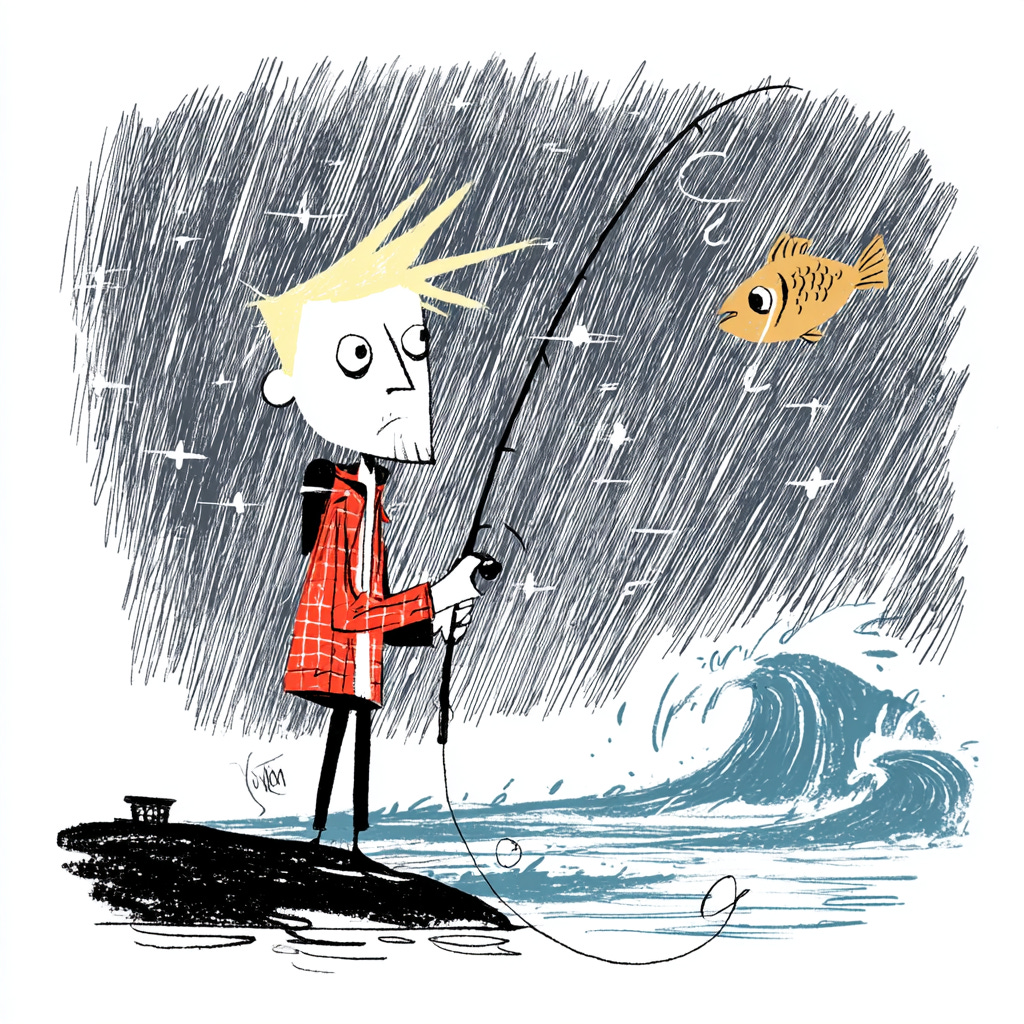
He once was a man by the wide blue sea / Who lived in a pigsty, sad as could be / He fished all day with his toes in the sand / Till a talking fish flopped into his hand.
The opening stanza establishes the production’s iambic couplet meter in the first two lines: “He ONCE was a MAN by the WIDE blue SEA / Who LIVED in a PIGS-ty, SAD as could BE.” The stressed beats arrive at approximately two per second — the 2 Hz delta-band oscillation frequency that a 2014 magnetoencephalography study found predicts vocabulary size at 24 months. The developing auditory cortex locks onto this pulse and uses it as a scaffold for speech segmentation: parsing the continuous speech stream into syllable-sized units that phonological processing requires. The scaffold is in place before the story has made its first move.
The phonemic inventory begins immediately. The /fl/ onset cluster in “flopped” — fricative into liquid — requires a distinct amplitude rise time from single-consonant onsets. The /tr/ in “toes” (the implied cluster of the toes-in-the-sand image reinforced by the /t/ onset pattern throughout), the /f/ in “fished,” the /t/ in “talking” — the auditory cortex is processing consonant boundaries from the first line, building the phoneme discrimination capacity that fifty years of reading research identifies as the strongest predictor of literacy.
The stanza also establishes the theory of mind frame that will carry the entire song: the fisherman is sad, the fish appears, something is about to change. The child who registers the fisherman’s emotional state — sad as could be, a man whose life is insufficient — has begun modeling a character’s internal condition. This is the foundation of narrative comprehension.
The First Wish: What Satisfaction Looks Like Before It Shifts
Home ran the man to his wife Ilsabill / Who said a cottage would suit us still / So back to the waves the fisherman sped / And the fish made a cottage with garden and bed.
The cottage wish is the clearest moment in the song, and it is the moment that makes everything that follows pedagogically possible. The cottage is granted. The wish is met. Ilsabill said a cottage would suit them — and it does, for exactly one stanza.
But a cottage grew small in Ilsabill’s dreams.
This is the reference point shift stated in eight words. The cottage did not change. Ilsabill’s reference point changed. The acquisition that was the object of desire has become the baseline from which the next desire is measured. This is the hedonic adaptation mechanism that Brickman and Campbell named in 1971: the documented tendency of the human reward system to normalize new levels of acquisition, making the new level feel insufficient relative to what is above it rather than sufficient relative to what was below it.
The child has almost certainly experienced this mechanism already — every child has received something, felt satisfied briefly, and then wanted something else. What the story provides is the external perspective: the child watching Ilsabill’s reference point shift is watching their own cognitive mechanism from the outside, at the scale of a fairy tale, before it has operated at the scale of their own life. Pattern recognition trained at narrative scale is available at behavioral scale. This is why stories like this have survived for two centuries and why Aesop’s fables survived for twenty-six.
The onset clusters in these stanzas expand the phonemic inventory: /sp/ in “sped,” /gr/ in “garden,” /str/ in “streams” (arriving in the next stanza), /dr/ in “dreams.” The rhyme pairs — Ilsabill/still, sped/bed, dreams/streams — create the anticipatory processing that active listening produces, building hippocampal encoding of the escalation sequence through the mnemonic structure of the rhyme.
The Chorus: Dual Encoding, Four Times
Oh a wish a wish what would you say / A fish who grants when you call his way / One wish granted and then one more / But greedy hearts keep asking for more.
The chorus does two things simultaneously that no prose version of this story can do: it states the mechanism propositionally and it enacts the mechanism structurally, in the same four lines, four times across the song.
“Greedy hearts keep asking for more” is a propositional claim — a statement about how desire operates, independent of the specific story. This is declarative knowledge: knowing that the pattern exists. The narrative stanzas provide procedural knowledge: knowing the specific sequence through which the pattern operates — desire, satisfaction, reference point shift, new desire, escalation. Educational psychology distinguishes these two knowledge types because they are encoded through different pathways and retrieved in different contexts. The child who has only declarative knowledge can recognize the pattern when someone names it. The child who has procedural knowledge can recognize the pattern when it is operating without a name. The child who has both — chorus plus narrative — is equipped for the widest range of recognition contexts.
The chorus also performs the treadmill structurally. It says the same thing every time. The story around it keeps escalating. This is the phenomenology of the hedonic treadmill from the inside: the justification for wanting repeats while the wanting expands without limit. The child who has encountered the chorus four times has felt, structurally, the disconnect between the stated sufficiency (one wish, one more) and the actual operation (no number is ever enough).
By the fourth chorus, the child who has been listening anticipates it before it arrives — they are generating the content from memory rather than receiving it from the song. This is the deepest mnemonic operation: the story’s structure has been internalized enough to project forward. The child is no longer listening. They are remembering and confirming.
The Escalation Stanzas: Theory of Mind Under Load
Soon Ilsabill cried I must be a king / And the fish though tired still granted the thing / She ruled with a crown and a scepter high / But already she stared with a hungrier eye.
Then came the cry for the emperor’s seat / And then for the pope with the world at her feet / Each wish twisted the sky and shore / And the fisherman feared what would come next door.
These two stanzas are where the song’s theory of mind demands become most complex. Three characters. Three distinct knowledge states. All active simultaneously.
The fish is tired. He grants the wish anyway, but the weariness is present — “the fish though tired.” The child who registers this detail is tracking a knowledge state that the human characters do not have access to: the fish’s awareness that the process is approaching a limit. This is the foundational theory of mind operation — recognizing that another being knows something the characters in the scene do not know.
The fisherman feared what would come next door. He is not ignorant. He sees the escalation. He returns to the fish anyway. This is the most cognitively demanding character to track: a person who acts against their own knowledge because the constraints of their situation leave no other option. Modeling the fisherman requires the child to hold three distinct mental states simultaneously — his belief that this is wrong, his fear of the consequences, and the constraint that overrides both. This is the complexity of mental state attribution that literary comprehension of mature fiction requires. The Fisherman and His Wife is training it through an emotionally engaging fairy tale.
Ilsabill stared with a hungrier eye. She is not unaware. She is in the grip of the reference point mechanism. The crown is on her head. The reference point has moved to the emperor’s seat. The child who models Ilsabill not as a villain but as a person in whom a cognitive mechanism is operating has achieved the empathic modeling that the neuroscience of reading identifies as one of the core capacities that fiction builds. They have understood a character’s behavior as the product of a process rather than the expression of a character flaw.
The phonemic inventory across these stanzas continues expanding: /cr/ in “cried,” /sc/ in “scepter,” /st/ in “stood” and “stared,” /tw/ in “twisted,” /sh/ in “shore” — distinct onset cluster types building phoneme class discrimination alongside the story’s emotional escalation.
The Final Wish: The Incomplete Sentence as Pedagogical Device
At last Ilsabill wild with delight / Cried tell him I’ll rule the sun and the—
The final wish is unfinished. The sentence breaks before the wish completes. This is one of the most sophisticated formal decisions in the Lyrical Literacy catalog, and it is doing something that the completed sentence could not do.
The child listening to this line completes it. Silently, automatically, from the escalation pattern they have been tracking: she wants to rule the sun and the night. The completion arrives from the child’s own memory of the escalation sequence — cottage, castle, crown, emperor, pope, and the logical extension: everything. The child is not receiving the wish. They are generating it from pattern.
This is predictive processing at its fullest development: the child has internalized the escalation structure so completely that they can project its next element before it is stated. Predictive processing is the brain’s fundamental mechanism for language comprehension — we do not wait for each word to arrive before processing meaning; we constantly generate predictions and update them as input arrives. The broken sentence trains this capacity deliberately. It requires the child to generate the prediction, and the generation is itself the encoding event that makes the pattern most durable.
The /wh/ in “whispered,” the /st/ in “stood,” the /str/ in “storming,” the /pl/ in “plea” — the phonemic inventory continues through the resolution stanzas, maintaining the auditory cortex’s processing workload through the narrative’s most emotionally charged moment.
The Pigsty Ending: Why Complete Return Is the Mechanistically Correct Outcome
The fish looked up from the churning shore / And said no more no more no more / And back to the pigsty they tumbled down / No castle no crown no emperor’s gown.
The ending returns them to the pigsty. Not to the cottage. Not to a middle position between what they had and what they abused. To the pigsty.
The dominant tradition of children’s storytelling would return them to the cottage. Proportional justice: she overreached, she loses the excess, she retains the reasonable baseline improvement. The lesson: overreaching is penalized, reasonable desire is permitted.
The Grimm ending, preserved without softening in the Lyrical Literacy adaptation, teaches something mechanistically more accurate. The reference point, having been elevated through six successive wishes, cannot be partially lowered. Any intermediate resting point — the cottage, the castle — would immediately generate the desire for what was above it, because the mechanism that drove the escalation upward does not reverse direction just because external circumstances change. The mechanism is the reference point shift. The reference point shift is not calibrated to moral desert. Complete return is the logical consequence of the mechanism having operated without limit.
The child who understands this ending as mechanism rather than punishment has learned something transferable. The pigsty is not what Ilsabill deserves. The pigsty is where the mechanism, having completed its cycle, deposits them. This distinction — between what someone deserves and what a mechanism produces — is among the most important cognitive tools the story delivers. It is the tool that allows a person to recognize when a bad outcome is the consequence of a structural process rather than the punishment for a moral failure. These require different responses. Knowing which is operating is the beginning of accurate situational assessment.
The child who has been tracking the chorus across four repetitions is the child who recognizes the pigsty as the mechanism completing. The chorus was the scaffold. The ending is what the scaffold was holding.
What the Song Carries Forward
A child who has heard The Fisherman and His Wife several times carries six things that did not exist in their mind before the song:
The escalation sequence encoded in order — pigsty, cottage, castle, crown, emperor, pope, cosmos — available through the mnemonic structure of the rhyme scheme and the chorus’s repeated anchor.
The reference point shift identified as a named, observable pattern — not a character flaw in Ilsabill but a mechanism that the child has watched operate six times and can now recognize when it operates once.
Three theory of mind models — the fish’s reluctant knowledge, the fisherman’s constrained knowledge, Ilsabill’s insufficient-feeling knowledge — each distinct, each accessible for comparison with characters they will encounter in every complex story they will ever read.
The iambic meter’s forward momentum encoded kinetically — the body’s memory of escalation that cannot stop, laid down through motor cortex synchronization to the verse’s relentless pulse.
The phonemic inventory across fourteen onset cluster types — building the auditory discrimination capacity that underlies reading through the emotional engagement of an escalating narrative.
The ending understood as mechanism rather than punishment — the most transferable cognitive tool in the catalog, available every time they encounter a structural process operating under the cover of moral judgment.
The fish said no more. The child who heard it understands why.
LYRICS:
He once was a man by the wide blue sea
Who lived in a pigsty, sad as could be
He fished all day with his toes in the sand
Till a talking fish flopped into his hand
Oh a wish a wish what would you say
A fish who grants when you call his way
One wish granted and then one more
But greedy hearts keep asking for more
Home ran the man to his wife Ilsabill
Who said a cottage would suit us still
So back to the waves the fisherman sped
And the fish made a cottage with garden and bed
But a cottage grew small in Ilsabill’s dreams
So she asked for a castle with towers and streams
Again to the fish the fisherman went
And the sea grew darker with each wish sent
Oh a wish a wish what would you say
A fish who grants when you call his way
One wish granted and then one more
But greedy hearts keep asking for more
Soon Ilsabill cried I must be a king
And the fish though tired still granted the thing
She ruled with a crown and a scepter high
But already she stared with a hungrier eye
Then came the cry for the emperor’s seat
And then for the pope with the world at her feet
Each wish twisted the sky and shore
And the fisherman feared what would come next door
Oh a wish a wish what would you say
A fish who grants when you call his way
One wish granted and then one more
But greedy hearts keep asking for more
At last Ilsabill wild with delight
Cried tell him I’ll rule the sun and the
The fisherman shook as he stood by the sea
And whispered his prayer in a storming plea
The fish looked up from the churning shore
And said no more no more no more
And back to the pigsty they tumbled down
No castle no crown no emperor’s gown
Oh a wish a wish what would you say
A fish who grants when you call his way
One wish granted and then one more
But greedy hearts keep asking for more
Tags: hedonic adaptation reference point shift stanza-by-stanza wish escalation, dual-channel declarative procedural chorus four repetitions predictive processing, theory of mind fish constrained fisherman insufficient Ilsabill simultaneous three states, iambic 2Hz motor cortex kinetic incomplete sentence predictive generation, pigsty mechanism vs punishment proportional return reference point structural consequence
#LyricalLiteracy #FairyTaleRetold #GrimmTales #MusicEducation #HumansAndAI #NeuroscienceOfMusic #CognitiveDevelopment #OpenSourceAI #HumanitariansAI #AIforHumans
<iframe width="560" height="315" src="
" title="YouTube video player" frameborder="0" allow="accelerometer; autoplay; clipboard-write; encrypted-media; gyroscope; picture-in-picture; web-share" referrerpolicy="strict-origin-when-cross-origin" allowfullscreen></iframe>
<iframe data-testid=”embed-iframe” style=”border-radius:12px” src=”width=”100%” height=”352” frameBorder=”0” allowfullscreen=”“ allow=”autoplay; clipboard-write; encrypted-media; fullscreen; picture-in-picture” loading=”lazy”></iframe>


