


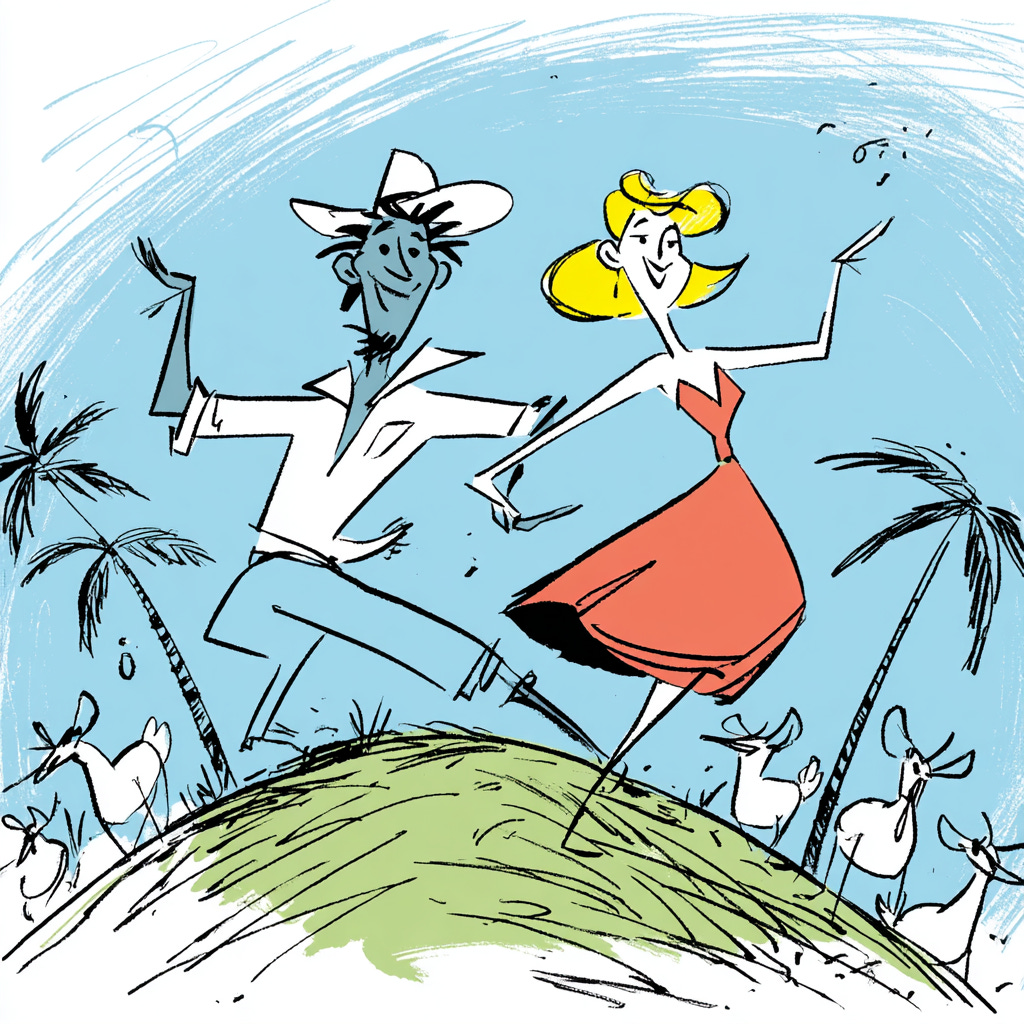
What the Original Four Lines Never Had Time to Do
How Tumbling Down Di Hill Uses Nine Stanzas to Build What Two Hundred and Sixty Years of Brevity Left Undone
Jack and Jill is one of the most studied nursery rhymes in the early literacy literature, and what the research consistently finds is both straightforward and limiting: it works. The iambic rhythm entrains the nervous system. The rhyme scheme builds phonological awareness. The narrative resolution — problem, fall, consequence — encodes the basic expectation that stories proceed toward closure. These are real and significant developmental outcomes.
They are also everything a four-line rhyme can do.
The original form has no room for characters who speak. No room for Jill to be right before the fall. No room for anyone to help Jack home, or wrap his head, or make an informed decision about whether the hill was ever worth it. No room for goats in mud or a driver’s shout or the specific sound of a mum who has handled this exact injury before. No room for the children who live in a world where the faucet is there and the hill was always the wrong solution.
Tumbling Down Di Hill has nine stanzas. It uses every one of them.
This essay traces what each additional stanza makes possible developmentally — six mechanisms that the original’s brevity structurally prevented — and why the specific choices made in this Patois adaptation produce outcomes that a generic extension, in standard English, with generic details, could not replicate.
The Brevity Problem in Early Childhood Literature
Before the mechanisms, the structural argument.
The early literacy literature on children’s narrative comprehension has documented a consistent relationship between text length, character depth, and the development of what researchers call narrative theory of mind — the capacity to model multiple characters’ internal states simultaneously within a story. Short texts, particularly the compressed verse forms of the nursery rhyme tradition, are optimally designed for phonological awareness building and narrative schema installation. They are structurally incapable of character depth, perspective complexity, or the kind of narrative arc that models sophisticated social cognition.
This is not a flaw in the nursery rhyme tradition. It is the tradition doing what it does well. But it means that children who encounter only the canonical short forms are systematically underexposed to the narrative conditions that build the higher-order literary comprehension capacities: perspective-taking across multiple characters, modeling of complex emotional states, observation of evidence-based decision-making, and the recognition of culturally specific community detail as worthy of story.
Longer adaptations — when they extend the original schema rather than replacing it, when they add culturally specific content rather than generic filler, when they give voice to characters who had none — can address this gap. Tumbling Down Di Hill does all three. The essay that follows explains what each addition produces.
What Cultural Specificity Does That Generic Extension Cannot
The distinction between this adaptation and a hypothetical generic English extension — Jack and Jill climbed up the hill but then rolled past some animals and a truck driver — is not aesthetic. It is neurobiological.
Rudine Sims Bishop’s mirror-window-sliding glass door framework documents that mirror texts — texts in which children recognize their own cultural world — produce categorically different neurobiological engagement than window texts. The amygdala responds to recognized cultural signals with the same neural activation as recognized belonging. This response directly modulates hippocampal consolidation: the belonging signal deepens the encoding of everything arriving with it. Content received in the context of cultural recognition is more deeply encoded, more durably retained, and more completely integrated than equivalent content in a culturally neutral or foreign context.
The faucet that Jill’s father uses is not a plot detail. It is a mirror. The goats and cows in mud are not comic texture. They are a specific community’s everyday world, treated as worthy of story. The driver who shouts wha dis mess is a character from a real place. Jack’s mum and her vinegar wrap are a specific community’s caregiving knowledge, rendered with the specificity of actual practice.
For Caribbean children and children from Patois-speaking families, these details activate the in-group limbic advantage that the Lyrical Literacy framework documents consistently: measurably stronger amygdala engagement, deeper hippocampal consolidation, more durable retention. The learning that arrives in a mirror lands differently than learning that arrives in a window.
For children for whom this is a window, the adaptation does something the generic extension cannot: it demonstrates that the nursery rhyme form is large enough to contain worlds they had never associated with it. Jack and Jill is not English property. The oldest stories belong to whoever inhabits them. This is cultural empathy through narrative — more durably encoded than any explicit lesson about cultural diversity, because it arrives as story rather than instruction.
The cultural specificity is not what the adaptation adds on top of the developmental work. The cultural specificity is the developmental work.
The Four Agentic Moments and What Each One Is Building
The original Jill has one line of action: Jill came tumbling after. She is grammatically secondary, narratively dependent, and entirely silent. The developmental research on character agency is consistent: children build their own sense of self-efficacy most effectively by inhabiting characters who exercise judgment, make decisions, and act on them.
The adaptation gives Jill four sequential agentic moments, each building on the last.
Moment one: the correct opening assessment. Use faucet like mi fada. Jill opens the poem with accurate situational analysis. She is right. She is not listened to. The adaptation makes this explicit — the fall happens immediately after her correct solution is ignored — which installs a specific and important causal understanding: correct assessment does not guarantee that the people around you will act on it. This is a social cognition concept that children encounter regularly in group situations and rarely have named for them.
Moment two: decisive physical intervention. Jill jump up an’ grab Jack shirt / Mi nah let yuh drop dead. When the crisis arrives, Jill acts before deliberating. The Patois grammar here is doing work: mi nah let yuh is present continuous refusal — active, ongoing, not a past decision but a current commitment. The child inhabiting this moment is practicing what psychologists call approach motivation under pressure: the orientation toward a problem rather than away from it, even when the situation is frightening and the outcome uncertain.
Moment three: organizing the community response. Let’s carry yuh home quick time. Jill shifts from individual action to collective coordination. She assesses what the situation requires (Jack needs to move), what resources are available (two people, one injured), and what sequence is necessary (home first, then medical attention). This is executive function — planning, sequencing, and coordinating resources — modeled through a character in a crisis.
Moment four: evidence-based self-determination. From now mi sip mi lemonade / An’ Jack go fetch mi stead. The evidence is complete. She was right, she was ignored, she bore the consequences of being ignored, she helped anyway, and she has now reached the appropriate conclusion. The developmental literature on executive function distinguishes between persistence that is virtuous (continuing in the face of difficulty when the approach is sound) and persistence that is injurious (continuing a demonstrably ineffective pattern because stopping feels like failure). Jill’s final declaration treats the distinction correctly: the problem was never the effort, it was the route. The faucet was always there. The hill was always the wrong choice.
The child who has followed Jill’s arc has inhabited four distinct demonstrations of agency, each modeling a different component of the full skill set: accurate initial assessment, decisive intervention, collective coordination, and evidence-based course correction. No single moment gives the child the full picture. The arc does.
Why Lawd Jack Yuh Again Is the Essay’s Most Important Line
Readers of the Lyrical Literacy series will recognize the recurring claim about theory of mind: the ability to model another person’s internal state — their perspective, motivation, and complex emotional experience — develops most effectively through narrative, and specifically through narratives where the child is invested enough to inhabit character perspective rather than observe it.
Lawd Jack yuh again is doing more theory of mind work in five words than most children’s texts accomplish in five pages.
To understand this line, the child must simultaneously model: the historical context (this has happened before, possibly multiple times), the current emotional state (exasperation that is not anger, worry that is not panic), the relational context (this is love expressed as performed impatience, not genuine reproach), and the behavioral response (reaching for vinegar rather than walking away is the action of someone who intends to help). These four components must be integrated simultaneously — they cannot be processed sequentially — for the line to land with its full meaning.
This is high-level theory of mind. It is the same cognitive operation that underlies the capacity to understand dramatic irony, unreliable narrators, and characters whose stated feelings differ from their enacted feelings. It arrives here in five words of Patois, inside a story the child already knows — which means the working memory that would normally go to narrative tracking is freed entirely for perspective inhabitation.
The familiarity of the Jack and Jill schema is not just comfort. It is a cognitive resource allocation that makes the theory of mind work accessible to children younger than the complexity of the emotional state would normally permit.
The Reading and Heritage Language Infrastructure Running in Parallel
The phonological architecture of the Patois lyric is building two distinct capacities simultaneously, through the same exposure, in the same three minutes.
For all children: phonological awareness through consonant density. Likkle, tumble, stump, vinegar, bounce, cyaan, mash, bawl, inna, grab, crash. Each of these presents the auditory cortex with phonemic patterns — consonant clusters, vowel contrasts, phoneme combinations at word boundaries — that build the auditory processing infrastructure underlying reading ability. The Lyrical Literacy framework treats phonemic diversity as a first-order production requirement precisely because it is the strongest predictor of reading achievement in the developmental literature. The adaptation is delivering this in every stanza, in parallel with every other mechanism it deploys.
For Patois-speaking children: implicit heritage language encoding in the optimal context. Implicit language knowledge — stored in procedural memory rather than declarative memory, acquired through emotionally significant exposure rather than explicit instruction — is more resistant to attrition and more automatically available than explicitly taught language knowledge. The heritage language arriving inside the oldest story the child knows, in a context of cultural recognition and emotional engagement, is encoding at the level that formal instruction cannot reach. The phonological learning and the heritage language preservation are not two separate outcomes. They are one outcome produced by the same exposure through two different neurobiological pathways.
The Developmental Architecture, Complete
Six mechanisms. One adaptation. Nine stanzas.
Cultural mirror recognition opens the amygdala and deepens the encoding of everything that follows. Schema extension into culturally specific territory builds cognitive flexibility with real cultural content rather than comic abstraction. The four-moment agentic arc builds self-efficacy, approach motivation, executive planning, and evidence-based decision-making through a single character’s trajectory. The caregiving scenes build theory of mind through the freed cognitive resources of familiar narrative. The cost-benefit conclusion installs the distinction between virtuous persistence and injurious pattern-repetition. The phonological architecture builds reading infrastructure and heritage language simultaneously through the same exposure.
None of these mechanisms requires a separate intervention. None requires specialized instruction. All of them are running simultaneously, through the same nine stanzas, for any child who hears the poem enough times to carry it.
The original Jack and Jill was doing one thing in four lines. The adaptation is doing six things in nine stanzas. All six were always possible. The original just never had time.
LYRICS:
Jack an’ Jill climb up di hill
Fi fetch a likkle wata
But Jill seh Jack yuh fool yuhself
Use faucet like mi fada
Jack tek one step trip pon root
An’ tumble wid a shout
Jill try grab on him ole boot
But both a dem roll out
Dey roll past goats an’ cows in mud
Bounce pon rock an’ stump
Scare di duck dem inna pond
Den crash into a dump
Di drivah bawl out wha dis mess
Jack groan mi bruk mi brain
Jill seh mi tink mi soul jus lef
But maybe dat’s di pain
But Jill jump up an’ grab Jack shirt
Mi nah let yuh drop dead
Let’s carry yuh home quick time
An’ patch yuh likkle head
Jack mum look up an’ rub she brow
Lawd Jack yuh again
She grab di vinegar and wrap
Him skull fi stop di pain
Jill seh mi done wid hill fi real
Dem slope bring too much dread
From now mi sip mi lemonade
An’ Jack go fetch mi stead
Oh Jack an’ Jill yuh neva learn
Dem hill a set yuh back
Stay low pon flat no more concern
Or roll down like a sack
Jack an’ Jill tek mi advice
Hill life come wid price
Keep yuh foot pon de level road
An’ yuh cyaan mash up twice
Tags: narrative theory of mind character depth text length early literacy brevity constraint, cultural specificity mirror text in-group limbic encoding generic versus specific extension, four agentic moments approach motivation executive planning Jill arc self-efficacy, Lawd Jack yuh again five words theory of mind simultaneous emotional modeling, implicit heritage language procedural memory phonological awareness parallel pathways
#MusiqueAI #HumansAndAI #AIMusic #LyricalLiteracy #SpiritSongs #GhostArtists #OpenSourceAI #MusicResearch #AIforHumans #IndieMusician
<iframe width=”560” height=”315” src=”
title=”YouTube video player” frameborder=”0” allow=”accelerometer; autoplay; clipboard-write; encrypted-media; gyroscope; picture-in-picture; web-share” referrerpolicy=”strict-origin-when-cross-origin” allowfullscreen></iframe>
<iframe data-testid=”embed-iframe” style=”border-radius:12px” src=”width=”100%” height=”352” frameBorder=”0” allowfullscreen=”“ allow=”autoplay; clipboard-write; encrypted-media; fullscreen; picture-in-picture” loading=”lazy”></iframe>


